
Championing the
Changemakers
BuildingGreen champions the changemakers in sustainable design and building, with trusted insight, unparalleled education, and communities that are transforming the industry.
Log in to your profile

Image: Piranka

Product Review
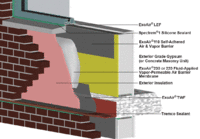
The Tremco ETA system offers the first-ever warranty on the performance of an assembly's air and water barriers.
Designing, specifying, and constructing high-performance commercial building assemblies is a tall order. Lining up and integrating all of the components for continuous air and water barriers can be maddening. And whose job is this? It’s actually a chain of responsibility: architect, specifier, general contractor—and, finally, all the trades.... Read more
News Brief
NSF International (NSF) has announced the first certification to evaluate the life-cycle sustainability of single-ply roofing membranes for commercial buildings. NSF/ANSI 347, Sustainability Assessment for Single Ply Roofing Membranes, is one of eight NSF sustainability standards for building products and the first to address the building... Read more
Feature

Exterior coatings protect buildings from the environment but often contain hazardous ingredients, so maximizing their durability is often the greenest option.
For many applications, there are no environmentally responsible alternatives to these products, so maximizing their durability is the best way to minimize their impact. This article explores what is in exterior paints and stains, their environ-mental tradeoffs, and how to prolong their service life.
What’s in Exterior PaintIn... Read more
Blog Post
... Read more
Blog Post
Photo Credit: Big Ass Fans
Last week, I wrote about a number of innovative window and glazing products I came across at the AIA Convention in Washington, DC... Read more
News Analysis

Since November 2010, Google’s facilities teams have been methodically adhering to stringent building product selection criteria for all of the company’s North American projects. To... Read more
Blog Post
I just spent... Read more
News Analysis

by Nadav Malin
At its annual convention in Washington, D.C., the American Institute of Architects released its second annual report documenting progress toward AIA’s 2030 Commitment. Developed to support... Read more
Blog Post
Environmental product declarations (EPDs) are, in theory, the answer to our... Read more
Blog Post
A lot of things come to mind when I think about the annual AIA Convention; electoral politics isn't one of them. But today's opening keynote... Read more
Blog Post
For a number of reasons, the Cook+Fox-designed Bank of America tower at One Bryant Park is an object lesson in how difficult it can be to... Read more
Blog Post
News Brief

As architects from all over the country descend on Washington, D.C., this week for the American Institute of Architects (AIA) annual convention, the Honest Buildings real estate network is releasing data on more than 15,000 commercial and mixed-use buildings in the D.C. metro area.
The Honest Buildings online platform is... Read more
Blog Post
Last week I laid out some... Read more
News Analysis
The dangers of flame retardants have been understated and the benefits exaggerated, while groups promoting them may not be what they seem, according to the Chicago Tribune in a recent investigative series. In reviewing thousands of government, scientific, and internal industry documents, the Tribune found evidence of long-term... Read more
Blog Post
The annual Living Future event rotates between Vancouver, Seattle, and Portland... Read more
News Analysis
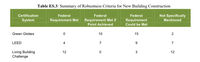
A new report suggests that Green Globes is slightly more robust than LEED when it comes to fulfilling federal green building requirements for new construction.
6/5/2012 UPDATE: GSA has pushed back the dates of the listening sessions. Please read below for more details.
5/11/2012 UPDATE: This article has been updated to incorporate comments from GSA, including opportunities for public comments that will influence the outcome of the review process.After almost a decade of... Read more
Blog Post
Seals at window openings and other penetrations need to be done right the first time. Are your seals failing because of the most common application error—forgetting the bond break?
This is part of an ongoing series. Read all the Sticky Business posts here.
It's great they remembered the backer rod in this attempt to seal the joint, but with the depth of the sealant so skinny compared to the width, it's probably going to fail. Read on to learn why.Continuous air and... Read more
Blog Post
There are a lot of things not to like about fossil fuels. Most obviously... Read more
Blog Post
What if all of the common plastics in use today were made from renewable materials rather than from fossil fuels? Would they start looking better in the eyes of environmentalists?
This is no idle... Read more


