
Championing the
Changemakers
BuildingGreen champions the changemakers in sustainable design and building, with trusted insight, unparalleled education, and communities that are transforming the industry.
Log in to your profile

Image: Piranka

News Analysis
The report refers to building codes as “the DNA of a city—rules that are applied many times over [with] an exponential impact on how the city functions.” Russell Unger, executive director of Urban Green Council, the New York chapter of the U.S. Green Building Council, says one benefit of the code review process has been to draw... Read more
Feature

Resilience is the new green. With decades of green building experience, we are ready to face climate change.
Updated May 26, 2026; updates by Elene Drosos
I began an eight-month sabbatical in 2011 with a bicycle trip through the Southwest. I chose the Southwest in part because I wanted to have time to think about some of the vulnerabilities we face—particularly with climate change—and what we should do about it. From what climate scientists... Read more
News Brief
By Erin Weaver
The Urban Land Institute (ULI) and the Greenprint Foundation have come together to form the ULI Greenprint Center for Building Performance. Designed to facilitate information exchange throughout the real estate and land-use industries, this collaboration unites ULI’s 30,000 members with the foundation’s goal of reducing... Read more
News Brief
By Erin Weaver
A National Academy of Sciences (NAS) panel of experts has issued a report expressing concern about the health and environmental effects of nanomaterials (see “Is Nano a No-No?”,
EBN Mar. 2008). The report points out that suspected risks are already being ignored, and as the nanotechnology market continues to... Read more
News Analysis
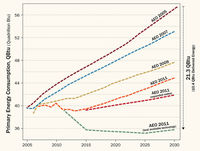
Architecture 2030 says new energy projections from the federal government show the building sector is on its way to achieving long-term goals in energy and carbon reductions.
The organization’s 2030 Challenge asks architectural firms to meet progressively rising standards in building energy use and emissions, with the ultimate goal of... Read more
News Brief
By Erin WeaverDeutsche Bank has released a report analyzing actual energy savings achieved through multifamily retrofits and encouraging capital investment in energy retrofits of affordable housing in New York City. A collaboration of the Deutsche Bank Americas Foundation and the Living Cities philanthropic organization, “Recognizing the... Read more
Explainer

Dynamic glazing—coated plastic or glass that changes tint in response to light, heat, or electricity—has been around for decades as a feature of eyeglasses, mood rings, and digital watches. Similar technologies have been developed more recently to make dynamic glass at a much larger scale for architectural applications. These so-called smart... Read more
News Analysis
By Paula MeltonThe Passive House standard, often admired for simplicity, has also been criticized for rigidity. Now that Passive House Institute U.S. (PHIUS) has achieved independence from Europe and started its own certification system, called PHIUS+ (see ”Passive House U.S. Develops Separate North American Certification,” EBN Dec. 2011), the... Read more
News Analysis
Tarkett manufacturing in North America will transition to a phthalate-free formulation for virgin vinyl flooring. Used to provide flexibility to PVC, phthalates are endocrine disruptors that may also affect IQ and cause respiratory illness.
Flooring manufacturer Tarkett North America has unveiled improvements to many of its vinyl flooring products, from reduced emissions to phthalate-free materials. Much of its Johnsonite flooring line now has total VOC emissions of 100 mcg/m3 or less, with some products below 10 mcg/m3.
Beginning this year, Tarkett manufacturing in North... Read more
Blog Post
Blog Post
Blog Post
Blog Post
Blog Post
During these spring-like days in mid-February in Vermont, it's hard not to think about climate change. It's been reaching the mid- and upper-40s over the past few weeks in a winter that really isn't. Yes, this particular year might... Read more
Blog Post
Editor's note: Thanks to Evan Dick for this guest post. Evan is a former writer from BuildingGreen and now works at the Center for EcoTechnology in Massachusetts.
The adage "If it's yellow let it mellow, if it's brown flush it down" might be an... Read more
Blog Post
Even before you choose an exterior paint product, it's important to learn a bit about what makes paint stick--or not. For... Read more
Blog Post
In this final installment of my ten-part series on resilient design, I'm taking a look at where our food comes from and how we can achieve more resilient food systems... Read more
Blog Post
There is so much confusion about energy modeling--what it should cost, what benefits it offers, how to approach it--that clear statements addressing these questions are like a breath of fresh air.
When I was... Read more
Op-Ed
By Peter YostDariush Arasteh, a leading researcher and scientist in glazing and window performance, died on February 3, 2012, after a nearly ten-year struggle with a rare form of cancer. He was 51 years old.
For 30 years, Dariush was a leader in all aspects of window energy efficiency research at Lawrence Berkeley National Laboratory (... Read more
Blog Post
BuildingGreen has been defining what makes a product green since the start of the GreenSpec directory in 1998--and we're repeatedly surprised by how far and wide our list of green attributes travels. The... Read more


