

Blog Post

Building Tips for Reducing Flood Risks

Adapting to climate change will require making our buildings more resilient to storms and flooding.

A lot can change in two hours. At 8 a.m. Sunday, I walked the length of our half-mile driveway here in southern Vermont, checking the culverts and water bars, all fortified and cleared the day before. All good. The brook next to our driveway was raging, but staying within its banks. The Green River was doing the same across the town road.

At 10 a.m., I got a call from my neighbor that my other neighbor's house was flooding and they'd had to get out. Going back down the driveway with the hope of helping them, I found that the brook had grown to 10 times its usual width, filling the valley that this tranquil little brook usually meanders through. The Green River had done the same, covering the road and making it impossible to get anywhere. Friends who had been excited about rafting the swollen rivers canceled their plans after watching whole trees float by, and hearing boulders roll through the river.

The flooding crested before the neighbor's home was seriously damaged, but the road is badly washed out. For everyone affected by flooding in the Northeast connected to Hurricane Irene, my heart goes out to you. As I've been pulling together with my neighbors to adapt to these events, I've been wishing the best for everyone else in doing the same. As you know, it will be a long-term effort here.

Global weirding could bring more floods...

As we think about our built environment in light of these events, we have to consider the reality of climate change. Some people prefer to refer to "global warming" as "global weirding," because our climate is a complex system, and all kinds of odd storms and weather patterns may erupt. It won't just be a linear ride of slightly higher-than-average As water temperatures rise in the South Atlantic, tropical storm systems will pick up more energy, resulting in higher-magnitude hurricanes on the Gulf Coast and Eastern Seaboard. Elsewhere, changing precipitation patterns are expected to deliver more rainfall in intense storms that could result in river flooding.

...While development makes our landscapes less absorptive

To complicate matters, development has made our landscapes less able to absorb rainfall, says architect Don Watson, who is writing a book on "design for resilience." "We've taken away all the absorptive capacity of our landscapes," Watson says. Adapting to climate change will require making our buildings more resilient to storms and flooding. In the longer term, we need to prepare for rising sea levels and restoring the ability of our land to absorb water.

SUPPORT INDEPENDENT SUSTAINABILITY REPORTING

BuildingGreen relies on our premium members, not on advertisers. Help make our work possible.

See membership options »

While it may be cold (and wet) comfort to owners and residents in damaged buildings, here are some tips for adapting to increased flooding, adapted from "Design for Adaptation: Living in a Climate-Changing World," an article on our website written by Alex Wilson and Andrea Ward. 

Expand capacity with natural systems

Avoid building in flood zones. Flood zones are expanding--often faster than revisions to zoning regulations, meaning that simply following the law relative to the siting of buildings may not be enough. Instead of designing to 100-year floods, consider designing to 500-year floods, seeking civil engineering or surveyor assistance as needed.

Expand stormwater management capacity and rely on natural systems. More intense storms will strain the capacity of standard stormwater management infrastructure in some areas. Provide larger stormwater conveyance and detention basins, and try to rely on natural features, constructed wetlands, and other ecologically based systems to manage stormwater. "Restore the ecological services of the landscape," says Watson.

Design to survive extreme winds

Design buildings to survive extreme winds. Examples of specific measures that impart good wind resistance to a building include installing impact-resistant windows or exterior shutters; installing outward-opening doors that are less likely to be pushed inward in intense wind; designing walls to resist uplift using hurricane strapping and other metal fasteners that provide a continuous load path from foundation to roof.

Raise buildings off the ground. In flood-prone areas--even where flooding is only remotely possible--raise buildings or living spaces above ground level to minimize damage in the event of flooding. With any type of pier foundation, use great care to ensure that energy performance and airtightness are not compromised; raised floors are notoriously difficult to insulate and seal.

Specify materials and components to survive flooding

Specify materials that can survive flooding. Especially in locations where flooding or hurricane damage is likely, use materials that can get wet and then dry out with minimal damage. Such materials include preservative-treated sills and wood framing, fiberglass-faced rather than paper-faced drywall, and tile or resilient flooring rather than carpeting.

Install specialized components to protect buildings from flooding or allow flooding with minimal damage. Breakaway wall panels on pier foundations in flood-prone areas can allow floodwaters to pass under a house without destroying it. Flood vents (permanent openings in foundation walls) allow floodwaters to escape. Specialized flood barriers, including removable barriers for entrances, can keep rising floodwaters out in certain situations.

Elevate mechanical and electrical equipment. To minimize damage--and danger--from flooding, elevate mechanical equipment, electrical panels, and other equipment above a reasonably expected flood level. Even if the whole building can't be elevated to such a level, it may be cost-effective to elevate just the equipment.

Please share below your flood survival stories and thoughts on adapting to global weirding!

Photos by Tristan Roberts.

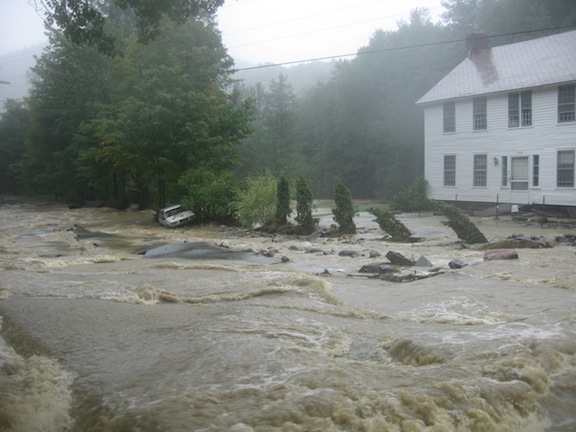
Top image: Floodwaters rose higher than at any time in memory, surrounding valley homes that thought they were safe.

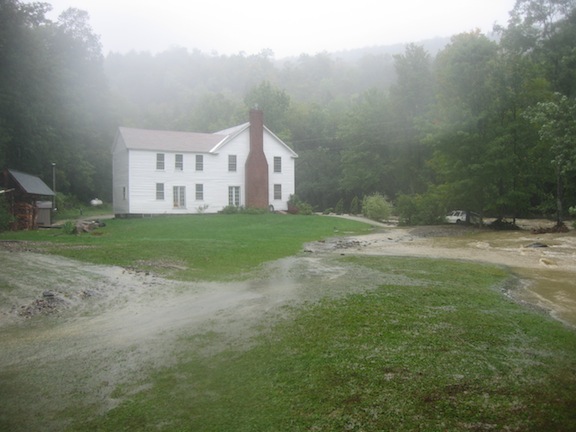
Middle: The builders of some of these homes were either lucky or knew something, though: the slight rise on this site was enough to protect this home from major damage.

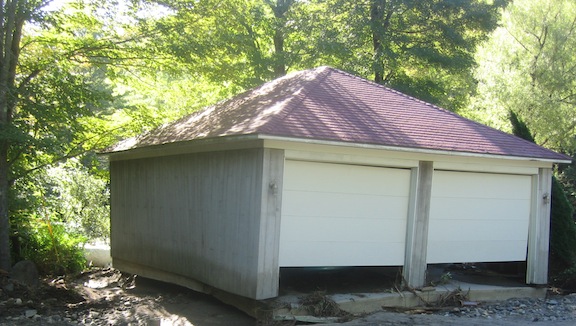
Bottom: The house adjoining this garage was on slightly higher ground and survived, but even a solid foundation here meant little to the raging waters.

Published September 6, 2011

(2011, September 6). Building Tips for Reducing Flood Risks. Retrieved from https://www.buildinggreen.com/news-article/building-tips-reducing-flood-risks

Add new comment

To post a comment, you need to register for a BuildingGreen Basic membership (free) or login to your existing profile.

Comments

September 7, 2011 - 1:45 pm

I guess "global weirding" is a good expression, because it expresses very well the fact that we no longer have the fixed weather patterns of the past - to the extent that our forefathers could predict almost to the day the changes of the seasons or, in other parts of the world, the onset of the monsoon.

Why not?

The simple answer is - however much the climate change skeptics may wish to play ostrich about it - man-made warming.

Without Humanity, the weather patterns of this planet would be governed almost entirely by solar radiation, the seasons, and the Earth's internal warming, with the occasional random disturbance of a volcano blowing its top. And, as the skeptics continually point out, these weather patterns show fluctuations associated with solar and other astronomical cycles.

The point is, however, that in the last century or so the weather's "weirdness" has been increasing by leaps and bounds, particularly in the last half-century, and changing much faster than the rates of cyclical changes of the past could explain.

Why?

Because there has been a global explosion in the production and use of disposable goods and gas-guzzling automobiles with planned obsolescence. This has required vast quantities of energy; but, typically, for every 4 units of energy produced at a power plant, another 6 units of energy in the form of heat has gone straight up the chimney to heat the atmosphere (while also adding to it the greenhouse gases CO2 and H2O). Not only that, but more waste heat was typically gotten rid of by dumping it into unsuspecting rivers, which then flowed into the sea, helping to warm the oceans.

When you drive your automobile, again around 4 units out of every ten produced by burning the fuel actually goes to drive the wheels (and, nowadays, all the power-hungry accessories which serve to distinguish one model from another), while the other 6 warm the atmosphere via the exhaust pipe or the radiator. But it isn't as simple as that: the 4 units that drive the wheels also all end up heating the atmosphere by pushing the car against wind resistance and tire friction heating the road.

Let's look at it another way.

The East coast of the US, including Vermont, has just experienced extreme rainfall, as have many areas of the world in recent years. Without us humans, the weather could have been expected to be "normal", with natural cyclic variations as described above.

The rule of rainfall is that what comes down must first have somehow gotten up. The only way it can get up is through evaporation; and evaporation requires heat. Since the Sun hasn't suddenly started throwing out much more than average radiation and the Earth beneath our feet hasn't suddenly gotten hotter, there can be only one culprit for the increase in rainfall: us. QED (at least, I think so).

As for the weirdness or, if you prefer, instability, if you accept man-made warming, you only have to look at how the patterns of heat emission from industry and other human activity have changed over the years to see the explanation. In broad terms, industrialization started in Europe, spread to the USA, expanded rapidly there up to and through WW II, and has since accelerated rapidly in Asia, particularly in India and China - not least as a direct consequence of globalization. The corresponding injections of heat into the atmosphere have changed wind patterns, while hot water from rivers has affected ocean currents. And the patterns of emission are still changing. Throw in the effects of this overall warming on glaciers and the polar ice caps, with positive feedback from the resultant overall darkening of the Earth's surface leading to greater absorption of solar radiation, and it is easy to see why we should all be getting more than a little worried about what the future may hold for our offspring.
One final thought: all the advice in this article is good, logical and sensible - but it's only treating the symptoms, not curing the illness.


