Year: 
2011
Volume: 
20
Issue: 
5

Forest Products Certification: How It Works

Explainer

Forest Products Certification: How It Works

When specifying or using forest products, some people want to know that they originated in a forestry operation that respects the long-term health of the forest and its important functions, such as wildlife habitat, recreation, and support for local communities. You can’t tell those things by scrutinizing the lumber or furniture product—that’s where certification programs come in.

The goal of forest product certification programs is to offer independent, third-party validation of responsible forest management. The certifiers are hired by the forest owner or forest products company to inspect the company’s logging and forest management practices, review its policies, and audit its records. The certifier’s job is to verify that practices on the ground conform to the relevant standard from the organization whose certification label will go on the products.

Published December 31, 1969

(2011, April 29). Forest Products Certification: How It Works. Retrieved from https://www.buildinggreen.com/taxonomy/term/318/0

Measuring Energy Use in Buildings: Do Our Metrics Really Add Up?

Knoll, Steelcase in Lead with Level 3 Certified Products

Product Review

Knoll, Steelcase in Lead with Level 3 Certified Products

EBN July 2009). Products can be certified as level 1, 2, or 3 under this multi-attribute, life-cycle-based assessment.

Two companies, Knoll and Steelcase, contribute all of the level 3 product certifications, which were awarded through Scientific Certification Systems (SCS). Stowe Hartridge-Beam, environmental certification services director at SCS, told

Published December 31, 1969

(2011, April 29). Knoll, Steelcase in Lead with Level 3 Certified Products. Retrieved from https://www.buildinggreen.com/taxonomy/term/318/0

Spray-Applied Latex: A New Tool for Air-Sealing

Product Review

Spray-Applied Latex: A New Tool for Air-Sealing

Fiberglass insulation provides good thermal insulation when properly installed, and its vapor and air permeability can aid the drying of a building’s structure, but this permeability is also its weakness. If outside air gets into a home’s interior through cracks and penetrations in the building envelope, the result can be moisture damage, mold, and energy losses.

Knauf and Owens Corning created their sealants in order to bring their fiberglass insulation products up to par with other insulations that provide better protection against air infiltration, such as spray polyurethane foam (SPF) and dense-pack cellulose. “We looked at our core product, fiberglass insulation, and recognized the conversation was shifting away from just R-value to total home performance,” said Matt Girand, Owens Corning’s director of products.

Published December 31, 1969

(2011, April 29). Spray-Applied Latex: A New Tool for Air-Sealing. Retrieved from https://www.buildinggreen.com/taxonomy/term/318/0


New Polystyrene Flame Retardant Uses Old Chemistry

News Analysis

New Polystyrene Flame Retardant Uses Old Chemistry

<

Published December 31, 1969

(2011, April 29). New Polystyrene Flame Retardant Uses Old Chemistry. Retrieved from https://www.buildinggreen.com/taxonomy/term/318/0

A Surge of Popularity for Efficient DC Power

News Analysis

A Surge of Popularity for Efficient DC Power

In a digital world, why are we still using analog power? That’s the question posed by Brian Patterson, general manager of business development for Armstrong Ceilings and chairman of EMerge Alliance, an industry association that is trying to change the way power is distributed. EMerge promotes the idea that a long-term switch from alternating current (AC) to direct current (DC) for power distribution is crucial to our energy future. EMerge, which includes a variety of members, from Johnson Controls to Herman Miller to Underwriters Laboratories, has started the ball rolling by developing standards for “microgrids” in commercial buildings that allow hybridized use of AC and DC.

In the 1890s a power struggle between Thomas Edison and Nikola Tesla—known as “the war of the currents”—resulted in a standard AC grid. At that time, AC was the better choice, because no one had the technology to efficiently transmit DC power over long distances. Edison stood to make a great deal of money building a large number of small DC power plants, but rural electrification would have been impossible without AC.

Published December 31, 1969

(2011, April 29). A Surge of Popularity for Efficient DC Power. Retrieved from https://www.buildinggreen.com/taxonomy/term/318/0

Heavy Metals Help Superbugs Hatch in Sewage

News Brief

Heavy Metals Help Superbugs Hatch in Sewage

By Paula MeltonCombining heavy metals and excreted antibiotics in wastewater is a formula for breeding antibiotic-resistant “superbugs,” according to a study presented to the American Chemical Society. The scientists found that copper alone, without any antibiotics, increases resistance to ciprofloxacin in bacteria, while zinc amplifies resistance to tetracycline. Tetracycline with no metals caused 44% of bacteria to become resistant, and tetracycline plus zinc caused 68% of bacteria to become resistant. Heavy metals are prevalent in industrial wastewater, and domestic wastewater tends to contain high levels of antibiotics: mixing the two in treatment plants is a common but risky practice, according to the researchers. Previous studies have established that copper could increase antibiotic resistance in microbes living in soil, according to Chemical & Engineering News, but scientists have yet to determine whether the effects of heavy metals are passed on genetically to subsequent generations of microbes.

Published December 31, 1969

(2011, April 29). Heavy Metals Help Superbugs Hatch in Sewage. Retrieved from https://www.buildinggreen.com/taxonomy/term/318/0

Add new comment

To post a comment, you need to register for a BuildingGreen Basic membership (free) or login to your existing profile.

Home Depot Switches 40 Stores to FSC Lumber

News Brief

Home Depot Switches 40 Stores to FSC Lumber

By Paula MeltonHome Depot stores in the San Francisco Bay Area will now stock framing lumber only if it is certified according to Forest Stewardship Council (FSC) standards. Regional FSC-certified suppliers Mendocino Redwood Company and Humboldt Redwood Company are providing plywood, dimensional lumber, fencing, and other Douglas fir and redwood products, which Home Depot says will be sold at no extra cost. FSC certification is region-specific and requires not only environmentally responsible forestry but also adherence to social and economic standards (see "Forest Products Certification: How It Works," EBN May 2011). In addition to sustainable, low-impact harvesting, the two Home Depot suppliers say they actively manage habitat to support dwindling species like Coho salmon and spotted owls.
Published December 31, 1969

(2011, April 29). Home Depot Switches 40 Stores to FSC Lumber. Retrieved from https://www.buildinggreen.com/taxonomy/term/318/0

Add new comment

To post a comment, you need to register for a BuildingGreen Basic membership (free) or login to your existing profile.

Washington, D.C. Leads U.S. with LEED-Certified Space

News Brief

Washington, D.C. Leads U.S. with LEED-Certified Space

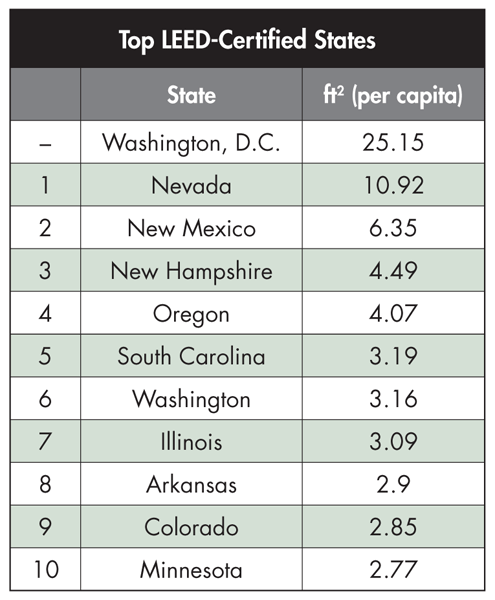
By Emily CatacchioThe U.S. Green Building Council (USGBC) has released a list of states with the most LEED-certified commercial space. USGBC’s 2010 list is led by Washington, D.C., with 25 ft2 of LEED-certified space per person; next follows Nevada with 10.92 ft2; New Mexico, New Hampshire, and Oregon complete the top five. Within USGBC’s list, commercial office space was the most common LEED project type. For more information, visit www.usgbc.org.
Published December 31, 1969

(2011, April 29). Washington, D.C. Leads U.S. with LEED-Certified Space. Retrieved from https://www.buildinggreen.com/taxonomy/term/318/0

Add new comment

To post a comment, you need to register for a BuildingGreen Basic membership (free) or login to your existing profile.

EPA Lists U.S. Cities with the Most Energy Star Certified Space

News Brief

EPA Lists U.S. Cities with the Most Energy Star Certified Space

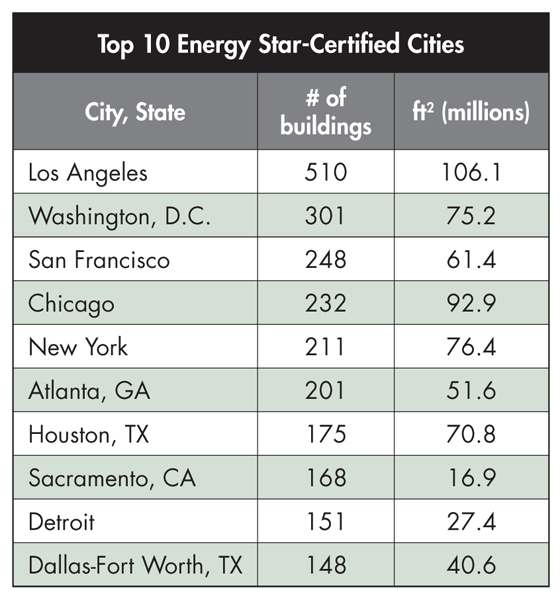
By Emily CatacchioThe U.S. Environmental Protection Agency (EPA) recently released its third annual list of U.S. cities with the most Energy Star-certified buildings. The top three are familiar from past years: Los Angeles is first for the third year and Washington, D.C. and San Francisco are second and third, respectively, for the second year. New York made the biggest jump to fifth, up five places from 2009. California dominates EPA’s list with five out of the 25 listed cities. More than 6,200 commercial buildings were Energy Star certified in 2010, up 60% from 2009. Commercial building energy consumption makes up almost 20% of greenhouse gas emissions in the U.S. For more information, visit www.energystar.gov/TopCities.

Published December 31, 1969

(2011, April 29). EPA Lists U.S. Cities with the Most Energy Star Certified Space. Retrieved from https://www.buildinggreen.com/taxonomy/term/318/0

Add new comment

To post a comment, you need to register for a BuildingGreen Basic membership (free) or login to your existing profile.

