Scientists Report 165% Performance Boost from New Additive

April Fools

Scientists Report 165% Performance Boost from New Additive

The industry’s most respected semanticists have developed a new eco-prefix—but do they have the numbers to back up their claims?

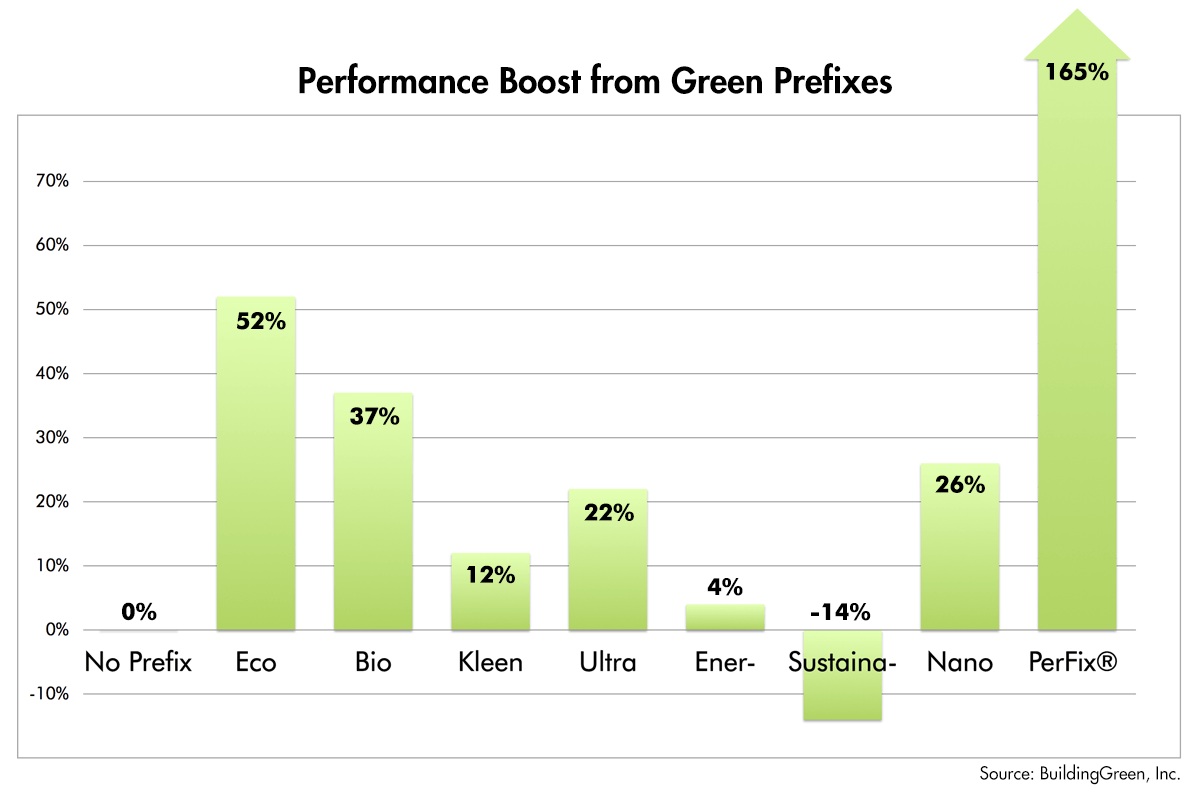
Claiming a “once-in-a-lifetime semantic breakthrough,” researchers at Dow Linguistic today introduced a new additive they say could boost any product’s sustainability 165% compared with conventional eco-prefixes.

“This is the graphene of morphemes,” quipped lead developer Iima Silliman, Ph.D. “It out-performs ‘bio’—and even ‘eco’ itself—by an order of magnitude on two key ASTM tests: Y-ME and 1TS-BS. There is literally no other way to more than double a product’s sustainability just by leveraging the power of linguistics.”

Dow is keeping the formula proprietary while it “negotiates hyphenation rights with certain clients,” according to a press release, which simply refers to the new lexical tool by its trade name, PerFix. But the developers have released preliminary data comparing the new prefix to conventional technologies (see chart).

Some are skeptical of the performance claims, however. “We don’t even know what letters are in it,” complained one well-known architect. “‘Eco’ might not be the latest and greatest prefix, but it’s been around forever, and it has proven its durability.”

She continued, “When we switched from pavers to ecopavers and from regular SPF [spray polyurethane foam] to biofoam in the ’90s, our perception—and, more importantly, our clients’ perception—of our projects’ runoff impacts and energy performance shot up more than 40%. And it has stayed up for decades.”

Adoption of the prefix is likely to be driven by cost: existing affixes don’t carry a premium. “Frankly, I’m hesitant to adopt an expensive new morpheme whose pre-formative properties haven’t been thoroughly tested in the field,” said one specifier BuildingGreen spoke with.

There will be a first-cost premium, Silliman acknowledges, but he said that the “tiny yet potent” collection of as-yet-undisclosed letters will be worth it. “Soon enough, our new prefix will speak for itself.”

Add new comment

To post a comment, you need to register for a BuildingGreen Basic membership (free) or login to your existing profile.

Judge Robs Yost of Gold Medal in WUFI Modeling

April Fools

Judge Robs Yost of Gold Medal in WUFI Modeling

Despite a perfect 10 for Yost from two of the judges, this year’s WUFIlympics gold medal goes instead to Terry Brennan.

The crowds roared and pocket-protector-bumped in the stands as U.S. WUFIlympian Peter Yost, vice president of technical services at BuildingGreen, stuck the landing on the first perfect WUFI run in the entire recorded history of hygrothermal modeling (see Go with the Flows: The Promise and Perils of Hygrothermal Modeling). Two of the three judges awarded him a perfect “10.”

ESPN commentators noted that Yost probably earned points not only for modeling a wall that insulates and dries well in all climatic conditions but also for the degree of difficulty for his chosen routine in the freestyle portion. “The safe choice would have been to model the ‘perfect wall,’” noted color commentator Joe Lstiburek, P.E., referring to the assembly design that he has written about in books and promoted from his respected perch at Building Science Consulting. But, Lstiburek explain, “[Bleeping] Yost went out of his [bleep] to [bleep] and then he [bleeped] the retrofit [bleep] SPF [bleep] radon, and no one saw that coming.”

But a shocked silence fell over the stadium as the frowning judge from Germany held up a “7.” His controversial score pulled Yost down to second place in the overall rankings, leaving the field open for fellow U.S. team member Terry Brennan, of building-science consulting firm Camroden Associates, to bag the gold.

In related news, the U.S. WUFIlympics Committee announced it has opened an investigation into rumors that Brennan has received secret kickbacks—including unlimited access to unauthorized performance-enhancing WUFI plugins—from Germany’s Fraunhofer Institute.

Add new comment

To post a comment, you need to register for a BuildingGreen Basic membership (free) or login to your existing profile.

AIA-Certified Projects Pulling Ahead of LEED

April Fools

AIA-Certified Projects Pulling Ahead of LEED

Pilot AIA-certified green projects are changing the rules for “green,” throwing sacred cows out of the many, many windows.

The green building cognoscenti are chopping off their rules of thumb as projects certified through a pilot American Institute of Architects (AIA) program are showing unexpected benefits.

“Architectural solutions pioneered by our members haven’t been getting proper recognition in programs like LEED,” Robert Ivy, FAIA, CEO of the AIA, told BuildingGreen. “Our new pilot certification program has proven more friendly to those solutions.”

DEEL: Design Elegance for Energy Leadership

The AIA Design Elegance for Energy Leadership (AIA|DEEL) program focuses on four “forms”:

  • Process: Design teams must vision, revision, and, finally, re-imagine projects.
  • Dematerialization: Structures must borrow a metaphor of texture and symmetry.
  • Architectonics: Recognizing that traditional measures are outmoded, designers will redefine a commitment to design excellence that conceptualizes new rubrics.
  • Experience: Articulation is uniquely responsive to client needs while foregrounding attributes shared by catalyzing spaces.

Details of the first crop of AIA|DEEL-certified projects are confidential pending the conclusion of the standard 12-month pre-litigation period running from April 1, 2015, to April 1, 2016, but BuildingGreen obtained some initial lessons learned.

New weather data favor glass façades  

Although it has been accepted that all-glass façades are energy-wasters (BuildingGreen is hereby retracting Rethinking the All-Glass Building), a design-first/model-later residential high-rise in Miami persisted—and found that climate change has changed the rules.

“The increased incidence of hurricanes as well as lower-level atmospheric systems—particularly in shoulder seasons with lower-angle sun—has translated to no cooling-load penalty from the glass,” explains a project brief. “What’s more, the smog suffuses the façade with gentle daylight.” Project photos show clean lines unencumbered by shades, frits, louvers, or shelves—earning the project points under two AIA|DEEL categories: Dematerialization and Experience.

The architect chose a north-south orientation to maximize the biophilic benefit of ocean views, which fresh climate data again supported. Climate-change-enhanced coastal storm patterns power elliptical-axis wind turbines on the roof. To counter vibrations entering the building, the turbine uses governors (mechanical devices that reduce rotational speed) to dampen vibration with a 75% loss in output. Defending the predictable result (actually still relevant: The Folly of Building-Integrated Wind,) the project brief states, “In a state where the Governor has banned the phrase ‘climate change’ in official use, the project’s selection of a governor that slows renewable energy output is a tangible statement that is sensitive to place.”

Overall, “we appreciate that the data validate what we told the model,” the project brief states.

Thermal bridging offers heat exchange

Even as heat loss through thermally unbroken floor plates extending out to balconies has been well documented, many architects haven’t changed that detail. But in Chicago, an AIA|DEEL project with air-to-balcony-to-water heat exchange (see diagram) is showing that the architects were right all along.

The project followed occupant comfort all the way outside: the radiant floor heating system in the conditioned space also heats the balcony. Although that results in an energy penalty, the effect is overridden in the summer when the design flips the thermal switch.

“Elevated summertime temperatures due to climate change were making these balconies uncomfortably hot,” according to AIA|DEEL documentation. “By reversing the radiant flow from the balcony to the interior and tying it to the domestic hot water system via a heat exchanger, the balconies are now providing 88% of the building’s hot water needs through nine months of the year.”

The balconies are now pushing the entire building into net-positive energy production, and the project is considering piping steam into a district system. That would be used to serve neighboring LEED-certified buildings whose outmoded, thermally broken balconies (kindly ignore our recent article, Thermal Bridging Can Degrade Wall Performance 70%) limit their energy upside to only the solar thermal production on their small rooftops.

Solutions by architects

“While it’s true that engineering wizardry is a resource in providing our energy needs,” Ivy told BuildingGreen, “in this changing climate, there are solutions that only an architect would think of.” Noting that AIA|DEEL has grown beyond expectations, he said, “Based on mockup uptake alone, these concepts are spreading.” Ivy admitted that his vision might be blurring, however: “I think I’ve seen the same mother and child in the last dozen renderings that crossed my desk.”

AIA|DEEL pilot projects have attracted some of the biggest names in design:

  • A Gehry-designed parabolic stainless façade has repurposed the swimming pool in an adjacent building as a solar thermal storage system.
  • A new Calatrava design translates potential energy stored in the structure to kinetic energy, using unanticipated periodicity to dynamically adjust natural breezes for occupant delight.
  • Sustainability historians are now naming Frank Lloyd Wright the inventor of “micro-rainwater harvesting.” Hairline cracks in a project’s concrete façade are capturing rainwater for room-by-room evaporative cooling. Thanks to the thriving ecosystems this rainwater has helped engender, the project is aiming to be certified “Living” under the Living Building Challenge in addition to AIA|DEEL.

Add new comment

To post a comment, you need to register for a BuildingGreen Basic membership (free) or login to your existing profile.

WELL Building Auditor Will Drink Your Milkshake

April Fools

WELL Building Auditor Will Drink Your Milkshake

The WELL standard for healthy spaces and lifestyles is backed by onsite auditing, but some occupants would prefer to slowly kill themselves in peace.

A spokesperson for the International Well Building Institute (IWBI) responded today to allegations that an auditor for its certification program, WELL, stole private property during his visit to a commercial high-rise in Manhattan.

 “All indications are that our auditor was performing a routine PSBD [Public Safety Burger Disposal],” claims Michelle Moore, senior vice president at IWBI. “However, we have opened an investigation into this matter. I have no further comments.”

IWBI officially launched WELL, which it calls “the world’s first building standard to focus on enhancing people’s health and well-being through the built environment,” in late 2014. The program requires an onsite “WELL commissioning” process before certification (see WELL Building Standard Officially Launches).

Exclusive to BuildingGreen: The victim speaks

The alleged victim of the theft, Ryan Miller Jr., told BuildingGreen, “I was just running to the break room for an extra salt packet, and when I got back, my lunch was gone!”

Miller, a junior underwriter at Chubb Group’s Manhattan offices, continued, “Then this smarmy guy in yoga pants comes around the corner with my McDonald’s bag in one hand and my milkshake in the other, and is all smirking, like, ‘IIIIIIIII’ll take this, young man.’ Then he just walks out, drinking my Neapolitan shake! Double-u tee eff?”

Too much of a good thing?

Responses to WELL have been mixed due to an increasing number of similar commissioning incidents—refrigerators ripped from the wall because they lack the requisite number of crisper doors; yoga mats tossed down garbage chutes because they were sprayed with Lysol instead of IWBI’s patented vinegar wash; and pipes severed because of water filtration mechanisms that had not been replaced every 31.6 hours as required by the stringent health standard.

The incidents have also renewed concerns about IWBI’s rigorous Paternalistic Training Regimen (PTR) for WELL Building auditors. In addition to grueling repetitions of such phrases as “Nice muffin top,” the PTR is reputed to require three hours of CrossFit daily, total avoidance of fluorescent light in all its forms, and a strict diet of chia seeds, with occasional sniffs of wheatgrass juice for dessert. Questions also remain about the stringent admissions exams. Tristan Roberts, a DEEL AP and executive editor at BuildingGreen, attempted to enter the program but was rejected due to low vitamin D levels, traces of dairy in his bloostream, an inability to touch his heels to the floor while in the yoga pose known as downward-facing dog, and alleged possession of a “yellow-green aura.”

“I’m not saying these auditor people are going to drink your milkshake,” noted Detective John O’Malley of the NYPD. “But the motive is there, and we’ve got our eye on WELL.”

Add new comment

To post a comment, you need to register for a BuildingGreen Basic membership (free) or login to your existing profile.

News in Brief

April Fools

News in Brief

Global Weirding Wonders Why No One Listens To It

With global warming being declared dead as a result of the polar vortex, Global Weirding feels strangely vindicated but also lonesome.

Now a pariah, Global Weirding previously had a career as a baseball mascot and was happily married. “I’ve lost everything,” he told EBN. “Except for my convictions.”

Photo: slgckgc on Flickr

With the cold 2013–14 cold winter just confusing the heck out of everyone, Global Weirding was left wondering why it never caught on. “I always said that anthropromorphic climate change wasn’t about evenly increased temperatures everywhere,” it said to no one in particular.

“Rather, the rise in average global temperature is going to lead to unpredictable and uneven changes in long-term climatic patterns. But all it takes is one cold winter, and all people can talk about is how Global Warming isn’t for real.” It added, “I couldn’t agree more, but did they somehow not notice the unprecedented California drought, the massive Midwest tornados, and the annual superstorms up the East Coast?”

“Maybe we should encourage tar sands development to stop the polar vortex,” said Global Weirding, in a mocking tone that went over everyone’s head. Weirding added, “Did people just feel a little uncomfortable saying my name? Ah, forget it.”

Millions of Dollars Back Organization Writing Key Building Standard

In other news, sources close to the organization have revealed that the U.S. Green Building Council (USGBC) is a private nonprofit entity that over the last 20 years has poured millions of dollars in membership dues into financing the LEED rating system for green buildings. In turn, hundreds of municipalities as well as state and federal government agencies have paid modest fees to use that standard to evaluate their building projects.

Upon hearing the revelation, billionaire industrialist Charles Koch made a rare public statement. “I just never imagined that private money could dovetail so well to make the government so much less wasteful,” he said. “If I didn’t hate LEED for its strong environmental stances, I might just have to hold this collaboration up as an example of good government.”

Vinyl Institute Seeking to Remove PVC From Living Building Challenge Red List

At a rally outside the Omega Center for Sustainable Living, one of the first Living Building Challenge-certified projects, representatives for the Vinyl Institute (VI) started gathering signatures in a petition drive to remove PVC from the banned substances, or Red List, for the Challenge. Sources told EBN that if PVC was dethroned as the Red List “bad boy,” the Cyanide Association was ready to step up, feeling miffed at not being included previously.

Bullitt Center Reveals Truth About Bender: “After Meeting the Living Building Challenge, My Life Didn’t Have Purpose”

Although it squeaked by with net-zero energy and water use in its first year of operation, Seattle’s Bullitt Center fell apart in year two, friends revealed to EBN. It started with lights being left on after hours, and dripping faucets, and before you knew it, Bullitt was just hemorrhaging energy all through its curtainwall, according to distressed family members.

Add new comment

To post a comment, you need to register for a BuildingGreen Basic membership (free) or login to your existing profile.

GSA Adopts LEED, Green Globes, Living Building Challenge, and Weimaraner

April Fools

GSA Adopts LEED, Green Globes, Living Building Challenge, and Weimaraner

Saying it “just couldn’t choose a favorite,” the U.S. General Services Administration has picked all the major green rating systems to certify its buildings.


This adorable hound, dubbed Olive Green by her handlers, is the very first Weimaraner hired to sniff out unsustainable features in federal buildings. She has specialized training in finding both air leakage and halogenated flame retardants.

Photo: DeviantArt user SemiRetiredJedi. License: CC-BY-SA 3.0.

Following a years-long process of deliberation, debate, committee meetings, public comments, and eeny, meeny, miny, moe, the GSA has adopted the LEED rating system, Green Globes, and the Living Building Challenge as the standards by which federal buildings will be judged. Just in case those measures fall short, projects will also be subject to a “sniff test” by a qualified Weimaraner.

Republicans respond

Despite the obvious duplication of effort entailed by the move, congressional Republicans who had been critical of LEED and GSA praised the decision. Senator Rand Paul of Kentucky called it “government gridlock at its best.”

He said, “With all those standards to meet, the government will have to halt its building programs. It will grind to a full stop all on its own. That’s when we’ll choke off the remaining air supply.” It was not immediately clear if the senator’s comment referred to energy-saving measures for reducing make-up air provided in the ventilation standard ASHRAE 62.1 or to his libertarian philosophy of radically shrinking the size of government, famously articulated by Grover Norquist as “reducing it to the size where I can drag it into the bathroom and drown it in the bathtub.”

“Come together”

In response, Green Building Initiative (GBI) president Jerry Yudelson trumpeted the decision as a victory for Green Globes, which he predicted would soon eclipse its competition. The green building marketplace needs competing standards, noted Yudelson, and “Green Globes will eventually be all of them.”

Jason McLennan, founder of the uncompromisingly strict Living Building Challenge, was also surprisingly pleased with GSA, noting that the rating systems would just have to “all get along.” The organizations have had their differences, he said, “but it’s time to come together, right now, over me.”

At USGBC, Brendan Owens, vice president for LEED technical development, said, “Is this what we wanted? Is this good for the industry? Is this a third rhetorical question in a row? I think it’s up to the green building community to decide.”

AKC slams process

Meanwhile, the American Kennel Club issued a statement criticizing GSA’s “lack of consensus process” in selecting Weimaraners only, calling for a new public comment period to establish “guiding principles” for choosing additional breeds. The National Weimaraner Association, for its part, touted Weimaraners’ “leadership” in hunting, tracking, pointing, and retrieving both on land and in the water.

GSA’s press office was unable to schedule an interview with EBN to discuss its decision, citing its policy to not return emails after 7 a.m. or before 6 a.m., except on alternate Wednesdays.

Add new comment

To post a comment, you need to register for a BuildingGreen Basic membership (free) or login to your existing profile.

LEED Exposed; Pyke Resigns

April Fools

LEED Exposed; Pyke Resigns

The “GUID-gate” scandal that has rocked the green building world and brought the construction industry to a virtual standstill may be winding down.


In an emotional interview with Barbara Walters, Pyke maintained he had done nothing wrong and was only teary-eyed because he would “deeply, deeply miss USGBC’s database server capacity.”

Source: Screen capture

Research kingpin Chris Pyke, Ph.D., of the U.S. Green Building Council (USGBC) finally resigned yesterday evening in the wake of an ongoing controversy dubbed “GUID-gate” by the New York Times, which has called it “the largest data-standardization scandal in the history of the Existing Commercial Buildings Working Group.”

“So big it’s GBIG”

“We’ve never seen anything like this before—a private nonprofit colluding with government officials to standardize the way multiple software applications keep track of building locations,“ said green building attorney Stuart Kaplow, also a commentator at Green Building Law Update. Alluding to USGBC’s “Green Building Information Gateway” website, he quipped, “This is so big, it’s GBIG.”

At the center of the scandal are emails between Pyke and various members of the U.S. Department of Energy, which EBN uncovered earlier this year through a Freedom of Information Act request. Littered with apparent code-names like “BUID,” “GUID,” and “SEED,” these emails involve the secret development of a building mapping system. The exchanges focus primarily on what Pyke refers to as “assigning identifiers to spaces and buildings.”

The pivotal “map” statement

The earliest messages between Pyke and his key DOE contact, Cody Taylor, energy technology and policy specialist in the Office of Energy Efficiency and Renewable Energy (EERE), appear to be seeking ways to help local officials.

“I was looking at the new NYC benchmarking report today,” wrote Pyke to Taylor on September 6, 2012. “The tables of data are labeled: Borough, Block, Lot, Bin, and Building… Fantastic information, painfully hard to use in this form. I’m going to go off and work really hard on the ‘GUID’ project now.” (According to expert analysts we consulted, “GUID” is an obscure code for “globally unique identifier.”)

Several months later, things had spiraled out of control.

“In thinking specifically about the needs of cities with these building energy disclosure ordinances,” Taylor frantically typed to Pyke on March 5, 2013, “they also have the challenge of needing a way to automate almost the whole process to [sic] that hundreds of building owners in their cities don’t have to spend time finding their buildings on a map.”

Pyke’s ominous March 6 reply is the centerpiece of a class-action lawsuit led by the Green Building Initiative (GBI), developer of LEED’s rival, the Green Globes tool, and the Taxpayers Protection Alliance: “This issue of unique ID continues to be the most fundamental and ubiquitous problem that we face.”

PowerPoint shocker

Although Taylor denies responsibility for the sordid chain of events, saying he is “100% in favor of finding buildings on maps, actually” and claiming that “by the end, I don’t think even Chris could see clearly through the haze of acronyms,” some have argued that the nature of the project should have been obvious to DOE officials well before that explosive email was written.

The explosive wording of this PowerPoint slide should have alerted federal officials to questionable activities, claim anti-LEED advocates.

Source: Screen capture

In a shockingly revealing November 2012 PowerPoint presentation to the State and Local Energy Efficiency Action Network, a national group facilitated by DOE, one of Pyke’s slides said, “We propose defining buildings as spatial and temporal volumes associated with many aliases.” On the same slide, an image from the 1985 comedy film Fletch stares coldly at the viewer.

President Obama has reportedly requested the resignation of Taylor and several of Taylor’s colleagues at EERE.

Yet some commentators are more forgiving. “Indications are that the project failed to attain its ambitious yet sinister goals—or at least that no one has been able to figure out whether it succeeded,” said Kaplow. “Anyone who’s ever tried to use GBIG can tell you that.”

Green Globes response

In a statement made on behalf of GBI, Calvin M. Dooley, president of the American Chemistry Council (ACC), vehemently denied that any member of the GBI staff or board has ever exchanged technically focused, data-related emails with anyone in any federal agency—“Not that I would know,” he added, explaining that the two organizations “don’t really know each other that well.”

Dooley declined to answer questions about the lawsuit, offering instead a statement from the ACC. “ANSI true consensus process science-based life-cycle assessment stakeholders risk assessment ANSI,” noted the statement. “Risk assessment ANSI true consensus process life-cycle assessment science-based ANSI stakeholders.”

Pyke, meanwhile, continues to deny any wrongdoing and says his resignation had no connection with the scandal. “I am stepping down so I can spend more time with my data,” he said.

Editor’s Note: The above email exchange between Pyke and Taylor was quoted verbatim from actual documents obtained by EBN through Freedom of Information Act requests. See “Our FOIA Requests.”


Add new comment

To post a comment, you need to register for a BuildingGreen Basic membership (free) or login to your existing profile.

Sandcastle Contest Ends in Controversy

April Fools

Sandcastle Contest Ends in Controversy

Use of hazardous materials and lack of third-party certification doomed sixth-grader Brittany Stanford’s chances at the Daytona Daze Sandcastle Contest.

Red-listed materials were removed from the mermaid sandcastle (top) and destroyed by the ILFI hazmat crew (bottom).

Photo (top): Robin Zebrowski. License: CC BY 2.0. Photo (bottom): Lard Anemone

In a controversial decision that could have far-reaching implications among sand sculpture (better known as “sandcastle”) competitors and aficionados worldwide, judges at the Daytona Daze “Fun in the Sun” Sandcastle Contest disqualified 12-year old Brittany Stanford for a variety of “material and environmental” infractions.

Both judges—Amanda Sturgeon, vice president of the International Living Future Institute (ILFI), and Tom Lent, policy director for the Healthy Building Network (HBN)—had concerns about the materials used to create Stanford’s dolphin/manatee-themed Mermaid Castle. Though Sturgeon said Mermaid Castle was a “powerful symbol of life and earth, transcending traditional building materials and forms,” Lent could not get past the plastic flower necklace and hat on the manatee and the dolphin, respectively. “The use of vinyl is unacceptable,” exclaimed Lent, who for decades has been advocating against the use of PVC in buildings. “Plus, the orange and yellow sunhat was tacky and made the dolphin look fat.”

Whimsical, or deadly?

Sturgeon called the colorful necklace and hat “refreshingly whimsical” but agreed that the materials were problematic. PVC is on the Living Building Challenge red list of banned materials, and the Chinese-made accessories clearly had to be transported more than 500 miles to Daytona—grounds enough for disqualification. But vinyl was not the only material that posed problems for the judges. Lent, in particular, was troubled by Stanford’s use of driftwood to make the drawbridge, gate, and flagpole; by her egregious use of quartz crystals; and by the chemical intermediary chlorine, which was found throughout the main structure and surrounding moat.

Lent referenced HBN’s Pharos materials and product database, pointing out that quartz is a carcinogen and potential persistent, bioaccumulative toxic chemical (PBT) and that the seawater used as binder contains high levels of NaCl, the chlorine component of which is an acute aquatic toxicant as well as potential PBT. This chlorine is extremely reactive, Lent explained, and the charred tips of driftwood used as accents on the turrets “are primary pathways for formation of dioxin, one of the most powerful carcinogens on the planet.”

“Long history” of polluting

Asked to respond to the judge’s criticisms, Stanford stopped mid-text and seemed agitated. “It’s just a stupid sandcastle,” she complained. “I told mom we should have gone to South Beach.” But Lent was not moved, stating, “Brittany has a long history of careless disregard for health and the environment, from her early habit of eating adhesives to her most recent volcano science project that introduced massive amounts of acetic acid and CO2 into her classroom.”

Had Stanford come forth and fully disclosed the “material constituents” in her project through a Health Product Declaration, a Declare label, or through a third-party certification, the judges may have given her some leeway, Lent suggested, but disqualifying Stanford—and most of the other Fun in the Sun contestants—“sends a clear message to future sand sculptors” and pushes the envelope “toward cleaner, more sustainable structures in all their forms.”

Add new comment

To post a comment, you need to register for a BuildingGreen Basic membership (free) or login to your existing profile.

Rooms “a Waste of Space,” Says Feist, Dissolves Passivhaus Institut

April Fools

Rooms “a Waste of Space,” Says Feist, Dissolves Passivhaus Institut

Shifting focus toward fully insulated forms, Passive House advocates urge designers to “trash that unvernünftig spreadsheet already.”

PHI founder and destroyer Wolfgang Feist wants “inefficient monstrosities” like this Vermont passive house, with its “unforgivably drafty” leakage rate of 0.29ACH@50pa, to become a thing of the past.

Photo: Adrenal Omen

The Passivhaus Institut has closed its super-insulated doors and drawn its high-performing roller shutters for good.

“True efficiency can never be achieved in a building that is centered around useless space, such as living rooms, bedrooms, and dining rooms,” said Wolfgang Feist, founder of the Passivhaus Institut (PHI). “I am now ashamed of the years I wasted on these poorly designed structures. This is not what German engineering means.”

Feist went on to criticize the infamously simple Passive House metrics as “baroque,” the infamously complex Passive House Planning Package (PHPP) as “sinful,” and the entire Passive House concept as “futile.”

Founding Sphere House Institute

Feist is turning his attention to a new project, he says, involving solid cubes of rigid insulation he has dubbed Sphärhäuser. The Sphärhaus Institut (SHI) promotes three simple metrics for its cubic structures, explained Feist:

  • 0.0 m2 interior space
  • 0.0 kWh/m2/year energy use
  • 0.0 human inhabitants

Feist is so committed to SHI, he explains, that he has filled his own home with insulation as a pilot retrofit project—“Retrofits in this regime must follow the exact same metrics as new construction,” he explained—and is now living in a large cardboard box in his garden.

Meanwhile, back in the U.S.

“This is the worst neologism to come out of Darmstadt yet,” said Martin Holladay, a frequent Passivhaus commentator. “These houses are not even spheres! They are cubes!”

Holladay adds that the system itself is a major improvement over Passive House, however: “At least these houses are actually passive,” he noted. “Also, they don’t deliver space heat through the ventilation ducts. There are no ventilation ducts! Brilliant.” He did have one additional critique, however. “I still say the metrics are arbitrary. Why 0.0 human inhabitants? What’s that even based on? Central Europe, is what.” But, Holladay huffed, “Who can be surprised? This was all foretold by inscriptions made in the thermal mass of the Saskatchewan Conservation House.”

North American Passive House practitioners, however are already “on the ball” and responding to the updates, says Mike Eliason of the Brute Force Collaborative. “It’s time to trash that unvernünftig spreadsheet and get back to the basics of what Passive House is really about—foam,” Eliason argues. “Let’s put the ‘über’ back in ‘superinsulated.’”

“We have always been the only true believers in Wolfie’s dream, even though he ignores me when I text him a 2 a.m. Darmstadt time,” claims Katrin Klingenberg, executive director of Passive House Institute U.S. (PHIUS), which parted from PHI in a high-profile schism in August 2011 (see “Passive House Schism Leaves U.S. in Limbo”). “That’s why we’ve also dissolved PHIUS and have founded the Sphere House Institute U.S. [SHIUS].”

SHIUS hits U.S. fan base

(Editor’s Note: Lloyd Alter, if you are reading this, the following paragraph encapsulates this story’s relevance particularly well and is recommended for your block quote.)

Klingenberg went on to say that, due to the variety of climates in North America—ranging “from subarctic to subtropical”—the group would be tweaking the original German Sphärhaus model. “A cube is not a cube is not a cube when you move from Darmstadt to Denali to Daytona,” she said, adding that SHIUS’s goals would only slightly modify those of its German counterpart:

  • 0.0 m2 or potentially more interior space, depending on the average relative humidity at dawn on September 16 on the proposed building site
  • 0.0 kWh/m2/year energy use or possibly more, or possibly less, in keeping with the lifestyle and heritage of the cube owner’s native subculture
  • 5.0 “likes” per year for Klingenberg’s status updates on Facebook
  • ≥ 1.0 Rottweiler puppy
  • SAT math and verbal scores above the 85th percentile
  • Fresh long-stemmed roses on display at all times
  • Certification of fluency in the German mother tongue and at least two others
  • Lifetime membership at Costco (or regional equivalent)

Feist maintains that SHIUS’s model is not “in the spirit of the true Sphere House,” adding, “Please tell Kat that I do not answer her texts only because my thumbs are cold...so cold.”

Add new comment

To post a comment, you need to register for a BuildingGreen Basic membership (free) or login to your existing profile.

Resilient Design Institute Completes Six-Continent Outreach Tour

April Fools

Resilient Design Institute Completes Six-Continent Outreach Tour

BuildingGreen and Environmental Building News founder Alex Wilson crisscrosses the globe to spread his climate-change preparedness gospel.

The exhaust system on the BuildingGreen corporate jet was modified to write an important message over Sydney, Australia

Photo: jimmyharris (license: CC BY 2.0) and Armchair Aviator (license: CC BY 3.0). Changes made by Lard Anemone.

Citing the urgency of climate change, Resilient Design Institute founder and president Alex Wilson traveled more than 28,000 miles in 88 days—by chartered plane, SUV, and Jet-Ski—educating audiences large and small about the importance of preparing for disruptions due to unforeseen weather events.

“Catastrophic storms like Hurricane Katrina and Superstorm Sandy have opened our eyes to the importance of preparing for disaster,” he said from atop a diesel mega-yacht to a beachfront crowd in Rio de Janeiro. “You should really consider retrofitting your building envelope with some rigid mineral wool,” he shouted to the crowd, emphasizing his major points with pyrotechnic displays.

Reaching a broader audience

Wilson’s worldwide tour represents a broad departure from his understated approach of the previous 30 years. He confessed he’d grown weary of “preaching to the choir” about passive solar heating, “tuning” glazing characteristics by building orientation, and the global warming potential of insulation blowing agents.

“You go to conference after conference and see the same two dozen people talking about ‘moving the needle.’ I needed to reach a new audience, so I had to go big,” he said, adding that the worldwide tour might also help him locate the needle.

Tour highlights include:

  • Arriving in Tokyo by Concorde (borrowed from Russian oligarch/Foamglas magnate Dimitri Zhutov), and explaining to a 20,000-person stadium audience how heat pumps work.
  • Skydiving into the courtyard of a Balinese elementary school and telling the kids all about the durability and fire-resistance of slate roofing.
  • Appearing on live television in Ulan Bator and describing how traditional Mongolian yurts could be improved with smart vapor retarders.

The RDI stretch Hummer, donated by longtime EBN sponsor General Motors, will become Alex Wilson’s primary vehicle back in Vermont. “Did you know you can fit a pair of canoes right on top?” he enthusiastically exclaimed.

Photo: Lard Anemone

Wilson spoke fondly of the stretch Hummer he used for portions of the tour. “It was great on roads that were washed out by storms, and it made a real impression whenever I drove into a new town—kids especially loved it! And it stayed very temperate inside, since I coated it with some of that insulating paint before the tour. Three coats and—bam!—R-57… I’m not sure why this stuff isn’t listed in GreenSpec” (BuildingGreen’s database of green building products).

Next stop: Antarctica

Wilson is already looking ahead to his 2015 outreach tour, which will cover all seven continents.

“I’m excited about next year’s trip to Antarctica—with a warming climate, I believe it has a lot of potential as a human habitat. The passive solar possibilities are terrific, of course, and I think we’ll discover some interesting locavore options once we acquire a taste for the local fauna. In fact, now that Jerelyn and I have completed and moved into our renovated farmhouse [in Vermont], I’ll have time to start planning our next home, and I think the poles have a lot to offer.”

Jerelyn Wilson was unavailable for comment.

Add new comment

To post a comment, you need to register for a BuildingGreen Basic membership (free) or login to your existing profile.