U.S. Greenhouse Gas Emissions Plummeted in 2009

News Brief

U.S. Greenhouse Gas Emissions Plummeted in 2009

Published December 31, 1969

(2010, June 1). U.S. Greenhouse Gas Emissions Plummeted in 2009. Retrieved from https://www.buildinggreen.com/departments/newsbrief

Add new comment

To post a comment, you need to register for a BuildingGreen Basic membership (free) or login to your existing profile.

NSF Develops Sustainability Standard for Resilient Flooring

News Brief

NSF Develops Sustainability Standard for Resilient Flooring

Independent standards developer NSF International, in conjunction with the American National Standards Institute (ANSI), recently finalized American National Standard 332: Sustainability Assessment Standard for Resilient Floor Coverings.

Operating on a point-based system, the standard uses four levels of certification—conformant, silver, gold, and platinum—and covers a range of products, including vinyl composition tile, vinyl and rubber sheet flooring, and linoleum sheet flooring and tile. Product evaluation, according to NSF, is based on informed design, intelligent manufacturing, long-term value, progressive corporate governance, and innovation.

Standard 332 is founded on principles such as the ISO 14000 series standards on life-cycle assessment and was subject to public comment and voting for two years before its approval in the spring of 2010.

Published December 31, 1969

(2010, June 1). NSF Develops Sustainability Standard for Resilient Flooring. Retrieved from https://www.buildinggreen.com/departments/newsbrief

Add new comment

To post a comment, you need to register for a BuildingGreen Basic membership (free) or login to your existing profile.

Rebuilt Kansas Community Now Powered Completely by Wind

News Brief

Rebuilt Kansas Community Now Powered Completely by Wind

On May 4, 2007, Greensburg, Kansas, was hit by a tornado that destroyed 95% of the town. Three years later, the town of 1,400 has become a clean energy success story, complete with a new wind farm that powers the entire community (see EBN Feb. 2008).

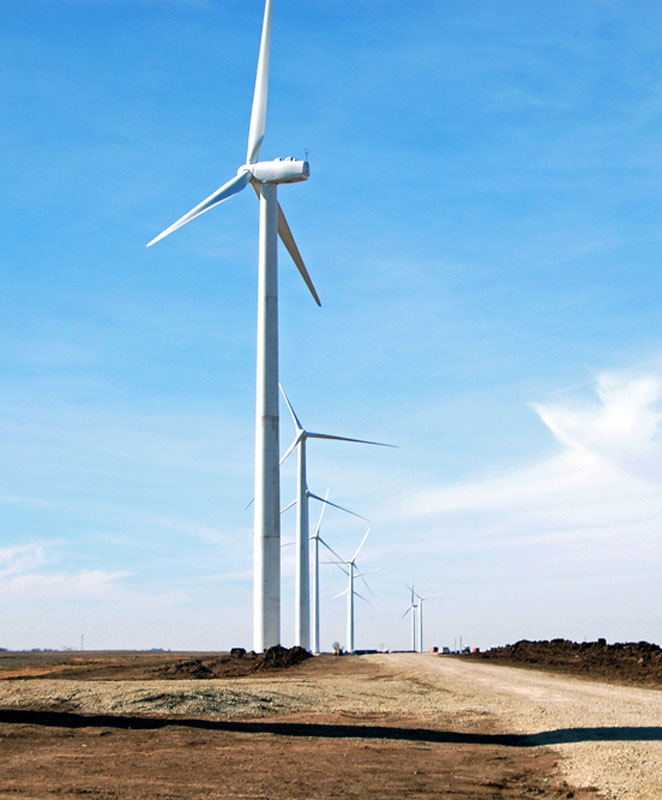
Developed by John Deere Renewables, the Greensburg Wind Farm began operating in March 2010 and generates more than enough energy to power all of the town’s homes and businesses on an annual basis. The 12.5 MW farm includes ten turbines that are rated at 1.25 MW each. Surplus renewable energy credits are being purchased by NativeEnergy, a green energy retailer, and sold as carbon offsets.

Greensburg was recently honored with an Edison Green Award, which recognizes communities that work to minimize their carbon footprint while creating green collar jobs and improving community health and self-sufficiency. For more information, see www.greensburggreentown.org.

Published December 31, 1969

(2010, June 1). Rebuilt Kansas Community Now Powered Completely by Wind. Retrieved from https://www.buildinggreen.com/departments/newsbrief

Add new comment

To post a comment, you need to register for a BuildingGreen Basic membership (free) or login to your existing profile.

Living Cities Design Competition Announced

News Brief

Living Cities Design Competition Announced

The International Living Buildings Institute (ILBI), along with the National Trust for Historic Preservation, has announced a design competition for Living Cities.

Entries are due February 1, 2011, and must include photo-realistic, three-dimensional renderings of the proposed town or urban neighborhood, and must show how a future city would meet the goals of the Living Building Challenge (see EBN June 2009).

The entry fee is $500 for firms and $100 for students or unemployed individuals. Prizes total $125,000, including a $25,000 prize for the best example of a future city that reuses existing, 2010 infrastructure and buildings. More information is available at ilbi.org/resources/competitions/livingcity/main/.


Published December 31, 1969

(2010, May 24). Living Cities Design Competition Announced. Retrieved from https://www.buildinggreen.com/departments/newsbrief

Add new comment

To post a comment, you need to register for a BuildingGreen Basic membership (free) or login to your existing profile.

California Mandates Carbon Monoxide Detectors

News Brief

California Mandates Carbon Monoxide Detectors

Homes in California must have carbon monoxide (CO) detectors installed by July 2011 under a new bill signed into law by Governor Arnold Schwarzenegger on May 7, 2010.

The latest versions of California building and residential codes already demand that new dwellings in the state come equipped with CO detectors beginning in January 2011; the new law (SB 183) will hold existing homes to the same standard. Exemptions apply to homes that have no fossil fuel-burning appliances, fireplace, or attached garage.

With the signing of the bill California joined 19 other states requiring CO detectors in residential buildings; most of those requirements, including California’s, are enforceable for existing buildings only upon the sale of the home or the application for a building permit for renovations.


Published December 31, 1969

(2010, May 24). California Mandates Carbon Monoxide Detectors. Retrieved from https://www.buildinggreen.com/departments/newsbrief


Add new comment

To post a comment, you need to register for a BuildingGreen Basic membership (free) or login to your existing profile.

U.S. Greenhouse Gas Emissions Fell Significantly in 2009

News Brief

U.S. Greenhouse Gas Emissions Fell Significantly in 2009

Emissions of greenhouse gases (GHG) associated with energy use were down 7% in 2009 compared to 2008, according to the U.S. Energy Information Administration (EIA). That’s the largest single-year decline in emissions since the agency began keeping data on energy consumption (from which GHG are derived) in 1949, more than 60 years ago.

EIA attributes some of the fall in emissions to the economic downturn, but also points to a decline in the energy intensity of the economy as well as the carbon intensity of the energy supply. Total energy consumption during 2009 fell across all sectors, most notably in the industrial sector, where consumption dropped by nearly 10%. Meanwhile, the carbon intensity of the energy supply decreased mainly in the electric sector, where the price of coal rose while the relative price (per Btu) of natural gas fell dramatically.

For more information, visit www.eia.doe.gov/oiaf/environment/emissions/carbon/index.html.


Published December 31, 1969

(2010, May 17). U.S. Greenhouse Gas Emissions Fell Significantly in 2009. Retrieved from https://www.buildinggreen.com/departments/newsbrief
Add new comment

To post a comment, you need to register for a BuildingGreen Basic membership (free) or login to your existing profile.

Federal Government Can Do More For Green Building, Says USGBC

News Brief

Federal Government Can Do More For Green Building, Says USGBC

A report commissioned by the U.S. Green Building Council (USGBC) argues that the Obama administration has the legal authority to use 30 existing federal programs worth over $72 billion to improve energy efficiency in U.S. building stock.

The report recommends reforming appraisal and underwriting practices at lenders Freddie Mae and Freddie Mac, incorporating energy efficiency criteria into competitive grants, strengthening standards for federal housing programs and leases, supporting small business energy-efficiency investments, and other actions.


Published December 31, 1969

(2010, May 17). Federal Government Can Do More For Green Building, Says USGBC. Retrieved from https://www.buildinggreen.com/departments/newsbrief

Add new comment

To post a comment, you need to register for a BuildingGreen Basic membership (free) or login to your existing profile.

EPA Study Shows Increase in Urban Development

News Brief

EPA Study Shows Increase in Urban Development

A recent report from the Environmental Protection Agency (EPA) is shedding some light on residential construction patterns in urban areas. “Residential Construction Trends in America’s Metropolitan Regions 2010” finds that redevelopment in urban centers is surpassing suburban construction in roughly half of the 50 largest cities in the U.S. The study is an updated version of a 2009 report that examined housing data from 1990 through 2007; this year’s report includes data from 2008.


Both reports illustrate that smart growth is becoming increasingly popular, due in part to the support of programs like the Partnership for Sustainable Communities, a collaborative effort of EPA, the Department of Transportation, and the Department of Housing and Urban Development to increase the availability of affordable, transit-oriented, high-density development (see EBN Apr. 2010). Additionally, the 2010 report finds that the last five years have seen the most dramatic increase in urban redevelopment, despite economic trouble in the real estate market, and notes that new housing construction on undeveloped land is still common.

The full report can be downloaded at www.epa.gov/smartgrowth/construction_trends.htm.

Published December 31, 1969

(2010, May 1). EPA Study Shows Increase in Urban Development. Retrieved from https://www.buildinggreen.com/departments/newsbrief

Add new comment

To post a comment, you need to register for a BuildingGreen Basic membership (free) or login to your existing profile.

ANSI Approves GBI Rating System Based on Green Globes

News Brief

ANSI Approves GBI Rating System Based on Green Globes

The Green Building Initiative (GBI), which administers the Green Globes rating system for commercial buildings, announced in April 2010 that the rating system had secured the approval of the American National Standards Institute (ANSI) to become an accredited national standard.

The new standard includes seven areas of assessment: Project Management, Site, Water, Energy, Emissions, Indoor Environment, and Resources. New additions to the rating system include a water consumption calculator, a materials and resources section that fully incorporates Life Cycle Assessment (LCA), and an emphasis on building integrity issues. The standard will now enter a limited pilot phase, accepting applications beginning May 1. The current version of the Green Globes standard will continue to be available throughout the pilot period. For more information visit www.thegbi.org.

Published December 31, 1969

(2010, May 1). ANSI Approves GBI Rating System Based on Green Globes. Retrieved from https://www.buildinggreen.com/departments/newsbrief

Add new comment

To post a comment, you need to register for a BuildingGreen Basic membership (free) or login to your existing profile.

Nanoparticles Can Cross Placenta from Mother to Baby

News Brief

Nanoparticles Can Cross Placenta from Mother to Baby

According to a recent study published in Environmental Health Perspectives, nanoparticles can cross the human placenta. Often thought of as a barrier that can protect a developing fetus from the mother’s exposure to environmental pollutants, the placenta was found to be permeable to nanoscale particles of polystyrene.

In the study, placentas of full-term newborn infants were injected on the mother’s side with the nanoparticles. The authors noted that the injection was not intended to represent a realistic scenario, and that it cannot be generalized to all types of nanoparticles, but they wrote that the findings “underscore the need for further nanotoxicologic studies on this important organ system.”

Published December 31, 1969

(2010, May 1). Nanoparticles Can Cross Placenta from Mother to Baby. Retrieved from https://www.buildinggreen.com/departments/newsbrief

Add new comment

To post a comment, you need to register for a BuildingGreen Basic membership (free) or login to your existing profile.