People Get Sicker in Overcooled and Overheated Buildings

News Brief

People Get Sicker in Overcooled and Overheated Buildings

Energy-efficiency advocates fighting profligate energy use to overcool workplaces in summer and overheat them in winter now have a compelling new argument: people are healthier in spaces that are less severely conditioned. That is the finding of a peer-reviewed study by Mark Mendell, of Lawrence Berkeley National Laboratory, entitled “Indoor Thermal Factors and Symptoms in Office Workers: Findings from the U.S. EPA BASE Study.”

Mendell analyzed data from 95 buildings characterized in the U.S. Environmental Protection Agency's Building Assessment Survey and Evaluation (BASE) Study, comparing indoor temperatures to recommended comfort levels. They found that the buildings were consistently overcooled in the summer and some were overheated in winter. They then checked for a range of building-related health symptoms, and found that both cooler indoor temperatures in summer and warmer temperatures in winter consistently correlated with more symptoms.

The paper, LBNL-2083E, was posted online on August 24, 2009, and has been accepted for publication in Indoor Air.


Published December 31, 1969

(2009, September 17). People Get Sicker in Overcooled and Overheated Buildings. Retrieved from https://www.buildinggreen.com/departments/newsbrief

Add new comment

To post a comment, you need to register for a BuildingGreen Basic membership (free) or login to your existing profile.

LEED Certification Now with Guarantee

News Brief

LEED Certification Now with Guarantee

The inherent unpredictability of LEED projects creates a unique liability for green building owners and contractors that is rapidly gaining momentum. In an effort to ease its clients’ elevated legal anxiety, Energy Ace, an Atlanta-based consulting firm, is guaranteeing LEED certification—or your money back—when the company supervises administration, fundamental commissioning, and energy modeling to meet LEED standards.

The firm first establishes a contractual agreement with clients, then, through a series of LEED charrettes, provides a number of sustainability measures. Once all parties accept the measures, the certification guarantee is complete.

If a refund is granted, clients receive only monies associated with Energy Ace’s LEED administration fees—about 30%–45% of total fees. Through this partial refund, Energy Ace is able to allay client fears and limit its own risk.

The company has nearly 100 LEED projects under its belt and publicly backs its certification success rate. More information can be found at energyace.com.


Published December 31, 1969

(2009, September 4). LEED Certification Now with Guarantee. Retrieved from https://www.buildinggreen.com/departments/newsbrief

Add new comment

To post a comment, you need to register for a BuildingGreen Basic membership (free) or login to your existing profile.

AstroTurf Ordered to Curtail Lead Use

News Brief

AstroTurf Ordered to Curtail Lead Use

If you’ve ever wondered where AstroTurf gets its vibrant color, consider the mystery solved: turf-makers use lead to keep artificial grass green. Now, as the result of a 2008 California lawsuit against the Georgia-based company, AstroTurf will drastically reduce the lead content in its imitation turf.

Studies show lead levels of more than 5,000 parts per million (ppm) in certain AstroTurf products. Of particular concern are older AstroTurf fields from which dust can form and ultimately be ingested by those who come into contact with it.

The lawsuit—filed under California’s Proposition 65, which requires the labeling of products that contain toxins known to cause cancer or birth defects—establishes the movement to make playgrounds and recreational fields safer. The settlement requires AstroTurf to limit the lead content of products sold in California to 50 ppm.

According to AstroTurf general manager Lou Ziebold, the lead chromate used for fiber pigmentation was replaced with a non-leaded component. “We have two pigment suppliers who each have their own unique formulation but neither has any lead in the formula. The new pigments have been extensively tested and we've been using them now for over a year,” Ziebold told EBN.

The company will pay $170,000 in civil penalties, grants, and attorney fees and $60,000 for testing artificial playing fields around the state. Additionally, AstroTurf will provide safety information via the Internet and send lead content warnings to California consumers who purchased artificial grass in the last five years. California Attorney General Jerry Brown’s office has additional lawsuits pending against AstroTurf’s competitors, Field Turf and the Beaulieu Group.


Published December 31, 1969

(2009, September 1). AstroTurf Ordered to Curtail Lead Use. Retrieved from https://www.buildinggreen.com/departments/newsbrief

Add new comment

To post a comment, you need to register for a BuildingGreen Basic membership (free) or login to your existing profile.

LEED AP Credential Maintenance Program Launched

News Analysis

LEED AP Credential Maintenance Program Launched

The Green Building Certification Institute has released credential maintenance requirements for LEED APs, including education and fees.

The Green Building Certification Institute (GBCI) announced several changes to the LEED Accredited Professional (LEED AP) program in November 2008. Among those changes was the addition of a credential maintenance program that would require those at all levels of LEED accreditation to obtain a certain number of continuing education hours every two years to maintain their status.

The program, launched August 3, 2009, requires LEED APs to earn 30 hours every two years and LEED Green Associates, the new lower-tier credential, to earn 15 hours. Some of these hours must be LEED-specific, and some of those must be rating system-specific. LEED APs will also need to pay a biennial fee of $50.

Published December 31, 1969

(2009, August 28). LEED AP Credential Maintenance Program Launched. Retrieved from https://www.buildinggreen.com/departments/newsbrief

New Lease Model Shares Green Building Costs, Benefits

News Brief

New Lease Model Shares Green Building Costs, Benefits

Traditional leases in commercial buildings are either gross leases (the landlord pays for utilities and other expenses) or net leases (the tenant pays for everything). According to Glenn Fischer, executive vice president of The Corporate Realty, Design, and Management Institute (CRDMI), neither situation works particularly well for promoting green building. “All of the benefits of energy efficiency and other improvements are flowing to one party,” he said of typical leases. CRDMI created a task force to write a lease that would benefit both building owners and tenants, which the organization released in July 2009. The lease not only splits up the financial benefits of green building but also requires both parties to prepare environmental performance reports annually. The lease is available for download for $90 at www.squarefootage.net/mgldwnld.htm.


Published December 31, 1969

(2009, August 28). New Lease Model Shares Green Building Costs, Benefits. Retrieved from https://www.buildinggreen.com/departments/newsbrief

Add new comment

To post a comment, you need to register for a BuildingGreen Basic membership (free) or login to your existing profile.

Michelle Moore Joins the Obama Administration

News Brief

Michelle Moore Joins the Obama Administration

Formerly the senior vice president of policy and public affairs at the U.S. Green Building Council (USGBC), Michelle Moore has moved on to join the Council for Environmental Quality as the federal environmental executive.

In her new role, Moore will promote sustainability in the federal government’s operations.

Rick Fedrizzi, president and CEO of USGBC, said of Moore’s work at the organization: “She’s been at the center of our most important initiatives.”

He continued, “Her new role at the White House is only a change of address for her contributions, from which we will all continue to benefit.”


Published December 31, 1969

(2009, August 28). Michelle Moore Joins the Obama Administration. Retrieved from https://www.buildinggreen.com/departments/newsbrief

Add new comment

To post a comment, you need to register for a BuildingGreen Basic membership (free) or login to your existing profile.

Massachusetts Stretches the Energy Code

News Brief

Massachusetts Stretches the Energy Code

A recently adopted addendum to the Massachusetts state building codes, known as the “stretch code,” exceeds the 2009 International Energy Conservation Code (IECC) by 20%. The optional code sets performance standards for commercial buildings over 5,000 ft2 (460 m2) and residential buildings (see table above). According to Mike Guigli, technical director for the Department of Public Safety, “about a dozen municipalities at this point in time are considering adoption of the stretch code.” All buildings in the state will need to meet 2009 IECC standards when they become the baseline code for the state in 2010.


Published December 31, 1969

(2009, August 28). Massachusetts Stretches the Energy Code. Retrieved from https://www.buildinggreen.com/departments/newsbrief

Add new comment

To post a comment, you need to register for a BuildingGreen Basic membership (free) or login to your existing profile.

Renewables Surge as Percentage of U.S. Electricity

News Brief

Renewables Surge as Percentage of U.S. Electricity

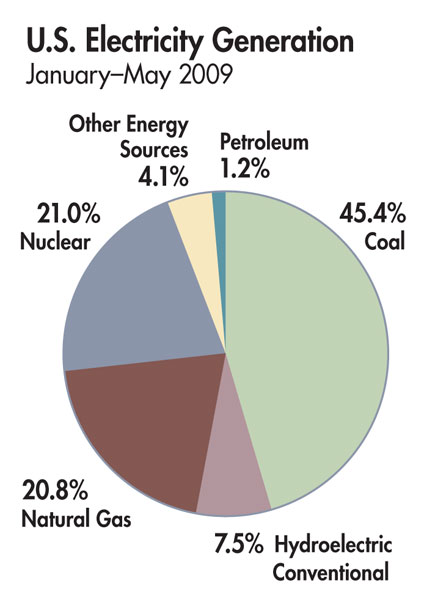
A recent report from the Energy Information Administration confirms a rapid increase in the percentage of electricity generated from renewable sources, crediting renewables with 11.1% of total U.S. electrical generation. The report covered a 12-month period ending in April 2009 and examined both hydropower and non-hydro renewables, including wind, solar, biomass, and geothermal. According to the findings for absolute output, hydropower generation jumped 8.22%, while non-hydro renewables saw a 12.47% increase over the previous year. Moreover, 4.24% of U.S. electrical output in April came from non-hydro renewables—1.24% higher than the target in the pending Senate energy bill for 2013. Energy conservation also increased, with net electricity generation dropping 5% from April 2008 to April 2009. Conversely, generation from coal, natural gas, and nuclear power declined as much as 13.9%.

Published December 31, 1969

(2009, August 28). Renewables Surge as Percentage of U.S. Electricity. Retrieved from https://www.buildinggreen.com/departments/newsbrief

Add new comment

To post a comment, you need to register for a BuildingGreen Basic membership (free) or login to your existing profile.

BAC Acquires Harvard Landscape Program

News Brief

BAC Acquires Harvard Landscape Program

The Landscape Institute at Arnold Arboretum, formerly run by Harvard University, has joined the Boston Architectural College (BAC) and is now named the Landscape Institute at the BAC. Starting in fall 2009, BAC will run all of the Institute’s educational programs, incorporating them into its catalog of continuing education courses. “Landscape Institute students will now be an integral part of an academic community committed to comprehensive design education,” said Heather Heimarck, director of the Institute. The connection to Harvard, which owns the arboretum, will continue as a way for students to receive hands-on experience with plant species and care. More information is available at www.the-bac.edu.

Published December 31, 1969

(2009, August 28). BAC Acquires Harvard Landscape Program. Retrieved from https://www.buildinggreen.com/departments/newsbrief

Add new comment

To post a comment, you need to register for a BuildingGreen Basic membership (free) or login to your existing profile.

AIG Insuring for Green Building Risks

News Brief

AIG Insuring for Green Building Risks

Green insurance coverage is not a new concept, nor are the risks associated with green building considered extraordinary. Nevertheless, American International Group (AIG) is now offering two advanced insurance policies for property owners and managers of LEED-certified buildings via its Risk Management Green (AIGRMGreen) product line: Indoor Environment Coverage and Reputation Coverage.

The company’s Indoor Environment Coverage guards against claims of bodily injury occurring from substances or odors originating from equipment used to improve air or water quality. “Claims of bodily injury from pollution may occur even with the most careful planning, construction, maintenance, and certification of a green building,” says Joseph Fobert, zone executive for AIG’s commercial risk division.

The Reputation Coverage, on the other hand, covers costs associated with reputational crisis management that result from adverse publicity, providing up to $50,000 per occurrence. More specifically, it “provides funds to employ crisis management specialists to manage adverse publicity; guide and counsel key company personnel; and provide other necessary services to assist in restoring a company's reputation,” according to AIG’s website. It should be noted that this policy does not cover actual financial loss resulting from damages to a company’s reputation.

“When a green building experiences the threat of adverse publicity, it may be more damaging than what is traditionally experienced by conventional properties. Raised expectations and increased public scrutiny may expose the owners of these buildings to negative media coverage should such a building fail to meet green industry standards,” Fobert told EBN. The policy is one response to lawsuits surrounding green buildings, which are becoming more common. A 2008 lawsuit that was brought by Shaw Development against contractor Southern Builders (see EBN Mar. 2009) is one example of many: when the Captain’s Galley condominium building in Crisfield, Maryland, failed to achieve LEED Silver standards, Shaw sued for breach of contract. The Reputation Coverage would have insured the contractor in this case, or any team members who are sued when a building fails to achieve certification under LEED or other rating systems.

According to Barbara Batshalom, executive director for The Green Roundtable in Boston, Massachusetts—a nonprofit organization that collaborated with AIG to shape its green policies—green projects often involve many independent entities working toward the common goal of LEED certification. This planning model makes liability issues tricky since it’s not always easy to ascertain where responsibility lies, or if it even lies with one party.

But how cost-effective will these policies be? “These forms are available as endorsements to our current insured’s commercial general liability programs, and would represent a small additional premium,” says Fobert. “It is very costly for property owners to build or upgrade their buildings to green. Likewise, it is important to make sure they properly protect these investments and should research all available insurance options to do so.”

For more information:

American International Group

 

Published December 31, 1969

(2009, August 20). AIG Insuring for Green Building Risks. Retrieved from https://www.buildinggreen.com/departments/newsbrief

Add new comment

To post a comment, you need to register for a BuildingGreen Basic membership (free) or login to your existing profile.