EPA's Portfolio Manager Slated for Improvements

News Brief

EPA's Portfolio Manager Slated for Improvements

Portfolio Manager, the interactive energy management tool operated by the U.S. Environmental Protection Agency (EPA), will receive significant updates at the end of August 2009, which could affect energy performance ratings for various building types.

Updates include a new rating for houses of worship, a revised rating for warehouses, a retail eligibility rule, and several optional features for hotels. Additionally, new fields will be available for documentation of onsite wind- or solar-generated electricity and tracking of renewable energy certificates (RECs). These changes in particular will influence site and source energy values and energy performance ratings, and will assist with accounting for green power and tracking the related decline in greenhouse gas emissions.

Finally, Portfolio Manager will add ‘District Hot Water’ and ‘District Chilled Water – Other’ as possible fuel types, and include two additional units of measure—liters for liquid fuel, and cubic meters for natural gas.

More information about the updates will be posted on August 31, 2009, at www.energystar.gov. Questions regarding these upcoming changes should be directed to

buildings@energystar.gov.


Published December 31, 1969

(2009, August 3). EPA's Portfolio Manager Slated for Improvements. Retrieved from https://www.buildinggreen.com/departments/newsbrief

Add new comment

To post a comment, you need to register for a BuildingGreen Basic membership (free) or login to your existing profile.

USGBC Appoints New Research Director

News Brief

USGBC Appoints New Research Director

Christopher Pyke, Ph.D., former director of climate change services at CTG Energetics in Irvine, California, has been named Research Director for the U.S. Green Building Council (USGBC). Dr. Pyke has extensive experience designing and implementing strategies for decreasing greenhouse gas emissions and adapting to dynamic climatic conditions, with expertise in the areas of land-use management, sustainable design, and local environmental policy.

Published December 31, 1969

(2009, July 30). USGBC Appoints New Research Director. Retrieved from https://www.buildinggreen.com/departments/newsbrief

Add new comment

To post a comment, you need to register for a BuildingGreen Basic membership (free) or login to your existing profile.

Maine Fluorescent Lamp Bill Puts Manufacturers in Recycling Hot Seat

News Brief

Maine Fluorescent Lamp Bill Puts Manufacturers in Recycling Hot Seat

Maine’s Governor John Baldacci signed bill LD 973, “An Act to Provide for the Safe Collection and Recycling of Mercury-Containing Lighting,” into law in June 2009. The bill, touted as the first of its kind in the nation, requires manufacturers to create programs for the collection and recycling of household compact and linear fluorescent lamps by January 2011; recycling of commercial fluorescents—as well as waste electronic equipment and thermostats containing mercury—is already required.

The state will oversee the recycling program, with participating retailers tasked with raising consumer awareness and acting as collection centers. Futhermore, the bill establishes mercury content standards consistent with those set under the European Union’s

Reduction of Hazardous Substances (RoHS) directive.

Published December 31, 1969

(2009, July 30). Maine Fluorescent Lamp Bill Puts Manufacturers in Recycling Hot Seat. Retrieved from https://www.buildinggreen.com/departments/newsbrief

Add new comment

To post a comment, you need to register for a BuildingGreen Basic membership (free) or login to your existing profile.

Obama Announces Stronger Lighting Efficiency Standards

News Brief

Obama Announces Stronger Lighting Efficiency Standards

President Barack Obama, together with Energy Secretary Steven Chu, announced new energy-efficiency standards for lighting in June 2009. The announcement extends the provisions in the Energy Independence and Security Act of 2007, which set standards that would phase out conventional incandescent lamps by 2014 (see

EBN Feb. 2008).

The new standards cover additional lamp types, lowering the electricity use of general-service fluorescent lamps (four-foot tubes and other fixtures) by 15%, and that of reflector incandescent lamps by 25%. In some cases, new lamps must increase the lumens per watt they provide. Lamps must meet the standards starting in 2012.

Published December 31, 1969

(2009, July 30). Obama Announces Stronger Lighting Efficiency Standards. Retrieved from https://www.buildinggreen.com/departments/newsbrief

Add new comment

To post a comment, you need to register for a BuildingGreen Basic membership (free) or login to your existing profile.

Drywall Problems Escalate

News Brief

Drywall Problems Escalate

Problematic drywall imported from China has been making headlines since 2008, when homeowners began complaining about sulfur odors and corrosion of copper wiring. Most of the complaints have come from southern states, where high temperatures and humidity seem to aggravate the problems. The issue has grown to national proportions, spawning a class-action lawsuit and involving Congress and several federal agencies. A new lawsuit against Georgia Pacific (GP) suggests that drywall made in the U.S., not just that made in China, may have some of the same problems.

Builder Michael Swidler of Lake County, Florida, and his wife Jill Swidler have brought a class-action suit against GP and supply company 84 Lumber, arguing that 289 sheets of GP’s ToughRock drywall caused corrosion in wiring and appliances, as well as a strong sulfur odor. According to court documents, the Swidlers vacated their house in 2009 because of the problems caused by the drywall. Melodie Ruse, a spokesperson for GP, noted that, “We are disappointed the Swidlers elected to pursue a lawsuit without first informing us of any issues and allowing us to investigate.” She continued, “We can say that we stand behind our products and take all customer complaints seriously.”

ToughRock, like many similar products on the market, is made with a mixture of natural gypsum and synthetic gypsum, a waste product from flue-gas desulfurization at coal-fired power plants. A mixture of limestone, water, and air is sprayed into a plant’s flue gas, causing a chemical reaction that converts calcium carbonate into calcium sulfate—gypsum. This is then used in drywall products to replace natural gypsum. The process has long been considered environmentally friendly, since it uses a waste product from power production and limits mining for natural gypsum.

Synthetic gypsum has been implicated in the imported drywall scandal, but it’s unclear whether it’s actually causing the problems. A small-scale study performed by the U.S. Environmental Protection Agency (EPA) in May 2009 found that levels of sulfur and strontium in Chinese drywall taken from houses where complaints had been reported were much higher than those in drywall manufactured in the U.S., including samples of GP’s ToughRock purchased at a retail location near the EPA testing facility. The ToughRock that was tested did have high levels of several semi-volatile organic compounds. EPA did not speculate on what effect high sulfur, strontium, or organic compound levels may have on indoor air quality, or whether any of these chemicals are the source of the corrosion problems being seen in so many houses.

For more information:

U.S. Environmental Protection Agency Report (pdf)


Published December 31, 1969

(2009, July 21). Drywall Problems Escalate. Retrieved from https://www.buildinggreen.com/departments/newsbrief

Add new comment

To post a comment, you need to register for a BuildingGreen Basic membership (free) or login to your existing profile.

New Standard 55: 'Cool People, Not Buildings'

News Brief

New Standard 55: 'Cool People, Not Buildings'

Recent updates to the industry standard for thermal comfort in buildings, the American Society of Heating, Refrigerating, and Air-Conditioning Engineers (ASHRAE) Standard 55, will for the first time recognize elevated air speed as a component of thermal comfort, giving building designers and operators the ability to turn up the fans, rather than the air-conditioning, to help occupants stay comfortable when building temperatures rise.

According to Standard 55 committee chair Stephen Turner, a growing body of research indicates that having some degree of air movement within a space can keep people just as comfortable, if not more so, than do uniform, still-air conditions at lower temperatures. Based on this research, the change to the standard represents a move away from “the pursuit of uniformity” inside buildings and toward allowing a wider variety of conditions. "The main application of the elevated air speed changes is to provide designers and building operators with the flexibility to reduce air-conditioning energy use by keeping people comfortable with local air movement in warmer conditions," Turner told EBN. This flexibility carries the potential for energy savings, and should give designers more latitude in creating spaces like atria, which are high-performance features for daylighting and cold-weather solar gain, but difficult and energy-intensive to condition efficiently to more traditional, uniform thermal conditions.

Other significant changes to the standard should help smooth over the documentation process for LEED project teams pursuing thermal comfort credits. Working closely with the Center for the Built Environment at the University of California–Berkeley, the committee brought the standard into closer alignment with the surveys many project teams use to verify occupant comfort in order to comply with LEED thermal comfort credits. The committee also worked with the U.S. Green Building Council to develop a new LEED template for documenting thermal comfort. “By simplifying and clarifying and making more meaningful the documentation requirements for designers, we've allowed a significant alignment for project teams using the standard to show LEED compliance," Turner told EBN.Standard 55 has historically struggled to account for the variety of factors at play in defining thermal comfort, which has sometimes led to the over-conditioning of spaces and excessive energy use (see EBN May 2009). By thinking about thermal comfort in terms of “cooling people, not buildings,” as Turner says, these changes to the standard should enable more high-performance design and give building operators more control over energy use.


Published December 31, 1969

(2009, July 21). New Standard 55: 'Cool People, Not Buildings'. Retrieved from https://www.buildinggreen.com/departments/newsbrief

Add new comment

To post a comment, you need to register for a BuildingGreen Basic membership (free) or login to your existing profile.

Funding Cut for Toxics Reduction

News Brief

Funding Cut for Toxics Reduction

Amid a fiscal meltdown, Massachusetts has eliminated funding for the Toxics Use Reduction Institute (TURI) at the University of Massachusetts-Lowell. Established in 1989, TURI provides research and training as well as technical, laboratory, and funding programs and services for reducing the use of toxic chemicals in manufacturing processes.

The institute’s CleanerSolutions Database (see EBN Nov. 2006) and support for the development of lead-free electrical wire and cable are among its many accomplishments. In conjunction with the Massachusetts Department of Environmental Protection and the Office of Technical Assistance, TURI has managed to cut the use of toxics in regional manufacturing by 41% over its brief history, helping businesses to reduce costs and better compete in a global market.

The university, which has admitted to a lack of financial resources, is expected to appropriate funding for TURI, whose fiscal year ended on June 30. There is a letter-writing campaign to reinstate TURI's funding; more details can be found on BuildingGreen’s blog.

Published December 31, 1969

(2009, July 13). Funding Cut for Toxics Reduction. Retrieved from https://www.buildinggreen.com/departments/newsbrief

Add new comment

To post a comment, you need to register for a BuildingGreen Basic membership (free) or login to your existing profile.

ASHRAE Unveils Building Energy Label

News Brief

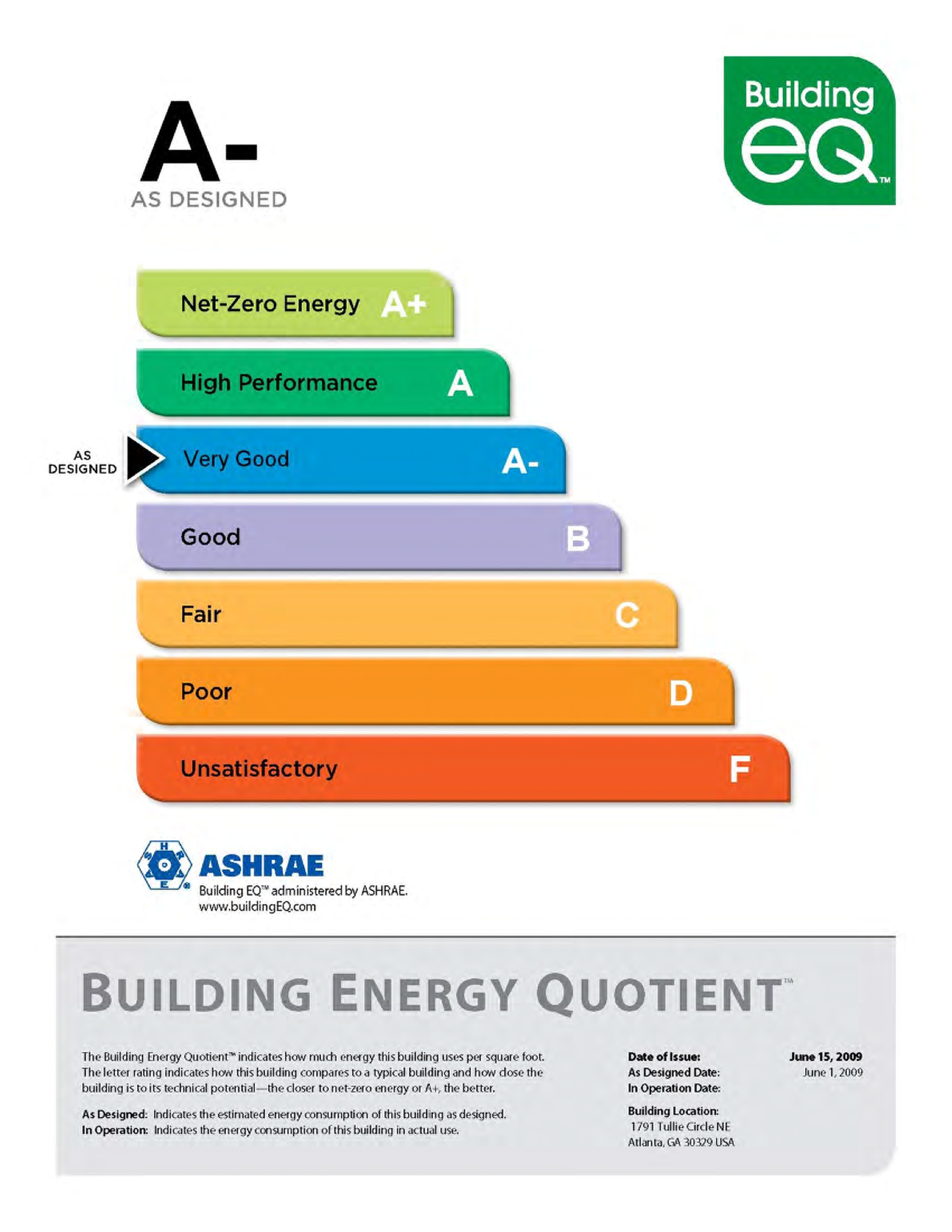
ASHRAE Unveils Building Energy Label

The American Society of Heating, Refrigerating, and Air-Conditioning Engineers (ASHRAE) announced the launch of its new building energy labeling program with the release of a prototype of the label at its 2009 annual conference in June.

The labeling program, called Building Energy Quotient or “Building EQ,” was developed in collaboration with the U.S. Environmental Protection Agency’s (EPA) Energy Star program and will grade new and existing buildings of all types (except residential) on both design energy use and actual energy performance.

According to ASHRAE representatives, the labeling program was designed to provide building operators with information that will allow them to improve building performance, and to provide building owners as well as potential buyers and tenants with quantifiable evidence of the value and cost of investing in a particular building based on its energy performance. ASHRAE is currently working with real estate developers to implement the label prototype in the fall of 2009, with a widespread launch of the full program in 2010.

For more information, visit http://buildingEQ.com/.For previous EBN coverage, see our Apr. 2009 issue.


Published December 31, 1969

(2009, July 9). ASHRAE Unveils Building Energy Label. Retrieved from https://www.buildinggreen.com/departments/newsbrief

Add new comment

To post a comment, you need to register for a BuildingGreen Basic membership (free) or login to your existing profile.

Zerofootprint Launches Retrofit Competition

News Brief

Zerofootprint Launches Retrofit Competition

With buildings producing over 40% of the greenhouse gas emissions in the U.S., making existing buildings more energy-efficient is a high priority. Motivating inventive solutions to the problem of existing buildings is the goal behind Zerofootprint’s international Building Re-skinning Competition. The organization hopes to promote its idea of re-skinning—adding a new layer to the building envelope that can include added insulation, new wiring and piping, daylighting controls, and building-integrated photovoltaics.

Zerofootprint is actually a group of three companies: Zerofootprint Not-for-Profit, which is focused on education and advocacy; Zerofootprint Software, which develops carbon accounting programs; and Zerofootprint Carbon, which develops carbon offsetting projects.

With buildings producing over 40% of the greenhouse gas emissions in the U.S., making existing buildings more energy-efficient is a high priority. Motivating inventive solutions to the problem of existing buildings is the goal behind Zerofootprint’s international Building Re-skinning Competition. The organization hopes to promote its idea of re-skinning—adding a new layer to the building envelope that can include added insulation, new wiring and piping, daylighting controls, and building-integrated photovoltaics.

Zerofootprint is actually a group of three companies: Zerofootprint Not-for-Profit, which is focused on education and advocacy; Zerofootprint Software, which develops carbon accounting programs; and Zerofootprint Carbon, which develops carbon offsetting projects.

Entries must be submitted to the competition by September 1, 2009. Only fully funded projects may enter the competition, since the winners will have energy use monitored publicly for three years after completion. A jury that includes Stephan Behnisch, Edward Mazria, and William McDonough will judge entries on five criteria: aesthetics, energy-efficiency, smart technology, return on investment, and potential as a solution for a large number of other buildings. After three years of energy monitoring, the building with the highest reduction in energy use per square foot (compared to the last year before retrofits) will win the “Z Prize.” Zerofootprint is raising funds for the monetary portion of this prize, but hopes to make it “the largest prize in the world for architecture.”

For more information:

ZerofootprintToronto, Ontario, Canada

416-365-7557


Published December 31, 1969

(2009, July 9). Zerofootprint Launches Retrofit Competition. Retrieved from https://www.buildinggreen.com/departments/newsbrief

Add new comment

To post a comment, you need to register for a BuildingGreen Basic membership (free) or login to your existing profile.

UNH Launches Landfill Gas-to-Energy Project

News Brief

UNH Launches Landfill Gas-to-Energy Project

At a May 2009 ceremony it billed as “the most sustainable commencement in [its] history,” the University of New Hampshire (UNH) announced the launch of EcoLine, a landfill gas-to-energy project. The project is expected to meet up to 85% of the 5 million ft2 (464,515 m2) campus’ electricity and heating needs, making UNH the only university in the U.S. to use purified landfill gas as its primary fuel source.

Two years in construction and four years in the making, the EcoLine project is a partnership between UNH and Waste Management’s Turnkey solid waste facility in nearby Rochester, New Hampshire, which manages over half of the state’s trash. The facility had long used the gas to power its own operations and about 9,000 homes in the area, but excess gas was still being burned off, adding pollutants to the atmosphere and contributing to climate change.

At a May 2009 ceremony it billed as “the most sustainable commencement in [its] history,” the University of New Hampshire (UNH) announced the launch of EcoLine, a landfill gas-to-energy project. The project is expected to meet up to 85% of the 5 million ft2 (464,515 m2) campus’ electricity and heating needs, making UNH the only university in the U.S. to use purified landfill gas as its primary fuel source.

Two years in construction and four years in the making, the EcoLine project is a partnership between UNH and Waste Management’s Turnkey solid waste facility in nearby Rochester, New Hampshire, which manages over half of the state’s trash. The facility had long used the gas to power its own operations and about 9,000 homes in the area, but excess gas was still being burned off, adding pollutants to the atmosphere and contributing to climate change.

To capitalize on the available resource, UNH constructed a gas purification facility at the landfill on a site leased from Waste Management. Three hundred 36" (91 cm) wells reach down into the trash layer, where decomposition produces gas, primarily methane. The gas is pumped out and piped to the purification facility, where first sulfur compounds and then carbon dioxide are removed in order to “clean” the gas and raise the volumetric content of methane relative to other gases. (The extracted carbon dioxide is currently being released into the atmosphere, diminishing the environmental benefit of the project, but UNH and Waste Management are exploring methods for sequestering and recycling the greenhouse gas, according to a report by a local news agency.) The purified gas is then compressed and sent through a 12.7-mile (20.4 km) pipeline to the Durham, New Hampshire, campus, where it replaces natural gas as the primary fuel for an on-campus cogeneration plant that provides both heat and power to campus buildings. Built at a cost of $28 million with an estimated 20-year payback, the cogeneration plant went online in 2006 and is a signature feature of the university’s WildCAP initiative to combat climate change. Through the program, UNH aims to cut its greenhouse gas emissions by 50% by 2020, 80% by 2050, and 100% by 2100.

The EcoLine project cost UNH roughly $49 million to build, and was financed through traditional borrowing. The university expects to recover its costs within 10 years—a payback period that it will expedite through the sale of renewable energy credits (RECs) through 2012. The project will also stabilize the university’s fuel expenses by reducing its dependence on volatile fossil fuel markets. UNH and Waste Management officials estimate that the landfill gas supply would last 20–30 years even if Turnkey were shut down immediately, and there are no plans to close the facility any time soon.

For more information:

EcoLine


Published December 31, 1969

(2009, July 9). UNH Launches Landfill Gas-to-Energy Project. Retrieved from https://www.buildinggreen.com/departments/newsbrief

Add new comment

To post a comment, you need to register for a BuildingGreen Basic membership (free) or login to your existing profile.