EPA Releases Draft WaterSense Standard for Showerheads

News Brief

EPA Releases Draft WaterSense Standard for Showerheads

In September 2009 the U.S. Environmental Protection Agency (EPA) released its long-awaited draft WaterSense standard for showerheads.

The new standard will set a maximum flow rate for WaterSense-labeled showerheads of 2.0 gallons per minute (7.6 lpm) at 80 psi water pressure and require that the showerheads meet specific performance requirements: adequate flow rate across a range of pressures (delivering at least 60% of the maximum flow at 20 psi and 75% at 45 psi); a minimum spray force of 2.0 ounces (0.56 newtons) at 20 psi; and suitable spray coverage (using an apparatus that measures the distribution or spread of water from the showerhead). In addition, the showerhead must not be packaged with instructions that show a user how to modify its maximum flow rate.

The intent, according to EPA, is for WaterSense showerheads to “not only save water but also perform as well as or better than conventional models on the market.” Following a comment period, which ends November 9, 2009, WaterSense-labeled showerheads are expected to begin appearing in early 2010.

Published December 31, 1969

(2009, October 30). EPA Releases Draft WaterSense Standard for Showerheads. Retrieved from https://www.buildinggreen.com/departments/newsbrief

Add new comment

To post a comment, you need to register for a BuildingGreen Basic membership (free) or login to your existing profile.

Trane Completes Transition to Ozone-Safe R-410A

News Brief

Trane Completes Transition to Ozone-Safe R-410A

Trane, acquired by Ingersoll Rand in June 2008 and the largest North American manufacturer of commercial HVAC equipment (#2 in the world), has completed the conversion away from R-22 in its unitary HVAC product line in the Americas. (Unitary equipment is self-contained, often rooftop-mounted, HVAC equipment that typically includes a motor-driven refrigeration compressor, evaporative cooling coil, air-cooled condenser, filters, fans, and controls.)

The announcement was made on October 13, 2009, by Ingersoll Rand president and chief operating officer Mike Lamach at Trane’s 1.2-million-square-foot (110,000-m2) manufacturing plant in Clarksville, Tennessee. As part of the U.S. commitment to the Montreal Protocol, the U.S. Environmental Protection Agency mandated a shift from ozone-depleting HCFC refrigerants in new HVAC equipment by January 1, 2010. Trane has introduced 17 redesigned products during 2008 and 2009, most offering improved energy efficiency in addition to ozone-safe operation.

For information, visit www.trane.com.

Published December 31, 1969

(2009, October 30). Trane Completes Transition to Ozone-Safe R-410A. Retrieved from https://www.buildinggreen.com/departments/newsbrief

Add new comment

To post a comment, you need to register for a BuildingGreen Basic membership (free) or login to your existing profile.

Germany Wins Solar Decathlon for Second Time

News Brief

Germany Wins Solar Decathlon for Second Time

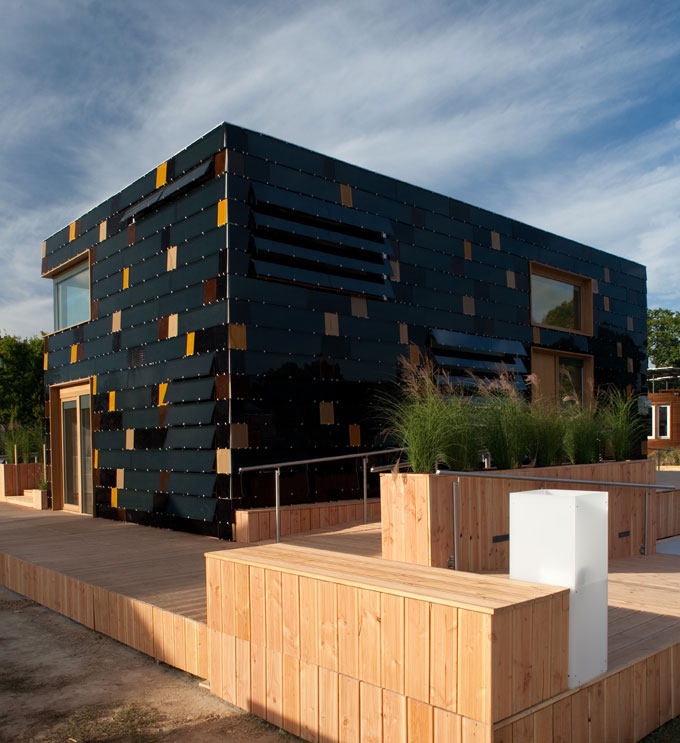
Team Germany, made up of students from Technische Universität Darmstadt, has taken first place in the 2009 Solar Decathlon competition, repeating its performance from the last competition, held in 2007 (see EBN Dec. 2007). The biennial student competition, run by the U.S. Department of Energy (DOE), is designed to demonstrate net-zero-energy homes and spur innovation.

Team Germany’s home was covered in solar cells: an 11-kW photovoltaic (PV) system on the roof made up of 40 single-crystal silicon panels and about 250 thin-film copper indium gallium diselenide (CIGS) panels spread over all four walls. Taken together, the PV systems produce approximately twice the electricity needed by the house, carrying the team into first place in the net-metering contest, new to this year’s competition. Team Germany also used some cutting-edge materials, including vacuum-insulated structural panels and phase-change materials in the walls and ceiling. Automated louvers on the windows were designed to maximize daylight exposure while controlling solar heat gain.

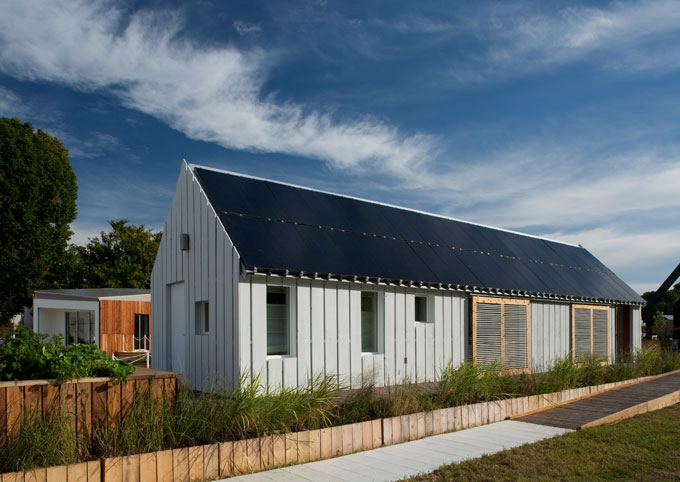
The University of Illinois at Urbana-Champaign took second place in the competition with its superinsulated house designed to echo traditional designs from the Midwest. Using salvaged barn wood, the team constructed a house with large amounts of insulation and high-performance windows, boasting that it could be heated with the equivalent of a hair-dryer. A 9.1-kW photovoltaic system on the gabled roof provides more electricity than needed by the house. The Illinois team hopes that a version of the house will soon be available to the public through a partnership with a modular home manufacturer.
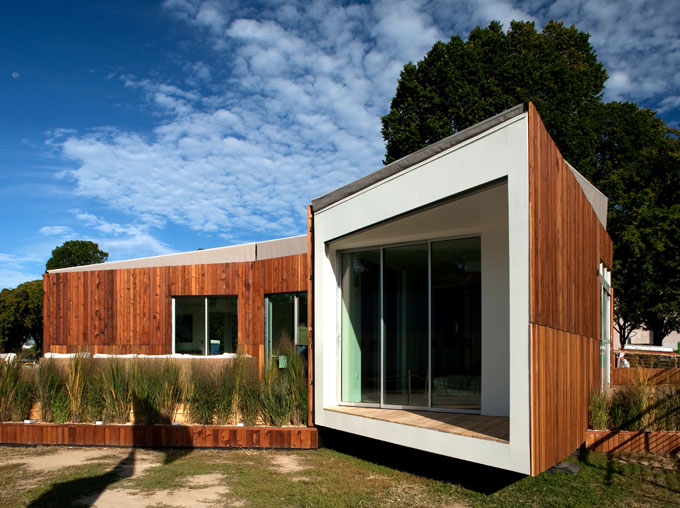
Team California, which included students from Santa Clara University and California College of the Arts, designed its third-place-winning house to take advantage of the California climate, with south-facing windows and a protected courtyard to promote outdoor living. Passive solar design in the mild climate eliminates most heating needs, and a solar-thermal absorption chiller supplies radiant cooling panels. Waste heat from the chiller preheats water for the solar hot water system, and an 8.1-kW photovoltaic system provides all of the house’s electricity.
A total of 20 teams were entered in the 2009 Solar Decathlon, and their projects were on exhibit on the National Mall for two weeks during October. According to DOE, this year's event broke previous records, attracting more than 300,000 house visits and more than 2 million website page views.

For more information:

Solar Decathlon

www.solardecathlon.org

Published December 31, 1969

(2009, October 30). Germany Wins Solar Decathlon for Second Time. Retrieved from https://www.buildinggreen.com/departments/newsbrief

Add new comment

To post a comment, you need to register for a BuildingGreen Basic membership (free) or login to your existing profile.

Granite Study Reveals Radiation Risks for Workers

News Brief

Granite Study Reveals Radiation Risks for Workers

Granite, which is known to naturally accumulate uranium, made headlines last year when it was reported that granite countertops can release radon gas into homes. Now, a new study, “Implications of Granite Counter Top Construction and Uses,” raises concerns that as many as half of all granite-cutters may be at risk of radiation exposure up to 3,000 times the U.S. Nuclear Regulatory Commission’s limit.

According to the study, the dust created from cutting granite contains large quantities of uranium and other hazardous isotopes. Workers who inhale this dust are exposed to a damaging form of radiation, thereby increasing their risk of cancer. Granite workers can protect themselves by keeping work areas clean and by using water-based cutting techniques, which minimize dust.

The study’s findings were disputed by The Marble Institute of America, a prominent stone industry trade group. The U.S. Department of Labor is calling for additional research and the Occupational Safety and Health Administration (OSHA) is targeting the granite-cutting industry for continual monitoring of dust levels.

Published December 31, 1969

(2009, October 30). Granite Study Reveals Radiation Risks for Workers. Retrieved from https://www.buildinggreen.com/departments/newsbrief

Add new comment

To post a comment, you need to register for a BuildingGreen Basic membership (free) or login to your existing profile.

California Utilities to Pump Billions into Energy Efficiency

News Brief

California Utilities to Pump Billions into Energy Efficiency

Published December 31, 1969

(2009, October 30). California Utilities to Pump Billions into Energy Efficiency. Retrieved from https://www.buildinggreen.com/departments/newsbrief

Add new comment

To post a comment, you need to register for a BuildingGreen Basic membership (free) or login to your existing profile.

STARS Rating System for Campuses Open for Registration

News Brief

STARS Rating System for Campuses Open for Registration

The first public version of the rating system designed for colleges and universities by the Association for the Advancement of Sustainability in Higher Education (AASHE) was made available in October 2009.

Campuses can now register for version 1.0 of the Sustainability Tracking, Assessment, and Rating System (STARS), which measures not only green building but also curriculum goals, socially responsible labor practices, and food purchasing practices, among other metrics (see

EBN Dec. 2007). More information is available at www.aashe.org/stars/.

Published December 31, 1969

(2009, October 30). STARS Rating System for Campuses Open for Registration. Retrieved from https://www.buildinggreen.com/departments/newsbrief

Add new comment

To post a comment, you need to register for a BuildingGreen Basic membership (free) or login to your existing profile.

ORNL Testing Energy Efficiency in Model Homes

News Brief

ORNL Testing Energy Efficiency in Model Homes

Oak Ridge National Laboratory (ORNL), in cooperation with the Tennessee Valley Authority, is building three houses in Tennessee to different energy-efficiency specifications in order to test their performance for up to seven years.


The homes range in size from 2,400­ to 2,512 square feet (220–230 m2) and have HERS ratings of 85, 64, and 30 (the lower the number, the better the energy performance). Each house incorporates some energy-efficient features; the highest-performance house will feature triple-glazed windows from Serious Materials and a roof that is expected to perform 55% better than a roof built to code.

Researchers will use mechanical devices and control systems to simulate, in a consistent manner, occupants in the house—including opening the refrigerator, running the clothes washer and dryer, and taking showers. Each home will be tested with the equivalent of low-energy-use and high-energy-use families based on national averages.

Published December 31, 1969

(2009, October 30). ORNL Testing Energy Efficiency in Model Homes. Retrieved from https://www.buildinggreen.com/departments/newsbrief

Add new comment

To post a comment, you need to register for a BuildingGreen Basic membership (free) or login to your existing profile.

ASHRAE Certifying Energy Modelers

News Brief

ASHRAE Certifying Energy Modelers

Beginning in January 2010, building energy modelers will be able to take an exam and become certified energy modelers. The American Society of Heating, Refrigerating, and Air-Conditioning Engineers (ASHRAE), together with the International Building Performance Simulation Association and the Illuminating Engineering Society of North America, has developed the exam to test modelers’ abilities to choose, use, and interpret the results of energy modeling software.

According to ASHRAE’s test preparation guide, the exam will cover a wide range of topics divided into four categories: determining the scope of a model; modeling components of buildings and energy systems; applications of energy models in the design process; and interpreting results. More information is available at www.ashrae.org/bemp/.

Published December 31, 1969

(2009, October 30). ASHRAE Certifying Energy Modelers. Retrieved from https://www.buildinggreen.com/departments/newsbrief

Add new comment

To post a comment, you need to register for a BuildingGreen Basic membership (free) or login to your existing profile.

New York Greening Buildings One Super at a Time

News Brief

New York Greening Buildings One Super at a Time

Most buildings could achieve better energy performance through operational changes that ensure systems are operating at peak efficiency. New York City officials joined 32BJ, the local property service workers’ union, in harnessing the possibility of operational changes by launching the One Year, One Thousand Green Supers program.

Through the program, 32BJ will offer a 40-hour class on energy-efficient building operations that will cover identifying wasted energy, creating and implementing green operating plans, and performing cost-benefit analysis on equipment replacements and other decisions. These strategies could save the city’s real estate industry as much as $230 million annually in operating expenses. More information is available at www.1000supers.com.

Published December 31, 1969

(2009, October 30). New York Greening Buildings One Super at a Time. Retrieved from https://www.buildinggreen.com/departments/newsbrief

Add new comment

To post a comment, you need to register for a BuildingGreen Basic membership (free) or login to your existing profile.

CBRE Experiments With One-Day Energy Reductions

News Brief

CBRE Experiments With One-Day Energy Reductions

On September 23, 2009, development company CB Richard Ellis Group (CBRE) joined with Brookfield Properties and ING Clarion Partners in a one-day pursuit of energy savings through building management across its portfolio.

The company reports that the effort resulted in 9.2% overall energy savings across 43 million square feet (4 million m2), prevented 138 tons of carbon emissions, and saved more than $26,500 in energy costs. CBRE worked with its tenants and building managers to implement energy-saving strategies not only at the building level but also with individual occupants.

Published December 31, 1969

(2009, October 30). CBRE Experiments With One-Day Energy Reductions. Retrieved from https://www.buildinggreen.com/departments/newsbrief

Add new comment

To post a comment, you need to register for a BuildingGreen Basic membership (free) or login to your existing profile.