FSC, USGBC Accused of Deception, Anti-Competitive Practices

News Brief

FSC, USGBC Accused of Deception, Anti-Competitive Practices

A group of forestry industry entities has filed a complaint with the Federal Trade Commission (FTC) against the Forest Stewardship Council (FSC) alleging unfair and deceptive trade practices and asking the commission to investigate.

The complaint, submitted by the law firm Steptoe & Johnson on behalf of a group calling itself the Coalition for Fair Forest Certification, also points a finger at the U.S. Green Building Council (USGBC) for what it calls “anticompetitive behavior”—namely, awarding LEED credits for wood certified by FSC but not other certifying bodies.

The firm would not disclose (nor could

EBN confirm) identities of the coalition members, but it is believed that many are also members of the Sustainable Forestry Initiative, which has sought equal treatment under LEED but which offers certifications that many see as less rigorous than those offered by FSC.

Published December 31, 1969

(2009, December 1). FSC, USGBC Accused of Deception, Anti-Competitive Practices. Retrieved from https://www.buildinggreen.com/departments/newsbrief


Add new comment

To post a comment, you need to register for a BuildingGreen Basic membership (free) or login to your existing profile.

Diverse Interest Groups Support National Formaldehyde Standard

News Brief

Diverse Interest Groups Support National Formaldehyde Standard

A bill recently introduced in the U.S. Senate proposing a national standard for formaldehyde in composite wood products has garnered support from a variety of organizations that may not be very accustomed to one another’s company. The bill (S-1660), sponsored by Senators Amy Klobuchar of Minnesota and Mike Crapo of Idaho, would amend the federal Toxic Substances Control Act to limit the allowable formaldehyde content in composite wood products to roughly 0.09 ppm, varying slightly by product type.

The proposed standard is based on the limits enacted by the California Air Resources Board (see

EBN June 2007), and would make U.S. formaldehyde regulations the strongest in the world, according to a statement by Senator Klobuchar.

Organizations offering their support of the national formaldehyde standard include the Kitchen Cabinet Manufacturers Association, the Sierra Club, the Composite Panel Association, the steelworkers’ union, and a variety of other industry and housing organizations. S-1660 has been referred to the Senate Committee on Environment and Public Works.

Published December 31, 1969

(2009, December 1). Diverse Interest Groups Support National Formaldehyde Standard. Retrieved from https://www.buildinggreen.com/departments/newsbrief
Add new comment

To post a comment, you need to register for a BuildingGreen Basic membership (free) or login to your existing profile.

Website Promotes Green Building for Campuses

News Brief

Website Promotes Green Building for Campuses

Massachusetts non-profit Second Nature has introduced a free website, the Campus Green Builder (CGB), to provide online green building resources for colleges and universities.

CGB’s primary tar-get is higher education institutions that lack resources for green building and renovation. Such institutions face numerous impediments to green building, including lack of funding and knowledge about green building.

Seeking to provide a level playing field for all colleges and universities, the portal provides opportunities for under-resourced institutions to share experiences and learn best practices. It furnishes users with links to green building resources and grant opportunities, green building expert directories, case studies, announcements of campus sustainability events, and peer-to-peer blogging.

Second Nature’s mission is “to accelerate movement toward a sustainable future by serving and supporting senior college and university leaders in making healthy, just, and sustainable living the foundation of all learning and practice in higher education.” For more information, visit www.campusgreenbuilder.org.

Published December 31, 1969

(2009, December 1). Website Promotes Green Building for Campuses. Retrieved from https://www.buildinggreen.com/departments/newsbrief

Add new comment

To post a comment, you need to register for a BuildingGreen Basic membership (free) or login to your existing profile.

California Delays Energy Cost Disclosure Requirements

News Brief

California Delays Energy Cost Disclosure Requirements

California Governor Arnold Schwarzenegger signed a bill in October 2009 postponing the deadline for building owners to report energy information when they sell or lease a property. The bill delays the implementation of AB 1103, passed in 2007 and scheduled for full implementation on January 1, 2010 (see

EBN Oct. 2008).

The new bill, AB 531, has not done away with the requirements but put them on a delayed schedule yet to be determined by the California Energy Resources Conservation Commission. For more information, visit www.legislature.ca.gov.

Published December 31, 1969

(2009, December 1). California Delays Energy Cost Disclosure Requirements. Retrieved from https://www.buildinggreen.com/departments/newsbrief

Add new comment

To post a comment, you need to register for a BuildingGreen Basic membership (free) or login to your existing profile.

USGBC Announces LEED Pilot Credit Library

News Brief

USGBC Announces LEED Pilot Credit Library

Prospective LEED projects will now have the opportunity to earn an Innovation in Design point by pilot-testing credits listed in the U.S. Green Building Council’s (USGBC) new LEED Pilot Credit Library. Launched in October 2009, the credit library is meant to encourage project teams to provide feedback on credits still in development and to enable USGBC to incorporate field-tested credits into the LEED rating systems on an ongoing basis. Six proposed credits, including one on life-cycle assessment (LCA), have been listed in the credit library and are currently open for pilot testing. For more information, visit www.usgbc.org.

Published December 31, 1969

(2009, December 1). USGBC Announces LEED Pilot Credit Library. Retrieved from https://www.buildinggreen.com/departments/newsbrief

Add new comment

To post a comment, you need to register for a BuildingGreen Basic membership (free) or login to your existing profile.

Study Shows Green Construction Creates Jobs

News Brief

Study Shows Green Construction Creates Jobs

The U.S. Green Building Council (USGBC) has released a study, performed by consulting firm Booz Allen Hamilton, that estimates the number of jobs that will be created by the green building industry by 2013.

According to the study, green buildings were responsible for 2.4 million jobs worth $123 billion in labor earnings from 2000 to 2008. By 2013, the industry will support 7.9 million jobs worth $396 billion in labor earnings.

USGBC also asked Booz Allen Hamilton to calculate how much of the job market LEED buildings support. Between 2000 and 2008, LEED buildings supported 15,000 jobs worth $703 million; by 2013, the LEED building industry will support 230,000 jobs worth $10.7 billion in earnings.

Published December 31, 1969

(2009, December 1). Study Shows Green Construction Creates Jobs. Retrieved from https://www.buildinggreen.com/departments/newsbrief

Add new comment

To post a comment, you need to register for a BuildingGreen Basic membership (free) or login to your existing profile.

RMI Releases Carbon Footprint Tool for Buildings

News Brief

RMI Releases Carbon Footprint Tool for Buildings

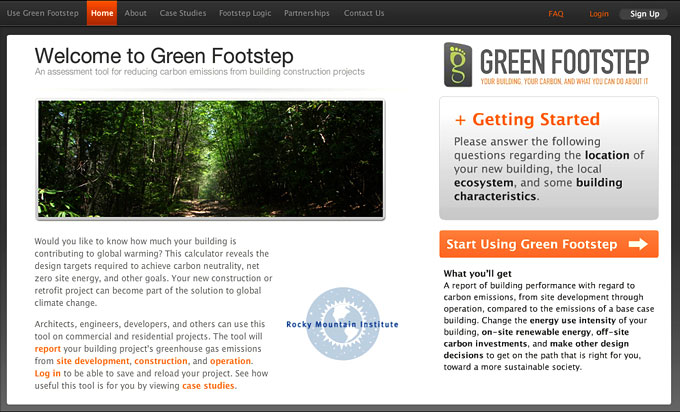
Although many carbon-footprint calculators exist, none account for a building’s emissions over time, according to the Rocky Mountain Institute (RMI). The organization’s new online tool, Green Footstep, is designed to do just that.

Meant for use from early in the design process, the tool helps project teams set goals for carbon emissions reductions and offers basic design principles to work from. Teams can then use the tool throughout the design process to see how their decisions affect carbon emissions and how designs stack up against base-case buildings that are updated with recent data. Case studies offer ideas and show how other project teams have used Green Footstep.

The tool is online at www.greenfootstep.org.

Published December 31, 1969

(2009, December 1). RMI Releases Carbon Footprint Tool for Buildings. Retrieved from https://www.buildinggreen.com/departments/newsbrief

Add new comment

To post a comment, you need to register for a BuildingGreen Basic membership (free) or login to your existing profile.

Rumsey Engineers Joins the Integral Group

News Brief

Rumsey Engineers Joins the Integral Group

Based in Oakland, California, Rumsey Engineers is known for its commitment to green building. Now, it has joined a group of firms, The Integral Group, that shares that commitment. Led by Kevin Hydes, this collaborative group brings engineering firms into a business arrangement that allows them to work collaboratively on deep-green projects. The Integral Group focuses primarily on high-performance buildings, pursuing net-zero-energy and regenerative buildings whenever possible. Managing principal Peter Rumsey, P.E., will continue to lead his California-based firm while also working on projects with The Integral Group. More information is available at www.integral-group.net.

Published December 31, 1969

(2009, December 1). Rumsey Engineers Joins the Integral Group. Retrieved from https://www.buildinggreen.com/departments/newsbrief

Add new comment

To post a comment, you need to register for a BuildingGreen Basic membership (free) or login to your existing profile.

Living Building Challenge 2.0 Released

News Brief

Living Building Challenge 2.0 Released

The International Living Buildings Institute and Cascadia Green Building Council have overhauled the Living Building Challenge (LBC), releasing version 2.0 at the U.S. Green Building Council’s Greenbuild conference in Phoenix. LBC is known for its unbending principles and all-prerequisite structure (see

EBN June 2009).

The new version consolidates some of the old prerequisites (now called “imperatives”) and adds six new ones: urban agriculture, car-free living, biophilia, human scale and humane places, democracy and social justice, and rights to nature. The last three imperatives form a new section that deals with equity issues; the intent behind the section is to foster communities “that allow equitable access to all people regardless of physical abilities, age, or socioeconomic status,” according to the LBC document. In general, the changes to LBC reflect a desire to extend the system beyond single buildings to address environmental and social issues at a larger scale. More information is available at www.ilbi.org.

Published December 31, 1969

(2009, December 1). Living Building Challenge 2.0 Released. Retrieved from https://www.buildinggreen.com/departments/newsbrief

Add new comment

To post a comment, you need to register for a BuildingGreen Basic membership (free) or login to your existing profile.

Perkins + Will Lists Chemicals to Avoid

News Brief

Perkins + Will Lists Chemicals to Avoid

With over 1,000 design professionals and many high-profile green projects to its name, Perkins + Will is recognized as a leader in the green building industry. Now it is using that leadership position to influence the way designers think about chemicals in building materials with the launch of the Perkins + Will Precautionary List.

Available free online, the list assembles pertinent facts about chemicals that the firm wishes to avoid because of health and environmental concerns. Chemical names, health impacts, prevalence in building products, and regulatory actions worldwide are available for each chemical and organized alphabetically, by CSI division, by health effects, and by category (such as indoor air quality or ozone depletion). The list is available at transparency.perkinswill.com.

Published December 31, 1969

(2009, December 1). Perkins + Will Lists Chemicals to Avoid. Retrieved from https://www.buildinggreen.com/departments/newsbrief

Add new comment

To post a comment, you need to register for a BuildingGreen Basic membership (free) or login to your existing profile.