ASHRAE Launches Commissioning Certification

News Brief

ASHRAE Launches Commissioning Certification

The American Society of Heating, Refrigerating, and Air-Conditioning Engineers (ASHRAE) will offer a new exam, starting in June, for Commissioning Process Management Professionals. Intended to help building owners and others find qualified people to lead the commissioning process, the certification considers people- and project-management skills as well as knowledge of mechanical systems. To be eligible for the exam, candidates must have been involved with commissioning at least three projects and have a combination of relevant education and work experience.

The first exam will be offered in June 2009 at the ASHRAE annual conference, in Louisville, Kentucky. Beginning in August, the test will be available at testing centers worldwide. ASHRAE developed the program with help from professional and industry groups and the University of Wisconsin–Madison. More information, including a candidate’s guidebook, is available at www.ashrae.org

Published December 31, 1969

(2009, April 29). ASHRAE Launches Commissioning Certification. Retrieved from https://www.buildinggreen.com/departments/newsbrief

Add new comment

To post a comment, you need to register for a BuildingGreen Basic membership (free) or login to your existing profile.

YouthBuild Event Gives Rise to a Green House in D.C.

News Brief

YouthBuild Event Gives Rise to a Green House in D.C.

On March 18, 2009, members of the nonprofit organization YouthBuild gathered on the Mall in Washington, D.C., to learn about green building and construct a home for a family in Texas. The program celebrated the 30th anniversary of the organization, which helps at-risk youth earn high school diplomas or GEDs while they gain usable skills by constructing affordable housing.

Exhibits at the event provided information on energy efficiency, weatherization, recycling, photovoltaics, and green roof technology. First Lady Michelle Obama spoke to the gathering, saying, “Community service is an integral part of empowering our people and making our communities stronger.”

Published December 31, 1969

(2009, April 29). YouthBuild Event Gives Rise to a Green House in D.C.. Retrieved from https://www.buildinggreen.com/departments/newsbrief

Add new comment

To post a comment, you need to register for a BuildingGreen Basic membership (free) or login to your existing profile.

GBI and AIA Pledge Cooperation

News Brief

GBI and AIA Pledge Cooperation

The Green Building Initiative (GBI), which administers the Green Globes building rating system, and The American Institute of Architects (AIA) have signed a memorandum of understanding that expresses their intent to work in concert to promote green building.

Chris McEntee, AIA’s executive vice president and chief executive officer, praised GBI’s “engagement in life-cycle assessment and promotion of post-construction, third-party review.” Included in the memorandum is a pledge to collaborate on educational programs that address life-cycle assessment, Green Globes New Construction, and Green Globes Continual Improvement of Existing Buildings. AIA’s policy is not to endorse specific rating systems but to help its members understand the options and how to use them.

Published December 31, 1969

(2009, April 29). GBI and AIA Pledge Cooperation. Retrieved from https://www.buildinggreen.com/departments/newsbrief

Add new comment

To post a comment, you need to register for a BuildingGreen Basic membership (free) or login to your existing profile.

Indiana Development First to Certify Through NAHB

News Brief

Indiana Development First to Certify Through NAHB

The Village in Burns Harbor, a mixed-used development on Lake Michigan in Indiana, has earned certification for land use through the National Association of Homebuilders’ (NAHB) National Green Building Program. The 60-acre (24 ha) development, when completed, will contain 265 single-family, semi-detached, and multifamily homes as well as a walkable town center and park space.

It is this dense, walkable land-use pattern that has earned the development its certification through NAHB; individual homes must be certified separately. Of the 60 homes built so far, two have been certified through the National Green Building Program. More information is available at www.villageinburnsharbor.com

Published December 31, 1969

(2009, April 29). Indiana Development First to Certify Through NAHB. Retrieved from https://www.buildinggreen.com/departments/newsbrief

Add new comment

To post a comment, you need to register for a BuildingGreen Basic membership (free) or login to your existing profile.

HUD and DOT Coordinating Efforts

News Brief

HUD and DOT Coordinating Efforts

Affordable housing and transportation need to be planned together, said the secretaries of the U.S. Department of Transportation (DOT) and the Department of Housing and Urban Development (HUD) at a March 2009 House subcommittee hearing. DOT Secretary Raymond LaHood and HUD Secretary Shaun Donovan announced that a high-level task force with members from both departments would focus on putting affordable housing near employment opportunities, lowering transportation costs and reducing travel times.

Under HUD’s proposed Sustainable Communities Initiative, states would have to create integrated housing, transportation, and land-use plans. The agencies noted that current federal definitions of affordable housing do not account for transportation costs associated with travel between work and home; for many households, the cost of transportation approaches, or even exceeds, the cost of housing.

Published December 31, 1969

(2009, April 29). HUD and DOT Coordinating Efforts. Retrieved from https://www.buildinggreen.com/departments/newsbrief

Add new comment

To post a comment, you need to register for a BuildingGreen Basic membership (free) or login to your existing profile.

Water Stewardship Label in the Works

News Brief

Water Stewardship Label in the Works

Six high-profile environmental advocacy groups have joined forces to create a water certification label intended to change the way water is managed and valued worldwide. The “Water Stewardship” label, announced in March 2009 at the 5th annual World Water Forum in Istanbul, Turkey, will assure consumers that the water used to manufacture products carrying the label has been obtained from sources that are managed sustainably. Leaders of the initiative, called the Alliance for Water Stewardship, say that the water label will be modeled on the Forest Stewardship Council (FSC) program for certifying wood and wood products.

Participating organizations, which include the World Wildlife Fund and The Nature Conservancy, will develop a set of standards for the label over the next several months. The Alliance for Water Stewardship estimates that the label will be available in 18–24 months. For information visit www.allianceforwaterstewardship.org.

Published December 31, 1969

(2009, April 29). Water Stewardship Label in the Works. Retrieved from https://www.buildinggreen.com/departments/newsbrief

Add new comment

To post a comment, you need to register for a BuildingGreen Basic membership (free) or login to your existing profile.

Flame-Retardant Chemical Found in All U.S. Coastal Waters

News Brief

Flame-Retardant Chemical Found in All U.S. Coastal Waters

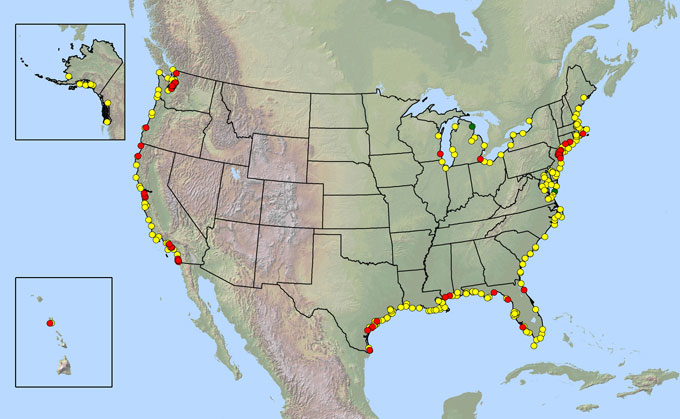
Polybrominated diphenyl ethers (PBDEs) may now be found in all coastal waters of the United States and in the Great Lakes, with elevated levels near urban and industrial areas, according to a report just released by the National Oceanic and Atmospheric Administration.

Beginning in the 1970s, PBDEs were widely used as flame retardants in building materials, electronics, furnishings, motor vehicles, plastics, polyurethane foams, textiles, and other consumer goods (see

EBN June 2004). Certain PBDEs have been banned in many European and Asian countries (and largely phased out voluntarily in the U.S.) due to mounting evidence that exposure to PBDEs can lead to impaired thyroid, liver, and neurobehavioral development.

PBDEs are introduced into the ecosystem through runoff from industrial sites, municipal incineration, sewage outflows, and leaching from aging or discarded consumer products. As recently as 1996, the presence of PBDEs in coastal waters was limited to heavily industrial areas, but the chemical is now found even in remote areas, providing evidence that PBDEs may also be transported atmospherically.


Published December 31, 1969

(2009, April 29). Flame-Retardant Chemical Found in All U.S. Coastal Waters. Retrieved from https://www.buildinggreen.com/departments/newsbrief

Add new comment

To post a comment, you need to register for a BuildingGreen Basic membership (free) or login to your existing profile.

Data Center Groups Lobby USGBC for New LEED Rating System

News Brief

Data Center Groups Lobby USGBC for New LEED Rating System

Packed with servers running 24 hours a day, data centers are energy hogs by nature. A coalition of public and private entities is pushing the U.S. Green Building Council (USGBC) for a LEED rating system that would deal specifically with data centers. In an effort spearheaded by the Lawrence Berkeley National Laboratory and funded by the California Energy Commission, industry partners including the Green Grid, the Uptime Institute, and the American Society of Heating, Refrigerating, and Air-Conditioning Engineers (ASHRAE) have created and submitted a draft set of guidelines to USGBC that they hope may be adopted as LEED for Data Centers as early as 2009.

Only a fraction of the total building stock, data centers have not been a high priority for USGBC in the past. The proposed guidelines would not use several common LEED credits that are only marginally relevant to data centers, while introducing several others that are more relevant. The draft guidelines are available for download at http://hightech.lbl.gov/dc-epc.html

Published December 31, 1969

(2009, March 26). Data Center Groups Lobby USGBC for New LEED Rating System. Retrieved from https://www.buildinggreen.com/departments/newsbrief

Add new comment

To post a comment, you need to register for a BuildingGreen Basic membership (free) or login to your existing profile.

NAHB Research Center Launches "Green Approved" Label

News Brief

NAHB Research Center Launches "Green Approved" Label

The National Association of Home Builders (NAHB) Research Center has recently begun designating products “Green Approved” and linking them to “green practices” in the NAHB scoring tool that serves as the first step toward certification under the new National Green Building Standard (see

EBN Mar. 2009). Despite the label’s name, the Research Center says that “a product bearing the NAHB Research Center Green Approved mark is not certified as being ‘green.’ Rather, the product has been approved as eligible for earning points if the product is used in a qualifying way.” Third-party assessments of products are considered in approving or disapproving certification under the program. Manufacturers pay a fee to have a product listed as Green Approved, based on the number of green practices it is associated with—typically $1,000–$2,000 yearly, according to the Research Center. Bob Hill, directory of laboratory and certification services for the Research Center, notes that a building can receive certification without using any Green Approved products. But, he says, the product program makes it easier to specify products that are eligible for certification points and obviates the need for certification verifiers to research listed products.

Published December 31, 1969

(2009, March 26). NAHB Research Center Launches "Green Approved" Label. Retrieved from https://www.buildinggreen.com/departments/newsbrief

Add new comment

To post a comment, you need to register for a BuildingGreen Basic membership (free) or login to your existing profile.

Alternative Septic Systems Draw Criticism

News Brief

Alternative Septic Systems Draw Criticism

The board of supervisors of Loudoun County, Virginia, declared a five-year moratorium on non-conventional, or alternative, septic systems in November 2008, but three months later the state assembly passed bills prohibiting localities from banning the systems. Governor Tim Kaine has not yet taken a position on the matter. Alternative septic systems, used in areas lacking public sewage systems where soil conditions preclude typical tank-and-leachfield systems, can be more complex than conventional systems and are prone to failure without adequate maintenance, say their critics. On the other hand, alternative systems are equipped with alarms to alert owners of system failures, and, according to contractors, they result in cleaner effluent when working properly. An article published by the Center for Public Integrity cited the opinion of a Loudoun County real estate agent that the attempt to impose a moratorium on alternative septic systems is actually a tactic to slow development, a claim Loudoun County Supervisor Jim Burton denies.


Published December 31, 1969

(2009, March 26). Alternative Septic Systems Draw Criticism. Retrieved from https://www.buildinggreen.com/departments/newsbrief

Add new comment

To post a comment, you need to register for a BuildingGreen Basic membership (free) or login to your existing profile.