AskNature.org Connects Designers to Biomimicry Research

News Brief

AskNature.org Connects Designers to Biomimicry Research

www.AskNature.org, maintained by the Biomimicry Institute

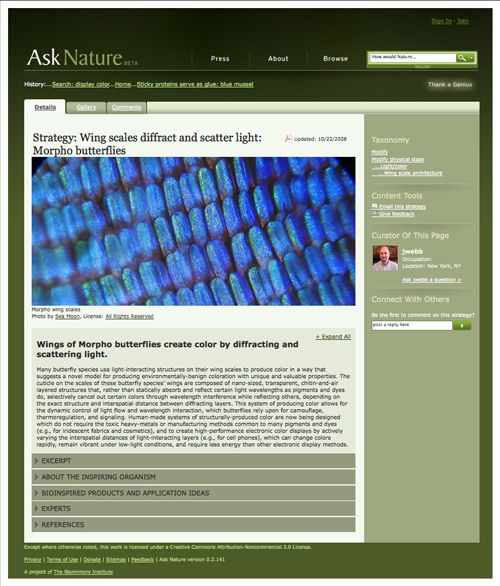
If biomimicry brings nature’s solutions to bear on design problems, AskNature.org brings modern internet technology—and the expanded audience it facilitates—to the biomimicry discussion. The site, created by the Biomimicry Institute, offers an encyclopedia of nature’s solutions to common design problems such as structural support, adhesion, energy harvesting, and cleaning. Natural design solutions are linked to products based on that solution when they are available (an entry on photosynthesis, for example, links to an entry on dye-based solar cells).

www.AskNature.org, maintained by the Biomimicry Institute
If biomimicry brings nature’s solutions to bear on design problems, AskNature.org brings modern internet technology—and the expanded audience it facilitates—to the biomimicry discussion. The site, created by the Biomimicry Institute, offers an encyclopedia of nature’s solutions to common design problems such as structural support, adhesion, energy harvesting, and cleaning. Natural design solutions are linked to products based on that solution when they are available (an entry on photosynthesis, for example, links to an entry on dye-based solar cells).

What makes the site unique isn’t just the fact that it pulls together biomimicry research in one easily accessible resource; it’s that users can generate content through online discussions and submissions and can also apply to be curators of content in their fields of expertise. In this way the site can grow beyond the expertise of the current team of editors at the Biomimicry Institute, creating the potential for rapid growth in access to innovative, environmentally friendly technologies.

Janine Benyus, naturalist and founder of the Biomimicry Institute, announced the launch of AskNature.org at the November 2008 Greenbuild convention. So far the site is relatively small, with about 700 examples of natural design solutions and fewer than 30 products (the products are not necessarily “green,” but are inspired by natural solutions in some way). Entries are brief, limited by a lack of research or the need for a knowledgeable curator.

Either by design or by result of the limited content, the experience of browsing the site is more serendipitous than practical. Type “build” and the search engine suggests searching for “build a house.” The search results include information on how iguanas expel fluid, how the long-eared owl maps sounds, and how house sparrows self-medicate to prevent malaria by lining their nests leaves of the paradise flower tree.

AskNature.org is a platform for inspiration, not a toolbox of ready designs. If it can surmount the challenge faced by all user-driven tools and gain a critical mass of experts and content, it could become a powerful tool for design and construction.


Published December 31, 1969

(2008, December 4). AskNature.org Connects Designers to Biomimicry Research. Retrieved from https://www.buildinggreen.com/departments/newsbrief

Add new comment

To post a comment, you need to register for a BuildingGreen Basic membership (free) or login to your existing profile.

USGBC Members Approve LEED 2009

News Brief

USGBC Members Approve LEED 2009

The U.S. Green Building Council (USGBC) announced at its Greenbuild conference in Boston in November 2008 that LEED 2009, a revision of the LEED Rating System first made available for comment in May 2008, has been approved by its 18,000 member organizations.

The revision is intended to create greater consistency among the several LEED rating systems, reflect a more scientifically grounded weighting of credits—including a stronger focus on energy and climate issues—and accommodate new developments in building technology as well as regional variations (see EBN Vol. 17, No. 6). All LEED rating systems now contain 100 points.

The U.S. Green Building Council (USGBC) announced at its Greenbuild conference in Boston in November 2008 that LEED 2009, a revision of the LEED Rating System first made available for comment in May 2008, has been approved by its 18,000 member organizations.

The revision is intended to create greater consistency among the several LEED rating systems, reflect a more scientifically grounded weighting of credits—including a stronger focus on energy and climate issues—and accommodate new developments in building technology as well as regional variations (see EBN Vol. 17, No. 6). All LEED rating systems now contain 100 points.

USGBC will update LEED 2009 regularly to keep the system up to date with technological and market developments, much like code organizations do with building codes. USGBC has not yet announced when registration under LEED 2009 will begin, but it will likely coincide with the launch of a revamped LEED Online tool, expected in Spring 2009.

For more information:

U.S. Green Building Council

Washington, D.C.

800-795-1747

www.usgbc.org/leed2009/


Published December 31, 1969

(2008, November 24). USGBC Members Approve LEED 2009. Retrieved from https://www.buildinggreen.com/departments/newsbrief

Add new comment

To post a comment, you need to register for a BuildingGreen Basic membership (free) or login to your existing profile.

Illinois Synagogue Earns LEED Platinum

News Brief

Illinois Synagogue Earns LEED Platinum

When the Jewish Reconstructionist Congregation in Evanston, Illinois, decided in 2003 to build a new synagogue, it resolved to build a green structure that could achieve a high level of LEED certification.
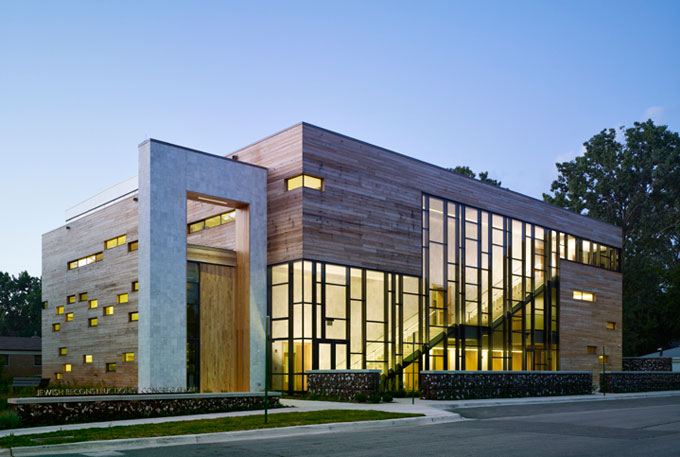
The 31,000-ft2 (2,900-m2) building, designed by Ross Barney Architects and completed in February 2008, has now earned a Platinum rating from the U.S. Green Building Council, earning 53 out of 69 possible points. Designed to use 45% less energy than a conventional building, the synagogue features high-efficiency mechanical equipment, daylighting, occupancy sensors for lighting, and other energy-saving features. Dual-flush toilets and low-flow plumbing fixtures conserve water, and 50% of the wood used in the building was salvaged or certified to Forest Stewardship Council standards.

More information is available at www.jrc-evanston.org/green_synagogue/.

Published December 31, 1969

(2008, November 24). Illinois Synagogue Earns LEED Platinum. Retrieved from https://www.buildinggreen.com/departments/newsbrief

Add new comment

To post a comment, you need to register for a BuildingGreen Basic membership (free) or login to your existing profile.

Tax Credit Promotes Green Roofs in NYC

News Brief

Tax Credit Promotes Green Roofs in NYC

State legislation passed in June 2008 allows New York City building owners who install vegetation on at least half their buildings’ available rooftop space to offset $4.50 in property taxes for each square foot of green roof they install, for one year. The credit covers about a quarter of the cost of installation and is capped at $100,000.

The tax credit was designed to encourage property owners to contribute to the public benefits of green roofs, such as increased rainwater storage and reduced sewer overflows. As little as 1/10" (3 mm) of rain can overwhelm the capacity of the city’s combined sewers, contributing to the 2 billion gallons (7 billion liters) of raw sewage released into waterways annually. According to New York City Soil & Water Conservation District board member Paul Mankiewicz, 10,000 ft2 (1,000 m2) of vegetated roof can capture 6,000–12,000 gallons (23,000–45,000 l) of water during a storm.

Building owners can apply for the credit as of January 1, 2009; the program is authorized through March 2013.

Published December 31, 1969

(2008, November 24). Tax Credit Promotes Green Roofs in NYC. Retrieved from https://www.buildinggreen.com/departments/newsbrief

Add new comment

To post a comment, you need to register for a BuildingGreen Basic membership (free) or login to your existing profile.

Federal Agenda for High-Performance Buildings Released

News Brief

Federal Agenda for High-Performance Buildings Released

The National Science and Technology Council has released a report detailing research and development opportunities for the federal government in the area of net-zero-energy buildings.

The report calls on federal agencies to support the design and construction of buildings that will: produce as much energy as they consume; double the service life of materials, products, and systems; halve the use of domestic water; and improve occupant health, productivity, and comfort.

It goes on to define steps these agencies need to take to achieve these goals, thus providing focus for a broad mandate given to the agencies in the Energy Policy Act of 2005 and the Energy Independence and Security Act of 2007 (see

EBN

Vol. 17, No. 2). Both those acts directed federal agencies to support the development of high-performance buildings; the 2007 act specifically created the Net-Zero Energy Commercial Buildings Initiative (see

EBN

Vol. 17, No. 9).

The report is available for download at www.bfrl.nist.gov/buildingtechnology/documents/FederalRDAgendaforNetZeroEnergyHighPerformanceGreenBuildings.pdf.

Published December 31, 1969

(2008, November 24). Federal Agenda for High-Performance Buildings Released. Retrieved from https://www.buildinggreen.com/departments/newsbrief

Add new comment

To post a comment, you need to register for a BuildingGreen Basic membership (free) or login to your existing profile.

Sustainable Sites Initiative Draft Guidelines Available

News Brief

Sustainable Sites Initiative Draft Guidelines Available

Founded in 2007, the Sustainable Sites Initiative has been working to develop a rating system for landscapes (see

EBN Vol. 16, No. 11). The group has now released a draft set of guidelines and benchmarks that includes options for prerequisites and credits for the new rating system.

Public comment on the draft will be accepted until January 20, 2009; the group expects to complete the rating system by 2012. More information is available at www.sustainablesites.org.

Published December 31, 1969

(2008, November 24). Sustainable Sites Initiative Draft Guidelines Available. Retrieved from https://www.buildinggreen.com/departments/newsbrief

Add new comment

To post a comment, you need to register for a BuildingGreen Basic membership (free) or login to your existing profile.

ICLEI Developing Rating System for Communities

News Brief

ICLEI Developing Rating System for Communities

Joining forces with the U.S. Green Building Council and the Center for American Progress, ICLEI–Local Governments for Sustainability is developing the STAR Community Index. STAR will be a rating system designed to measure communities’ performance in three areas: environment, economy, and society.

Credits in the system may cover land use, transportation, green job development, education, and affordable housing, among other areas. ICLEI is currently staffing technical advisory committees and hopes to launch STAR in 2010. More information is available at www.icleiusa.org/programs/sustainability/star-community-index/.

Published December 31, 1969

(2008, November 24). ICLEI Developing Rating System for Communities. Retrieved from https://www.buildinggreen.com/departments/newsbrief

Add new comment

To post a comment, you need to register for a BuildingGreen Basic membership (free) or login to your existing profile.

Proximity Hotel in North Carolina is First to Earn LEED Platinum

News Brief

Proximity Hotel in North Carolina is First to Earn LEED Platinum

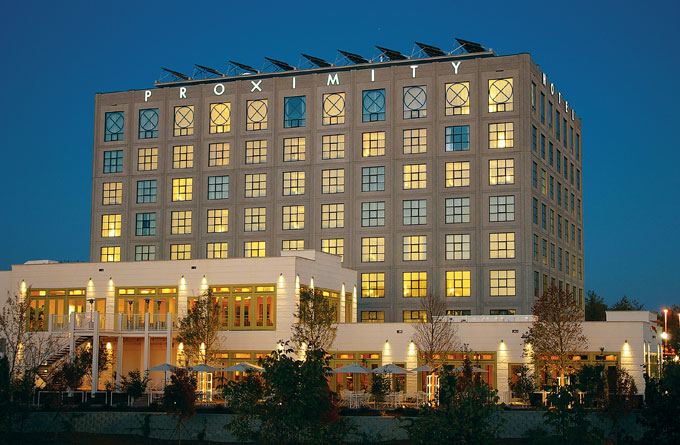
“Conservation doesn’t have to mean deprivation,” is how host Ali Ogden wraps up her seven-minute video tour of the Proximity Hotel in Greensboro, North Carolina, which recently became the first hotel in the U.S. to earn LEED Platinum certification. (The video was created for National Geographic’s Intelligent Traveler blog and is available on YouTube.) Certified together with its Print Works Bistro, the hotel has 4,000 ft2 (400 m2) of solar water-heating panels on the roof, uses ground-coupled heat pumps for cooling, and features an innovative hydronic distribution system to deliver heating and cooling to guest rooms. Among the many other green aspects are locally produced furniture, abundant fresh air, and the restoration of an adjacent stream. Proximity, owned by Quaintance-Weaver Restaurants and Hotels, opened for business late in 2007 and achieved LEED certification in October 2008. Details are at www.proximityhotel.com.

“Conservation doesn’t have to mean deprivation,” is how host Ali Ogden wraps up her seven-minute video tour of the Proximity Hotel in Greensboro, North Carolina, which recently became the first hotel in the U.S. to earn LEED Platinum certification. (The video was created for

National Geographic’s Intelligent Traveler blog and is available on YouTube.)

Certified together with its Print Works Bistro, the hotel has 4,000 ft2 (400 m2) of solar water-heating panels on the roof, uses ground-coupled heat pumps for cooling, and features an innovative hydronic distribution system to deliver heating and cooling to guest rooms. Among the many other green aspects are locally produced furniture, abundant fresh air, and the restoration of an adjacent stream.

Proximity, owned by Quaintance-Weaver Restaurants and Hotels, opened for business late in 2007 and achieved LEED certification in October 2008. Details are at www.proximityhotel.com.


Published December 31, 1969

(2008, November 24). Proximity Hotel in North Carolina is First to Earn LEED Platinum. Retrieved from https://www.buildinggreen.com/departments/newsbrief

Add new comment

To post a comment, you need to register for a BuildingGreen Basic membership (free) or login to your existing profile.

New Group at Bentley for BIM and Building Performance

News Brief

New Group at Bentley for BIM and Building Performance

In September 2008, building information modeling (BIM) software firm Bentley Systems announced the creation of a new group within the company to consolidate its tools and services that support designers’ ability to model the energy and environmental performance of buildings. The Building Performance Group aims to provide tools that enhance energy efficiency and occupant satisfaction from the earliest design stages through construction and operations. Vice President Noah Eckhouse will lead the new group.

Published December 31, 1969

(2008, October 29). New Group at Bentley for BIM and Building Performance. Retrieved from https://www.buildinggreen.com/departments/newsbrief

Add new comment

To post a comment, you need to register for a BuildingGreen Basic membership (free) or login to your existing profile.

Study Finds Quick Payback for LEED Investments

News Brief

Study Finds Quick Payback for LEED Investments

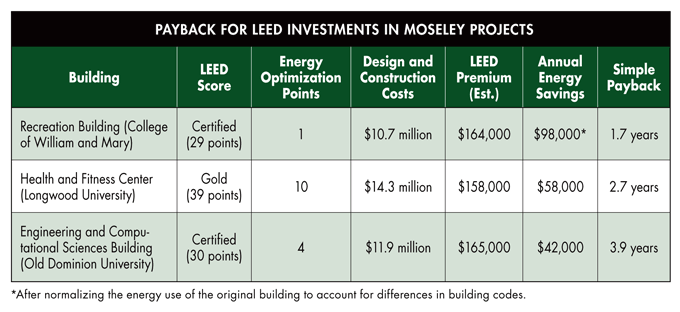
Managing principal George Nasis, AIA, and director of environmental research Bryna Dunn, Assoc. AIA, both of Moseley Architects in Richmond, Virginia, studied three of the firm’s LEED-certified institutional buildings and found paybacks for green features of under four years based on energy savings alone. Nasis and Dunn monitored energy use in the buildings and compared it to the energy use of a baseline building meeting minimum ASHRAE 90.1 requirements. Using the firm’s average LEED premium of 1.5% for design and construction costs, they calculated simple payback figures of 1.7 years, 2.7 years, and 3.9 years (see table). According to Dunn, calculating the baseline figures was far from easy, especially for the renovation and expansion of a recreation building at William and Mary College, which had been built to earlier codes with different requirements for ventilation, lighting, and other energy-using features.

Managing principal George Nasis, AIA, and director of environmental research Bryna Dunn, Assoc. AIA, both of Moseley Architects in Richmond, Virginia, studied three of the firm’s LEED-certified institutional buildings and found paybacks for green features of under four years based on energy savings alone. Nasis and Dunn monitored energy use in the buildings and compared it to the energy use of a baseline building meeting minimum ASHRAE 90.1 requirements. Using the firm’s average LEED premium of 1.5% for design and construction costs, they calculated simple payback figures of 1.7 years, 2.7 years, and 3.9 years (see table). According to Dunn, calculating the baseline figures was far from easy, especially for the renovation and expansion of a recreation building at William and Mary College, which had been built to earlier codes with different requirements for ventilation, lighting, and other energy-using features.


Published December 31, 1969

(2008, October 29). Study Finds Quick Payback for LEED Investments. Retrieved from https://www.buildinggreen.com/departments/newsbrief

Add new comment

To post a comment, you need to register for a BuildingGreen Basic membership (free) or login to your existing profile.