CFL Savings Affected by Heating and Cooling Impacts

News Brief

CFL Savings Affected by Heating and Cooling Impacts

The dramatic energy savings reported for compact fluorescent lamps (CFLs) over conventional incandescents typically do not take into account the impact on space heating and cooling energy.

A study at the Canadian Centre for Housing Technology in Ottawa used two identical houses, both on fixed lighting schedules for their 31 lamps, but one outfitted with CFLs and the other with incandescents. During the heating season the CFL-equipped house showed an 8%–33% higher heating load; during the cooling season the CFL house used an average of 3.1 kWh less electricity per day for air-conditioning. The study used the HOT2000 residential energy simulation program to extend its conclusions to 33 locations in a wide range of climates.

Nowhere did increased heating costs negate the savings from CFL use. But the simulation found that in predominantly heating climates, increased need for space heating can reduce CFL savings by 40%, while in cooling climates savings can be increased by 30%.

Published December 31, 1969

(2009, January 2). CFL Savings Affected by Heating and Cooling Impacts. Retrieved from https://www.buildinggreen.com/departments/newsbrief

Add new comment

To post a comment, you need to register for a BuildingGreen Basic membership (free) or login to your existing profile.

FM Benchmarking Offers Cost and Sustainability Comparisons

News Brief

FM Benchmarking Offers Cost and Sustainability Comparisons

A new database and analysis service collects information from users on facility costs and sustainability, and allows facility managers to compare their buildings to others using more than 30 data filters that ensure meaningful comparisons to similar buildings.

The tool, FM Benchmarking from FMLink and Facility Issues, uses cost data on utility usage, maintenance, and cleaning. The program assesses sustainability using measures from the LEED for Existing Buildings rating system. FM Benchmarking generates graphs and tables that show the user’s building in relation to comparable facilities, LEED certification requirements, and best practices appropriate for the building.

Currently the database has information for more than 800 million square feet (74 million square meters) of building space. Access to the service is by annual subscription; full use of FM Benchmarking costs $375 for one building; there are discounts for additional buildings. For more information, visit www.fmbenchmarking.com.

Published December 31, 1969

(2009, January 2). FM Benchmarking Offers Cost and Sustainability Comparisons. Retrieved from https://www.buildinggreen.com/departments/newsbrief

Add new comment

To post a comment, you need to register for a BuildingGreen Basic membership (free) or login to your existing profile.

Survey Targets Facility Energy Programs

News Brief

Survey Targets Facility Energy Programs

A recent survey of 30,000 facility managers, designed and analyzed by Peter Kimmel, AIA, and funded by the online publication FMLink, found that an increasing number are engaged in energy auditing and re-commissioning. Their efforts resulted in an average 5%–10% energy savings from 2006 to 2008, with the most effective changes being inexpensive operational changes rather than capital investments.

Of respondents who reported more than 5% energy savings, most were larger buildings that installed a building automation system. Those who re-commissioned their buildings at least twice a year enjoyed greater energy savings than those who did not. Forty-one percent of respondents reported having a professionally developed program to educate staff about energy strategies, and about 12% more plan to have such a program within a year. More information is available at www.fmlink.com.

Published December 31, 1969

(2009, January 2). Survey Targets Facility Energy Programs. Retrieved from https://www.buildinggreen.com/departments/newsbrief

Add new comment

To post a comment, you need to register for a BuildingGreen Basic membership (free) or login to your existing profile.

Recurrent Energy Leases Rooftops for Distributed Generation

News Brief

Recurrent Energy Leases Rooftops for Distributed Generation

San Francisco company Recurrent Energy was founded on the powerful idea of leasing rooftop space to produce and sell solar power to the tenants inside (see

EBN

Vol. 17, No. 2). In its first year, the company has completed several large installations including a 1-MW system on the North Face distribution center in Visalia and a 412-kW system at the San Domenico school in Marin County, both in California. A 5-MW project at the Sunset Reservoir in San Francisco is currently in the works.

With a $75 million investment from Hudson Clean Energy Partners, Recurrent Energy hopes to continue its growth not only in California but in other states with strong incentives for renewable energy. More information is available at www.recurrentenergy.com.

Published December 31, 1969

(2009, January 2). Recurrent Energy Leases Rooftops for Distributed Generation. Retrieved from https://www.buildinggreen.com/departments/newsbrief

Add new comment

To post a comment, you need to register for a BuildingGreen Basic membership (free) or login to your existing profile.

EPA Proposing New Stormwater Guidelines

News Brief

EPA Proposing New Stormwater Guidelines

As part of its management of the Clean Water Act, the U.S. Environmental Protection Agency (EPA) has proposed national stormwater guidelines for construction sites. Under the proposed regulations, all construction sites would be required to implement erosion and sediment-control best practices. In addition, construction projects disturbing over 10 acres (4 ha) would require sediment basins to treat stormwater runoff.

In areas with high rainfall intensity and clay soils, sites larger than 30 acres (12 ha) would be subject to a turbidity limit that would require the removal of fine-grained and slowly settling or non-settling particles from the stormwater. Such removal is not achieved by conventional stormwater management practices and would likely require chemical treatment or filtration of stormwater.

These guidelines would expand the state-administered requirement of the National Pollutant Discharge Elimination System (NPDES). EPA is accepting comments at www.regulations.gov through February 26, 2009; more information on the proposal is available at www.epa.gov/waterscience/guide/construction/proposed/index.html.

Published December 31, 1969

(2009, January 2). EPA Proposing New Stormwater Guidelines. Retrieved from https://www.buildinggreen.com/departments/newsbrief

Add new comment

To post a comment, you need to register for a BuildingGreen Basic membership (free) or login to your existing profile.

GE Developing Grid-Smart Appliances

News Brief

GE Developing Grid-Smart Appliances

A number of utilities across the country are moving to peak power pricing that gives lower rates to consumers using electricity during off-peak hours. General Electric (GE) is developing appliances that can automatically take advantage of those policies.

These appliances, set for launch in early 2009, will be able to receive signals from the utility telling them when rates are favorable for turning themselves on or performing energy-intensive functions, like automatic defrosting on a refrigerator. GE is putting this technology into refrigerators, ranges, clothes washers and dryers, dishwashers, and microwave ovens. Customers will be able to override the automatic functioning. More information is available at www.ge.com.

Published December 31, 1969

(2009, January 2). GE Developing Grid-Smart Appliances. Retrieved from https://www.buildinggreen.com/departments/newsbrief

Add new comment

To post a comment, you need to register for a BuildingGreen Basic membership (free) or login to your existing profile.

EPA Recognizes First WaterSense Home

News Brief

EPA Recognizes First WaterSense Home

Vanguard Homes, based in Cary, North Carolina, has built the first home in the nation to receive a WaterSense label from the U.S. Environmental Protection Agency. The home is part of Briar Chapel, a green community development in Chapel Hill, North Carolina.

One of several builders in the development, Vanguard chose to go above and beyond the required green specifications to pursue the WaterSense label, which signifies that the home uses about 20% less water than a comparable conventional home. According to Robert Smart, vice president of construction for Vanguard, the prescriptive specifications from the WaterSense program are straightforward and easy to follow, especially since they follow best practices. “You get nearly all the way there just by doing it right,” he said.

The home also achieved a Gold rating under the National Association of Home Builders’ Green Building Standard. More information is available at www.vanguardhomesnc.com.

Published December 31, 1969

(2009, January 2). EPA Recognizes First WaterSense Home. Retrieved from https://www.buildinggreen.com/departments/newsbrief

Add new comment

To post a comment, you need to register for a BuildingGreen Basic membership (free) or login to your existing profile.

USGBC Education Post Changes Hands

News Brief

USGBC Education Post Changes Hands

The U.S. Green Building Council (USGBC) has announced that Rebecca Flora will replace Peter Templeton as its senior vice president of education and research.

Flora leaves her post as the executive director of the Green Building Alliance in Pittsburgh and ends her tenure as chair of the USGBC Board of Directors; she begins her new position on January 15, 2009. Templeton, who has been instrumental in the development of USGBC’s educational programs, will become the president of the Green Building Certification Institute, USGBC’s sister nonprofit that administers LEED certification and LEED professional accreditation.


Published December 31, 1969

(2009, January 2). USGBC Education Post Changes Hands. Retrieved from https://www.buildinggreen.com/departments/newsbrief

Add new comment

To post a comment, you need to register for a BuildingGreen Basic membership (free) or login to your existing profile.

USGBC Members Approve LEED 2009 Revisions

News Brief

USGBC Members Approve LEED 2009 Revisions

LEED 2009, a revision of the LEED Rating System first made available for comment in May 2008, has been approved by the 18,000 member organizations of the U.S. Green Building Council (USGBC). The revision is intended to create greater consistency among the several LEED rating systems, reflect a more scientifically grounded weighting of credits, and gracefully accommodate future changes (see EBN

Vol. 17, No. 6).

The affected LEED rating systems include the five nonresidential systems that are officially released: LEED for New Construction, LEED for Existing Buildings: Operations & Maintenance, LEED for Core & Shell, LEED for Commercial Interiors, and LEED for Schools. Each of these systems now contain 100 points, weighted to reflect the relative importance of climate change. USGBC will update LEED 2009 biannually to keep the system up to date with technological and market developments, much as code organizations do with building codes.

Educational workshops on LEED 2009 will begin in February 2009, and projects will begin registering under the revised system in March. Projects that are registered under the current LEED system may either continue to use it as they move toward certification or adopt LEED 2009. 


Published December 31, 1969

(2009, January 2). USGBC Members Approve LEED 2009 Revisions. Retrieved from https://www.buildinggreen.com/departments/newsbrief

Add new comment

To post a comment, you need to register for a BuildingGreen Basic membership (free) or login to your existing profile.

Coal Ash in Spill Could Not Have Been Used in Concrete

News Brief

Coal Ash in Spill Could Not Have Been Used in Concrete

The ash from the Tennessee Valley Authority’s (TVA) Kingston Fossil Plant that is now endangering the local community following a December 22 breach in a holding pond is most likely an 80/20 mix of fly ash (from smokestack pollution control systems) and bottom ash. To be used in concrete, fly ash must be low in residual carbon, as defined by ASTM Standard C 618. The boilers at the Kingston plant run at relatively low temperatures to reduce emissions of nitrogen oxides. A side effect of this lower temperature is that the coal is not burned as completely and the ash retains more carbon.

There are technologies for post-processing the fly ash to remove carbon, but those are not used at Kingston. Any marketable fly ash for use in concrete or as a filler in products such as carpet backing would have been protected from weather and stored in silos. Unmarketable ash is flushed through pipelines into holding ponds, including the one that just burst, with water as the carrier.
The ash from the Tennessee Valley Authority’s (TVA) Kingston Fossil Plant that is now endangering the local community following a December 22 breach in a holding pond is most likely an 80/20 mix of fly ash (from smokestack pollution control systems) and bottom ash. To be used in concrete, fly ash must be low in residual carbon, as defined by ASTM Standard C 618. The boilers at the Kingston plant run at relatively low temperatures to reduce emissions of nitrogen oxides. A side effect of this lower temperature is that the coal is not burned as completely and the ash retains more carbon.

There are technologies for post-processing the fly ash to remove carbon, but those are not used at Kingston. Any marketable fly ash for use in concrete or as a filler in products such as carpet backing would have been protected from weather and stored in silos. Unmarketable ash is flushed through pipelines into holding ponds, including the one that just burst, with water as the carrier.

David Goss, executive director of the American Coal Ash Association, told EBN that about 10% of the coal burned in a power plant typically ends up as a combination of fly ash and bottom ash. Nationwide, the amount of ash produced from coal-fired power plants each year, according to the U.S. Environmental Protection Agency, is about 90 million tons—an amount that would fill three trains stretching from New York to San Francisco. Trace metals and other impurities in the coal are concentrated in the ash, more so in recent decades as air-pollution controls have reduced the amount of toxicants that go out the smokestack. These hazardous constituents can leach out and cause ecological and health problems when the ash is loose—Goss argues that they do not present a threat when the ash is bound up in concrete.

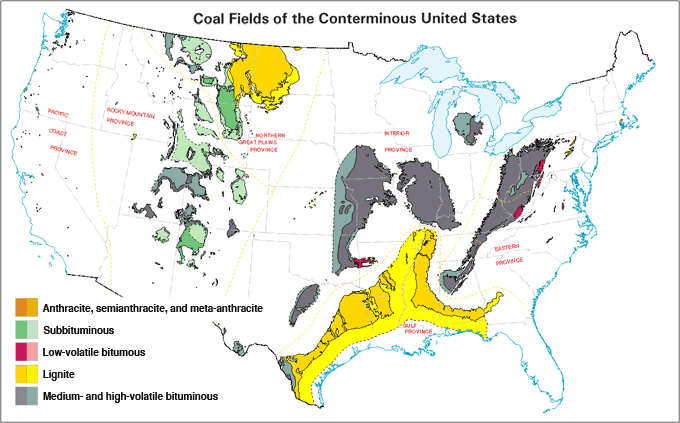
If the TVA plant were generating fly ash that has value as a concrete additive, it would very likely be “type F” fly ash, which has pozzolanic properties (meaning that it contributes to the curing of cement), but has no cementitious properties of its own. The chemical composition of the bituminous coal found in the Appalachian Mountains creates type F fly ash, while subbituminous coal from the western states tends to create the more cementitious type C.


Published December 31, 1969

(2008, December 30). Coal Ash in Spill Could Not Have Been Used in Concrete. Retrieved from https://www.buildinggreen.com/departments/newsbrief

Add new comment

To post a comment, you need to register for a BuildingGreen Basic membership (free) or login to your existing profile.