Department of Energy Focuses on Net-Zero Commercial Buildings

News Brief

Department of Energy Focuses on Net-Zero Commercial Buildings

In response to provisions in the Energy Independence and Security Act of 2007, the U.S. Department of Energy (DOE) launched its Zero Net Energy Commercial Building Initiative in August 2008.

To support that initiative, which aims to develop marketable net-zero energy commercial buildings by 2025, DOE also announced a cooperative effort among its five national laboratories through the National Laboratory Collaborative on Building Technologies.

Announcing the moves, DOE’s David Rodgers said, “We are bringing to bear the unprecedented collaboration in scientific resources of five national laboratories to bring about the needed transformation of the built environment, lower our carbon footprint in buildings, and accelerate commercial deployment of clean, efficient building technologies.”

More information is at www.buildings.energy.gov.

Published December 31, 1969

(2008, August 28). Department of Energy Focuses on Net-Zero Commercial Buildings. Retrieved from https://www.buildinggreen.com/departments/newsbrief

Add new comment

To post a comment, you need to register for a BuildingGreen Basic membership (free) or login to your existing profile.

Paint Companies Not Responsible in Rhode Island Lead Case

News Brief

Paint Companies Not Responsible in Rhode Island Lead Case

In 2006, a Rhode Island jury held paint companies Sherwin-Williams, Millennium Holdings, and NL Industries liable for the adverse consequences of lead paint sold more than 30 years ago, before the 1978 ban on lead paint (see

EBN

Vol. 15, No. 4).

Now, a State Supreme Court ruling has overturned that earlier decision, which state officials estimated could have cost the companies $2.4 billion in lead abatement costs in 240,000 houses. The court found that the public nuisance law under which the suit was filed did not apply to the case. DuPont, another target of the suit, settled in 2005 for $12.5 million. Appellate courts have rejected similar lawsuits in Illinois, Missouri, and New Jersey. Other suits are currently pending in Ohio and California.

Even though lead paint has not been legal in the U.S. since 1978, about 38 million houses still contain lead paint, which can have a number of adverse health effects, especially on neurological development in children.

Published December 31, 1969

(2008, August 28). Paint Companies Not Responsible in Rhode Island Lead Case. Retrieved from https://www.buildinggreen.com/departments/newsbrief

Add new comment

To post a comment, you need to register for a BuildingGreen Basic membership (free) or login to your existing profile.

D.C. Requires Building Owners to Report Energy Use

News Brief

D.C. Requires Building Owners to Report Energy Use

Washington, D.C., was among the early cities to require privately owned buildings to meet LEED standards (see EBN

Vol. 15, No. 12). Now, it is requiring the city government as well as private building owners to benchmark their buildings using the Energy Star Portfolio Manager tool and to submit performance data to the City, which will then publish it for the public.

City buildings must be benchmarked annually starting in 2009. Annual benchmarking for private buildings will be phased in over four years, starting in 2010 (for buildings over 200,000 ft2, or 18,000 m2) and ending in 2013 (for buildings over 50,000 ft2, or 4,600 m2).

Published December 31, 1969

(2008, August 28). D.C. Requires Building Owners to Report Energy Use. Retrieved from https://www.buildinggreen.com/departments/newsbrief

Add new comment

To post a comment, you need to register for a BuildingGreen Basic membership (free) or login to your existing profile.

San Francisco Passes Stringent Green Building Requirements

News Brief

San Francisco Passes Stringent Green Building Requirements

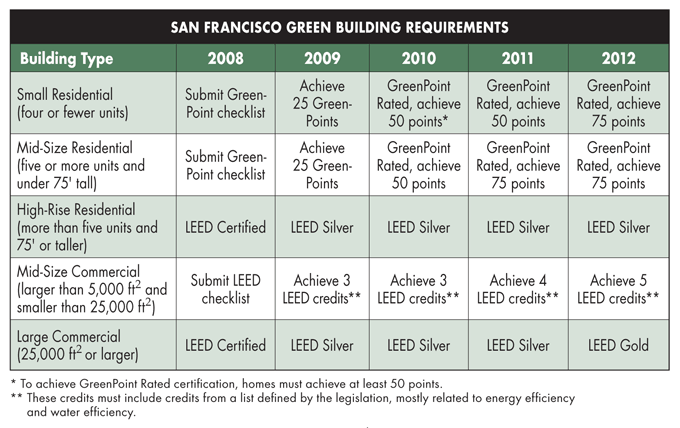
Joining the growing ranks of cities requiring green building in some form, San Francisco is requiring all new buildings to meet either LEED standards or those of the regional program GreenPoint Rated, depending on building type and size (see chart below).

San Francisco is the first city to require larger commercial buildings (those over 25,000 ft2, or 2,300 m2) to be certified through the U.S. Green Building Council; the legislation does allow developers to request alternate documentation paths without certification.

The requirements go into effect immediately and become increasingly stringent until 2012. The new standards grew out of recommendations from the mayor’s task force on green building, created in 2007 (see

EBN

Vol. 16, No. 8).

Published December 31, 1969

(2008, August 28). San Francisco Passes Stringent Green Building Requirements. Retrieved from https://www.buildinggreen.com/departments/newsbrief

Add new comment

To post a comment, you need to register for a BuildingGreen Basic membership (free) or login to your existing profile.

Groups Merge to Coordinate Greening of Hospitals

News Brief

Groups Merge to Coordinate Greening of Hospitals

Practice Greenhealth, a new nonprofit organization, hopes to shake up America’s healthcare industry. “We’re here to help the healthcare community develop sustainable systems,” according to communications director Eileen Secrest. “Its environmental footprint is huge, and we can make a difference.”

The organization is largely an expanded version of Hospitals for a Healthy Environment (H2E), which was born in 1993 as a joint project of the U.S. Environmental Protection Agency (EPA) and the American Hospital Association. Funded largely by EPA, H2E focused on pollution prevention and operational improvements. Despite the program’s success, however, EPA pulled financial support in 2004. When H2E struggled without that support, Health Care Without Harm (HCWH), a founding member of H2E, took over and guided the organization’s reincarnation as a Practice Greenhealth, an independent nonprofit that should eventually support itself through membership dues. HCWH provided the startup funding for Practice Greenhealth, and it continues to offer administrative support and office space. “As soon as they’re financially stable, they’ll take on more and more of these responsibilities,” said Anna Gilmore Hall, executive director of HCWH.

Practice Greenhealth also absorbed two other preexisting programs: the Green Guide for Health Care and the Healthcare Clean Energy Exchange. The Green Guide, a project of HCWH and the Center for Maximum Potential Building Systems, was launched in 2004 as a rating system to evaluate and improve the environmental responsibility of the planning, design, construction, operations, and maintenance of healthcare facilities (see EBN Vol. 14, No. 1). It formed the basis of the draft LEED for Healthcare, which the U.S. Green Building Council should soon release for member ballot (see EBN Vol. 17, No. 1). The Healthcare Clean Energy Exchange was recently started by HCWH to help hospitals use reverse auctions to drive down the cost of energy, allowing them to use the savings to purchase green energy.

The organization also hopes to take on some new activities, including onsite training sessions. Many hospital sustainability coordinators “don’t have training and don’t have mentors who’ve done the same thing,” said Secrest, noting that “sustainability classes will help them get a handle on the entire job.” Practice Greenhealth is also working to convince hospitals that simply tacking environmental responsibilities onto existing job descriptions is usually insufficient. “It needs to be a full-time job,” Secrest said.

Merging H2E, the Green Guide, and the Energy Exchange “seemed like a natural confluence,” said Robin Guenther, FAIA, principal at Perkins+Will Architects. Guenther helped write the Green Guide and recently joined Practice Greenhealth’s board of directors. She hopes that, over time, the organization’s broad member base will allow it to collect extensive information on green practices in the healthcare industry, illuminating trends and opportunities for improvement. “There’s no intent for Practice Greenhealth to do broad-based public policy,” said Guenther, “but I think the need for public policy will make itself clear.”

The organization currently has about 650 members—most of which transferred over from H2E. About 90% of these are healthcare facilities, with the remainder split between businesses (which include architecture and design firms, group-purchasing organizations, and other companies) and strategic network members (which include nonprofits, associations, and government agencies). The annual membership fee ranges from $200 for the smallest nonprofits to $20,000 for the largest businesses. A hospital with 200 beds and an architecture firm with annual revenues of $20 million would each pay an annual fee of $2,500.

Practice Greenhealth has a staff of 13 and is based in Arlington, Virginia. Its board of directors remains largely the same as that of H2E. Although Practice Greenhealth was started in early 2008 with little fanfare, Gilmore Hall says the organization is planning a larger launch in the fall of 2008. For more information on greening the design and construction of healthcare facilities, see EBN Vol. 14, No. 6.

For more information:

Practice Greenhealth

Arlington, Virginia

888-688-3332

www.practicegreenhealth.org

Published December 31, 1969

(2008, August 28). Groups Merge to Coordinate Greening of Hospitals. Retrieved from https://www.buildinggreen.com/departments/newsbrief

Add new comment

To post a comment, you need to register for a BuildingGreen Basic membership (free) or login to your existing profile.

Canadian Development Dockside Green Earns LEED Platinum

News Brief

Canadian Development Dockside Green Earns LEED Platinum

Several buildings in Dockside Green, an environmentally sensitive development in Victoria, British Columbia, have earned LEED Platinum certification from the Canada Green Building Council, achieving 63 points out of a possible 70.


The certification applies to the first phase of the development, which includes a total of 93 residential units and some commercial space. Green strategies used in the buildings include heat-recovery ventilation, high-performance glazing, and exterior shading. The development will also feature a biomass-gasification district heating system and onsite wastewater treatment.

As a sign of their commitment to green building, Vancity and Windmill West, the developers of the project, agreed to pay the City of Victoria a penalty if any individual building in the development did not achieve LEED Platinum. Dockside Green is also one of the pilot projects for the U.S. Green Building Council’s LEED for Neighborhood Development Rating System (see

EBN

Vol. 16, No.6).

More information is available at www.docksidegreen.com.

Published December 31, 1969

(2008, August 28). Canadian Development Dockside Green Earns LEED Platinum. Retrieved from https://www.buildinggreen.com/departments/newsbrief

Add new comment

To post a comment, you need to register for a BuildingGreen Basic membership (free) or login to your existing profile.

Electrical Contractors Group Endorses Green Training

News Brief

Electrical Contractors Group Endorses Green Training

Anticipating opportunities for its members in the growing green building sector, the National Electrical Contractors Association (NECA) recently convened an Energy Solutions Summit with 30 of its members experienced in green building.

The summit’s recommendations for meeting growing demand for alternative energy systems and greater energy efficiency will be presented at NECA’s annual convention in October 2008.

The recommendations will emphasize the value of performing energy audits, ensuring that existing electrical systems operate correctly, and taking a leading role in installation of renewable energy equipment. NECA is also placing new emphasis on training in photovoltaic systems, building automation, and efficient lighting as part of its work with the National Joint Apprenticeship and Training Committee, which oversees the training of electricians.

Published December 31, 1969

(2008, August 28). Electrical Contractors Group Endorses Green Training. Retrieved from https://www.buildinggreen.com/departments/newsbrief

Add new comment

To post a comment, you need to register for a BuildingGreen Basic membership (free) or login to your existing profile.

Aspen Considers Renewable Energy Requirements for Commercial Buildings

News Brief

Aspen Considers Renewable Energy Requirements for Commercial Buildings

Aspen, Colorado, already has a strong residential program for promoting energy conservation and renewable energy. The Renewable Energy Mitigation Program, or REMP, requires builders of large homes (those over 5,000 ft2, or 500 m2) or those with snowmelt systems, spas, or heated pools, to install renewable energy systems or pay a mitigation fee into an account that funds renewable energy projects in the area (see

EBN

Vol. 10, No. 7).

Now, the City is drafting a similar program for commercial buildings. The new program would also include broader green building requirements based on the proposed ASHRAE Standard 189 (see EBN Vol. 15, No. 3). A draft of Aspen's standards should be available for public comment by the end of 2008; if the standards become law, they will likely become effective sometime in 2009.

Published December 31, 1969

(2008, August 28). Aspen Considers Renewable Energy Requirements for Commercial Buildings. Retrieved from https://www.buildinggreen.com/departments/newsbrief

Add new comment

To post a comment, you need to register for a BuildingGreen Basic membership (free) or login to your existing profile.

Giant Dow Chemical Grows with Rohm and Haas Acquisition

News Brief

Giant Dow Chemical Grows with Rohm and Haas Acquisition

With an $18.8 billion transaction, two giants in the chemical industry have merged. Dow Chemical has agreed to acquire smaller company Rohm and Haas, which has found a niche in the specialty coatings and materials market. According to Dow, the two companies share several synergies, particularly in the coatings and biocides divisions, that could lead to increased profitability.

Rohm and Haas will maintain its name and remain headquartered in Philadelphia. Both companies produce a wide variety of building materials, including paints, epoxies, and plastics products. For more information visit Dow Chemical at www.dow.com or Rohm and Haas at www.rohmhaas.com.

Published December 31, 1969

(2008, August 21). Giant Dow Chemical Grows with Rohm and Haas Acquisition. Retrieved from https://www.buildinggreen.com/departments/newsbrief

Add new comment

To post a comment, you need to register for a BuildingGreen Basic membership (free) or login to your existing profile.

Utah Goes to Four-Day Work Week to Save Energy

News Brief

Utah Goes to Four-Day Work Week to Save Energy

As part of Utah’s effort to reduce its energy use by 20% by 2015, most state employees are moving to a four-day work week as of August 2008. About 17,000 people—80% of state workers—are working from 7 a.m. to 6 p.m. Monday through Thursday. The State expects to save about $3 million in energy costs annually by closing offices on Fridays, and expects the move to cut greenhouse gas emissions in the state by reducing the frequency of workers’ commutes.

Rex Facer, a Brigham Young University professor who is studying the four-day work week, has found that about a sixth of U.S. cities with over 25,000 people offer the option of such a schedule; most states also offer the four-day option. Utah, however, is the first state to mandate the shorter week. Governor John Huntsman Jr. plans to evaluate the schedule after a year and decide whether to continue it.

Published December 31, 1969

(2008, August 21). Utah Goes to Four-Day Work Week to Save Energy. Retrieved from https://www.buildinggreen.com/departments/newsbrief

Add new comment

To post a comment, you need to register for a BuildingGreen Basic membership (free) or login to your existing profile.