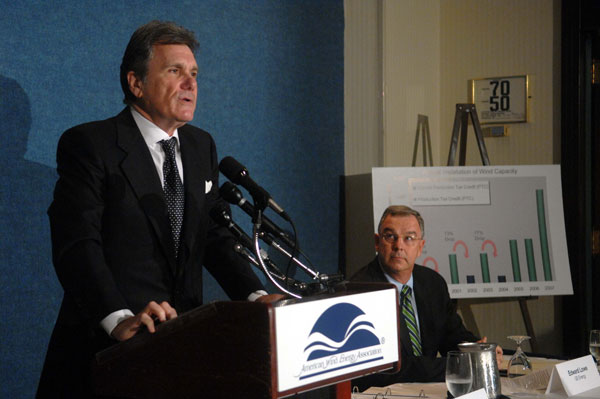
On April 10, 2008, the U.S. Senate passed legislation with significant provisions supporting the renewable-energy industry. The Clean Energy Tax Stimulus Act of 2008, which must be voted on in the House before being sent to the President, modifies and extends the incentives for energy-efficient technologies and renewable energy that were introduced in the Energy Policy Act of 2005 (see EBN Vol. 14, No. 9); many of these incentives were set to expire at the end of 2008.
For existing homes, the new legislation would take the 10% investment tax credit for energy-efficiency improvements and extend it to property “placed in service” (the day an asset becomes available for use) through 2009. A tax credit for energy-efficient new homes would be available through 2010. Owners of commercial buildings would be able to deduct the cost of energy-efficiency improvements by up to $2.25/ft2 ($24.20/m2) through 2009. Also through 2009, homeowners would be able to claim a personal tax credit (without the current $2,000 cap) for property that uses solar energy to generate electricity or heat water. A credit for energy-efficient appliances would be extended to products manufactured in 2008, 2009, and 2010.
On April 10, 2008, the U.S. Senate passed legislation with significant provisions supporting the renewable-energy industry. The Clean Energy Tax Stimulus Act of 2008, which must be voted on in the House before being sent to the President, modifies and extends the incentives for energy-efficient technologies and renewable energy that were introduced in the Energy Policy Act of 2005 (see EBN Vol. 14, No. 9); many of these incentives were set to expire at the end of 2008.
For existing homes, the new legislation would take the 10% investment tax credit for energy-efficiency improvements and extend it to property “placed in service” (the day an asset becomes available for use) through 2009. A tax credit for energy-efficient new homes would be available through 2010. Owners of commercial buildings would be able to deduct the cost of energy-efficiency improvements by up to $2.25/ft2 ($24.20/m2) through 2009. Also through 2009, homeowners would be able to claim a personal tax credit (without the current $2,000 cap) for property that uses solar energy to generate electricity or heat water. A credit for energy-efficient appliances would be extended to products manufactured in 2008, 2009, and 2010.
Utility-scale facilities that generate electricity from solar energy, wind energy, geothermal energy, hydropower, micro-hydropower (150 kW – 5 MW; including marine and hydrokinetic energy), closed-loop biomass, open-loop biomass, landfill gas, and trash combustion would have through 2009 to qualify for the renewable-energy-production tax credit. Another utility-scale incentive—the solar-energy and fuel-cell investment tax credits—would extend through 2016, enabling taxpayers to claim a 10% credit for the purchase of stationary microturbines and a 30% business credit for the purchase of fuel-cell power plants and qualified solar-energy property. The bill would also authorize an additional $400 million (on top of the currently allocated $1.2 billion) in Clean Renewable Energy Bonds (CREBs) and extend the authority to issue such bonds through 2009. (CREBs reduce the cost of renewable-energy investments for publicly-owned utilities and electric cooperatives that cannot benefit from tax credits.)
Clean-energy advocates hope that Congress and the White House can unify behind a tax package that benefits renewable energy. However, two major issues stand in the way of further progress. First, the Senate bill resists appropriating funds from oil and gas subsidies to pay for the incentives, rivaling a bill approved by the House earlier this year that would redirect oil and gas subsidies to renewable energy. Second, the Senate's tax package is part of a larger bill—the Housing Stimulus Bill—that the White House currently opposes. Until these issues are settled, less significant “extender bills,” such as one introduced by the Senate Finance Committee on April 17, 2008, may prevent disruption to the renewable-energy markets and support green-building initiatives by providing at least one more year of clean-energy incentives.
– Rachel Navaro


 When rating various criteria for choosing forest products to sell in their stores, the top building-supply retailers in the U.S. rank environmental certification last. That was the main finding when the top 500 retailers in the country were surveyed in 2005–2006 by Priyan Perera and others at Louisiana State University, with results published in March 2008 in
 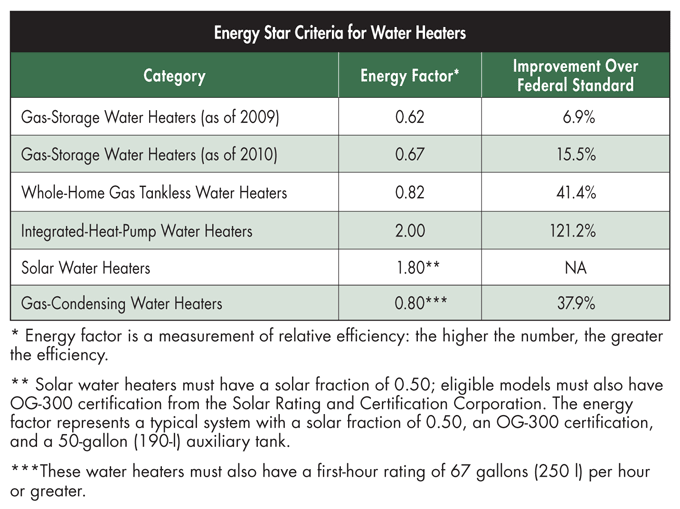 According to the U.S. Department of Energy, water heating is responsible for up to 17% of national residential energy use. Now, for the first time, builders and homeowners will have an Energy Star standard by which to judge water heaters for efficiency. The new criteria cover five categories of water heaters and go into effect on January 1, 2009 (see chart). In some categories, water heaters with the Energy Star label will be significantly more efficient than models meeting basic federal standards—up to 121% for drop-in or integrated-heat-pump water heaters. High-performance gas-storage water heaters are subject to phased criteria, with the first phase representing a 6.9% improvement over federal standards and a second phase starting in September 2010 that will represent a 15.5% improvement over federal standards. One of the most popular types of water heaters, electric storage units, are not eligible for Energy Star labeling. For more information, visit www.energystar.gov/waterheaters.
 Under the federal Clean Water Act, developers must replace the functions of any wetland lost to construction. Rules covering the practice, called
  The Centers for Disease Control and Prevention (CDC) has found formaldehyde levels ranging from 3 to 590 parts per billion (ppb) in trailers supplied by the Federal Emergency Management Agency (FEMA) to Americans displaced by Hurricanes Katrina and Rita.CDC found an average formaldehyde concentration of 77 ppb, compared with 10 to 30 ppb in typical indoor environments. These levels are high enough to pose health concerns—especially for elderly people, children, and those with asthma—and CDC encourages residents of the 34,000 trailers still in use along the Gulf Coast to move to safer housing as soon as possible.The findings, based on tests performed in December 2007 and January 2008 and published in an interim report, likely under-represent long-term exposures, since formaldehyde levels tend to be higher in newer trailers and during warmer months. More information is online at
  A leading green design firm doing business in Seattle for nearly 60 years, Mithun is expanding into California and increasing its staff to include Sandy Mendler, AIA, as a principal in its new San Francisco office. “I am so excited to join such a strong group,” Mendler told
  In December 2007, New Jersey’s Board of Public Utilities (BPU) announced that the state would be suspending its solar rebate program—one of the nation’s most vigorous—and replacing it with one based on solar renewable energy certificates (RECs), tradable credits that represent the environmental attributes of the solar electricity.BPU made the policy switch because of overwhelming demand for the state’s generous solar rebates, creating (since early 2006) queues for rebate funding. BPU has ordered rebates to be phased out entirely by May 31, 2012, and limited to small projects until then. The new REC program facilitates the sale of certificates to the electricity suppliers who, under New Jersey’s renewable portfolio standard are required to invest in a minimum amount of renewable energy; by 2009, that amount will be the equivalent of 90 MW, or enough to power 8,000 homes.Any of New Jersey’s solar photovoltaic owners with grid-connected generators are eligible to participate in the REC program. More information is at
  The new headquarters for the 12,000-member International Interior Design Association (IIDA), located in Chicago’s Merchandise Mart, is considered by IIDA to be “an illustration of green ideas at work, featuring products and materials that demonstrate how sustainable design can be both beautiful and functional.”The design association earned a Gold rating in LEED for Commercial Interiors, with a space that includes underfloor air distribution, T-5 linear pendant fixtures, and glass walls and doors for private offices to maximize the penetration of natural light. Of the materials specified for the project, such as ceiling tiles and upholstered wall panels, 25% (by cost) contain pre- and post-consumer recycled content, and 5% (by cost) are made with rapidly renewable materials, such as cork.Envision Design, an architecture and interior design firm based in Washington, designed the space and provided LEED consultation. More information is available at

Add new comment
To post a comment, you need to register for a BuildingGreen Basic membership (free) or login to your existing profile.