Federal 2009 Budget a Mixed Bag for Green Building

News Brief

Federal 2009 Budget a Mixed Bag for Green Building

In February 2008, President George W. Bush sent his proposed budget to Congress, which, if passed, would deliver a blow to some programs aimed at energy efficiency and renewable energy even as it increases the funding for others.

The U.S. Department of Energy (DOE) would lose all of its funding for two programs: the Weatherization Assistance Program, which provides funding and technical assistance to state weatherization programs for low-income families, and the Renewable Energy Production Incentive, which provides financial incentives for electricity produced from renewable sources. The budget also cuts funding for solar energy programs by $12 million from 2008 levels (about 7%). The Building Technologies program, however, which promotes high-performance buildings, would gain $15 million over 2008 levels (about 14%).The 2009 budget, which is a starting point for the legislative process, is available at www.whitehouse.gov/budget/.

Published December 31, 1969

(2008, March 31). Federal 2009 Budget a Mixed Bag for Green Building. Retrieved from https://www.buildinggreen.com/departments/newsbrief

Add new comment

To post a comment, you need to register for a BuildingGreen Basic membership (free) or login to your existing profile.

Study Links Biobased Products with Emissions

News Brief

Study Links Biobased Products with Emissions

A new study performed by University of Texas–Austin doctoral student Chi Phuong Hoang shows preliminary evidence that some green and biobased materials—often touted as low-emitting—may react with low levels of naturally occurring ozone to create “secondary” emissions of volatile organic compounds (VOCs), which are harmful to human health. Hoang tested ten common wall, flooring, ceiling, and cabinetry materials that have been identified as green by a third party. She found that ceiling tile made from inorganic perlite, cork wallpaper, and wheat-straw board were the most reactive with “realistic outdoor and indoor concentrations” of ozone. The Greenguard Environmental Institute, a nonprofit organization that establishes acceptable indoor air standards for indoor products, environments, and buildings, funded the study. Carl Smith, CEO of Greenguard, thinks the study reveals, “in a meaningful way, a new facet of how to look at how one’s product may contribute to indoor air issues.” For more information, visit www.greenguard.org.

Published December 31, 1969

(2008, March 31). Study Links Biobased Products with Emissions. Retrieved from https://www.buildinggreen.com/departments/newsbrief

Add new comment

To post a comment, you need to register for a BuildingGreen Basic membership (free) or login to your existing profile.

Televisions Must Meet New Requirements to Earn Energy Star

News Brief

Televisions Must Meet New Requirements to Earn Energy Star

Version 3.0 of the Energy Star specification for televisions has been finalized and is scheduled to go into effect November 1, 2008. The new specification requires all Energy Star televisions to be 30% more efficient than conventional models.While the one-watt maximum for the standby mode remains the same in the new version, the specification now requires energy savings while the television is on. Currently, about 25% of the televisions on the market qualify under version 3.0, a percentage that is expected to grow. About 60% of products satisfy Version 2.0 requirements today, compared with 25% when the requirements were released in 2002.EPA expects the new specification to save about $1 billion (over the life of the products) in energy costs. For more information, go to www.energystar.gov/pdtv.

Published December 31, 1969

(2008, March 31). Televisions Must Meet New Requirements to Earn Energy Star. Retrieved from https://www.buildinggreen.com/departments/newsbrief

Add new comment

To post a comment, you need to register for a BuildingGreen Basic membership (free) or login to your existing profile.

Low Emissions, Quick Energy Payback for Thin-Film PV

News Brief

Low Emissions, Quick Energy Payback for Thin-Film PV

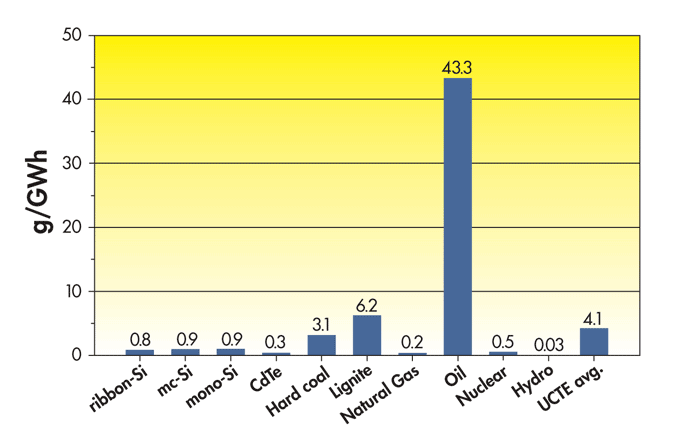
Manufacturers of new thin-film cadmium telluride modules have reinvented the solar photovoltaic (PV) field in recent years. But doubts have lingered about the overall life-cycle benefits of PV systems in general because of the intensive energy use of the manufacturing process as well as the heavy metals required for the panels (see EBN Vol. 10, No. 3). However, a new study shows all current PV technologies offer at least an 89% reduction of air emissions compared with conventional electricity, while also offering an energy-payback time of less than three years. Of the four main types of PV technology, thin-film modules offer the lowest life-cycle greenhouse gas emissions and heavy metal emissions.

The study, led by Vasilis Fthenakis of Brookhaven National Laboratory and Columbia University and released in January 2008 by Environmental Science & Technology, compiled life-cycle assessment data from numerous sources, including data from companies making single-crystal, multicrystal, and ribbon-silicon solar cells as well as data from one Arizona company, First Solar, which makes thin-film cadmium-telluride, or CdTe, PV systems. The analysis accounted not only for energy used in making the PV modules using average proportions of electricity from the grid (including some renewable energy), but also for support frames and other materials. It assumed that systems would be used in ground-mounted conditions under southern European light with 30-year lifetimes.

According to the study, emissions from any of the four PV technologies examined are “insignificant in comparison to the emissions that they replace when introduced in average European and U.S. grids.” The best-performing system was the CdTe thin-film technology, which, the study showed, leads to at least 89% and up to 98% reductions in greenhouse-gas emissions as well as other pollutant and heavy-metal emissions compared with grid-source electricity, which is sourced mostly from fossil fuels. When comparing the different types of PV technology against each other, CdTe had the lowest emissions of all heavy metals, in some cases showing more than a 50% reduction compared with other PV systems. Monocrystalline silicon consistently had the highest relative emissions for most pollutants.

The study does not update previous research on energy-payback time, or EPBT, the time it takes for a PV system to generate the amount of electricity used in its production. However, the most recent study, from 2006 and also led by Fthenakis, found that at 1.1 years CdTe systems have the lowest EPBT among PV systems, which can have EPBTs as high as 2.7 years for monocrystalline silicon PV.

The relatively high retail price per watt of photovoltaic-module generating capacity—currently $4.82 per watt, according to Solarbuzz, an industry consultant—has limited the growth in of photovoltaics (see EBN Vol. 17, No. 3). But along with the low environmental impact of CdTe systems comes a relatively low production cost, and a number of companies, including PrimeStar Solar, based in Golden, Colorado, are racing to bring new manufacturing capacity online. Fred Seymour, Ph.D., the director of PV technology for PrimeStar, told EBN that one of his competitors reports manufacturing costs of $1.12 per watt. “There’s ample room to go below that,” Seymour said. “We’re in the steep part of the learning curve with cadmium telluride.”

For more information:

Environmental Science & Technology

“Emissions from Photovoltaic Life Cycles”

http://pubs.acs.org/journals/esthag/index.html

 

Published December 31, 1969

(2008, March 24). Low Emissions, Quick Energy Payback for Thin-Film PV. Retrieved from https://www.buildinggreen.com/departments/newsbrief

Add new comment

To post a comment, you need to register for a BuildingGreen Basic membership (free) or login to your existing profile.

USGBC Doubles Research Funding

News Brief

USGBC Doubles Research Funding

In November 2007 the U.S. Green Building Council (USGBC) committed $1 million in funding for research on green building topics (see

EBN

Vol. 16, No. 12). Now it has doubled that commitment to $2 million and reserved $500,000 of the additional funds for research on occupant impacts in K-12 schools. Although it represents a significant commitment for USGBC, the research fund is small in comparison to the amount of federal funding the organization says is needed. In March 2007, the USGBC Research Committee called for a significant increase in federal funding for green building research, from an average of $193 million annually to over $1 billion (see

EBN

Vol. 16, No. 6). USGBC called for pre-proposals (due March 6, 2008) for use of the research funds and will ask selected applicants to submit more detailed proposals for the final phase of the award process. Questions about the research fund and proposals may be emailed to research@committees.usgbc.org.

Published December 31, 1969

(2008, March 1). USGBC Doubles Research Funding. Retrieved from https://www.buildinggreen.com/departments/newsbrief

Add new comment

To post a comment, you need to register for a BuildingGreen Basic membership (free) or login to your existing profile.

RK Stewart Joins Perkins+Will

News Brief

RK Stewart Joins Perkins+Will

After his 2007 term as president of The American Institute of Architects (AIA), RK Stewart, FAIA, has joined the San Francisco office of Perkins+Will as an associate partner. Before his post at AIA, Stewart was a principal at San Francisco-based Gensler, where he worked for 20 years. While at AIA, Stewart emphasized green building, leading the organization to adopt the 2030 Challenge. He will likely bring that focus to his new role at Perkins+Will.

Published December 31, 1969

(2008, March 1). RK Stewart Joins Perkins+Will. Retrieved from https://www.buildinggreen.com/departments/newsbrief

Add new comment

To post a comment, you need to register for a BuildingGreen Basic membership (free) or login to your existing profile.

AQS Earns ISO-17025 Accreditation for Competence

News Brief

AQS Earns ISO-17025 Accreditation for Competence

Air Quality Sciences (AQS) in Marietta, Georgia, specializes in testing for indoor air quality and product emissions and is the main testing laboratory for the Greenguard Environmental Institute and its Greenguard certifications. The laboratory already met standards set by the International Organization for Standardization (ISO) for quality management (ISO-9001). Now the laboratory has been accredited to a more stringent standard, ISO-17025, that includes technical requirements for the competence of the staff, methodology, and testing equipment. The accreditation of AQS covers the laboratory’s testing of air for volatile organic compounds as well as its testing of indoor materials for organic and chemical emissions and microbial growth. For more information, visit www.aqs.com.

Published December 31, 1969

(2008, March 1). AQS Earns ISO-17025 Accreditation for Competence. Retrieved from https://www.buildinggreen.com/departments/newsbrief

Add new comment

To post a comment, you need to register for a BuildingGreen Basic membership (free) or login to your existing profile.

National Design Associations Propose National Academy

News Brief

National Design Associations Propose National Academy

A group of national design associations has proposed the creation of a National Academy of Environmental Design to add to the four existing national academies (National Academy of Sciences, National Academy of Engineering, Institute of Medicine, and National Research Council). The group includes the Association of Collegiate Schools of Architecture, American Institute of Architects, American Society of Landscape Architects, American Institute of Architecture Students, Association of Collegiate Schools of Planning, and Council of Educators in Landscape Architecture. The new academy would coordinate research efforts, distribute information, and make policy recommendations in the areas of green building, urban planning, landscape design, and transportation. The group plans to petition Congress to support the establishment of the academy in 2009. More information is available at www.naedonline.org.

Published December 31, 1969

(2008, March 1). National Design Associations Propose National Academy. Retrieved from https://www.buildinggreen.com/departments/newsbrief

Add new comment

To post a comment, you need to register for a BuildingGreen Basic membership (free) or login to your existing profile.

Northern Arizona University Research Facility Earns LEED Platinum

News Brief

Northern Arizona University Research Facility Earns LEED Platinum

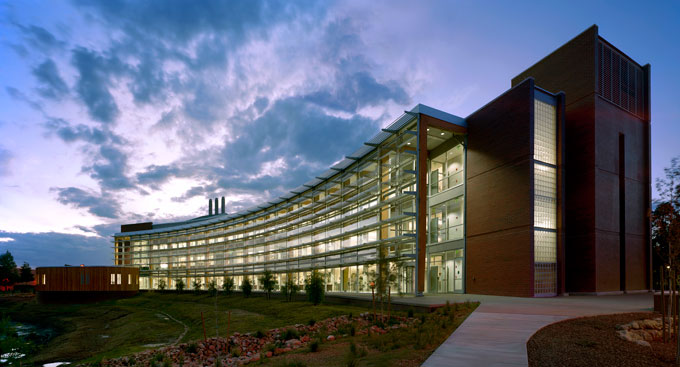
The Applied Research and Development building at Northern Arizona University in Flagstaff, Arizona, has achieved a Platinum rating in the U.S. Green Building Council’s LEED Rating System. The 60,000-ft2 (5,600-m2) building, designed by architecture firm Burns Wald-Hopkins in Tucson, earned 60 out of 69 possible points and is expected to achieve over 60% energy savings compared with a similar conventional building. Passive ventilation, radiant heating and cooling, heat-recovery ventilation, superinsulated walls and roof, high-performance glazing, and solar shading all contribute to the energy performance. A 165-kilowatt photovoltaic array is expected to meet about 20% of the building’s electricity needs, and solar thermal collectors contribute to water heating. Waterless urinals and low-flush toilets using reclaimed water contribute to an estimated 60% water savings compared with a conventional building. Most of the wood used in the project (76% by cost) was certified to Forest Stewardship Council standards.


Published December 31, 1969

(2008, March 1). Northern Arizona University Research Facility Earns LEED Platinum. Retrieved from https://www.buildinggreen.com/departments/newsbrief

Add new comment

To post a comment, you need to register for a BuildingGreen Basic membership (free) or login to your existing profile.

Study Finds Elevated PCB Levels in Homes

News Brief

Study Finds Elevated PCB Levels in Homes

Polychlorinated biphenyls (PCBs) are persistent, bioaccumulative chemicals that can cause both acute and chronic health problems in humans and may cause cancer; their production was banned in the U.S. in the 1970s. Most studies have focused on how these chemicals enter the human body through the food chain, but a new study published in the online journal

Environmental Health implicates another mechanism. An earlier study had found elevated PCB levels in 31% of 120 homes studied; the homes studied belonged to breast cancer patients and a control group. The current study looked more closely at two of the homes, and the high levels of PCBs were traced to finishes used in the 1950s and 1960s on hardwood floors. Based on their findings, the study’s authors believe that floor finishes and other building products may be contributing significantly to PCB exposure, and that the effect of this exposure has been underestimated and requires further research. The full study is available at www.ehjournal.net/content/7/1/2/.

Published December 31, 1969

(2008, March 1). Study Finds Elevated PCB Levels in Homes. Retrieved from https://www.buildinggreen.com/departments/newsbrief

Add new comment

To post a comment, you need to register for a BuildingGreen Basic membership (free) or login to your existing profile.