USGBC Provides List of LEED Project Innovations

News Brief

USGBC Provides List of LEED Project Innovations

In January 2008 the U.S. Green Building Council published an “Innovation & Design Credit Catalog” listing the actions that project teams have taken to earn innovation points in LEED. The catalog, a 28-page PDF file, lists about 200 innovations. Items on the list range widely and include solutions such as reduced steel in a structural system, good acoustical design, and food composting. Some are simply adaptations of a credit from one LEED rating system into another—such as the low-emitting furniture credit from LEED for Commercial Interiors, used (presumably) in LEED for New Construction. Unfortunately, the catalog doesn’t identify the rating system in which each innovation point was achieved, so some of those crossover credits can be confusing. Users are warned that solutions listed in the catalog are not guaranteed to be approved on subsequent products, as standards may change over time and some points are awarded based on specific project circumstances. The catalog is available here: http://www.usgbc.org/ShowFile.aspx?DocumentID=3569.

Published December 31, 1969

(2008, February 3). USGBC Provides List of LEED Project Innovations. Retrieved from https://www.buildinggreen.com/departments/newsbrief

Add new comment

To post a comment, you need to register for a BuildingGreen Basic membership (free) or login to your existing profile.

Alliance for Water Efficiency Offers Water Conservation Assistance

News Brief

Alliance for Water Efficiency Offers Water Conservation Assistance

The Alliance for Water Efficiency (AWE), a stakeholder-based nonprofit dedicated to the efficient and sustainable use of water, has recently opened its headquarters as a public resource in Chicago. AWE serves as a North American advocate for water-efficient products and programs, and provides information and assistance on water conservation efforts. Supporters of AWE include product and appliance manufacturers, irrigation equipment manufacturers, environmental organizations, academic institutions, municipalities, and water utilities. Among its seven stated key tasks is AWE's effort to coordinate with green building initiatives to institutionalize water efficiency. More information is available at www.allianceforwaterefficiency.org.

Published December 31, 1969

(2008, February 3). Alliance for Water Efficiency Offers Water Conservation Assistance. Retrieved from https://www.buildinggreen.com/departments/newsbrief

Add new comment

To post a comment, you need to register for a BuildingGreen Basic membership (free) or login to your existing profile.

GGHC Announces Prescriptive Paths to Energy Points

News Brief

GGHC Announces Prescriptive Paths to Energy Points

The Green Guide for Healthcare (GGHC) has announced two new prescriptive paths for achieving energy optimization points in its self-certification program for healthcare facilities (see

EBN

Vol. 14, No. 1). Buildings over 70,000 ft2 (6,500 m2) can achieve two points in the energy optimization credit using prescribed measures that include low lighting-power density, high-performance windows, occupancy sensors, central variable-air-volume air handlers, and high-efficiency boilers, among others. Buildings under 70,000 ft2 (6,500 m2) can achieve the same two points using the

Core Performance Guide from the New Buildings Institute (see

EBN

Vol. 16, No. 12). Both paths lead to approximately 14% energy savings over the ASHRAE 90.1-2004 standard. LEED for Healthcare, the U.S. Green Building Council’s similar third-party rating system, also incorporates the measure in its draft version (see

EBN

Vol. 17, No. 1). More information is available at www.gghc.org.

Published December 31, 1969

(2008, February 3). GGHC Announces Prescriptive Paths to Energy Points. Retrieved from https://www.buildinggreen.com/departments/newsbrief

Add new comment

To post a comment, you need to register for a BuildingGreen Basic membership (free) or login to your existing profile.

Oregon Group Develops Ecosystem Services Trading System

News Brief

Oregon Group Develops Ecosystem Services Trading System

A group of business, environmental, and government leaders in Oregon has formed the Ecosystem Services Council to support market-based approaches to promote clean air and water, land protection, and habitat restoration. Among the initial members are the Cascadia Region Green Building Council, Ecotrust, and the Nature Conservancy, along with the City of Portland and others. The council hopes to build on existing carbon markets and regulatory markets for things like wetland restoration, which allow developers to offset ecological damage by supporting restoration projects. Trading credits for ecosystem services could be quite complex, as a single project could produce credits for carbon sequestration, water purification, and habitat preservation, for example. According to Kevin Halsey of Parametrix, Inc., a founding member company of the council, an administrative database has been developed to track ecosystem services and credits for several pilot projects in Oregon. After an initial pilot phase, the council hopes to expand its markets nationally. More information is available from info@ecosystemservicescouncil.org.
Published December 31, 1969

(2008, February 3). Oregon Group Develops Ecosystem Services Trading System. Retrieved from https://www.buildinggreen.com/departments/newsbrief

Add new comment

To post a comment, you need to register for a BuildingGreen Basic membership (free) or login to your existing profile.

First U.S. City Resolves to Build LEED Platinum

News Brief

First U.S. City Resolves to Build LEED Platinum

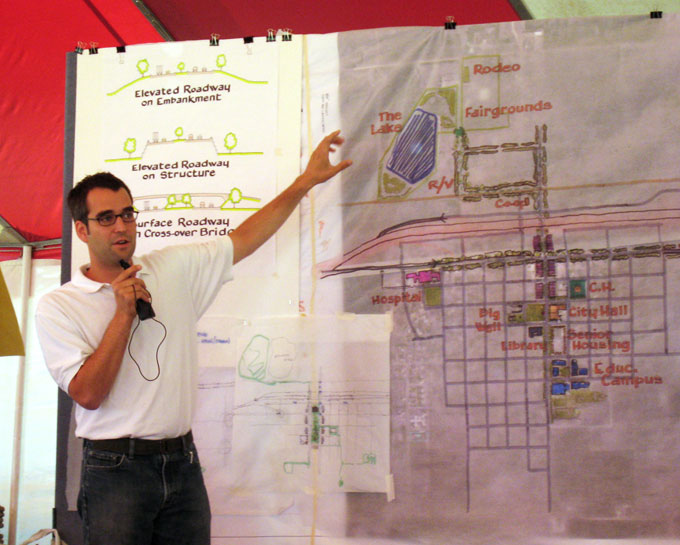
The city council of Greensburg, Kansas (pop. 1,500), a town devastated by a tornado in May 2007 (see EBN Vol. 16, No. 12), announced in December 2007 that all city-owned buildings greater than 4,000 ft2 (400 m2) would be required to meet LEED Platinum standards. Greensburg, which is rebuilding with a focus on sustainability, became the first U.S. city to pass such a resolution. Similar laws elsewhere have so far called for lower levels of LEED certification. BNIM Architects of Kansas City, Missouri, the firm contracted to develop Greensburg’s master plan, helped draft the resolution, which requires the energy use of the buildings to be 42% lower than current building code requirements. For more information, see the BNIM Greensburg, KS Master Plan.


Published December 31, 1969

(2008, February 3). First U.S. City Resolves to Build LEED Platinum. Retrieved from https://www.buildinggreen.com/departments/newsbrief

Add new comment

To post a comment, you need to register for a BuildingGreen Basic membership (free) or login to your existing profile.

California Limits Ozone-Generating Air Purifiers

News Brief

California Limits Ozone-Generating Air Purifiers

In 2006, the California legislature passed a law requiring the California Air Resources Board (CARB) to develop and adopt a regulation limiting the ozone emitted from indoor air cleaning devices. According to the U.S. Environmental Protection Agency, there is increasing evidence that the ozone from some of these devices leads to throat and lung irritation, and that, at levels considered safe, ozone does little to clean the air (see Good Ozone, Bad Ozone). In September 2007, CARB approved a regulation limiting ozone emission concentrations from these devices to 0.05 parts per million, matching a voluntary standard set by the Federal Drug Administration. When

Consumer Reports tested air purifiers in December 2007, it found several exceeded this limit, most notably those designed to generate ozone (as opposed to those that generate ozone as a byproduct of electrostatic cleaning). The regulation includes a testing method that must be approved by both the Underwriters Laboratory (UL) and the American National Standards Institute (ANSI) before the regulation can become law. CARB expects the regulation to go into effect in April 2008 and will give manufacturers two years to have their products tested and certified as meeting the emissions requirements. More information is available at www.arb.ca.gov/research/indoor/aircleaners/aircleaners.htm.

Published December 31, 1969

(2008, February 3). California Limits Ozone-Generating Air Purifiers. Retrieved from https://www.buildinggreen.com/departments/newsbrief

Add new comment

To post a comment, you need to register for a BuildingGreen Basic membership (free) or login to your existing profile.

Home Inspectors Get Their Own Green Building Course

News Brief

Home Inspectors Get Their Own Green Building Course

Responding to growth in the green homebuilding industry, the International Association of Certified Home Inspectors (InterNACHI), the world’s largest nonprofit inspection association, has released a free, online course to educate building inspectors about green building techniques, materials, and technologies. Developed by home inspector Kenton Shepard, the course offers contextual information about energy use and climate change as well as technical details on photovoltaic installations, passive solar design, building envelope construction, and other specific green building techniques. The course is available to InterNACHI members as well as the public, and a final exam allows users to test their knowledge. The course is available at www.nachi.org.

Published December 31, 1969

(2008, February 3). Home Inspectors Get Their Own Green Building Course. Retrieved from https://www.buildinggreen.com/departments/newsbrief

Add new comment

To post a comment, you need to register for a BuildingGreen Basic membership (free) or login to your existing profile.

Southface Partners with Building Performance Institute

News Brief

Southface Partners with Building Performance Institute

The Southface Energy Institute, a green-building nonprofit in Atlanta, has announced its new role as an affiliate of the Building Performance Institute (BPI), a growing third-party certifier for building-industry professionals. In this role, Southface will offer training as well as field and written exams for contractors and others hoping to become certified BPI Building Analysts. This certification allows a contractor to examine a home under the Home Performance with Energy Star program, managed by the U.S. Environmental Protection Agency and the U.S. Department of Energy. BPI also offers certifications for contractors specializing in building envelopes, heating, and air conditioning; the program grew from nine affiliates to 24 in 2007, and hopes to add at least 12 more affiliates in 2008, according to CEO Larry Zarker. More information is available at www.southfacehomeperformance.com and at www.bpi.org.

Published December 31, 1969

(2008, February 3). Southface Partners with Building Performance Institute. Retrieved from https://www.buildinggreen.com/departments/newsbrief

Add new comment

To post a comment, you need to register for a BuildingGreen Basic membership (free) or login to your existing profile.

Canadian Multifamily Project Earns LEED Platinum

News Brief

Canadian Multifamily Project Earns LEED Platinum

The Vento, an urban infill mixed-use project in Calgary, Alberta, designed by Perkins + Will for Windmill Development Group, earned a Platinum rating in the Canada Green Building Council’s LEED Rating System, making it the first multifamily residential project to do so. Twenty two-story townhouse suites are situated above ground-floor retail spaces in the project, which also contains two affordable housing units. Heat-recovery ventilators, high-performance windows, and occupancy sensors for lighting help conserve energy, making the building 47% more efficient than required by the Model National Energy Code, according to modeling. Decks on the units provide shading from unwanted solar heat gain. Rainwater and graywater are collected and used for flushing toilets and irrigation; the project uses approximately 50% less potable water than a comparable development built to code.




Published December 31, 1969

(2008, January 1). Canadian Multifamily Project Earns LEED Platinum. Retrieved from https://www.buildinggreen.com/departments/newsbrief

Add new comment

To post a comment, you need to register for a BuildingGreen Basic membership (free) or login to your existing profile.

CCI Wields Purchasing Power for Energy Efficiency

News Brief

CCI Wields Purchasing Power for Energy Efficiency

The Clinton Climate Initiative (CCI) has announced several large partnerships in support of its Energy Efficiency Building Retrofit Program, announced in May 2007 (see

EBN Vol. 16, No. 7). Working with 40 cities throughout the world, CCI has created a purchasing consortium to leverage buying power for lower prices on energy-saving technologies and to support the development of new technologies. The latest partners in this effort, Wal-Mart and the U.S. Conference of Mayors, are working with CCI to bring the benefits of the purchasing consortium to the 1,100 member cities of the Conference of Mayors. Among the organizations tapping into this purchasing power is the New York City Housing Authority (NYCHA), which has announced a partnership with CCI and the U.S. Department of Housing and Urban Development (HUD) to retrofit its more than 2,600 public housing buildings. NYCHA, the largest public housing authority in the U.S., will work with CCI and HUD to update its central heating plants, replace some hot water tanks with on-demand water heaters, upgrade lighting fixtures, and reduce overall electricity consumption by 15%. More information is available at www.clintonfoundation.org/cf-pgm-cci-home.htm or at www.nyc.gov/nycha.

Published December 31, 1969

(2008, January 1). CCI Wields Purchasing Power for Energy Efficiency. Retrieved from https://www.buildinggreen.com/departments/newsbrief

Add new comment

To post a comment, you need to register for a BuildingGreen Basic membership (free) or login to your existing profile.