Plastic Water Piping Leads to Greater Corrosion, Lead Levels

News Brief

Plastic Water Piping Leads to Greater Corrosion, Lead Levels

Despite the reduced use of metals in potable-water piping systems using plastic pipe such as PEX and CPVC, recent research has found that the bacterial environments in those pipes can lead to higher content of metals, including lead, than in systems using copper pipe.

A paper published in

Environmental Science & Technology examined interactions among several variables: pipes of various kinds, water treated with chloramine (commonly used by water utilities as an alternative to chlorine), pH, phosphates (often added to water as an anti-corrosive), and nitrifying bacteria. While most water-test protocols involve flushing pipes before collecting a sample, the researchers studied stagnant “first draw” water that had been sitting in pipes. They found that the greater inertness of plastic pipe allows nitrifying bacteria to create more acidic conditions, which in turn leach more lead, copper, and zinc from brass fittings and fixtures.

That leaching created lead contamination exceeding U.S. Environmental Protection Agency standards, as well as potentially causing premature failure of fittings. Copper pipe inhibits those same bacteria, resulting in less leaching. While the findings might be a reason to avoid plastic piping, or at least run the water before using it, the researchers declined to make firm recommendations.

Published December 31, 1969

(2008, June 27). Plastic Water Piping Leads to Greater Corrosion, Lead Levels. Retrieved from https://www.buildinggreen.com/departments/newsbrief

Add new comment

To post a comment, you need to register for a BuildingGreen Basic membership (free) or login to your existing profile.

Facility Operating Costs Increase Despite Drop in Energy Consumption

News Brief

Facility Operating Costs Increase Despite Drop in Energy Consumption

According to a recent report by the International Facility Management Association (IFMA), rising utility costs have led to increased overall operating costs even as energy consumption has dropped. The report, “Benchmarks V: Annual Facility Costs,” pulls data from over 1,000 survey responses from IFMA members.

Operating costs have risen 10% since 2004, according to the report, thanks in part to a 19% increase in utility costs since 2006 but despite a decrease in energy consumption; average electricity consumption dropped from 93 kBtu/ft2 (1,060 MJ/m2) in 2006 to 81 kBtu/ft2 (920 MJ/m2) in 2007. Natural gas consumption has remained constant at an average of 35 kBtu/ft2 (400 MJ/m2). According to IFMA, increases in energy costs have led to energy efficiency measures, decreasing consumption.

Costs tied to some environmental initiatives have also risen: for example, the cost of recycling doubled from $0.02/ft2 to $0.04/ft2 ($0.21/m2 to $0.43/m2) since 2004. The 2008 report (which does not include 2004–2005 data for comparison) is available for $120 at www.ifma.org/tools/research/benchmarks_v.cfm/.

Published December 31, 1969

(2008, June 27). Facility Operating Costs Increase Despite Drop in Energy Consumption. Retrieved from https://www.buildinggreen.com/departments/newsbrief

Add new comment

To post a comment, you need to register for a BuildingGreen Basic membership (free) or login to your existing profile.

Nation's First LEED Platinum Affordable Housing Built in Massachusetts

News Brief

Nation's First LEED Platinum Affordable Housing Built in Massachusetts

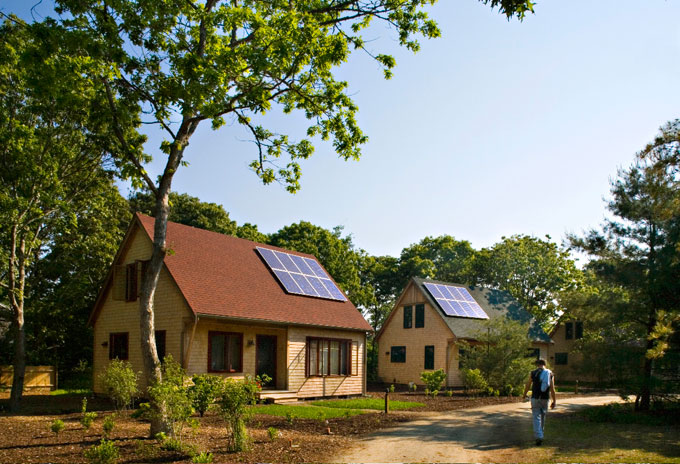
On Martha’s Vineyard, an island where affordable housing is in short supply, nine single-family, detached, green homes were recently developed and funded by the Island Affordable Housing Fund and sold for 25%–50% of the median home sale price on the island; one additional home in the cluster was sold at the market rate.

The homes, collectively known as Jenney Way, were designed and built by South Mountain Company with green strategies, including white cedar siding certified to Forest Stewardship Council standards, high-performance windows tuned to building orientation, and tankless water heaters. Because of high insulation levels and air-sealing, heating costs for the homes are expected to be 60% below those of comparable houses built to code, allowing use of high-efficiency, direct-vent space heaters instead of central heating systems.

The project team faced a choice between preserving trees on the site and providing solar access for all of the homes, and decided to preserve trees and put a 1.5-kilowatt photovoltaic array on just four homes. These four homes achieved Platinum ratings in the LEED for Homes program, the first single-family affordable housing units to do so.

Published December 31, 1969

(2008, June 27). Nation's First LEED Platinum Affordable Housing Built in Massachusetts. Retrieved from https://www.buildinggreen.com/departments/newsbrief

Add new comment

To post a comment, you need to register for a BuildingGreen Basic membership (free) or login to your existing profile.

Los Angeles Limits "Mansionization"

News Brief

Los Angeles Limits "Mansionization"

In what may be a sign of backlash against the decades-long trend toward larger houses, the Los Angeles city council unanimously passed an ordinance in May 2008 limiting the footprints of new and renovated houses in many neighborhoods—affecting about 304,000 lots—to about half their lot size.

The Neighborhood Character Ordinance, commonly known as the “mansionization ordinance,” also limits the size of garages to 400 ft2 (37 m2), which can hold two cars. The law is intended to halt the construction of out-of-scale houses in older neighborhoods and the loss of privacy that results from residences being built up to property lines, but also has environmental benefits, such as limiting the growth of hardscape.

While some homeowners, builders, and real-estate professionals predictably opposed the measure, other critics say it isn’t tough enough. In fact, the City’s planning department says 70% of houses built in recent years would not have been affected had the rules been in place, and many houses could still be doubled in size.

Published December 31, 1969

(2008, June 27). Los Angeles Limits "Mansionization". Retrieved from https://www.buildinggreen.com/departments/newsbrief

Add new comment

To post a comment, you need to register for a BuildingGreen Basic membership (free) or login to your existing profile.

Green Real Estate Certification Available

News Brief

Green Real Estate Certification Available

Promoting green building can be “extremely profitable” for real-estate professionals, according to one educational company, illustrating a trend in a market reeling from the subprime-mortage crisis.

Tampa-based Green Real Estate Education, a company that hosts courses for real estate agents, house inspectors, mortgage officers, and appraisers, is now offering a three-hour green building course that fulfills continuing education requirements for real estate licensees in numerous states. The course is intended to inform participants about green building materials and techniques, global climate issues, renewable energy, air quality, and marketing of green features, among other subjects.

Kerry Mitchell, Green Real Estate Education’s president, acknowledges that the course cannot be comprehensive: “I don’t think you can cover [the course’s topics] in three

days,” she said. Mitchell says the goal is to provide an overview, teaching real-estate professionals “how not to greenwash, not to call a house green if [the seller has] done one or two upgrades,” for example. She also hopes to train real estate agents to offer guidance on improving salability with green improvements. Those who complete the course—over 3,100 so far—may call themselves Green Certified Real Estate Professionals.


Published December 31, 1969

(2008, June 27). Green Real Estate Certification Available. Retrieved from https://www.buildinggreen.com/departments/newsbrief

Add new comment

To post a comment, you need to register for a BuildingGreen Basic membership (free) or login to your existing profile.

Bike Sharing Comes to the U.S.

News Brief

Bike Sharing Comes to the U.S.

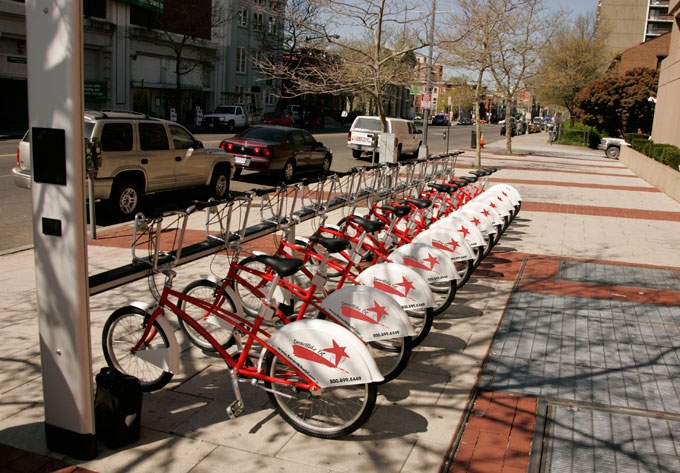
SmartBike, a bike-sharing program owned by Clear Channel Outdoor, has been available in Europe since its start in Rennes, France, in 1998. Having spread to ten European cities, the program is now making its U.S. debut in Washington, D.C., with 120 bicycles available in ten locations in the downtown area.

The program, a partnership between the city’s Department of Transportation and SmartBike, is membership based: users pay an annual fee of $40 to obtain a membership card that allows them to unlock bikes, which they can use for up to three hours at a time and return to any location.

Several other U.S. cities, including San Francisco and Philadelphia, are considering similar programs. More information is available at www.smartbikedc.com.

Published December 31, 1969

(2008, June 27). Bike Sharing Comes to the U.S.. Retrieved from https://www.buildinggreen.com/departments/newsbrief

Add new comment

To post a comment, you need to register for a BuildingGreen Basic membership (free) or login to your existing profile.

LEED Exam Required of ASU Real Estate Students

News Brief

LEED Exam Required of ASU Real Estate Students

Students entering the Master of Real Estate Development (MRED) program at Arizona State University in the 2008–2009 academic year will be required to study the U.S. Green Building Council’s LEED Rating System and take the LEED Professional Accreditation exam.

Begun in 2006, the program is one of only five in the nation to offer the master’s-level degree. According to its director, R. Nicholas Loope, FAIA, the university has been incorporating environmental awareness into its curricula and physical plant. The MRED program has added more focus on sustainability each year, Loope said. About a third of the program’s students volunteered to study LEED last year, and all students visited the LEED Gold Solaire building in New York City.

A thorough understanding of green building provided by LEED training, Loope said, helps graduates understand how to assemble the multifaceted team needed to tackle a complex green building project.

Published December 31, 1969

(2008, June 27). LEED Exam Required of ASU Real Estate Students. Retrieved from https://www.buildinggreen.com/departments/newsbrief

Add new comment

To post a comment, you need to register for a BuildingGreen Basic membership (free) or login to your existing profile.

Affordable Housing Benefits from IRS Rules Change on Solar Tax Credit

News Brief

Affordable Housing Benefits from IRS Rules Change on Solar Tax Credit

In May 2008, the Internal Revenue Service (IRS) issued a letter clarifying the rules for using the federal solar investment tax credit in conjunction with tax-exempt bond financing in affordable housing projects. The tax credit provides incentives for businesses purchasing solar arrays; it is set to expire at the end of 2008, although bills designed to extend the credit are still making their way through Congress.

Before this ruling, projects using tax-exempt bond financing could apply for half the value of the solar investment tax credit; the new rule allows these projects to apply for the full credit if the project team can prove that the bond funds were not used to purchase the solar equipment. Since it will make solar arrays more affordable, this ruling opens the door for many affordable housing projects to pursue the technology. This, in turn, will help them meet the green building requirements often associated with state funding for affordable housing (see

EBN

Vol. 17, No. 4).

Published December 31, 1969

(2008, June 27). Affordable Housing Benefits from IRS Rules Change on Solar Tax Credit. Retrieved from https://www.buildinggreen.com/departments/newsbrief

Add new comment

To post a comment, you need to register for a BuildingGreen Basic membership (free) or login to your existing profile.

Green Cleaning Required in LEED for Existing Buildings

News Brief

Green Cleaning Required in LEED for Existing Buildings

The U.S. Green Building Council (USGBC) first released LEED for Existing Buildings: Operations and Maintenance (LEED-EB) in November 2007. The reference guide for the system is due out in June 2008, and, as of July 1, all projects seeking certification must register under the new version.

Among the many changes are the addition of a green cleaning prerequisite and two points in a green cleaning credit requiring verification of custodial effectiveness. According to David Holly of the Ashkin Group, a green cleaning consulting firm, the prerequisite is a sign that the importance of cleaning is gaining recognition. The new points, which are awarded for achieving a certain level of cleanliness, also represent a shift away from thinking about green cleaning as a set of products towards thinking about it as a set of best practices that include making a cleaning plan, using less-toxic chemicals, and using energy-efficient equipment.

To achieve the performance-based points, a building must meet standards set by APPA, which provides guidelines for educational facilities. The Ashkin Group is working with APPA and USGBC to adapt the guidelines to other types of facilities; the resulting guidance will appear in the LEED-EB reference guide.

Published December 31, 1969

(2008, June 27). Green Cleaning Required in LEED for Existing Buildings. Retrieved from https://www.buildinggreen.com/departments/newsbrief

Add new comment

To post a comment, you need to register for a BuildingGreen Basic membership (free) or login to your existing profile.

ASID Endorses 2030 Challege

News Brief

ASID Endorses 2030 Challege

Joining a growing list of industry trade associations led by The American Institute of Architects and the U.S. Green Building Council, the American Society of Interior Designers (ASID) officially adopted the 2030 Challenge in June 2008. The challenge, spearheaded by the nonprofit Architecture 2030, calls on the building industry to reduce fossil fuel use in new buildings by half immediately and achieve carbon-neutral buildings by 2030 (see

EBN

Vol. 15, No. 12).

Although their ability to influence energy use in a building is generally minimal, interior designers can specify energy-efficient lighting fixtures and other environmentally responsible materials and products. According to Michael Alin, ASID’s executive director, “ASID is making a commitment to increase awareness within our membership and beyond that every effort to save energy, no matter how big or how small, can make a difference.”

More information on the 2030 Challenge is available at www.architecture2030.org. ASID is online at www.asid.org.

Published December 31, 1969

(2008, June 25). ASID Endorses 2030 Challege. Retrieved from https://www.buildinggreen.com/departments/newsbrief

Add new comment

To post a comment, you need to register for a BuildingGreen Basic membership (free) or login to your existing profile.