KB Home Leads Calvert's Green Ranking of Major Homebuilders

News Brief

KB Home Leads Calvert's Green Ranking of Major Homebuilders

The socially responsible mutual fund company Calvert has released a study, conducted with the Boston College Institute for Responsible Investment, ranking the 13 largest homebuilders in the U.S. according to their green practices.

Calvert assessed the policies, programs, and performance of each in four areas: energy, water, materials, and land use. Researchers measured energy performance primarily by the number of Energy Star homes built by each company. In the materials rankings the researchers focused on wood procurement and rewarded the top-ranked KB Home in Los Angeles for its policies preferring the use of Forest Stewardship Council-certified wood. Builders Pulte and D. R. Horton followed KB Home in the ranking, while NVR, Inc., came in last. All the homebuilders could do a lot better, according to the report, especially in the area of land use, by encouraging smart growth over sprawl.

Published December 31, 1969

(2008, May 29). KB Home Leads Calvert's Green Ranking of Major Homebuilders. Retrieved from https://www.buildinggreen.com/departments/newsbrief

Add new comment

To post a comment, you need to register for a BuildingGreen Basic membership (free) or login to your existing profile.

WaterSense Offers Certification for Houses

News Brief

WaterSense Offers Certification for Houses

Since 2006, the WaterSense program run by the U.S. Environmental Protection Agency (EPA) has labeled water-efficient lavatory faucets, toilets, and weather- and sensor-based irrigation systems (see

EBN

Vol. 15, No. 7). EPA now plans to extend the label to whole houses using specifications that will be finalized by the end of 2008. Draft specifications were released May 22; an online forum will be held June 18, and public comments will be accepted until July 21. Qualifying houses will be equipped with WaterSense plumbing fixtures as well as Energy Star washing machines and dishwashers (which use less water, as well as less energy, than standard machines), and will use water-efficient plumbing layouts that minimize the time residents must run faucets waiting for hot water—achieving a 20% reduction in water use compared with conventional houses.Several partners—including manufacturers such as Kohler and Delta, retailers such as Home Depot, municipalities, and nonprofits—have signed on to promote the voluntary program. More information is available at www.epa.gov/watersense.

Published December 31, 1969

(2008, May 29). WaterSense Offers Certification for Houses. Retrieved from https://www.buildinggreen.com/departments/newsbrief

Add new comment

To post a comment, you need to register for a BuildingGreen Basic membership (free) or login to your existing profile.

Major Cities Require Private Buildings to Go Green

News Brief

Major Cities Require Private Buildings to Go Green

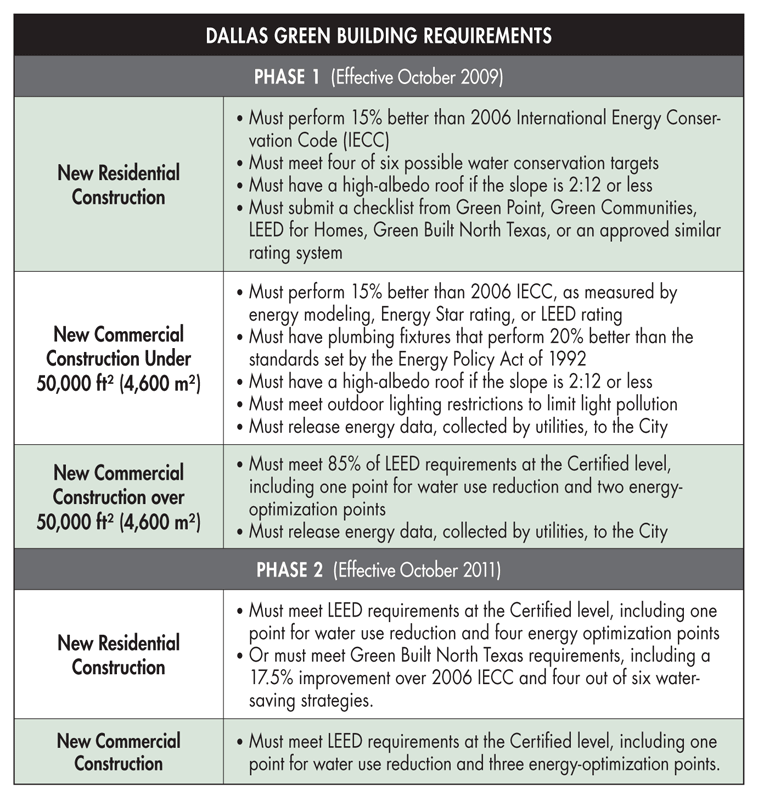
Both Los Angeles and Dallas passed legislation in April 2008 requiring privately owned buildings to meet green building standards. The Los Angeles legislation requires commercial and residential buildings larger than 50,000 ft2 (4,600 m2) to meet the U.S. Green Building Council’s LEED Certified standards (with expedited permitting for higher levels of performance) but does not require buildings to be certified. Instead, plans must be approved by a LEED accredited professional as well as the City before a building permit is issued. In Dallas, all new residential and commercial construction must meet energy and water conservation goals starting in October 2009 and must be LEED certifiable by October 2011. Dallas is training existing staff and adding green building experts to assist with the added work in the permitting process.

Published December 31, 1969

(2008, May 29). Major Cities Require Private Buildings to Go Green. Retrieved from https://www.buildinggreen.com/departments/newsbrief

Add new comment

To post a comment, you need to register for a BuildingGreen Basic membership (free) or login to your existing profile.

Strong Growth for Unvented Gas Heaters, Despite Hazards

News Brief

Strong Growth for Unvented Gas Heaters, Despite Hazards

While U.S. factory shipments were lower in 2007 than 2006 for nearly all residential appliances, according to the March 2008 issue of

Appliance magazine, factory shipments of unvented gas room heaters increased 43% during this period—from about 197,000 to 281,000 units. Dehumidifier shipments also increased significantly (38%), while shipments of refrigerators, clothes washers, and built-in dishwashers were all down (by 6.1%, 7.1%, and 3.6%, respectively).

EBN, among others, has argued that unvented gas heaters should be prohibited, since they introduce combustion gases to the home, reducing indoor air quality (see

EBN

Vol. 15, No. 5).

Published December 31, 1969

(2008, May 29). Strong Growth for Unvented Gas Heaters, Despite Hazards. Retrieved from https://www.buildinggreen.com/departments/newsbrief

Add new comment

To post a comment, you need to register for a BuildingGreen Basic membership (free) or login to your existing profile.

Insurers Promote Green Rebuilding

News Brief

Insurers Promote Green Rebuilding

Recognizing the durability benefits of green buildings, insurance company Fireman’s Fund began offering green rebuilding policies for commercial properties in 2006. These policies cover the cost premium for adding green features when a building is repaired or replaced. Covered upgrades include efficient lighting and plumbing, vegetated roofs, and finishes with low levels of volatile organic compounds as well as certification through a program such as LEED or Green Globes.

Now three other insurers, Travelers, ACE USA, and Lexington Insurance, are offering similar green upgrade coverage for commercial buildings. One company, Lexington, introduced a residential policy in November 2007; the policy adds 3% to the cost of standard coverage. Another form of green building policy, available from some insurers, will compensate owners of damaged renewable energy installations not only for the cost of the equipment itself but also for the interruption in revenue from selling electricity to the grid and for the cost of purchasing electricity while the system is offline.

Published December 31, 1969

(2008, May 29). Insurers Promote Green Rebuilding. Retrieved from https://www.buildinggreen.com/departments/newsbrief


Add new comment

To post a comment, you need to register for a BuildingGreen Basic membership (free) or login to your existing profile.

EU Bans DecaBDE Flame Retardant

News Brief

EU Bans DecaBDE Flame Retardant

In 2003, the European Union exempted the flame retardant deca polybrominated diphenyl ether (decaBDE), used in building materials as well as electronics and furnishings, from the RoHS (Restriction of Hazardous Substances in Electrical and Electronic Equipment) Directive, which restricts the use of brominated flame retardants (see

EBN

Vol. 13, No. 8).

That exemption has now been overturned by the European Court of Justice. To comply with the European ban and to address growing concerns about the chemical, a number of large electronics manufacturers have discontinued or plan to discontinue its use worldwide. In the U.S., numerous states have passed or are considering a ban.

Published December 31, 1969

(2008, May 29). EU Bans DecaBDE Flame Retardant. Retrieved from https://www.buildinggreen.com/departments/newsbrief

Add new comment

To post a comment, you need to register for a BuildingGreen Basic membership (free) or login to your existing profile.

GBI National Standard Released for Public Comment

News Brief

GBI National Standard Released for Public Comment

In 2005, the American National Standards Institute (ANSI) accredited the Green Building Initiative (GBI) as a standards developer, and GBI began working to turn its green building rating system, Green Globes, into an ANSI-accredited standard (see

EBN

Vol. 14, No. 11). A draft of that standard, known as the GBI Proposed American National Standard—along with a life-cycle assessment (LCA) credit calculator and a water consumption calculator for use with the standard—has been released for public comment.

The LCA calculator assigns credits based on data from the Athena EcoCalculator for common building assemblies as well as user-entered data about a project (see

EBN Vol. 16, No. 3). The water calculator uses several factors—including user-entered information about plumbing fixtures, number of occupants, and hours of occupancy—to estimate total water usage. GBI will accept comments on the standard and the calculators through June 9, 2008. More information is available at www.thegbi.org.

Published December 31, 1969

(2008, May 29). GBI National Standard Released for Public Comment. Retrieved from https://www.buildinggreen.com/departments/newsbrief

Add new comment

To post a comment, you need to register for a BuildingGreen Basic membership (free) or login to your existing profile.

Groups Petition EPA to Regulate Nanosilver

News Brief

Groups Petition EPA to Regulate Nanosilver

In November 2006, the U.S. Environmental Protection Agency (EPA) issued guidance for a washing machine that uses nanoparticles of silver, regulating the machine as a pesticide (see

EBN

Vol. 16, No. 1). At that time, EPA decided not to create broader rules governing nanosilver in general.

In response to what it sees as a failure by EPA to act, a group of nonprofit organizations led by the International Center for Technology Assessment has filed a petition demanding that nanosilver be classified and regulated as a pesticide. The petition also calls for further study of nanosilver and action against companies using nanosilver without pesticide labeling and precautions. The signatories on the petition include Beyond Pesticides, Friends of the Earth, Greenpeace, and the Center for Environmental Health, among others. The petition is available at www.nanoaction.org (click on “legal actions”). For more information on nanotechnology, see

EBN

Vol. 17, No. 3.

Published December 31, 1969

(2008, May 29). Groups Petition EPA to Regulate Nanosilver. Retrieved from https://www.buildinggreen.com/departments/newsbrief

Add new comment

To post a comment, you need to register for a BuildingGreen Basic membership (free) or login to your existing profile.

L.A. Community Colleges on the Road to Energy Independence

News Brief

L.A. Community Colleges on the Road to Energy Independence

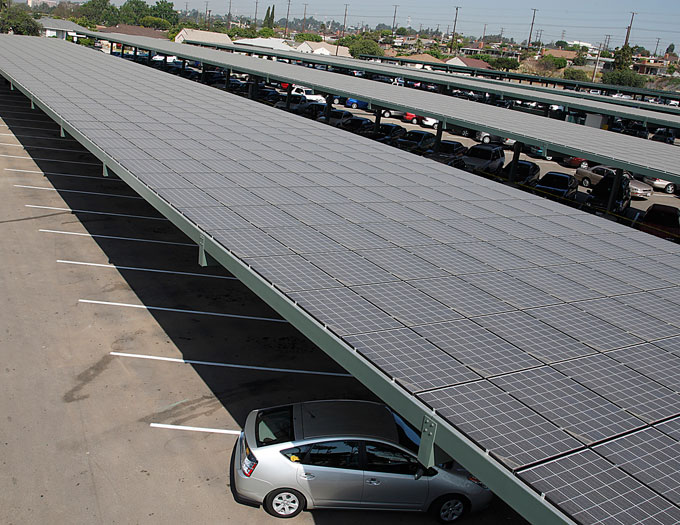
To celebrate Earth Day on April 22, 2008, students, faculty, and administrators at East Los Angeles College threw the switch on a 1.2-MW, $9-million solar array, located in one of the school’s parking areas, that will provide 45% of the college’s electricity. The array is part of a larger plan by the Los Angeles Community College District to provide renewable energy for all of its nine colleges. Funding for the project came in part from Southern California Edison, which offers incentives for renewable energy projects. Chevron Energy Solutions and MMA Renewable Ventures were also partners in the project. More information is available at www.laccdbuildsgreen.org.

Published December 31, 1969

(2008, May 29). L.A. Community Colleges on the Road to Energy Independence. Retrieved from https://www.buildinggreen.com/departments/newsbrief

Add new comment

To post a comment, you need to register for a BuildingGreen Basic membership (free) or login to your existing profile.

Home Depot Partners with Habitat on Green Affordable Housing

News Brief

Home Depot Partners with Habitat on Green Affordable Housing

Habitat for Humanity International has partnered with the Home Depot Foundation to create Partners in Sustainable Building, an initiative to encourage green building in affordable housing. The program will offer $30 million over five years to Habitat affiliates to offset the higher first costs of green building in up to 5,000 homes. According to Marty Koistra, senior director of global program design and implementation for Habitat, groups will be able to apply for a $2,000 grant for each home built to Energy Star with Indoor Air Quality standards, and for a $4,000 grant for each home built to higher green standards such as LEED for Homes or regional green building programs such as Earthcraft. The program will also provide training and technical support. A one-year pilot program will begin in 2008, with the larger national program scheduled to launch in early 2009 and continue for four years. More information is available at www.habitat.org/env/default.aspx.

Published December 31, 1969

(2008, April 29). Home Depot Partners with Habitat on Green Affordable Housing. Retrieved from https://www.buildinggreen.com/departments/newsbrief

Add new comment

To post a comment, you need to register for a BuildingGreen Basic membership (free) or login to your existing profile.