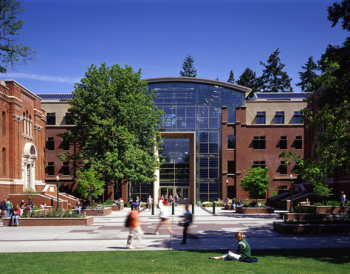
Top Architecture Department Launches Sustainability Ph.D. Program

News Brief

Top Architecture Department Launches Sustainability Ph.D. Program

The University of Oregon’s architecture department recently launched the state’s first doctoral program in sustainable design. According to the university, the Ph.D. program will focus on interdisciplinary investigations. Research topics will include design and policy for sustainable cities and livable communities; design for climate change and adaptation; high-performance building envelopes; net-zero buildings and eco-districts; resource forecasting; indoor environmental quality and occupants’ health; and life-cycle building analysis design and modeling. Collaboration between doctoral students and the architecture department’s research and lab work will ensure student engagement in teaching and research fellowships providing up to four years of funding. For more information visit architecture.uoregon.edu.


Published December 31, 1969

(2010, November 15). Top Architecture Department Launches Sustainability Ph.D. Program. Retrieved from https://www.buildinggreen.com/departments/newsbrief

Add new comment

To post a comment, you need to register for a BuildingGreen Basic membership (free) or login to your existing profile.

Model Building Code Now 30% More Energy Efficient

News Brief

Model Building Code Now 30% More Energy Efficient

Changes made to the International Energy Conservation Code (IECC) will increase the predicted energy efficiency of homes and commercial buildings by 30% over ASHRAE Standard 90.1-2004. Members of the International Code Council (ICC) approved the changes nearly unanimously in October 2010; they will be available for jurisdictions to adopt in April 2011, when the 2012 IECC is published.

Many of the changes relevant to commercial buildings came from a joint proposal developed by the New Buildings Institute (NBI), The American Institute of Architects, and the U.S. Department of Energy. Based on NBI’s Core Performance protocol, the new requirements include the addition of a continuous air barrier, HVAC economizers in more climate zones than in the old code, and lighting control systems that respond to daylight and occupancy needs. For the first time, IECC also requires basic commissioning for building systems to ensure they are running at peak efficiency.

Another package of changes brought by the Energy Efficient Codes Coalition and the Institute for Market Transformation (IMT) updated the residential side of the energy codes. The energy chapter of the International Residential Code was removed and replaced with the residential components of IECC. At the same time, residential requirements in IECC were adjusted to include increased window performance, increased insulation requirements, better duct-sealing measures, and greater lighting efficiency, among other things. The fact that builders will now have to prove airtightness achievement with a blower-door test was particularly controversial.

“The often contentious process of developing codes was largely avoided in this case because of the extensive outreach and collaboration that was undertaken to gain industry support for the proposals,” said Dave Hewitt, NBI executive director. By bringing packages of changes—rather than individual changes—the organizations were able to streamline the code development process and win broad support in the industry.

The result is perhaps the biggest improvement in energy efficiency ever achieved in a single code update. “In the 10 years I’ve been attending ICC code hearings, I have never seen a larger single stride taken for energy efficiency,” said Dick Meyer, building codes program director at IMT.

The advocacy group Architecture 2030 noted that having the code require 30% improvement over ASHRAE 90.1-2004 aligns it with the 2030 Challenge’s 2006 goal of 50% energy savings. This update was approved by code officials, which should improve its chances of adoption by states and local governments, but is no guarantee.

For more information:

New Buildings Institute

www.newbuildings.org

Institute for Market Transformation

www.imt.org

 

Published December 31, 1969

(2010, November 9). Model Building Code Now 30% More Energy Efficient. Retrieved from https://www.buildinggreen.com/departments/newsbrief

Add new comment

To post a comment, you need to register for a BuildingGreen Basic membership (free) or login to your existing profile.

Scientists Speak Out Against Halogenated Flame Retardants

News Brief

Scientists Speak Out Against Halogenated Flame Retardants

A statement published online by Environmental Health Perspectives

and signed by 145 scientists worldwide argues that we should stop using brominated and chlorinated flame retardants (BFRs and CFRs, respectively), which the scientists consider to be persistent, bioaccumulative, and toxic. The San Antonio Statement, as the piece is called, also calls for an end to a pattern of substitution in which one harmful chemical is replaced with an alternative of unknown toxicity.

In an editorial accompanying the statement, Linda Birnbaum, director of the National Institutes of Health and Human Services, and Åke Bergman, professor of environmental chemistry at Stockholm University, write that the San Antonio Statement is primarily a call to end a pattern of “unfortunate substitution.” They write, “Since the 1970s, BFRs and CFRs have commonly served as substitutes for other BFRs and CFRs, even though there have been early warnings and periodic reminders about the problematic properties of these chemicals.”

They refer to the case of polybrominated biphenyl (PBB) flame retardants, which were accidentally mixed with livestock feed in Michigan in the 1970s; the government destroyed thousands of animals and banned PBBs. Manufacturers switched to a chemically very similar class of compounds, polybrominated diphenyl ethers (PBDEs), that weren’t known to be toxic. But concerns about PBDEs have emerged as these chemicals have been found in increasing amounts in human breast milk and the evidence of negative human health effects grows (see “Flame Retardants Under Fire,” EBN June 2004).

In their statement, the scientists call for increased transparency about human health and environmental impacts of BFRs and CFRs, and demand further testing of alternative chemicals to ensure safety. They also call for alternatives to flame retardants in general. “The process of identifying alternatives to flame retardants should include not only alternative chemicals but also innovative changes in the design of products, industrial processes, and other practices that do not require the use of any flame retardant,” the statement says.


Published December 31, 1969

(2010, November 9). Scientists Speak Out Against Halogenated Flame Retardants. Retrieved from https://www.buildinggreen.com/departments/newsbrief

Add new comment

To post a comment, you need to register for a BuildingGreen Basic membership (free) or login to your existing profile.

Titanium Dioxide Nanoparticles May Be Environmentally Disruptive

News Brief

Titanium Dioxide Nanoparticles May Be Environmentally Disruptive

According to a new Northeastern University study, titanium dioxide nanoparticles (nTiO2) can disrupt photosynthetic organisms vital to aquatic ecosystems. Long used in paints, coatings, cement, and tile to create bright white coloring, titanium dioxide is now used in nanoparticle form in cosmetics, sunscreens, food coloring, and even building products, particularly white concrete products that are claimed to clean the air (see “Clean Concrete—and Air—with TX Active,”

EBN May 2007). April Gu, Carla Cherchi, and other environmental engineers studied how nTiO2 affects one blue-green algae organism that contributes to aquatic nitrogen and carbon cycles. The researchers found that algae growth was reduced by 90% and nitrogen fixation activity was diminished when the organisms were exposed to nTiO2 at levels similar to those found in wastewater. Effects increased with exposure time and nTiO2 concentrations. The laboratory study did not evaluate the effect of titanium nanoparticles in the environment, or whether such particles are released from common products. For more information visit www1.coe.neu.edu.

Published December 31, 1969

(2010, October 29). Titanium Dioxide Nanoparticles May Be Environmentally Disruptive. Retrieved from https://www.buildinggreen.com/departments/newsbrief

Add new comment

To post a comment, you need to register for a BuildingGreen Basic membership (free) or login to your existing profile.

"Solar Leaf" Prototype Can Produce Electricity

News Brief

"Solar Leaf" Prototype Can Produce Electricity

A new kind of solar cell, inspired by the process of photosynthesis in plants, has been developed by scientists at North Carolina State University. Hyung-Jun Koo, Orlin Velev, and others have impregnated a water-based gel with photosensitive molecules that produce electricity when exposed to sunlight. The gel is enclosed within two electrodes and embedded with two photosensitive ionic dyes. Two common plant compounds (including chlorophyll) are also included. This combination can generate as much or more electricity as other photovoltaic (PV) technologies that seek to mimic photosynthesis, and it could become a cheaper, less environmentally harmful alternative to silicon solar cells. The water-based gel is made with agarose, a natural polysaccharide. The hydrogel PV device is a prototype; further development is required to create an efficient, durable artificial “leaf.”

Published December 31, 1969

(2010, October 29). "Solar Leaf" Prototype Can Produce Electricity. Retrieved from https://www.buildinggreen.com/departments/newsbrief

Add new comment

To post a comment, you need to register for a BuildingGreen Basic membership (free) or login to your existing profile.

Rhode Island First to Adopt International Green Construction Code

News Brief

Rhode Island First to Adopt International Green Construction Code

Published December 31, 1969

(2010, October 29). Rhode Island First to Adopt International Green Construction Code. Retrieved from https://www.buildinggreen.com/departments/newsbrief

Add new comment

To post a comment, you need to register for a BuildingGreen Basic membership (free) or login to your existing profile.

External Power Adapters Removed from Energy Star

News Brief

External Power Adapters Removed from Energy Star

Published December 31, 1969

(2010, October 29). External Power Adapters Removed from Energy Star. Retrieved from https://www.buildinggreen.com/departments/newsbrief

Add new comment

To post a comment, you need to register for a BuildingGreen Basic membership (free) or login to your existing profile.

Yahoo! Data Center Sets High Marks for Efficiency

News Brief

Yahoo! Data Center Sets High Marks for Efficiency

Published December 31, 1969

(2010, October 29). Yahoo! Data Center Sets High Marks for Efficiency. Retrieved from https://www.buildinggreen.com/departments/newsbrief

Add new comment

To post a comment, you need to register for a BuildingGreen Basic membership (free) or login to your existing profile.

NEMA Voluntarily Reduces Mercury in CFLs, Again

News Brief

NEMA Voluntarily Reduces Mercury in CFLs, Again

A new voluntary commitment from National Electrical Manufacturers Association (NEMA) reduces the maximum mercury content in U.S. residential compact fluorescent lamps (CFLs) by a milligram (mg) more than a 2007 commitment. The move became effective in October 2010 and allows 4 mg of mercury per lamp in CFLs of less than 25 watts and 5 mg in CFLs of 25–40 watts. A dozen companies have made the 2010 commitment, and NEMA has made the voluntary program available to all U.S. manufacturers of self-ballasted CFLs. This voluntary reduction supports NEMA’s efforts to reduce the use of hazardous substances in electrical devices. NEMA continues to stress the importance of proper handling and disposal of CFLs. According to NEMA, CFLs with reduced mercury content are as effective and efficient as products with standard mercury concentrations. Based on this commitment, an updated NEMA LL-8 standard is expected soon. For more information visit www.cfl-mercury.org.

Published December 31, 1969

(2010, October 29). NEMA Voluntarily Reduces Mercury in CFLs, Again. Retrieved from https://www.buildinggreen.com/departments/newsbrief

Add new comment

To post a comment, you need to register for a BuildingGreen Basic membership (free) or login to your existing profile.

DOE Proposes New Refrigerator Standard for 2014

News Brief

DOE Proposes New Refrigerator Standard for 2014

The U.S. Department of Energy (DOE) has proposed a more stringent energy standard for residential refrigerators. The standard would result in a 20%–25% energy use reduction in most refrigerator-freezers by 2014. The common refrigerator model with the freezer on top would see a reduction in use of about 500 kilowatt hours per year from that of a similar model in 1990. If adopted, the new standard will save consumers over $18 billion and prevent 305 million metric tons of CO2 emissions over the next 30 years, according to DOE. The Association of Home Appliance Manufacturers and other associations involved in an August 2010 statement calling for stricter efficiency standards have expressed their support of the new standard. The proposal is available for public comment until November 26, 2010. The final standard will be issued in December 2010 and become effective in January 2014. For more information visit www.energy.gov..

Published December 31, 1969

(2010, October 29). DOE Proposes New Refrigerator Standard for 2014. Retrieved from https://www.buildinggreen.com/departments/newsbrief

Add new comment

To post a comment, you need to register for a BuildingGreen Basic membership (free) or login to your existing profile.