Procter & Gamble Breaks New Ground with LEED Commitment

News Brief

Procter & Gamble Breaks New Ground with LEED Commitment

One of the world’s largest manufacturers of personal products has committed to pursuing LEED certification for all new facilities worldwide. Procter & Gamble (P&G) broke ground in February 2011 on the first site for which it will seek a LEED rating—a manufacturing plant in Taicang, Jiangsu Province, China. According to P&G, its commitment to pursuing LEED will include all new office buildings, research facilities, and manufacturing and distribution centers. Maggie Habib, a spokeswoman for the company, said there were no current plans to pursue LEED certification for existing facilities.

The commitment to green building is part of a long-term sustainability plan undertaken by the global company in late 2010 with the help of the World Wildlife Fund and other partners. “LEED certified green buildings contribute to saving energy, water, and money,” said Doug Gatlin, vice president of the U.S. Green Building Council, in a press release. “P&G pursuing LEED certification represents a firm commitment to improving our environment for future generations.”

The facility in Taicang is designed to include rainwater harvesting and steam condensate recovery; photovoltaics to power outdoor lighting; and a waste management plan with a goal of zero waste in landfills. The company says it will pursue additional certifications through other rating systems in countries where LEED is not the standard.

P&G, based in Cincinnati, Ohio, manufactures many well-known brands, including Tide, Pampers, and Gillette.

For more information:


Procter & Gamble

pg.com/sustainability


Published December 31, 1969

(2011, March 3). Procter & Gamble Breaks New Ground with LEED Commitment. Retrieved from https://www.buildinggreen.com/departments/newsbrief

Add new comment

To post a comment, you need to register for a BuildingGreen Basic membership (free) or login to your existing profile.

Cooling Giants Introduce Smaller Thermal Storage Units

Product Review

Cooling Giants Introduce Smaller Thermal Storage Units

Thermal energy storage (TES) is mostly used in our largest buildings, but that may finally change. Two major manufacturers of rooftop air conditioning units, Trane and Carrier, have teamed up with Ice Energy to offer “ice-ready” equipment compatible with Ice Bear TES technology. The “plug-and-play” equipment will allow owners of small and medium-size commercial buildings to save money by using off-peak power for cooling. In addition to saving money, using off-peak power for cooling often offers environmental benefits as well—both by reducing the need for utilities to fire up supplemental power plants and by making it easier to incorporate renewable energy sources into the mix. If significant wind power is generated at night today, there is often no market for it; with greater use of TES, the market for nighttime wind power could grow.

The Ice Bear TES system does most of its chilling at night during off-peak hours; the energy is stored as ice, which is used during the heat of the day to cool the building (See EBN “Buildings on Ice: Making the Case for Thermal Energy Storage,”

Published December 31, 1969

(2011, February 28). Cooling Giants Introduce Smaller Thermal Storage Units. Retrieved from https://www.buildinggreen.com/departments/newsbrief

Infrastructure Rating System Coming from Engineering Group

News Brief

Infrastructure Rating System Coming from Engineering Group

We’ve seen numerous green rating systems for buildings, but there is currently no comprehensive way to rate the sustainability of structures like bridges and water treatment plants.

Now three engineering organizations have joined together to form the Institute for Sustainable Infrastructure (ISI) in order to develop a rating system for infrastructure projects. Set to launch this summer, the new rating system will evaluate environmental and social impacts of projects ranging from roads and bridges to energy and water systems. According to the American Society of Civil Engineers, which founded ISI along with the American Council of Engineering Companies and the American Public Works Association, the Web-based tool will focus on performance and will be adaptable based on project size and complexity in order to maximize its utility for both federal and local projects. The rating system will also allow users to opt for either self-assessment or third-party certification. For more information, visit www.asce.org.

Published December 31, 1969

(2011, February 28). Infrastructure Rating System Coming from Engineering Group. Retrieved from https://www.buildinggreen.com/departments/newsbrief

Add new comment

To post a comment, you need to register for a BuildingGreen Basic membership (free) or login to your existing profile.

STAR Green Community Rating System Launching This Year

News Brief

STAR Green Community Rating System Launching This Year

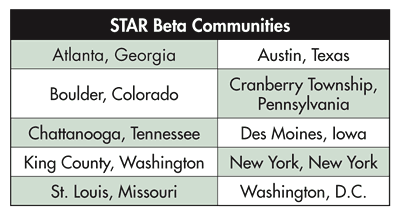
The STAR Community Index, a livability and sustainability rating system for communities, is launching this year with ten participating “beta communities.” Developed by ICLEI–Local Governments for Sustainability in partnership with the U.S. Green Building Council and the Center for American Progress, the STAR rating system is inspired by the LEED rating system but goes beyond measures of buildings and even neighborhoods to look at healthcare access, affordable housing, and green jobs, among other measures. STAR defines 81 sustainability goals and employs a variety of sustainability metrics considering policy, practices, and performance benchmarks in the categories of environment, economy, and society. The ten beta communities, chosen for their commitment to sustainability and their already-developed resources for tracking performance and progress, will help launch the program by providing feedback and by helping design online tools for use across the U.S. Other towns, cities, and counties will be able to participate in the STAR rating program beginning in 2012.


Published December 31, 1969

(2011, February 28). STAR Green Community Rating System Launching This Year. Retrieved from https://www.buildinggreen.com/departments/newsbrief

Add new comment

To post a comment, you need to register for a BuildingGreen Basic membership (free) or login to your existing profile.

Obama Introduces 'Better Building' Plan

News Brief

Obama Introduces 'Better Building' Plan

President Obama recently put forward the Better Buildings Initiative, an incentive program designed to stimulate spending on energy-efficient retrofits for commercial buildings. The initiative not only promotes efficiency but also aims to create jobs in the building and manufacturing industries hit hardest by the crash of the construction sector. Despite the long-term economic benefits of energy efficiency, building owners often have trouble raising capital to make improvements. To solve this problem, while aiming to increase the efficiency of commercial buildings 20% by 2020, Obama’s initiative proposes loan guarantees and corporate tax credits, and aims to reward local and state governments for taking a leadership role in requiring better building performance. Business and political leaders and industry groups have praised the initiative, saying it will create green jobs in the design, construction, and manufacturing industries for years to come.

Published December 31, 1969

(2011, February 28). Obama Introduces 'Better Building' Plan. Retrieved from https://www.buildinggreen.com/departments/newsbrief

Add new comment

To post a comment, you need to register for a BuildingGreen Basic membership (free) or login to your existing profile.

Southern California Slashes VOC Limits for Paints and Coatings

News Brief

Southern California Slashes VOC Limits for Paints and Coatings

The South Coast Air Quality Management District (SCAQMD), which sets policy in four Southern California counties, is updating its standards regarding volatile organic compounds (VOCs) in paints and other coatings. The proposed changes would cut maximum VOC limits in half for primers, special primers, sealers, and undercoaters from 100 grams per liter (g/L) to 50 g/L, and would also slash VOC maximums for a number of specialized coating types.

Another proposed change would limit VOCs to 50 g/L in colorants that are added to base paint at the point of sale. Even when base paints have low levels of VOCs, many tints, which are currently unregulated, can elevate VOC levels in the final product. While the proposed changes apply only within SCAQMD, the new standards will have an impact throughout California and even the entire U.S., because large paint manufacturers will need to change their formulas in order to sell products in densely populated Los Angeles, Orange, San Bernar-dino, and Riverside counties, and because the influential LEED rating system references the standards. The measure will come to a vote April 1, 2011, and many of the changes, if approved, would take effect in January 2012.

Published December 31, 1969

(2011, February 28). Southern California Slashes VOC Limits for Paints and Coatings. Retrieved from https://www.buildinggreen.com/departments/newsbrief

Add new comment

To post a comment, you need to register for a BuildingGreen Basic membership (free) or login to your existing profile.

$100 Million in Grants Offered to New York Data Centers

News Brief

$100 Million in Grants Offered to New York Data Centers

The State of New York is offering technical assistance and grant money to help data centers achieve greater energy efficiency. Data centers are notoriously energy-intensive, requiring large quantities of electricity to power computers as well as HVAC equipment to keep the computers cool—often during hours of peak demand.

The incentive program, funded and managed by the New York State Energy Research and Development Authority (NYSERDA) in partnership with utility Con Edison and technology giant IBM, will provide up to $5 million per facility per year (up to 50% of the total cost) for energy-efficiency projects, which may include facility renovations and IT equipment upgrades.

According to NYSERDA, New York has the second-highest concentration of data centers in the country. The program aims to cut total energy use by 55,000 megawatt-hours per year, representing savings of $8 million for the data centers.

Published December 31, 1969

(2011, February 28). $100 Million in Grants Offered to New York Data Centers. Retrieved from https://www.buildinggreen.com/departments/newsbrief

Add new comment

To post a comment, you need to register for a BuildingGreen Basic membership (free) or login to your existing profile.

UL Launches Environmental Product Declaration Program

News Brief

UL Launches Environmental Product Declaration Program

UL Environment, the environmentally focused subsidiary of international product-testing organization Underwriters Laboratories (UL), has launched an Environmental Product Declaration (EPD) program. The EPD program will provide a multi-attribute label documenting the life-cycle impact of a product, including such indicators as greenhouse gas emissions and use of primary energy.

The label will be standardized across many product categories and will require third-party-verified life-cycle assessment—meaning that the EPD accounts for environmental impacts from acquisition of raw materials through disposal or recycling. According to UL Environment’s website, its EPD product categories so far include structural steel, laminate flooring, carpet tiles, window films, and a variety of other building materials, lighting products and textiles. For more information, visit www.ulenvironment.com.

Published December 31, 1969

(2011, February 28). UL Launches Environmental Product Declaration Program. Retrieved from https://www.buildinggreen.com/departments/newsbrief

Add new comment

To post a comment, you need to register for a BuildingGreen Basic membership (free) or login to your existing profile.

Federal Judge Upholds Washington Energy Codes

News Brief

Federal Judge Upholds Washington Energy Codes

A federal judge in Tacoma, Washington, has upheld the state’s right to regulate the overall energy efficiency of buildings, even if complying with such codes could involve the purchase of equipment that is more efficient than federal regulations require.

According to federal law, states may set building codes, but the federal government sets efficiency standards for appliances, such as HVAC equipment; states may not preempt the federal government by setting appliance codes that exceed federal standards. While the new Washington building efficiency rules passed in November 2009 do not directly preempt federal appliance codes, the Building Industry Association of Washington filed suit against the Washington State Building Code Council in May 2010, claiming that the updated codes effectively set higher-than-federal standards on HVAC equipment. The judge disagreed, however, saying that there are other ways to comply with the code aside from purchasing high-efficiency equipment, such as improving insulation.

The new state standards apply only to new construction and are expected to increase both residential and commercial building efficiency 15%–18%.

Published December 31, 1969

(2011, February 28). Federal Judge Upholds Washington Energy Codes. Retrieved from https://www.buildinggreen.com/departments/newsbrief

Add new comment

To post a comment, you need to register for a BuildingGreen Basic membership (free) or login to your existing profile.

Parts of Obama's 'Better Buildings' Plan Ready to Go

News Brief

Parts of Obama's 'Better Buildings' Plan Ready to Go

President Obama yesterday put forward a Better Buildings Initiative, an incentive program designed to stimulate spending on energy-efficient retrofits for commercial buildings. The initiative not only promotes efficiency but also aims to create jobs in the building and manufacturing industries hit hardest by the crash of the construction sector.

Despite the long-term economic benefits of energy efficiency, building owners often have trouble raising capital to make improvements. To solve this problem, while aiming to increase the efficiency of commercial buildings 20% by 2020, Obama’s initiative proposes loan guarantees and corporate tax credits, and aims to reward local and state governments for taking a leadership role in requiring better building performance. Business and political leaders and industry groups have praised the initiative, saying it will create green jobs in the design, construction, and manufacturing industries for years to come.

Although many items on the president’s list will require legislation, federal agencies can take preliminary steps using existing authority, says Lane Burt, director of technical policy at the U.S. Green Building Council (USGBC). A pilot program guaranteeing loans for building owners, for example, could “run through existing programs at the Department of Energy,” he told EBN. And while tax credits for green upgrades will need Congressional approval, Burt explained, existing tax incentives like the Commercial Building Tax Deduction (CBTD) could improve almost immediately. “The deduction was designed for energy-efficient new construction,” said Burt, so it can be difficult and confusing to claim the deduction for retrofits. But he said the Internal Revenue Service would soon clarify its guidance on how to use the CBTD for improvements, potentially helping more building owners deduct as much as $1.80/ft2 from their gross income on tax forms.

The proposed tax credits (which directly decrease a taxpayer’s final tax liability) are more lucrative incentives, said Burt, but improving the CBTD while Congress debates the tax credits will help.

While Burt would not speculate on the exact timing of legislative action on the Better Buildings Initiative, acknowledging that “getting across the finish line is not easy,” he did not think the initiative would be controversial: “Energy efficiency is pretty much universally agreed upon,” he said.


Published December 31, 1969

(2011, February 4). Parts of Obama's 'Better Buildings' Plan Ready to Go. Retrieved from https://www.buildinggreen.com/departments/newsbrief

Add new comment

To post a comment, you need to register for a BuildingGreen Basic membership (free) or login to your existing profile.