Sustainability Survey Suggests Green Office Space is Valuable

News Brief

Sustainability Survey Suggests Green Office Space is Valuable

Half of corporate tenants were willing to pay higher rent for higher-performing buildings.

Fifty percent of corporate real estate executives were willing to pay higher rent for green office space in 2010—up 13% from 2009—according to the fourth annual international Sustainability Survey conducted by CoreNet Global and Jones Lang LaSalle. That number jumps to 73% when you add executives who said they would pay more if the cost were offset by lower energy bills. Nearly 50% would pay up to 10% more for sustainable office space, while only 2% would pay more than 10%. Of those surveyed, 92% consider sustainability criteria when choosing their location; 31% of corporate executives consider employee productivity and health their top sustainability concern. Dan Probst, chairman of energy and sustainability services at Jones Lang LaSalle, commented, “Five years ago, a corporate real estate executive might have thought sustainability was a costly way to make the company look good to employees. Two years ago, that same executive probably focused on energy management as a way to save money in the short run. Today, he or she may be pursuing green strategies that enhance employee productivity.”


Published December 31, 1969

(2011, March 30). Sustainability Survey Suggests Green Office Space is Valuable. Retrieved from https://www.buildinggreen.com/departments/newsbrief

Add new comment

To post a comment, you need to register for a BuildingGreen Basic membership (free) or login to your existing profile.

EcoBatt Maker Sues over Biobased Binder

News Brief

EcoBatt Maker Sues over Biobased Binder

Knauf Insulation, the manufacturer of EcoBatt, is suing competitor CertainTeed for patent infringement. CertainTeed’s undyed Sustainable Insulation, introduced in 2010, has the same mottled brown look as EcoBatt, introduced in 2008. EcoBatt’s color comes from its biobased Ecose binder, which U.S. patent documents suggest is sugar-based and relies on a chemical process called Maillard browning (caused by heating sugars and proteins together).

CertainTeed told EBN in May 2010 that its biobased binder has an initial chemical composition similar to that of a sugar (see “CertainTeed Introduces a Formaldehyde-Free Batt Insulation,”  EBN June 2010), but both companies’ processes are closely guarded, precluding a comparison of the two binders unless the lawsuit results in their public disclosure. In a statement, CertainTeed denied Knauf’s allegations, claiming it has its own “unique and proprietary sustainable insulation binder formulation” and has “filed patent applications throughout the world on this formulation.”

EBN could not confirm CertainTeed’s claim.


Published December 31, 1969

(2011, March 30). EcoBatt Maker Sues over Biobased Binder. Retrieved from https://www.buildinggreen.com/departments/newsbrief

Add new comment

To post a comment, you need to register for a BuildingGreen Basic membership (free) or login to your existing profile.

Universities Receive Millions to Study Nano Risks

News Brief

Universities Receive Millions to Study Nano Risks

By Paula MeltonThe U.S. Environmental Protection Agency (EPA) has awarded $5.5 million to three different research groups studying the health and environmental risks of nanotechnology—the science of manipulating very small particles in order to take advantage of unique properties displayed only at the molecular level. While nanomaterials such as antimicrobial “nanosilver” particles and thin-film photovoltaics are of increasing interest as a way to reduce manufacturing costs while increasing performance, the widespread use of nanotechnology has unknown effects (see “Is Nano a No-No? Nanotechnology Advances into Buildings,”

EBN Mar. 2008). Some nano-scale versions of common substances are toxic to humans. Also, nanoparticles are known to cross the human placenta, and research suggests that they can accumulate, undigested, in protozoan predators, earthworms, and tobacco hornworms (see “Nanosilver Particles Raise New Concerns,” EBN Sept. 2010). According to EPA, the newly funded research will focus on leaching and toxicity of certain nanomaterials, both during use and after disposal. For more information, visit www.epa.gov/nanoscience.

Published December 31, 1969

(2011, March 30). Universities Receive Millions to Study Nano Risks. Retrieved from https://www.buildinggreen.com/departments/newsbrief

Add new comment

To post a comment, you need to register for a BuildingGreen Basic membership (free) or login to your existing profile.

California Legislation Requires Carpet Recycling

News Brief

California Legislation Requires Carpet Recycling

By Emily CatacchioThe California Carpet Stewardship Bill (AB 2398) signed into law in October 2010 requires carpet retailers to help divert used carpet from landfills. Retailers are now required to create and implement a carpet-recycling plan to increase the percentage of post-consumer carpet diverted from the landfill. The nonprofit Carpet America Recovery Effort (CARE) is developing a carpet stewardship program that retailers can choose to participate in to meet AB 2398 requirements; otherwise, retailers must submit their own diversion implementation plan—including consumer education, fees, progress measurement, and annual reporting—to the California Department of Resources, Recycling, and Recovery (CalRecycle). Beginning July 1, 2011, California retailers will charge customers a fee of $0.05 per square yard for all new carpet purchased; the revenue will fund post-consumer carpet recycling measuers. CalRecycle will list compliant manufacturers on its website and enforce penalties for noncompliance. The Department of General Services will complete a study by January 1, 2014 with recommendations for changes to NSF/ANSI 140-2007 Standard, Platinum Level (a third-party, multi-attribute national standard for sustainable carpet) based on the outcomes of this program. For more information, visit www.carpetrecovery.org.

Published December 31, 1969

(2011, March 30). California Legislation Requires Carpet Recycling. Retrieved from https://www.buildinggreen.com/departments/newsbrief

Add new comment

To post a comment, you need to register for a BuildingGreen Basic membership (free) or login to your existing profile.

Schooled in Sustainability: STARS Grades First Campuses

News Brief

Schooled in Sustainability: STARS Grades First Campuses

By Paula MeltonSchooled in Sustainability: STARS Grades First Campuses—Thirty-nine colleges and universities have received sustainability ratings through the new Sustainability Tracking Assessment & Rating System (STARS). Nine schools got a gold rating, twenty got a silver rating, nine got a bronze rating, and one reported its data without requesting a rating. The STARS program rates institutions based on self-reported indicators that include sustainability education and research; efficiency of operations, including measures of energy, carbon, water, and waste; economic goals such as socially responsible investing; and social factors like diversity, employee wellness, and availability of child care. The program currently has 245 participants, most of which have not yet reached their twelve-month reporting deadline. STARS, developed and administered by the Association for the Advancement of Sustainability in Higher Education (AASHE), is specific to institutions of higher education and should not be confused with the similarly named STAR Community Index. Scorecards for all rated schools are available online at www.stars.aashe.org/institutions.

Published December 31, 1969

(2011, March 30). Schooled in Sustainability: STARS Grades First Campuses. Retrieved from https://www.buildinggreen.com/departments/newsbrief

Add new comment

To post a comment, you need to register for a BuildingGreen Basic membership (free) or login to your existing profile.

Websites Reveal Chemicals in Major Cleaning Products

News Brief

Websites Reveal Chemicals in Major Cleaning Products

By Paula MeltonTwo of North America’s largest cleaning product manufacturers, Clorox and SC Johnson, have disclosed nearly all the ingredients in each of their products. Consumers can now go to www.cloroxcsr.com to find out what’s in Clorox bleach, 409, Pine-Sol, Liquid-Plumr, and other Clorox products, and to www.whatsinsidescjohnson.com to learn the ingredients of brands including Windex, Drano, Glade, Ziploc, and Fantastik. Although smaller companies specializing in green household products have been disclosing ingredients for years, full disclosure by major manufacturers has been slower to materialize. Product-specific information on some of the most toxic and allergenic ingredients—the fragrances—still does not appear. The Clorox site lists more than 1,200 possible fragrance ingredients that might be in its products, while SC Johnson’s promises that “fragrance information will be added soon” on each product’s ingredient list.

Published December 31, 1969

(2011, March 30). Websites Reveal Chemicals in Major Cleaning Products. Retrieved from https://www.buildinggreen.com/departments/newsbrief

Add new comment

To post a comment, you need to register for a BuildingGreen Basic membership (free) or login to your existing profile.

Life-Cycle Buzz: BEES Now Available for All Operating Systems

News Brief

Life-Cycle Buzz: BEES Now Available for All Operating Systems

EBN June 2007). According to researcher Barbara Lippiatt at the National Institute for Standards and Technology (NIST), which developed BEES, the online version is “basically equivalent” to BEES 4.0, with a few small changes, including the removal of two metrics: operational energy use for products impacting building energy efficiency, and thermal performance calculations from the use stages for insulation, roofing, and siding. For future releases, said Lippiatt, NIST is developing an LCA calculator for entire buildings; the first phase of this project should be available in 2012 and will measure life-cycle operating energy. The next phase will take a few more years but will include life-cycle carbon footprint, embodied energy, life-cycle impacts, and life-cycle cost effectiveness of whole buildings. BEES Online is available at http://ws680.nist.gov/bees.


Published December 31, 1969

(2011, March 30). Life-Cycle Buzz: BEES Now Available for All Operating Systems. Retrieved from https://www.buildinggreen.com/departments/newsbrief

Add new comment

To post a comment, you need to register for a BuildingGreen Basic membership (free) or login to your existing profile.

Radio Frequency Exposure from Smart Meters Very Low, Says Study

News Brief

Radio Frequency Exposure from Smart Meters Very Low, Says Study

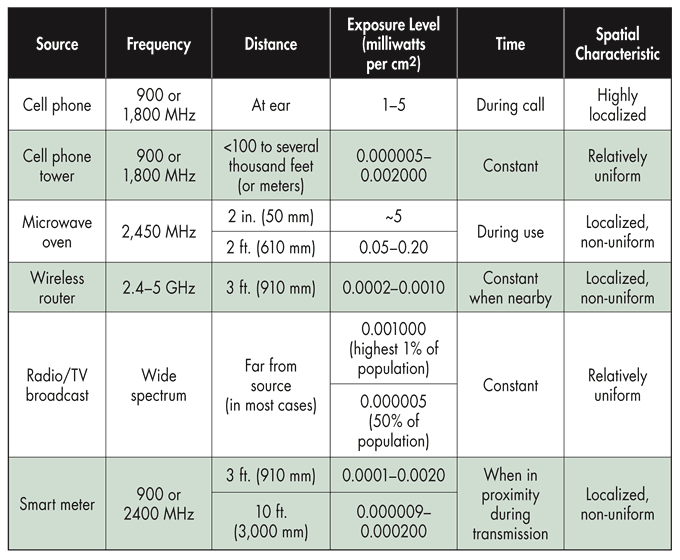
By Paula MeltonA new report from the Electric Power Research Institute (EPRI) suggests that a popular variety of “smart” meter installed by utilities does not cause excessive radio frequency (RF) exposure during normal operation. The meters employ wireless technology to transmit real-time energy-use data to utilities. As power and gas companies have begun installing them, however, some customers have protested (with a few reporting the onset of mysterious illnesses after installation), and some studies have claimed RF exposure might exceed U.S. Federal Communications Commission (FCC) limits. The California Public Utilities Commission responded to customer protests in March 2011 by ordering Pacific Electric & Gas to let customers opt out of smart meter installation. But according to the EPRI study, which used empirical data from two areas in California, the exposure risk from smart meters is much lower than that associated with many common household items that people use frequently and keep much closer to their bodies. The meters transmit only during a fraction of the day, and exposure levels remain well below regulated limits—about 8% of what FCC considers acceptable—even when a person stands close to a continuously transmitting meter (which is unlikely to occur, since the meters do not transmit continuously and are generally placed outside of buildings). The report went on to compare RF exposure levels from smart meters to exposure levels caused by televisions and wireless routers; in contrast, cell phones and microwave ovens cause much higher and more localized RF exposure.

Published December 31, 1969

(2011, March 30). Radio Frequency Exposure from Smart Meters Very Low, Says Study. Retrieved from https://www.buildinggreen.com/departments/newsbrief

Add new comment

To post a comment, you need to register for a BuildingGreen Basic membership (free) or login to your existing profile.

More U.S. Farmland Lost to Development

News Brief

More U.S. Farmland Lost to Development

By Emily CatacchioOne-third of all developed land in the U.S. was developed between 1982 and 2007, according to the National Resources Inventory (NRI)—a survey of non-federal land conducted by the U.S. Department of Agriculture’s National Resources Conservation Service along with Iowa State University. American Farmland Trust (AFT), a U.S. farmland conservation organization, reviewed NRI data and reported that every contiguous state lost agricultural land to development, with losses totaling 23 million acres. By area, Texas, California, Florida, Arizona, and North Carolina lost the most farmland; by percentage, New Jersey (26.8%), Rhode Island (22.5%), Massachusetts (18.1%), Delaware (14.3%), and New Hampshire (13.2%) lost the most. AFT also reported that 44% more prime agricultural land (land where crops can be grown with the fewest inputs and least erosion) was developed than non-prime land. The rate of farm loss declined over the 25-year period assessed, especially between 2002 and 2007. According to AFT, this decline could be due to increased smart growth and efficient development, since both these strategies use less land and often rely solely on previously developed sites. Vermont, Maryland, and Delaware protected more than one acre of land for every acre developed, while five other states protected half an acre for every acre developed.

Published December 31, 1969

(2011, March 30). More U.S. Farmland Lost to Development. Retrieved from https://www.buildinggreen.com/departments/newsbrief

Add new comment

To post a comment, you need to register for a BuildingGreen Basic membership (free) or login to your existing profile.

Online Tool Offers Preliminary Scoring for LEED Homes

News Brief

Online Tool Offers Preliminary Scoring for LEED Homes

A new online scoring tool should make the complex LEED for Homes rating system more accessible for both builders and homeowners. The Web-based application allows users to explore and compare a variety of green building options starting very early in the design process. Designed by BuildingGreen (publisher of BuildingGreen.com) for the U.S. Green Building Council (USGBC), the tool is intended to make the certification process easier for all team members regardless of their prior experience with LEED for Homes or other LEED rating systems.

After signing up and starting a project, users can choose one of two options: a “quick score” or a credit-by-credit analysis. The quick-score tool asks approximately 20 non-technical questions, alerting the user along the way if a design choice might disqualify a project from LEED for Homes certification, and produces a rough estimate of the project’s likely certification level along with a jargon-free list of actions the user would have to take to earn the predicted LEED certification. The quick score might give less experienced users a sense of green design options, and could also help a design team decide on a realistic certification target very early in the process.
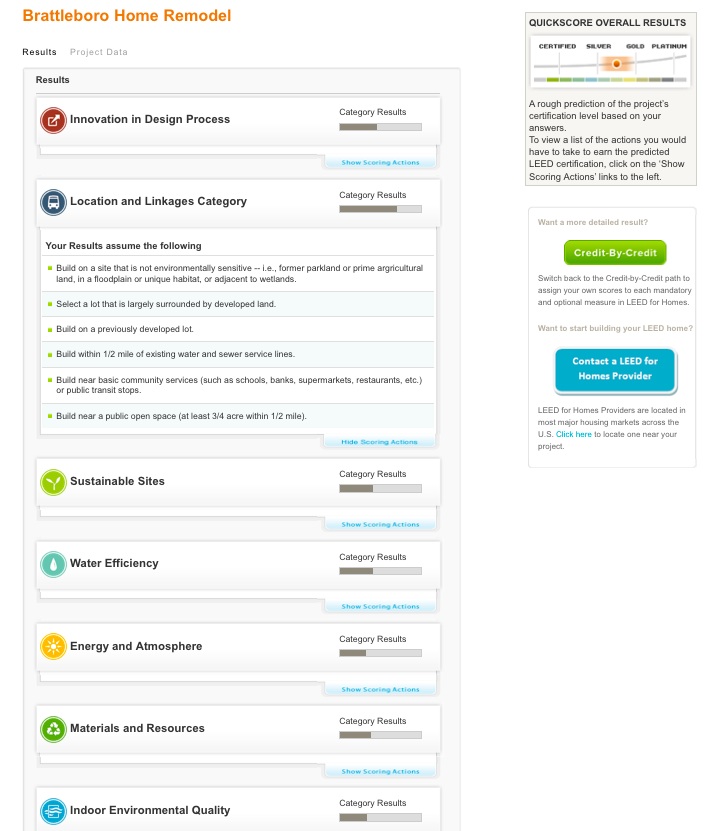
The more concrete credit-by-credit score allows users to choose which credits they expect to receive for the project, resulting in a more detailed prediction of certification level. This feature, according to USGBC, can help designers manage multiple projects or try out different scenarios regarding the same project. “The credit-by-credit path encompasses the entire LEED for Homes program, showing you that you may be closer to achieving LEED certification than you think,” said Nate Kredich, USGBC’s vice president of market development. The tool is available at www.leedforhomes.org.

The tool does not accept LEED documentation or provide a final score for certification. While LEED Online fills those functions for nonresidential LEED rating systems, LEED for Homes is documented through a provider network that includes field inspections.

For more information

U.S. Green Building Council

www.leedforhomes.org

 

Published December 31, 1969

(2011, March 8). Online Tool Offers Preliminary Scoring for LEED Homes. Retrieved from https://www.buildinggreen.com/departments/newsbrief

Add new comment

To post a comment, you need to register for a BuildingGreen Basic membership (free) or login to your existing profile.