
The U.S. Environmental Protection Agency (EPA) has published a higher emissions standard for producers of PVC (polyvinyl chloride), the type of vinyl commonly used to make pipes, windows, siding, and other building products. The proposed new rule is designed to protect public health in communities near the plants.
PVC plants emit a variety of toxic air pollutants, including vinyl chloride, a known carcinogen that particularly affects children. (For more information on PVC production, see “Should We Phase Out PVC?” EBN Jan. 1994.) The proposed new standards would set higher limits on emissions of vinyl chloride, hydrogen chloride, and chlorinated di-benzo dioxins and furans (CDDF), resulting in an estimated annual reduction in hazardous air pollutants of 1,570 tons. According to EPA, there are 17 PVC production facilities in the U.S., ten of them located in Texas and Louisiana.
EPA will accept comment for 60 days after the proposed rule is published on the federal register, and will publish the final rule on January 13, 2012.
– Paula Melton
For more information
U.S. Environmental Protection Agency
www.epa.gov


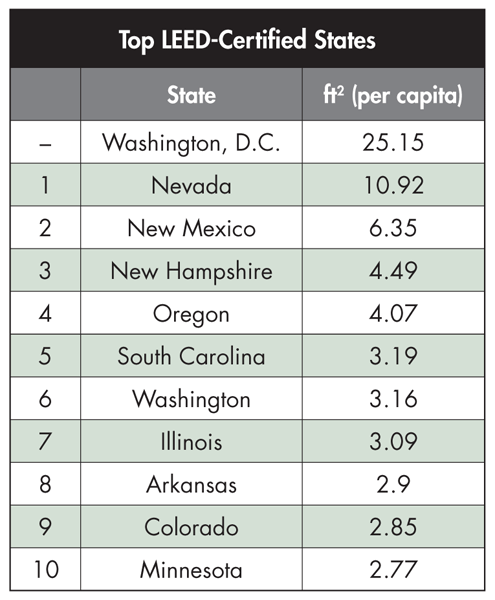 The U.S. Green Building Council (USGBC) has released a list of states with the most LEED-certified commercial space. USGBC’s 2010 list is led by Washington, D.C., with 25 ft2 of LEED-certified space per person; next follows Nevada with 10.92 ft2; New Mexico, New Hampshire, and Oregon complete the top five. Within USGBC’s list, commercial office space was the most common LEED project type. For more information, visit
 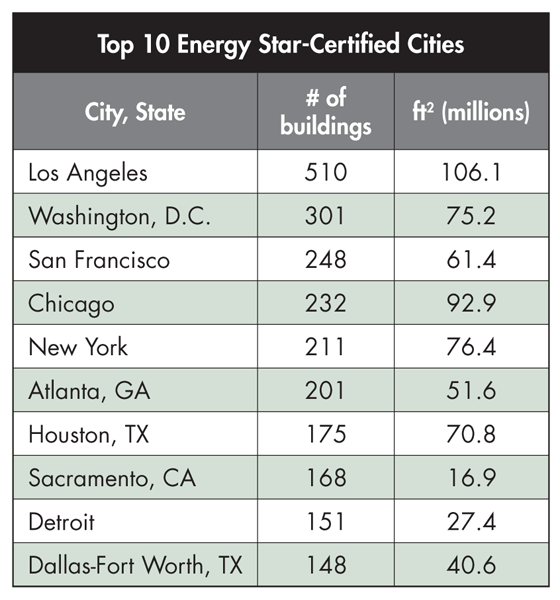 The U.S. Environmental Protection Agency (EPA) recently released its third annual list of U.S. cities with the most Energy Star-certified buildings. The top three are familiar from past years: Los Angeles is first for the third year and Washington, D.C. and San Francisco are second and third, respectively, for the second year. New York made the biggest jump to fifth, up five places from 2009. California dominates EPA’s list with five out of the 25 listed cities. More than 6,200 commercial buildings were Energy Star certified in 2010, up 60% from 2009. Commercial building energy consumption makes up almost 20% of greenhouse gas emissions in the U.S. For more information, visit

 U.S. homes expend far less energy on home heating than they did in the 1970s, but overall residential energy consumption remains virtually the same, reports the U.S. Energy Information Administration (EIA). According to EIA’s Residential Energy Consumption Survey, home energy use from appliances and electronics has surged by nearly 84%—from 1.77 quadrillion Btu (quads) in 1978 to 3.25 quads in 2009—despite higher efficiency standards for appliances. Energy consumption per household actually dropped an average of 31%, and net stability is due in part to an increase in the number of households. EIA points to several other factors that contribute to stable overall energy consumption, including dramatically increased ownership of clothes washers, dishwashers, and central air conditioners. Additionally, according to EIA data, 72.6% of households have at least one computer (39.4% have two or more), 88.6% have one or more rechargeable electronic devices (44.3% have four or more), and 98.5% own a television (more than half of households have at least three televisions). “Screen size and average energy consumption per television have continued to grow over time,” says the EIA website. For more information on the survey, visit
  Scientists have long known that when river water and seawater mix, as they do in river deltas and estuaries, the chemical reaction releases large amounts of waste energy. A recent breakthrough may enable the use of this reaction as a renewable energy source. Researchers at Stanford University, the University of Milan, and Penn State University created a device they call a “mixing entropy battery” that, when dunked alternately in seawater and river water, was able to store entropic energy created by the difference in salinity. According to an abstract on the website of the American Chemical Society (

Add new comment
To post a comment, you need to register for a BuildingGreen Basic membership (free) or login to your existing profile.