Carbon Footprint of Portland Cement Shrinks

News Brief

Carbon Footprint of Portland Cement Shrinks

By Paula Melton

The overall energy efficiency of domestic portland cement manufacture has increased 13% over a ten-year period, according to a report prepared for the U.S. Environmental Protection Agency (EPA) by economists at Duke University.

The decrease in total source energy, researchers wrote, is “equivalent to an annual reduction of 5.4 billion kg [5.9 million tons] of energy-related carbon dioxide emissions”—the equivalent of emissions from more than a million cars. Decreasing the energy used to make portland cement is a high priority, since the material’s manufacture has historically accounted for a full 2% of greenhouse gas emissions in the U.S.

It is an essential ingredient in concrete even when fly ash or other substitutes are used.

Published December 31, 1969

(2011, June 29). Carbon Footprint of Portland Cement Shrinks. Retrieved from https://www.buildinggreen.com/departments/newsbrief

Add new comment

To post a comment, you need to register for a BuildingGreen Basic membership (free) or login to your existing profile.

New HVAC Standards Will Be Regional

News Brief

New HVAC Standards Will Be Regional

By Paula MeltonThe U.S. Department of Energy (DOE) has released its final rules on new energy-efficiency standards for residential furnaces, central air conditioners, and air-source heat pumps.

The new standards, which will go into effect in 2013 for furnaces and 2015 for air conditioners and heat pumps, set regional equipment standards for the first time, upping the minimum annual fuel utilization efficiency (AFUE) to 90% for furnaces in northern states and 80% in southern states.

Seasonal energy efficiency ratio (SEER) ratings for central air conditioners will remain at 13 for northern states but be boosted to 14 in the south. Central air conditioners in four southwestern states—California, Nevada, Arizona, and New Mexico—must also have an energy efficiency ratio (EER) of 12.2, indicating they maintain a high level of efficiency even during extreme summer weather. Air-source heat pump standards remain national; the rule requires 14 SEER and an 8.2 heating seasonal performance factor (HSPF).

The new standards are part of a compromise among industry groups and environmental and consumer advocates resulting from a lawsuit brought against DOE by the Natural Resources Defense Council in 2004 after the Bush administration attempted to reverse air-conditioner efficiency standards set by the Clinton administration.

Published December 31, 1969

(2011, June 29). New HVAC Standards Will Be Regional. Retrieved from https://www.buildinggreen.com/departments/newsbrief

Add new comment

To post a comment, you need to register for a BuildingGreen Basic membership (free) or login to your existing profile.

Greenhouse Gases Reach Alarming High in 2010

News Brief

Greenhouse Gases Reach Alarming High in 2010

By Paula MeltonEnergy-related carbon emissions spiked in 2010, reaching a record high of 30.6 gigatons worldwide, according to the International Energy Agency (IEA). That’s 5% more than the previous high of 29.3 gigatons in 2008.

The global recession caused a dip in energy-related carbon emissions in 2009, but IEA reports that infrastructure investments have contributed to the emissions spike and that dollars poured into building new power plants have also “locked in” higher levels of CO2 emissions for the foreseeable future.

IEA says these numbers will make it extremely difficult to reach climate goals agreed upon by global leaders in 2010. According to IEA’s chief economist Faith Birol, Ph.D., “The world has edged incredibly close to the level of emissions that should not be reached until 2020 if the 2º C target is to be attained.”

Of the estimated CO2 emissions in 2010, 44% came from coal, 36% from oil, and 20% from natural gas.

Published December 31, 1969

(2011, June 29). Greenhouse Gases Reach Alarming High in 2010. Retrieved from https://www.buildinggreen.com/departments/newsbrief

Add new comment

To post a comment, you need to register for a BuildingGreen Basic membership (free) or login to your existing profile.

Study Says Urban Heat Islands Worsen Smog

News Brief

Study Says Urban Heat Islands Worsen Smog

By Paula Melton

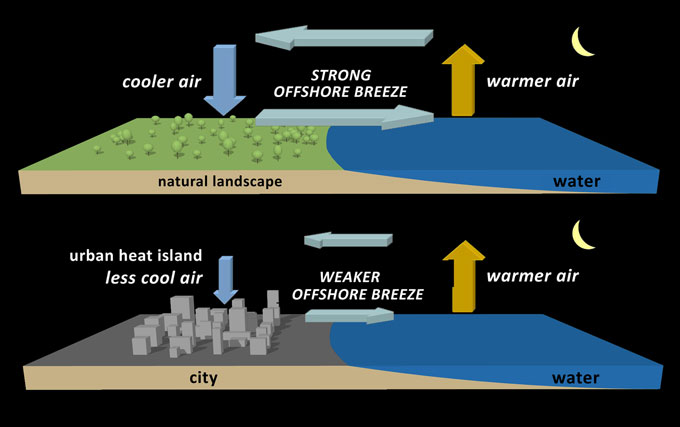
The urban heat island effect created by large areas of pavement and buildings can cause many problems, from increased energy use to reduced water quality. A new study from the National Center for Atmospheric Research (NCAR) suggests that expanses of paved surface may also worsen air quality in coastal cities like Houston, where the research was focused.

Because hot pavement and buildings continue to radiate heat even after the sun goes down, city air stays warm, preventing strong offshore breezes from forming. Such breezes would normally circulate over grasslands or croplands to help cleanse the air of pollutants. Weaker breezes cannot penetrate the urban landscape, so pollution remains in the warm, stagnant air. Drought conditions can cause similar effects, the study found.

Future research will focus on other rapidly growing coastal cities to determine whether topography, climate, and other factors also affect the formation of strong ocean breezes.

Published December 31, 1969

(2011, June 29). Study Says Urban Heat Islands Worsen Smog. Retrieved from https://www.buildinggreen.com/departments/newsbrief

Add new comment

To post a comment, you need to register for a BuildingGreen Basic membership (free) or login to your existing profile.

Bank of America Pledges $55 Million for Retrofits

News Brief

Bank of America Pledges $55 Million for Retrofits

By Paula MeltonBank of America has launched a competitive loan program to fund energy retrofits and to develop new strategies to encourage retrofits in financially underserved communities.

Through the program, Bank of America will distribute $50 million in low-interest loans as well as $5 million in grants to help community lenders administer local low-interest loan programs—which will include tracking of actual energy and water use and utility costs, both before and after retrofits. Rick Fedrizzi, CEO of the U.S. Green Building Council, remarked in a press release that the program would be more effective due to “the fact that Bank of America is not only launching this program but also gathering data and reporting on the conclusions.”

Winning community lenders will be announced in November 2011.

Published December 31, 1969

(2011, June 29). Bank of America Pledges $55 Million for Retrofits. Retrieved from https://www.buildinggreen.com/departments/newsbrief

Add new comment

To post a comment, you need to register for a BuildingGreen Basic membership (free) or login to your existing profile.

Hawaii Lab Declared 'Living'

News Brief

Hawaii Lab Declared 'Living'

The Energy Lab at Hawai’i Preparatory Academy is the third building worldwide and the first K–12 school facility to achieve “Living” certification through the Living Building Challenge (LBC).

The science building, completed in January 2010, houses classroom and meeting spaces for a school curriculum focused on renewable energy. Incorporating elements of traditional tropical huts, the structure uses passive strategies like natural ventilation and lighting as well as rainwater harvesting, onsite wastewater treatment, and a 26 kW photovoltaic array. LBC standards require that the Energy Lab harvest at least as much energy and water as it uses over the course of a year, incorporate low-impact building materials, and produce zero waste.

In its first year of operation, the building generated more than twice the energy it used. The project attained Platinum certification under LEED for Schools in December 2010.


Published December 31, 1969

(2011, June 29). Hawaii Lab Declared 'Living'. Retrieved from https://www.buildinggreen.com/departments/newsbrief

Add new comment

To post a comment, you need to register for a BuildingGreen Basic membership (free) or login to your existing profile.

Energy Savings Bill Targets Net-Zero by 2030

News Brief

Energy Savings Bill Targets Net-Zero by 2030

A bill introduced in the U.S. Senate in May 2011 targets net-zero-energy use in all new residential and commercial buildings by 2030, and aims to create jobs by using low-cost strategies to increase energy efficiency in existing buildings across residential, commercial, institutional, industrial, and government sectors.

The Energy Savings and Industrial Competitiveness Act of 2011, cosponsored by Senator Jeanne Shaheen (D-N.H.) and Senator Rob Portman (R-Ohio), was touted by Shaheen at a press conference as “a national energy efficiency strategy” that “can make our economy more competitive, start addressing our nation’s energy challenges, and create private-sector jobs today.” Some highlights of the wide-ranging bipartisan bill:

• The U.S. Department of Energy (DOE) would update national model building energy codes to exceed current baselines and would coordinate with states to track the effectiveness of the new codes in meeting energy savings targets.

• DOE would study direct-current microgrids and make policy recommendations (see “A Surge of Popularity for Efficient DC Power,” EBN May 2011).

• Manufacturers would have to comply with new energy standards for a variety of appliances, including refrigerators, room air conditioners, clothes dryers, commercial furnaces, and many others.

• The U.S. Environmental Protection Agency (EPA) would consider whether to update Energy Star criteria to give credit for products with smart-grid and demand-response features.

• The U.S. Department of Agriculture (USDA) would make zero-interest loans to rural public utilities and electric cooperatives to support energy-efficiency loans that rural customers could pay back through their utility bills.

• DOE would provide loan guarantees for energy retrofit projects in commercial and institutional buildings (eligible financing mechanisms would include power purchase agreements).

• DOE would research, develop, and promote energy-efficiency technologies for manufacturing, and would fund loan programs to help manufacturers implement already available efficiency technologies.

• DOE would establish a Supply Star program to recognize manufacturers and products that use resource-conserving supply chains.

• All federal agencies would implement energy-efficiency plans—incorporating power-saving tools for personal computers, advanced metering, and data collection—under the management of the Secretary of Energy.

The Alliance to Save Energy provides more information, including the full text of the bill.


Published December 31, 1969

(2011, June 1). Energy Savings Bill Targets Net-Zero by 2030. Retrieved from https://www.buildinggreen.com/departments/newsbrief

Add new comment

To post a comment, you need to register for a BuildingGreen Basic membership (free) or login to your existing profile.

Washington Bans Coal Tar Sealants for Asphalt

News Brief

Washington Bans Coal Tar Sealants for Asphalt

By Paula MeltonResponding to research on toxic runoff caused by coal tar pavement sealants, the State of Washington has banned their use. Coal tar sealant is sprayed or painted onto asphalt playgrounds, parking lots, and driveways to help prevent water penetration and resulting frost heaves. The sealant is common in the Midwest, because the substance is produced when coal is turned into coke for use in steel; coal tar contains polycyclic aromatic hydrocarbons (PAHs), a known human carcinogen. Although industry sources claim that the PAHs do not leach out after application, U.S. Geological Survey studies have found that the sealant is the single largest source of PAH pollution in many urban lakes, and that dust on driveways with coal tar sealants can contain highly concentrated levels of toxic chemicals. While many local governments already outlaw or restrict coal tar sealants, this is the first statewide ban. Asphalt-based sealants, a more expensive alternative to coal tar, are considered less toxic.

Published December 31, 1969

(2011, June 1). Washington Bans Coal Tar Sealants for Asphalt. Retrieved from https://www.buildinggreen.com/departments/newsbrief

Add new comment

To post a comment, you need to register for a BuildingGreen Basic membership (free) or login to your existing profile.

GSA to Use Federal Buildings as Test Bed for Green Technologies

News Brief

GSA to Use Federal Buildings as Test Bed for Green Technologies

By Emily Catacchio

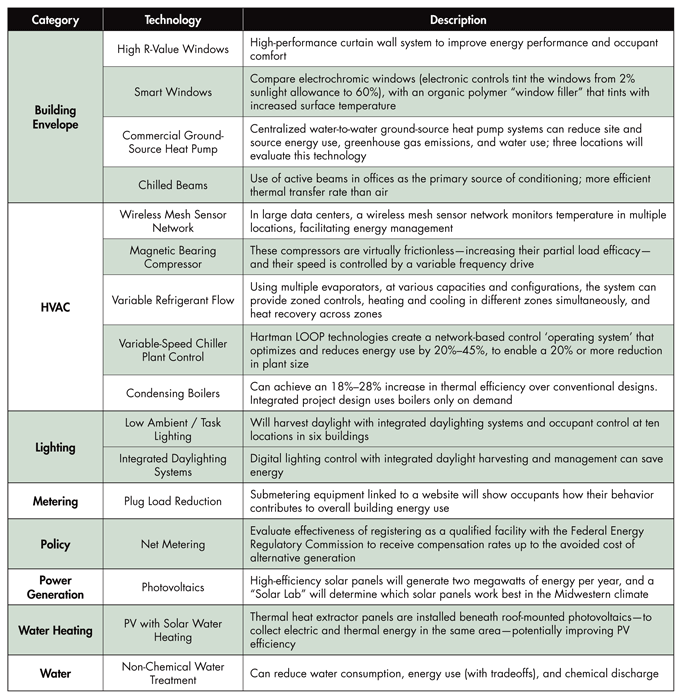
The U.S. General Services Administration’s (GSA) Green Proving Ground program plans to test 16 “emerging sustainable building technologies and practices” in some federal buildings. The program aims to transform sustainable technology markets by replicating successful technologies on other GSA buildings. In a press release, GSA Administrator Martha N. Johnson said that “by using our real-estate portfolio as a test bed for new technologies, we can then provide further innovation in energy efficiency standards and implement best practices that will lead the market.” The 16 technologies, selected from 140, “have the greatest potential to meet GSA’s sustainability goals.” The Green Proving Ground program will test, monitor, and evaluate the technologies with the U.S. Department of Energy’s National Laboratories. Findings from the research will help develop building performance specifications for GSA and other federal agencies. For more information visit www.gsa.gov/GPG.

Published December 31, 1969

(2011, June 1). GSA to Use Federal Buildings as Test Bed for Green Technologies. Retrieved from https://www.buildinggreen.com/departments/newsbrief

Add new comment

To post a comment, you need to register for a BuildingGreen Basic membership (free) or login to your existing profile.

DOE Offers Cheap Patents for Energy Startups

News Brief

DOE Offers Cheap Patents for Energy Startups

By Paula MeltonThe U.S. Department of Energy (DOE) is selling unlicensed patents for just $1,000 (normally they are $10,000–$50,000) through December 15, 2011 as part of its “America’s Next Top Energy Innovator” program. More than 15,000 unlicensed patents from 17 National Laboratories are available for entrepreneurs to commercialize, including an energy-efficient laboratory fume hood, a system to transport stored solar energy over long distances, and an alternating current photovoltaic building block. A complete database of available patents can be searched at www.techportal.eere.energy.gov. “Because we’ve cut the upfront fees and reduced the paperwork, we’ll make it easier for start-up companies to succeed and create the new jobs our economy needs,” said Energy Secretary Steven Chu in a press release. “Our goal is simple: unleash America’s innovation machine and win the global race for the clean energy jobs of the future.”

Published December 31, 1969

(2011, June 1). DOE Offers Cheap Patents for Energy Startups. Retrieved from https://www.buildinggreen.com/departments/newsbrief

Add new comment

To post a comment, you need to register for a BuildingGreen Basic membership (free) or login to your existing profile.