Renewables Jump to 11% of U.S. Energy Production

News Brief

Renewables Jump to 11% of U.S. Energy Production

Wind and solar have more than doubled their share of total production since 2008.

By Erin Weaver Renewable energy’s share of American energy production is increasing, according to a recent report from the U.S. Energy Information Administration (EIA).

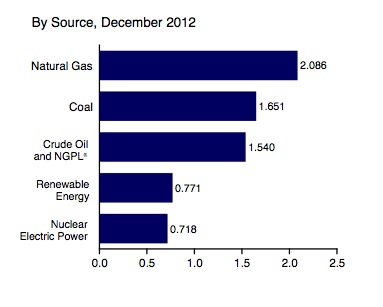
Comparing data from 2008 and 2012, EIA reports that the portion of domestic energy production from renewable sources increased from 9.84% to 11.23% (an increase of 14%) and from 7.24% to 9.3% of consumption (an increase of 28.45%). Overall domestic energy production increased 8.15% in that time, while production from renewable sources grew 23.48%.

Hydropower, making up the largest share of renewable energy production, at 30%, grew 7% since 2008, while wind and solar energy production more than doubled.

The country’s energy-related CO2 emissions fell by 9.38% in that time, to their lowest levels since 1994. EIA attributes this to a combination of warmer winter months (causing reduced heating demand) and lower natural gas prices, resulting in a 13.28% reduction in coal-fired energy production—the most carbon-intensive energy source. EIA intends to publish further analysis of 2012 CO2 emissions later in 2013.

Published December 31, 1969

(2013, April 19). Renewables Jump to 11% of U.S. Energy Production. Retrieved from https://www.buildinggreen.com/departments/newsbrief

Add new comment

To post a comment, you need to register for a BuildingGreen Basic membership (free) or login to your existing profile.

Seattle School Earns World's Fourth Living Building Certification

News Brief

Seattle School Earns World's Fourth Living Building Certification

The Bertschi School’s 3,380 ft2 Living Building Science Wing, completed in February 2011, adds to a main building that was Washington’s first LEED Gold-certified elementary school in 2007. The new science wing serves students from preschool through fifth grade with a sustainability curriculum that incorporates real-time monitoring of energy and water use. Head of the school Brigitte Bertschi notes, “We are not simply teaching about how to responsibly manage resources. The Science Wing allows students to put our curriculum to authentic use.”

A 20 kW photovoltaic system provides all of the net-zero-energy building’s electricity, rainwater is used for irrigation and a composting toilet, and an interior living wall treats the building’s graywater. The school’s urban site on a former basketball court includes a green roof, a vegetable garden, and a garden of native Northwest plants used in classes on indigenous culture and art materials.

The building was designed by KMD Architects’ Restorative Design Collective in collaboration with the Bertschi School and included both students’ and teachers’ input. To be certified under the Living Building Challenge, the project had to meet 20 “imperatives”—including net-zero energy, onsite wastewater treatment, and avoidance of a Red List of hazardous materials—and then perform as intended for a full year of occupancy.


Published December 31, 1969

(2013, April 15). Seattle School Earns World's Fourth Living Building Certification. Retrieved from https://www.buildinggreen.com/departments/newsbrief

Add new comment

To post a comment, you need to register for a BuildingGreen Basic membership (free) or login to your existing profile.

Flame Retardants Go Under the Microscope

News Brief

Flame Retardants Go Under the Microscope

By Erin Weaver Flame retardants will be the focus of risk assessments carried out in 2013 by the U.S. Environmental Protection Agency (EPA), constituting 20 of the 23 chemicals to be examined. Under the Toxic Substances Control Act (TSCA), EPA identifies commonly used chemicals on which to carry out assessments of potential health or environmental risks. In 2012, the agency identified 83 chemicals as candidates for review, from which 23 were chosen for this year’s assessments.

Full risk assessments will be conducted on four common flame retardants, with the results shedding light on the potential effects of structurally related chemicals for which there is not yet sufficient data to carry out individual risk assessments:

HBCD—Hexabromocyclododecane is used in virtually all polystyrene insulation manufactured in the U.S. The chemical is being phased out in Europe.

• TCEP—Tris (2-chloroethyl) phosphate is found in furniture foam, textiles, and other interior products.

• TBB—2-Ethylhexyl tetrabromobenzoate may be an additive in PVC, wire insulation, furniture foam, and various adhesives.

• TBPH—Bis(2-ethylhexyl) tetrabromophthalate is used in the same products in which TBB is found.

The agency hopes that evaluating groups of related chemicals (in this case, cyclic aliphatic bromides, chlorinated halogenated phosphate esters, and brominated phthalates) will avoid the replacement of known hazards with similar, unevaluated chemicals. Additional flame retardants will be analyzed for environmental persistence and bioaccumulation potential as well as to determine the mechanisms by which they break down and the behavior of their degradation products.

If the risk assessments, which will be available to the public, indicate significant risk, EPA will pursue risk reduction. EPA has expressed frustration at the agency’s limited abilities under TSCA, saying the legislation does not provide sufficient authority—or funds—to “take risk management actions when chemicals do not meet the safety standard.”


Published December 31, 1969

(2013, April 5). Flame Retardants Go Under the Microscope. Retrieved from https://www.buildinggreen.com/departments/newsbrief

Add new comment

To post a comment, you need to register for a BuildingGreen Basic membership (free) or login to your existing profile.

If You Build It, They Will Walk

News Brief

If You Build It, They Will Walk

The results of a decade-long study bear out the common-sense idea that walkable, mixed-use neighborhoods with recreational destinations encourage residents to walk more.

The study, beginning in 2003, surveyed more than 1,400 people who planned to move into new developments in Perth, Western Australia. Respondents self-reported their weekly walking habits in surveys filled out both before moving and approximately one year later; the authors tallied walkable destinations in the respondents’ previous neighborhoods and in the new developments, such as shops, parks, and mass transit stops.

Some developments provided fewer such amenities, causing a decline in residents’ walking. For those with increased access to walkable destinations, every additional local shop meant residents walked an extra 5–6 minutes per week, and every additional recreational facility correlated with an extra 20 minutes of physical activity per week. The authors suggest policies are needed that encourage the inclusion of recreational and transport-related destinations in housing developments to utilize “the potential of local infrastructure to support health-enhancing behaviors.”


Published December 31, 1969

(2013, April 3). If You Build It, They Will Walk. Retrieved from https://www.buildinggreen.com/departments/newsbrief

Add new comment

To post a comment, you need to register for a BuildingGreen Basic membership (free) or login to your existing profile.

Research Connects Cleaning Jobs with Asthma

News Brief

Research Connects Cleaning Jobs with Asthma

Occupational chemicals may carry more asthma risk than smoking, a new study finds.

Although many conventional cleaning products contain VOCs and other airborne hazards known to cause respiratory problems and other illnesses, this is the first time medical research has directly linked cleaning jobs with asthma risk. Occupations already known to increase risk—such as farming, hairdressing, and printing—also made an appearance, and both metalworking and textile production were identified as high-risk occupational exposures.

“Occupational asthma is widely under-recognized by employers, employees, and healthcare professionals,” said lead researcher Rebecca Ghosh. “Raising awareness that this is an almost entirely preventable disease would be a major step in reducing its incidence.”

Published December 31, 1969

(2013, March 26). Research Connects Cleaning Jobs with Asthma. Retrieved from https://www.buildinggreen.com/departments/newsbrief

Add new comment

To post a comment, you need to register for a BuildingGreen Basic membership (free) or login to your existing profile.

Bullitt Center Achieves FSC Project Certification

News Brief

Bullitt Center Achieves FSC Project Certification

Seattle office is the first commercial building to score the designation in the U.S., with 100% FSC wood in the core and shell.

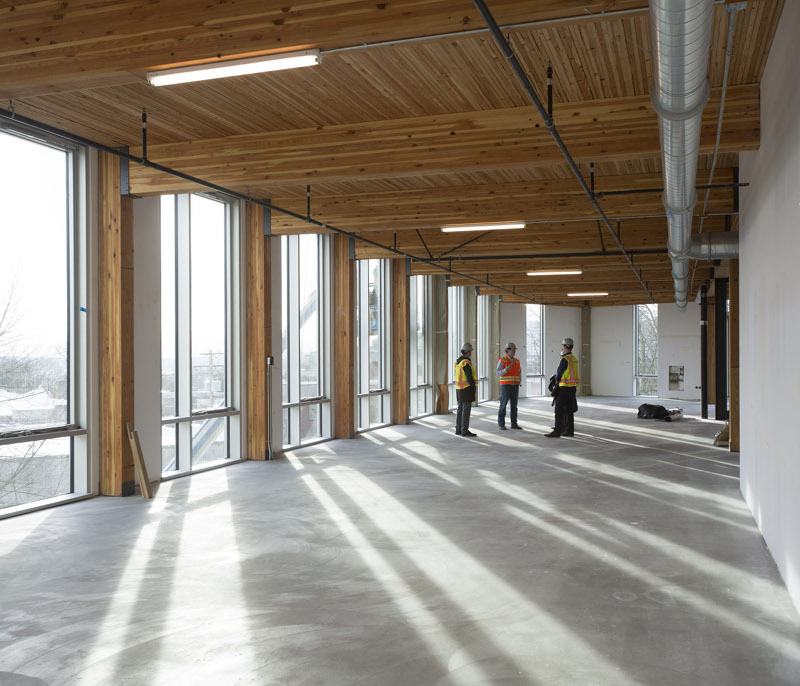
Seattle’s Bullitt Center has become the first commercial building in the U.S. to achieve project certification from the Forest Stewardship Council (FSC). The certification verifies that 100% of the wood in the core and shell is FSC-certified.

The six-story building will be the first heavy-timber commercial structure built in Seattle since the early 20th century, according to a press release. Wood used in the project includes laminated structural timbers, dimensional lumber, and structural plywood. It will serve as the headquarters for the Bullitt Foundation, which supports ecosystem restoration and other environmental initiatives in the Pacific Northwest.

The building also received the top 2013 Design & Build award from the U.S. affiliate of FSC and is pursuing Living Building Challenge certification, which will require verified net-zero water, energy, and waste for at least one calendar year after occupancy.


Published December 31, 1969

(2013, March 20). Bullitt Center Achieves FSC Project Certification. Retrieved from https://www.buildinggreen.com/departments/newsbrief

Add new comment

To post a comment, you need to register for a BuildingGreen Basic membership (free) or login to your existing profile.

Home Size, Appliance Glut Cancel Out Efficiency Gains

News Brief

Home Size, Appliance Glut Cancel Out Efficiency Gains

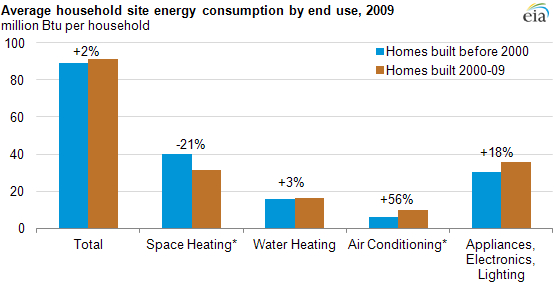
By Erin WeaverAs houses are built to more stringent energy codes and appliances increase in efficiency, the average U.S. home might be expected to see reduced energy use. Ever-increasing square footage and the accompanying glut of appliances, electronics, and lighting, however, mean that the average home built in the 2000s actually uses 2% more energy than the average home built prior to 2000.
The U.S. Energy Information Administration (EIA) continues to release analysis of data from its 2009 Residential Energy Consumption Survey (RECS), comparing housing units built between 2000 and 2009—about 14% of U.S. housing stock, from single-family houses to high-rise apartments—to those built in previous decades. The latest results show that homes built in the 2000s use 21% less energy for space heating than older homes; this is due not only to increased thermal efficiency but also to the increased share of construction happening in warmer parts of the country. At the same time, this migration to warmer areas has led to greater energy use for air-conditioning.

Homes built in the 2000s are 30% larger on average than older homes—and 17% larger than those built just a decade earlier—and are more likely to house dishwashers, clothes washers and dryers, and multiple televisions, computers, and refrigerators, as well as requiring more lighting for the additional space. The resulting 18% greater energy use for appliances, electronics, and lighting offsets the savings on heating energy, for an overall 2% increase in energy consumption.

Published December 31, 1969

(2013, March 15). Home Size, Appliance Glut Cancel Out Efficiency Gains. Retrieved from https://www.buildinggreen.com/departments/newsbrief

Add new comment

To post a comment, you need to register for a BuildingGreen Basic membership (free) or login to your existing profile.

Energy Could Be Twice as Thirsty by 2035

News Brief

Energy Could Be Twice as Thirsty by 2035

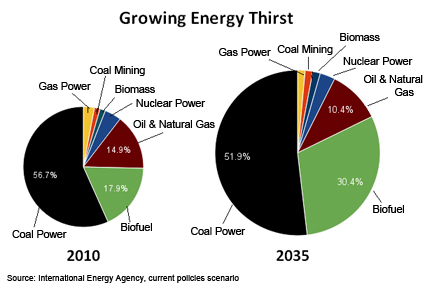
By Erin WeaverAlong with a projected population of nine billion people to feed—two-thirds of them living in water-stressed locations—the coming decades could see a doubling of the fresh water devoted to energy production. The International Energy Agency (IEA), in its “World Energy Outlook 2012,” attributes much of that rise to a continuing global increase in coal-fired power generation and biofuel production—both water-intensive processes.

Coal currently fuels 41% of power production worldwide; with demand for electricity expected to increase 90% by 2035, IEA predicts coal plants will continue to be responsible for more than half of all water used for energy production. Newer plants, which may cool their discharge water to protect aquatic ecosystems, can actually lose far more water to evaporation in the cooling process. Demand for coal is expected to grow in most parts of the world except the U.S., where it is being outpaced by natural gas. Despite the local impacts of hydraulic fracturing to obtain natural gas, at millions of gallons of water per well, IEA calculates that it will constitute a small percentage of global energy-related water use, with oil and natural gas production combined amounting to only 10% of the total demand in 2035.

Biofuels are predicted to use the second-largest share of water, at 30%, largely through evaporation during spray irrigation of fuel crops. While other methods of irrigation can reduce evaporation, they tend to use more electricity than surface spraying—thus contributing indirectly to the demand for water.

IEA recommends a shift to renewable energy as the best way to reduce the stress on the “water-energy nexus,” with electricity generated from wind and solar power requiring minimal water to produce.

Published December 31, 1969

(2013, March 15). Energy Could Be Twice as Thirsty by 2035. Retrieved from https://www.buildinggreen.com/departments/newsbrief

Add new comment

To post a comment, you need to register for a BuildingGreen Basic membership (free) or login to your existing profile.

Royal Institute Recognizes Passive House Founder

News Brief

Royal Institute Recognizes Passive House Founder

By Erin WeaverThe Royal Institute of British Architects has recognized the “father of Passive House,” Wolfgang Feist, Ph.D., with one of twelve annual Honorary Fellowships awarded to non-architects for their contributions to the field.
Feist, who founded the Passivhaus Institut in Germany in 1996 and is its current director, says the award “shows that architecture is aware of the environmental challenges” it is facing, and notes that “high levels of energy efficiency and excellent architectural design go hand in hand.” The awards ceremony was held in London on February 6, 2013.

Another nod to sustainability in this year’s awards was the Honorary Fellowship given to Harry Mallgrave, Ph.D., director of the International Center for Sustainable New Cities at the Illinois Institute of Technology.

Published December 31, 1969

(2013, March 11). Royal Institute Recognizes Passive House Founder. Retrieved from https://www.buildinggreen.com/departments/newsbrief

Add new comment

To post a comment, you need to register for a BuildingGreen Basic membership (free) or login to your existing profile.

EPA Reveals Chemicals Used in Thousands of Products

News Brief

EPA Reveals Chemicals Used in Thousands of Products

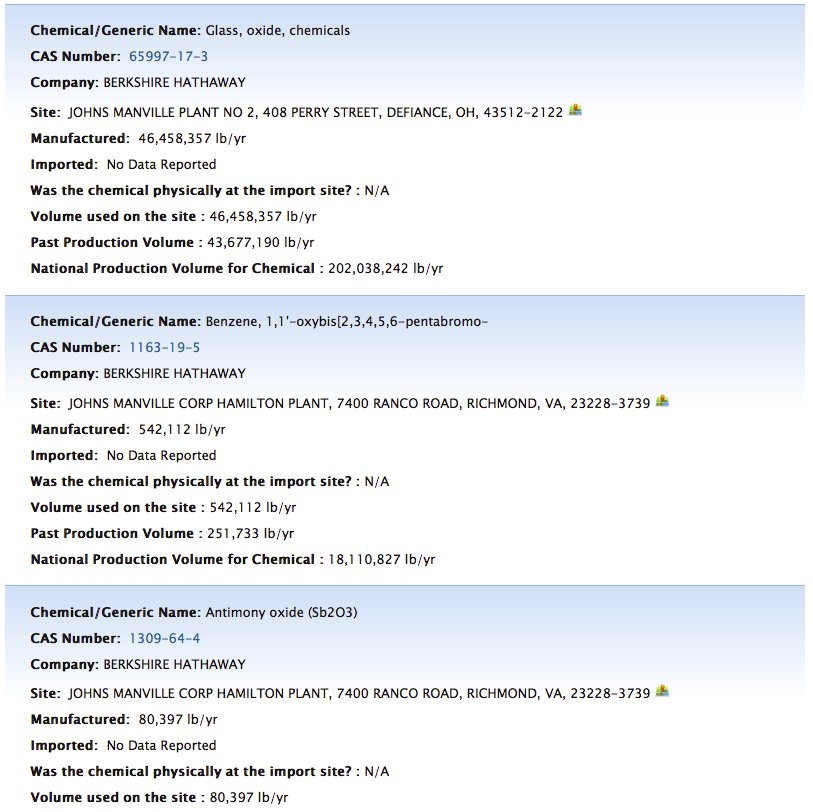
By Erin WeaverInformation on 7,674 chemicals manufactured or imported by more than 1,500 U.S. companies has been published in the first reporting cycle since the U.S. Environmental Protection Agency (EPA) reformed its Chemical Data Reporting (CDR) program in 2011.


The database does not provide information on toxicity, but it may be a powerful tool for product research along with material safety data sheets (MSDS) because of new EPA reporting rules about chemical use.

Based on information provided for that year, the report identifies chemicals used in commercial, industrial, and consumer products, including toys and furniture. Established under the Toxic Substances and Control Act (TSCA) in 1986, the CDR rule was amended in 2011; changes included lowering the reporting threshold to 25,000 pounds per year, requiring substantiation for confidentiality claims, and replacing the option of reporting information as “not readily obtainable” with the more stringent “not reasonably ascertainable.”

The online version of the database can be searched by chemical name or CAS number, or by company name. The entire database can also be downloaded for use in Microsoft Access.

Based on the data, EPA has proposed a list of 83 chemicals for further risk assessment, 25 of them fast-tracked for study by 2014. These include the chlorinated flame retardant tris (chloroethyl) phosphate (TCEP, used in furniture foam, textiles, carpet backing, and many other products), trichloroethylene (a VOC used in some adhesives and coatings), and antimony trioxide (used as a flame retardant in some coatings and adhesives).

The CDR database is available to the public on EPA’s website.

Published December 31, 1969

(2013, March 6). EPA Reveals Chemicals Used in Thousands of Products. Retrieved from https://www.buildinggreen.com/departments/newsbrief

Add new comment

To post a comment, you need to register for a BuildingGreen Basic membership (free) or login to your existing profile.