Big Data Can Shrink Footprint with DC Power

News Brief

Big Data Can Shrink Footprint with DC Power

By Paula MeltonAs data centers grow in size, number, and importance, the need to reduce their massive energy use—much of which is due to equipment and space cooling—is growing as well. While some strategies focus on the equipment itself and others on how it’s cooled, trade group EMerge Alliance has a different take: why not provide power that doesn’t heat up the computers so much in the first place?

The incompatibility between the direct current (DC) used by electronics and the alternating current (AC) provided by the grid, the group claims, not only heats up the equipment unnecessarily but also leads to conversion losses and premature failures. The group has just released a new standard for integrating DC-powered data centers with AC that comes directly from the grid (and may still be needed to power other parts of the building).

Onsite wind, photovoltaics, and other DC power sources can also supply power directly to the data center without having to be converted to AC and then back to DC, the group says, making net-zero energy easier to achieve. Additional benefits, they claim, include greater resilience during and after outages, more efficient use of space, and lower maintenance costs. More information is available at www.emergealliance.org.

Published December 31, 1969

(2012, December 31). Big Data Can Shrink Footprint with DC Power. Retrieved from https://www.buildinggreen.com/departments/newsbrief

Add new comment

To post a comment, you need to register for a BuildingGreen Basic membership (free) or login to your existing profile.

LEED for Existing Buildings Recertification Guidance Arrives

News Brief

LEED for Existing Buildings Recertification Guidance Arrives

The new guidance document offers specific performance requirements for recertification, building on original certification requirements. Projects won’t have to re-document static environmental features, but they will need to recertify under the most current version of the LEED-EBOM rating system (and USGBC is offering staff time to project teams to help with that process). Recertified projects will get a new plaque with a new date.


Published December 31, 1969

(2012, December 31). LEED for Existing Buildings Recertification Guidance Arrives. Retrieved from https://www.buildinggreen.com/departments/newsbrief

Add new comment

To post a comment, you need to register for a BuildingGreen Basic membership (free) or login to your existing profile.

New Study Ties Vehicle Exhaust to Autism

News Brief

New Study Ties Vehicle Exhaust to Autism

By Erin WeaverExposure to high levels of vehicle exhaust has been linked to a range of health issues, from premature birth to Alzheimer’s disease (see “Traffic Exhaust May Cause Brain Damage,”

EBN Dec. 2011); new research suggests a correlation between traffic pollution and autism.

A California study published in

Archives of General Psychiatry looked at 524 children, 279 of them with autism; using meteorological and traffic data from roads within approximately three miles of each home, researchers modeled traffic-related exposure to nitrogen dioxide and particulate matter during gestation and the first year of life. Children with the highest exposure, particularly during late gestation and early life, were three times as likely to have autism as those with the lowest exposure. The researchers observe that autism is likely caused by a combination of genetic and environmental factors.

Published December 31, 1969

(2012, December 31). New Study Ties Vehicle Exhaust to Autism. Retrieved from https://www.buildinggreen.com/departments/newsbrief

Add new comment

To post a comment, you need to register for a BuildingGreen Basic membership (free) or login to your existing profile.

New Guide Helps Manufacturers Phase Out Toxic Ingredients

News Brief

New Guide Helps Manufacturers Phase Out Toxic Ingredients

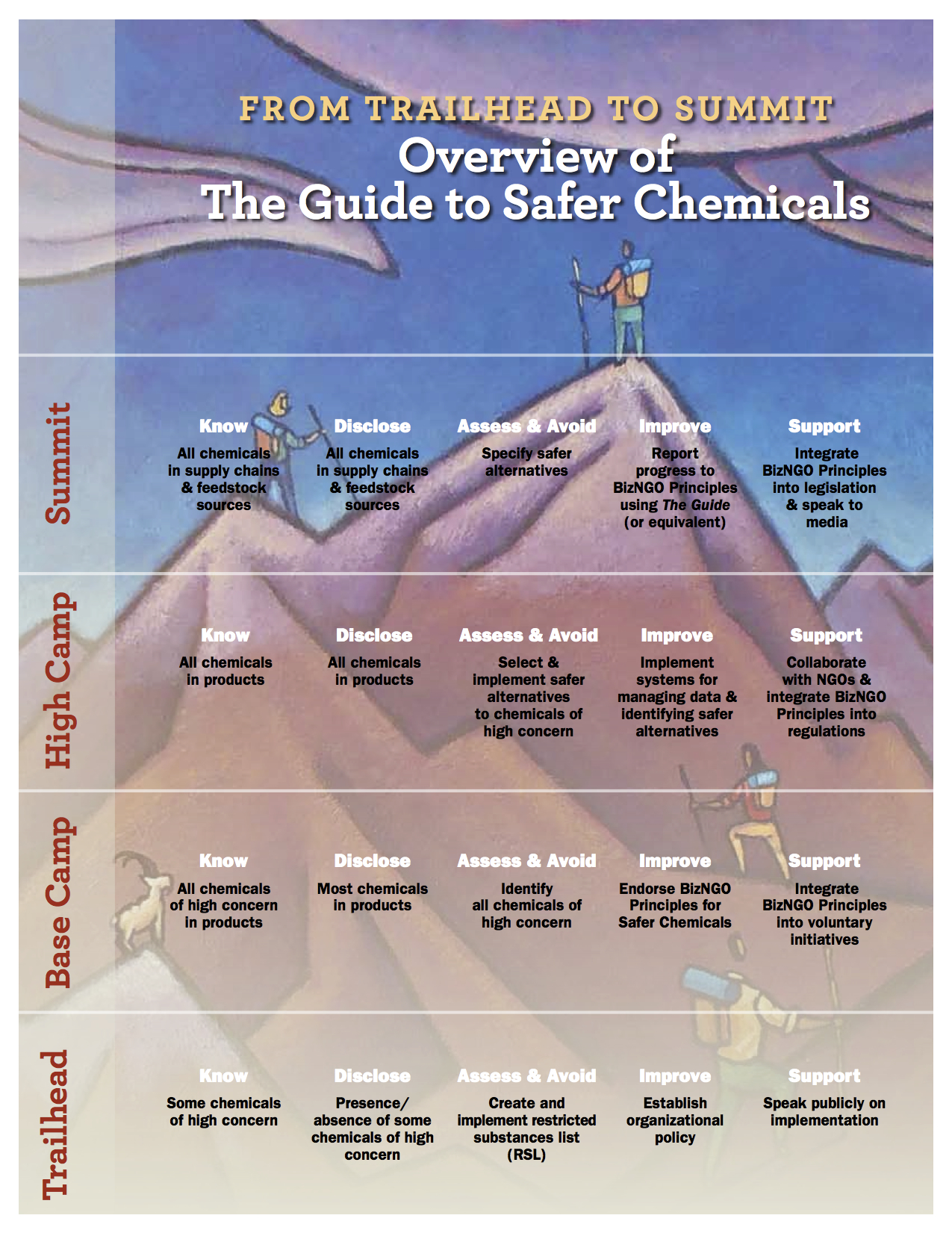
The Guide to Safer Chemicals.

Viewing the path to safer material chemistry as a journey that begins at a “trailhead” and ends at a “summit,” the guide provides four principles for safer chemicals—know and disclose product chemistry; assess and avoid hazards; commit to continuous improvement; and support public policies and industry standards for safer chemicals. The guide offers a clear framework for achieving each goal and provides real-world examples of how different companies have attained different levels of progress.

“The only way you really get to move beyond the trailhead level is that you have to have systems for implementing this work,” explains Mark Rossi, co-director of Clean Production Action. “What are your plans to move to a safer alternative, and how do you determine that the alternatives are safer than the one you’re replacing?” The guide is available at www.bizngo.org.


Published December 31, 1969

(2012, December 31). New Guide Helps Manufacturers Phase Out Toxic Ingredients. Retrieved from https://www.buildinggreen.com/departments/newsbrief

Add new comment

To post a comment, you need to register for a BuildingGreen Basic membership (free) or login to your existing profile.

Pedestrians and Cyclists Are Good for Business

News Brief

Pedestrians and Cyclists Are Good for Business

In a survey of thousands of shoppers leaving supermarkets, convenience stores, restaurants, and bars, researchers for the Oregon Transportation Research and Education Consortium asked customers about their spending per trip and trips per month, concluding that for all but supermarkets, cyclists spent the same amount or less per visit compared to drivers. The ease of stopping instead of passing, however, meant cyclists and pedestrians visited more often and so spent more in the course of a month. At restaurants, for example, while most customers still arrived by car, individual cyclists outspent individual drivers by about 20% monthly.

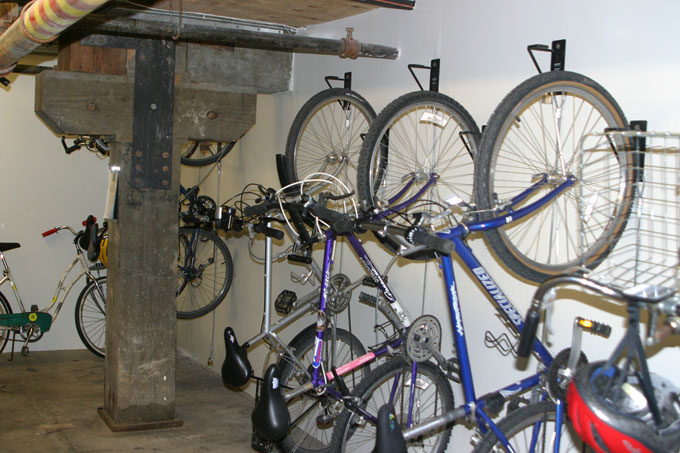
Developing infrastructure such as bike lanes and parking racks encourages greater ridership and increased impulse stops as well as catering to people with the potential to become regular customers. The study can be found at otrec.us/news.


Published December 31, 1969

(2012, December 31). Pedestrians and Cyclists Are Good for Business. Retrieved from https://www.buildinggreen.com/departments/newsbrief

Add new comment

To post a comment, you need to register for a BuildingGreen Basic membership (free) or login to your existing profile.

An Affordable Plan to Cut Power Plant Pollution?

News Brief

An Affordable Plan to Cut Power Plant Pollution?

By Erin WeaverThe Natural Resources Defense Council (NRDC) has proposed a program for the U.S. Environmental Protection Agency (EPA) intended to cut carbon emissions from power plants, the largest such pollution source in the U.S. at almost 2.4 billion tons of carbon dioxide released in 2011.

“Closing the Power Plant Carbon Pollution Loophole” suggests system-wide standards, a federal-state partnership, and broad flexibility in compliance for both states and plant owners—a combination NRDC claims would make the changes more affordable. The Clean Air Act would be used to set state-specific emission rates that could be met using a range of existing technologies, as well as credits earned by lower-emitting approaches such as wind power.

In addition to stimulating investment in efficiency and renewable energy, NRDC says that the plan would cut power plants’ carbon pollution by one-third by 2025; according to the group, at a cost of about $4 billion, this would save Americans between $25 billion and $60 billion in reduced mortality, illness, emergency room visits, and lost work days. NRDC executive director Peter Lehner points out, “This year’s ravaging heat waves, drought, wildfires, and Superstorm Sandy underscore why the nation must tackle head-on the biggest source of dangerous carbon pollution now.” For more information, see www.nrdc.org/air/pollution-standards.

Published December 31, 1969

(2012, December 31). An Affordable Plan to Cut Power Plant Pollution?. Retrieved from https://www.buildinggreen.com/departments/newsbrief

Add new comment

To post a comment, you need to register for a BuildingGreen Basic membership (free) or login to your existing profile.

USGBC Opens Information Gateway

News Brief

USGBC Opens Information Gateway

Published December 31, 1969

(2012, December 31). USGBC Opens Information Gateway. Retrieved from https://www.buildinggreen.com/departments/newsbrief

Add new comment

To post a comment, you need to register for a BuildingGreen Basic membership (free) or login to your existing profile.

Solar Power Keeps Getting Cheaper

News Brief

Solar Power Keeps Getting Cheaper

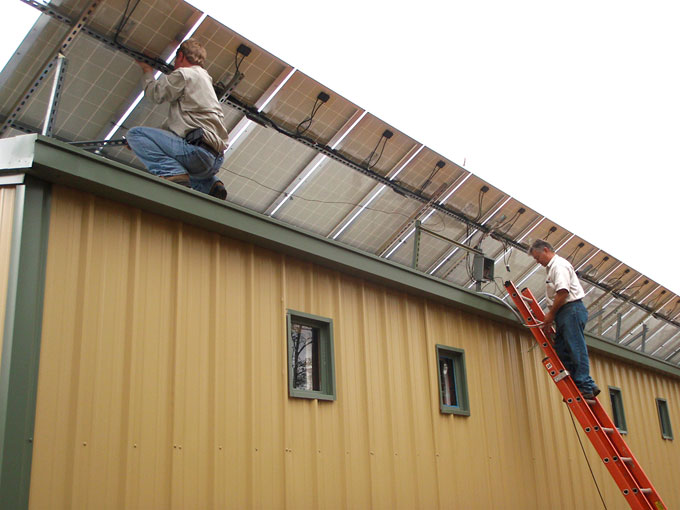
By Erin WeaverThe installed cost of solar power continues to decrease, largely due to the declining cost of the panels themselves. A new report from Lawrence Berkeley National Laboratory breaks down the numbers and makes suggestions for reducing other costs.

“Tracking the Sun V,” the lab’s fifth annual report, tracks the installed price of grid-connected photovoltaic (PV) systems in the U.S. by location, customer type, and system size from 1998 to 2011, based on data from more than 150,000 residential, commercial, and utility-scale systems. Prior to 2005, the decline in price was largely due to reductions in non-module, or “soft,” costs such as permitting, installation, and maintenance; prices stabilized for a few years and then, in 2008, module costs (for the panels themselves) began to fall sharply, with reductions of 25% in residential and commercial installations by 2011. Soft costs, however, have remained fairly consistent since 2005.

Overall price varied from state to state; small systems were installed for less than $5/W in Texas but well over $7/W in Washington, D.C., and much of that difference was in soft costs. The U.S. PV market, the world’s fourth largest, is encouraged by government incentives that include rebates and tax benefits; the report suggests targeting future policies at specific expenses, such as permitting and interconnection.


Published December 31, 1969

(2012, December 31). Solar Power Keeps Getting Cheaper. Retrieved from https://www.buildinggreen.com/departments/newsbrief

Add new comment

To post a comment, you need to register for a BuildingGreen Basic membership (free) or login to your existing profile.

Benchmarking Savings Add Up Quickly, Says EPA

News Brief

Benchmarking Savings Add Up Quickly, Says EPA

Data from 35,000 buildings in which EPA’s Energy Star Portfolio Manager was used to benchmark energy performance from 2008 to 2011 show average savings of 2.4% per year, for total average savings of 7% over three years. According to a survey in Building Operating Management, 70% of facility managers who use Portfolio Manager report using it to inform energy-efficiency upgrade plans.

The majority of buildings of all types in the analysis achieved savings, with the greatest improvements in retail, office, and K–12 school buildings; in general, buildings with the lowest initial performance achieved double the savings of more efficient buildings. According to EPA, similar average reductions in all U.S. buildings’ energy use would avoid the release of 18 million tons of CO2 equivalent every year—saving approximately $4.2 billion in the first year alone.


Published December 31, 1969

(2012, November 29). Benchmarking Savings Add Up Quickly, Says EPA. Retrieved from https://www.buildinggreen.com/departments/newsbrief

Add new comment

To post a comment, you need to register for a BuildingGreen Basic membership (free) or login to your existing profile.

Green Roofs Improve Solar Panel Efficiency

News Brief

Green Roofs Improve Solar Panel Efficiency

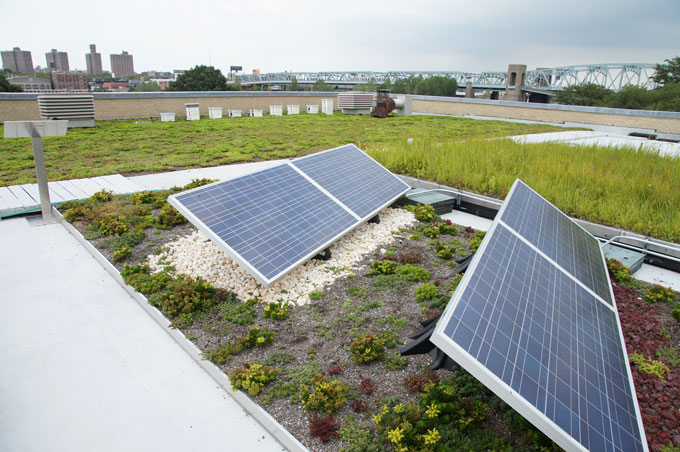
By Erin WeaverGreen roofs are known to extend roof life, conserve energy, and reduce stormwater runoff and air pollution; new studies show they can also boost the performance of solar panels. Plants reduce a roof’s contribution to the urban heat-island effect by lowering the surrounding air temperature through evaporation; this cooling can also make photovoltaic panels perform more efficiently. Plants also reduce airborne pollutants and dust particles, allowing the panels to absorb more sunlight.

Studies vary in the efficiency boosts reported, from 3% to 16%. This is in addition to green roofs’ known effect of cooling indoor air, which reduces annual energy use by 6%, according to a recent French study.

New designs for solar arrays allow water to drain evenly across the roof, and research suggests that the biodiversity created by including shade-tolerant plants below the panels can improve a green roof’s overall performance. A recent British study in Building and Environment found that broad-leafed plants such as lamb’s ear, which can thrive in partial shade, outperformed the traditional sedum in cooling the substrate and surrounding air.

Published December 31, 1969

(2012, November 29). Green Roofs Improve Solar Panel Efficiency. Retrieved from https://www.buildinggreen.com/departments/newsbrief

Add new comment

To post a comment, you need to register for a BuildingGreen Basic membership (free) or login to your existing profile.