Energy Star Certifies 26% of New Homes in 2011

News Brief

Energy Star Certifies 26% of New Homes in 2011

By Erin WeaverAbout one-quarter of new single-family homes constructed in 2011 were built to voluntary U.S. Environmental Protection Agency (EPA) Energy Star standards, according to the U.S. Energy Information Administration (EIA)—more than double the percentage of five years earlier. The states without statewide energy codes, most of them in the Mississippi Valley and Upper Midwest, also tend to have the lowest percentage of Energy Star homes.

The efficiency of appliances furnishing those homes varies by product type; according to a review by EIA, nearly all dehumidifiers, dishwashers, and televisions available in 2011 met Energy Star standards, leading to updated specifications for those categories. Energy Star standards are supposed to reflect the efficiency of the top 25% of products in a category; very few water heaters, for example, meet the standards because electric storage tank heaters cannot match the efficiency of hybrid heat-pump water heaters.

Published December 31, 1969

(2012, November 29). Energy Star Certifies 26% of New Homes in 2011. Retrieved from https://www.buildinggreen.com/departments/newsbrief

Add new comment

To post a comment, you need to register for a BuildingGreen Basic membership (free) or login to your existing profile.

New PV Rating System Models Real-World Test Conditions

News Brief

New PV Rating System Models Real-World Test Conditions

By Erin WeaverA new rating system for photovoltaic modules aims to improve upon standard test conditions (STC) by more fully reflecting real-world variations. The Principal Solar Institute (PSI), created by solar energy holding company Principal Solar, Inc., has introduced the PSI PV Module Rating to help the commercial and utility-scale markets compare the performance and cost of modules.

Compared to STC, which uses a constant light intensity at a fixed temperature, PSI models daily variations in light and temperature, as well as five other factors, to calculate total expected energy production over a module’s 25-year lifetime. Ratings for 500 modules are available on PSI’s website, with 10,000 more available upon request.

Published December 31, 1969

(2012, November 29). New PV Rating System Models Real-World Test Conditions. Retrieved from https://www.buildinggreen.com/departments/newsbrief

Add new comment

To post a comment, you need to register for a BuildingGreen Basic membership (free) or login to your existing profile.

EPA Releases Guidelines for Healthier Schools

News Brief

EPA Releases Guidelines for Healthier Schools

The guidelines focus on maintenance; moisture and mold issues; pests and pesticides; ventilation; and contaminants that include PCBs, radon, and diesel exhaust. Along with recommendations on assessing existing resources among state agencies, the guidelines offer case studies and technical advice, including regular HVAC inspection, selection of low-emitting paints and cleaners, and revision of school bus schedules to minimize idling. For more information, see www.epa.gov/schools.


Published December 31, 1969

(2012, November 29). EPA Releases Guidelines for Healthier Schools. Retrieved from https://www.buildinggreen.com/departments/newsbrief

Add new comment

To post a comment, you need to register for a BuildingGreen Basic membership (free) or login to your existing profile.

Students to Learn Building Science on Mars

News Brief

Students to Learn Building Science on Mars

The National Institute of Building Sciences (NIBS) is launching an education program to engage K–12 students in science, technology, engineering, and mathematics, collectively known as “STEM.” The program specifically focuses on building design, construction, and operations and maintenance, and includes developing age-appropriate content within the Whole Building Design Guide for student use.

The program’s first activity, in partnership with NASA and the Total Learning Research Institute (TLRI), focuses on building information modeling and facility management through use of TLRI’s virtual Mars environment. In addition to fostering a future skilled workforce for the building industry, NIBS says the program will educate students to be responsible occupants of high-performance buildings. The program is currently seeking technical and financial support from individuals and organizations. For more information, see www.nibs.org.


Published December 31, 1969

(2012, November 29). Students to Learn Building Science on Mars. Retrieved from https://www.buildinggreen.com/departments/newsbrief

Add new comment

To post a comment, you need to register for a BuildingGreen Basic membership (free) or login to your existing profile.

Thawing Permafrost Could Double Earth's Atmospheric Carbon

News Brief

Thawing Permafrost Could Double Earth's Atmospheric Carbon

By Erin WeaverThawing of Arctic permafrost could double Earth’s atmospheric carbon in the next century, according to a new field study in

Geophysical Research Letters. Scientists with the U.S. Geological Survey studied permafrost soils vulnerable to thawing and subsequent decomposition in a warming climate; they estimate the soils could release up to 850 billion tons of carbon and 44 billion tons of nitrogen, along with some methane.

In addition to disrupting aquatic ecosystems, this would contribute to further warming in what could become a runaway process. The scientists hope the new numbers will be taken into consideration by the upcoming Intergovernmental Panel on Climate Change.

Published December 31, 1969

(2012, November 29). Thawing Permafrost Could Double Earth's Atmospheric Carbon. Retrieved from https://www.buildinggreen.com/departments/newsbrief

Add new comment

To post a comment, you need to register for a BuildingGreen Basic membership (free) or login to your existing profile.

AIA/COTE Adds Top Ten "Plus" to Annual Awards

News Brief

AIA/COTE Adds Top Ten "Plus" to Annual Awards

Submissions are open for the latest, expanded round of annual Top Ten awards from the American Institute of Architects’ Committee on the Environment (AIA/COTE).

The 2013 Top Ten Green Projects Awards see the addition of the AIA/COTE Top Ten Plus Award, to be granted to a previous Top Ten recipient. Projects submitted for Top Ten Plus consideration must use the U.S. Environmental Protection Agency’s Portfolio Manager tool to provide at least one year’s post-occupancy performance data, along with baseline design metrics and lessons learned.

The original Top Ten awards are open to new construction, renovation, and restoration projects completed between 2003 and late 2012. Submissions for all awards must be received by January 25, 2013. A PDF of submission guidelines and other information can be found at www.aia.org/cote.


Published December 31, 1969

(2012, November 21). AIA/COTE Adds Top Ten "Plus" to Annual Awards. Retrieved from https://www.buildinggreen.com/departments/newsbrief

Add new comment

To post a comment, you need to register for a BuildingGreen Basic membership (free) or login to your existing profile.

USGBC Opens Green Building Information Gateway, GBIG.org

News Brief

USGBC Opens Green Building Information Gateway, GBIG.org

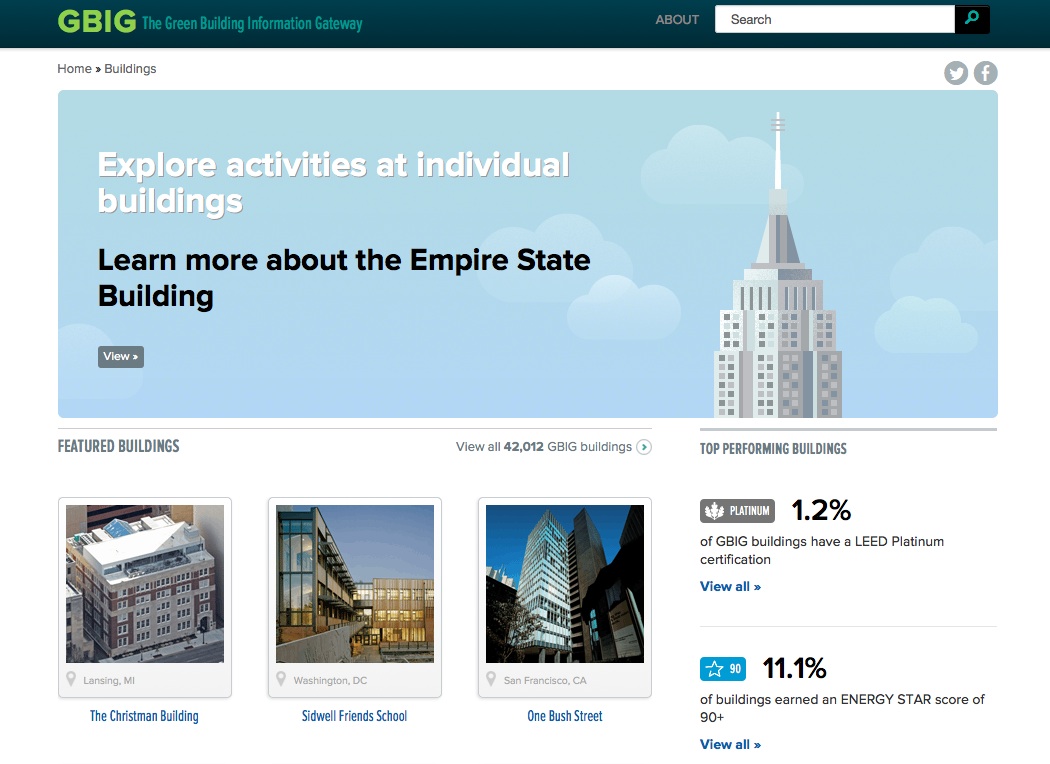
The U.S. Green Building Council (USGBC) has launched a massive online database of buildings called the Green Building Information Gateway, or GBIG. Many of the buildings with the most robust data in GBIG are LEED-certified, but despite its USGBC pedigree the database is not limited to LEED. The tool allows users to:

• find green buildings around the world by entering an address

• view green building data by city and find all green buildings within an area

• view project data by green building strategy (such as building reuse or daylighting), including how LEED credits or other certifications were achieved

• see timelines of green building “activities” like LEED, Living Building Challenge, or Energy Star certification

• compare green attributes among buildings

• look at energy performance data of buildings for which it’s available—such as those required to report energy data in New York and other cities

“The launch of GBIG represents years of research, information-gathering, and testing,” said Chris Pyke, vice president for research at USGBC, in a press release. “Green building has gone from an era of ‘firsts’ to a global movement connected by data.”

Among the many “collections” assembled in GBIG are:

projects with publicly accessible 3D building models• buildings organized by type, such as sports venues and K–12 schoolsprojects for which a McGraw-Hill Construction Dodge Report is availableHigh Performance Buildings Database projects displayed on BuildingGreen.com

For more information:

Green Building Information Gateway

www.gbig.org


Published December 31, 1969

(2012, November 16). USGBC Opens Green Building Information Gateway, GBIG.org. Retrieved from https://www.buildinggreen.com/departments/newsbrief

Add new comment

To post a comment, you need to register for a BuildingGreen Basic membership (free) or login to your existing profile.

Increase Fire Safety Without Flame Retardants, Group Urges

News Brief

Increase Fire Safety Without Flame Retardants, Group Urges

Certain flame retardants pose serious health and environmental risks without significantly increasing fire safety, according to a consensus statement being circulated this week at the U.S. Green Building Council’s Greenbuild convention in San Francisco. The resolution gathers fire safety experts, chemists, architects, and environmentalists under a banner of changing flammability requirements for foam insulation in the International Residential Code (IRC).

The statement lays out several reasons to forego halogenated flame retardants (those containing halogens like chlorine and bromine in their chemical makeup), many of which are persistent, bioaccumulative toxic chemicals that are being phased out of industry throughout the world. The reasons include:

• The addition of flame retardants at concentrations typically used in foam insulation does not significantly improve fire safety performance.

• Thermal barriers like drywall provide far better protection than chemical flame retardants.

• Test procedures for fire safety do not provide accurate results when testing foam insulation.

The resolution is the first step in an effort to build momentum for modifying the residential code. The group argues the code should no longer require flame retardants in foam insulation if the insulation is used with a thermal barrier like drywall or if it is used on the exterior of a building below grade.

BuildingGreen’s founder and executive editor, Alex Wilson, who helped organize the meeting on flame retardants at which this resolution was introduced, argues that “in boosting energy performance of buildings, we don’t want to sacrifice the health of building occupants or the environment.”

Wilson—along with chemist Arlene Blum, Ph.D., homebuilder and code expert David Eisenberg, and others involved with the initiative—believe that removing flame retardants from foam insulation will make buildings healthier while maintaining fire safety and actually reducing construction costs. “The proposed code changes would truly be win-win-win solutions,” Wilson said. “But bringing about these changes will be an uphill effort that will require a lot of hard work and support from progressive building professionals and manufacturers.”

He added that it is still possible for others to join the consensus statement as signatories.

For more information:

Green Science Policy Institute

www.greensciencepolicy.org

 

Published December 31, 1969

(2012, November 15). Increase Fire Safety Without Flame Retardants, Group Urges. Retrieved from https://www.buildinggreen.com/departments/newsbrief

Add new comment

To post a comment, you need to register for a BuildingGreen Basic membership (free) or login to your existing profile.

USGBC Boasts Top Energy Scores for LEED Buildings

News Brief

USGBC Boasts Top Energy Scores for LEED Buildings

LEED-certified buildings have better energy performance than 89% of buildings in the U.S., according to the results of a two-year study released today by the U.S. Green Building Council (USGBC), creator of the LEED rating systems. Overall, the 195 commercial and retail buildings in the sample were using 47% less energy than average buildings in the U.S.

More than half of the buildings in the analysis were certified under the LEED for Existing Buildings: Operations & Maintenance (EBOM) system, for which performance benchmarking through the U.S. Environmental Protection Agency’s Energy Star software is required. In order to be certified, EBOM buildings must achieve a minimum Energy Star score of 69, meaning they perform better than 69% of similar buildings—well below the average benchmark found for the buildings in the study.

The analysis also included new commercial and retail projects, some of which provided data to USGBC voluntarily; those certified under the 2009 version of the rating system are required to report. Critics of LEED have often pointed to a lack of data verifying energy performance after occupancy; in response to a 2008 study of actual energy performance, a few even argued that new LEED buildings use more energy than average buildings.

It’s unclear how many of the buildings in this analysis were reporting voluntarily, so it probably does not give an accurate sense of the energy performance of buildings certified before 2009. But even those that did report voluntarily did not risk being exposed or punished for poor performance, so the scores wouldn’t have been skewed on that account. They do represent the subset of projects that were paying attention to their energy use, though.

Taken as a whole, the release does provide preliminary evidence that both existing and new buildings certified under the 2009 version of the rating systems perform better than average buildings. USGBC has promised to update this analysis as it receives more data, so these preliminary findings should be either confirmed or modified before long.

For more information:

U.S. Green Building Council

www.usgbc.org


Published December 31, 1969

(2012, November 13). USGBC Boasts Top Energy Scores for LEED Buildings. Retrieved from https://www.buildinggreen.com/departments/newsbrief

Add new comment

To post a comment, you need to register for a BuildingGreen Basic membership (free) or login to your existing profile.

Health Product Declaration Provides Building Product "Nutrition Label"

News Brief

Health Product Declaration Provides Building Product "Nutrition Label"

The new format streamlines disclosure of building product ingredients and their potential health impacts.

A panel of leaders in the green building industry has unveiled a new format for reporting health-related information for building products.

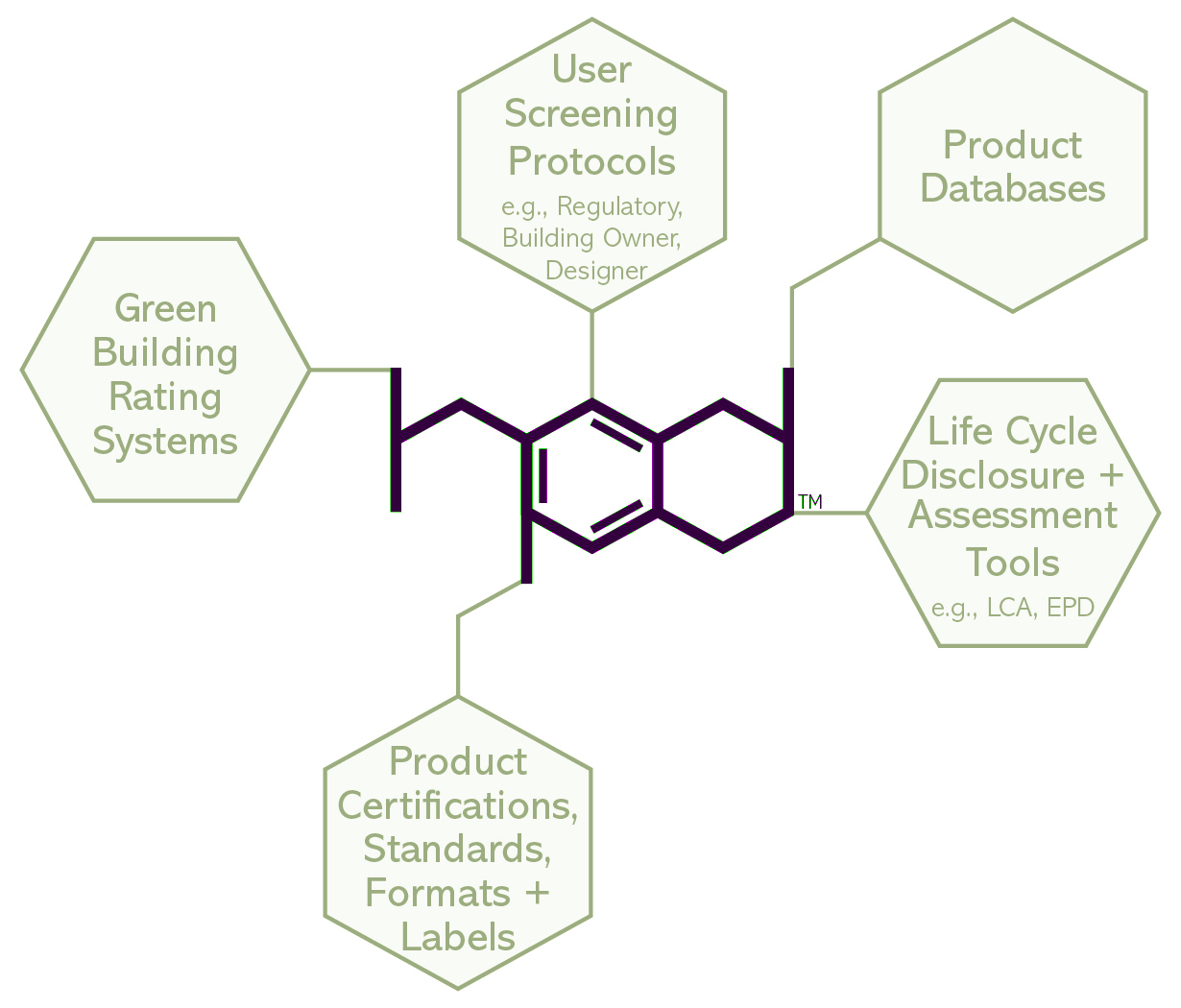
The Health Product Declaration (HPD) Open Standard Version 1 is available to manufacturers as a standardized format for disclosure of product contents, emissions, and health information to help designers, specifiers, and building owners and occupants make informed purchasing decisions. The HPD is meant to increase transparency and reduce redundant disclosure demands by referencing existing hazard lists and providing a human health context for information disclosed in an Environmental Product Declaration (EPD) and other documents (see “The Product Transparency Movement: Peeking Behind the Corporate Veil,” EBN Jan. 2012). It is included as a compliance option for the Building Product Disclosure and Optimization: Material Ingredients credit in the current public comment draft of the forthcoming LEED v4 rating system.

Says Aaron Smith of security-product manufacturer Assa Abloy, “While working toward EPDs, Assa Abloy realized that the human health impacts of building products were not adequately addressed. The HPD fills that gap.” Martha Vega of tile manufacturer Crossville told EBN, “Widespread adoption by manufacturers will be important to make HPD useful on a broad scale—hopefully we’ll see lots of participation from the start.”

The HPD was developed through a year-long process by the HPD Open Standard Working Group with the participation of 29 product manufacturers and 50 reviewers from the building industry; it will be maintained and revised by the HPD Collaborative.

The HPD Working Group was convened jointly by the Healthy Building Network and BuildingGreen, publisher of EBN. The standard is available at www.hpdcollaborative.org.


Published December 31, 1969

(2012, November 9). Health Product Declaration Provides Building Product "Nutrition Label". Retrieved from https://www.buildinggreen.com/departments/newsbrief

Add new comment

To post a comment, you need to register for a BuildingGreen Basic membership (free) or login to your existing profile.