Speed Bumps for Sunlight Could Improve Solar Cells

News Brief

Speed Bumps for Sunlight Could Improve Solar Cells

Most research in photovoltaics (PV) works by coaxing our materials to respond differently to sunlight. But what if we could change the light instead? Scientists at the Massachusetts Institute of Technology (MIT) are trying to do just that by slowing down the speed of light using nanomaterials.

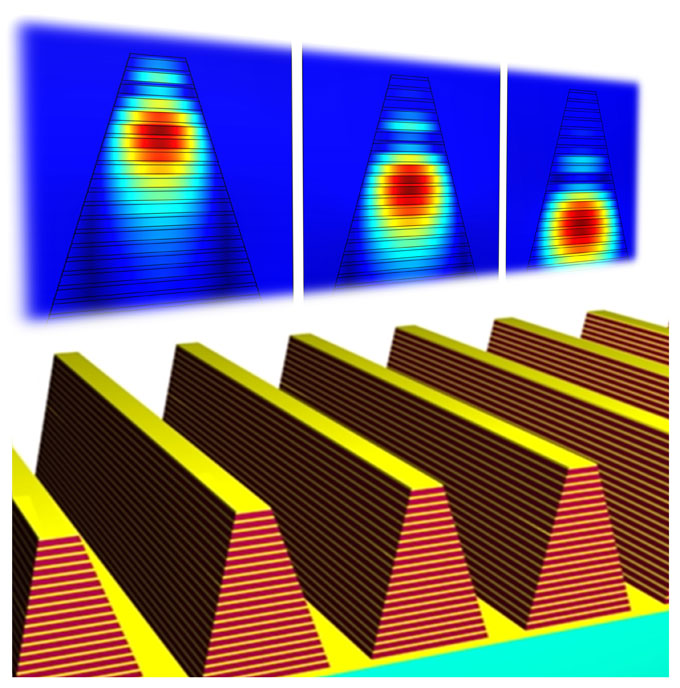
Working with researchers at Zehjiang University, Taiyuan University, and the University of Illinois–Urbana-Champaign, they have developed a new ultra-thin nanotech metamaterial that slows light in order to absorb it more effectively. As they explain in “Ultrabroadband Light Absorption by a Sawtooth Anisotropic Metamaterial Slab,” metamaterials are custom-engineered at the atomic level for specific purposes and can be fabricated with standard PV-cell manufacturing equipment.

MIT’s design involves wedge-shaped ridges of different widths; at various depths, the ridges slow light of specific wavelengths to less than 1/100 of its normal speed, selectively enhancing absorption of those wavelengths. This enhanced absorption could greatly increase the efficiency of solar cells, and the material’s efficiency at emitting electromagnetic radiation of particular wavelengths could lead to light bulbs with far lower energy consumption.


Published December 31, 1969

(2012, April 30). Speed Bumps for Sunlight Could Improve Solar Cells. Retrieved from https://www.buildinggreen.com/departments/newsbrief

Add new comment

To post a comment, you need to register for a BuildingGreen Basic membership (free) or login to your existing profile.

Report: For Cleaner, Cheaper Transport, Electric Vehicles Are Key

News Brief

Report: For Cleaner, Cheaper Transport, Electric Vehicles Are Key

Even in parts of the U.S. where electricity is generated by burning coal, electric vehicles pollute less than most gasoline-powered vehicles and save money on fuel, according to a new report from the Union of Concerned Scientists (UCS).

“State of Charge: Electric Vehicles’ Global Warming Emissions and Fuel Cost Savings Across the United States” is the first study to analyze emissions from charging vehicles on a conventional power grid that includes coal and natural gas. Compared to a gasoline-powered vehicle achieving 27 miles per gallon at $3.50 per gallon, an electric vehicle traveling 11,000 miles annually can save $750– $1,200 each year.

The study’s author, engineer Don Anair, points out that “As consumers get more electric vehicle choices over the coming years, it will be increasingly important to change how we generate our electricity,” but in the meantime “an electric vehicle is a good choice for reducing global warming pollution, cutting fuel costs, and slashing oil consumption.”

For more information, visit www.ucsusa.org.


Published December 31, 1969

(2012, April 30). Report: For Cleaner, Cheaper Transport, Electric Vehicles Are Key. Retrieved from https://www.buildinggreen.com/departments/newsbrief


Add new comment

To post a comment, you need to register for a BuildingGreen Basic membership (free) or login to your existing profile.

IgCC, Green Model Code, Released

News Brief

IgCC, Green Model Code, Released

By Paula MeltonThe final version of the 2012 International Green Construction Code (IgCC) has been officially released.

With requirements regarding site sustainability, building materials, energy and water conservation, indoor environmental quality, and commissioning, IgCC can be adopted by states or local jurisdictions as a required building code or an alternative one. Code developers—including the International Code Council, the American Institute of Architects, and the U.S. Green Building Council—designed the code to raise the sustainable design and construction bar for all buildings, including substantially renovated existing buildings.

For more information, visit www.iccsafe.org.

Published December 31, 1969

(2012, April 30). IgCC, Green Model Code, Released. Retrieved from https://www.buildinggreen.com/departments/newsbrief
Add new comment

To post a comment, you need to register for a BuildingGreen Basic membership (free) or login to your existing profile.

Urbanist Manifesto: Report Promotes DIY Urban Repair

News Brief

Urbanist Manifesto: Report Promotes DIY Urban Repair

The Street Plans Collaborative has released the second volume of “Tactical Urbanism: Short-Term Action, Long-Term Change.”


Two dozen case studies illustrate the process of small-scale, often self-funded improvements to a street or public area, and ways in which they lead to permanent change. Among the case studies are examples of “chair bombing” (building chairs from waste wood for distribution in public spaces) and “setback reclamation” (making use of the distance mandated between homes and sidewalks, which tends to limit social activity to the back yard).

Usually unsanctioned at first, tactics such as “guerrilla” crosswalks or bike lanes demonstrate a community’s desire for a given improvement and provide an affordable means of proving viability. Increasingly, says the publication, municipalities are permanently implementing activists’ low-budget improvements. For more information, see www.streetplans.org.


Published December 31, 1969

(2012, April 30). Urbanist Manifesto: Report Promotes DIY Urban Repair. Retrieved from https://www.buildinggreen.com/departments/newsbrief

Add new comment

To post a comment, you need to register for a BuildingGreen Basic membership (free) or login to your existing profile.

U.S. Carbon Emissions Resume Rise in Latest EPA Inventor

News Brief

U.S. Carbon Emissions Resume Rise in Latest EPA Inventor

The U.S. Environmental Protection Agency (EPA) has released its “Inventory of U.S. Greenhouse Gas Emissions and Sinks: 1990–2010,” tracking national trends in greenhouse gas (GHG) emissions and removals over two decades. In that time, U.S. emissions increased at an average annual rate of 0.5%, for an overall increase of 10.5%.

The annual increase spiked to 3.2% from 2009 to 2010, largely due to increased economic activity across sectors and warmer summer weather creating demand for air conditioning. Carbon sequestration in forests, soil, and landfilled organic material offset 15.8% of total U.S. GHG emissions in 2010, but net emissions still reached 5,747 million metric tons CO2 equivalent.

Each year, the majority of emissions come from fossil fuel combustion for electricity generation and transportation (2,258 and 1,746 million metric tons, respectively, in 2010).


Published December 31, 1969

(2012, April 30). U.S. Carbon Emissions Resume Rise in Latest EPA Inventor. Retrieved from https://www.buildinggreen.com/departments/newsbrief

Add new comment

To post a comment, you need to register for a BuildingGreen Basic membership (free) or login to your existing profile.

First Net-Zero Certifications Awarded

News Brief

First Net-Zero Certifications Awarded

Two West Coast projects are the first to achieve Net Zero Energy Building Certification in a program launched by the International Living Future Institute in late 2011 (see “Net-Zero Certification Spins Off from Living Building Challenge,” EBN Nov. 2011).

Both of the certified projects are retrofits: Painters Hall, in the Pringle Creek community near Salem, Oregon, is an 80-year-old building converted into a community center; Integrated Design Associates’ IDeAs Z2 Design Facility in San Jose, California, is a bright office space in a formerly windowless bank. Both buildings utilize rooftop solar arrays to produce enough energy for the buildings’ needs; at Painters Hall, excess generation offsets the energy used for the neighborhood’s ground-source heat system, and at IDeAs Z2, the PV system is integrated with the roofing membrane. Find out more at www.living-future.org/netzero.


Published December 31, 1969

(2012, April 30). First Net-Zero Certifications Awarded. Retrieved from https://www.buildinggreen.com/departments/newsbrief

Add new comment

To post a comment, you need to register for a BuildingGreen Basic membership (free) or login to your existing profile.

Federal Government Issues Challenge: Fix Our Buildings!

News Brief

Federal Government Issues Challenge: Fix Our Buildings!

After a thorough energy audit of a building, the energy services company (ESCO) arranges project funding; an ESPC is a guarantee that proposed improvements will result in sufficient cost savings to pay for the project over a contract period of up to 25 years, during which time the first costs of the retrofit are typically paid back to the ESCO through savings on utility bills (see “Obama Announces $4 Billion Retrofit Investment,” EBN Jan. 2012).


Published December 31, 1969

(2012, April 30). Federal Government Issues Challenge: Fix Our Buildings!. Retrieved from https://www.buildinggreen.com/departments/newsbrief

Add new comment

To post a comment, you need to register for a BuildingGreen Basic membership (free) or login to your existing profile.

EPA: New Coal Plants Must Limit Greenhouse Gases

News Brief

EPA: New Coal Plants Must Limit Greenhouse Gases

Releasing more than 1,700 pounds of carbon dioxide for every MWh of electricity produced, coal-fired power plants account for nearly 40% of U.S. carbon pollution. While some states limit this pollution, there are no federal carbon emissions standards for power plants. A new standard proposed by the U.S. Environmental Protection Agency (EPA) would limit new plants’ CO2 emissions to 1,000 pounds per MWh. Existing power plants are unaffected, as are any under construction in the next year.

Coal produces about half of the country’s electricity while creating 80% of total CO2 emissions from U.S. power generation. Most natural gas plants already meet the new standard; EPA calls natural gas combustion “the technology of choice for new and planned power plants.” Anticipated since the U.S. Supreme Court ruled that greenhouse gases fall under the Clean Air Act (see “EPA Declares Greenhouse Gases a Threat to Humans,” EBN Jan. 2010), the regulations are subject to public comment.


Published December 31, 1969

(2012, April 30). EPA: New Coal Plants Must Limit Greenhouse Gases. Retrieved from https://www.buildinggreen.com/departments/newsbrief

Add new comment

To post a comment, you need to register for a BuildingGreen Basic membership (free) or login to your existing profile.

Pollution Concerns Spawn Salmon-Safe Accreditation for Contractors

News Brief

Pollution Concerns Spawn Salmon-Safe Accreditation for Contractors

The program focuses on issues of water quality (sediment and pollutants) and water quantity (increase in peak flows from removal of plants and soil). Salmon-Safe assesses company policy affecting water quality, such as stormwater pollution prevention plans, and conducts jobsite inspections. Onsite, for example, contractors are expected to stabilize disturbed areas with erosion mats and mulches until 90% vegetative soil cover is achieved and to store vehicles and equipment in such a way that stormwater will not pick up chemical residue from them. Companies must also ensure that best practices are carried out by subcontractors and must commit to involvement in the design phase.

Accreditation allows a company to display the Salmon-Safe logo and include their credentials in bids; it lasts for five years with annual review. For more information, see www.salmonsafe.org.


Published December 31, 1969

(2012, March 29). Pollution Concerns Spawn Salmon-Safe Accreditation for Contractors. Retrieved from https://www.buildinggreen.com/departments/newsbrief

Add new comment

To post a comment, you need to register for a BuildingGreen Basic membership (free) or login to your existing profile.

President Obama Gives Biobased Products a Boost

News Brief

President Obama Gives Biobased Products a Boost

President Barack Obama has issued a memorandum directing federal agencies to significantly increase procurement of biobased products. The memorandum aims to drive innovation and rural job creation by ensuring the government executes the 2002 BioPreferred program in supporting farm-sourced products (see “USDA Biobased Label Identifies Farm-Grown Content,” EBN Jan. 2011). The memorandum directs agencies to include biobased products—which range from composite panels and erosion control products to toilet cleaners and wood stains—in their Affirmative Procurement and Preferable Purchasing programs and to ensure that 95% of applicable new contracts advance sustainable and biobased acquisition.


Published December 31, 1969

(2012, March 26). President Obama Gives Biobased Products a Boost. Retrieved from https://www.buildinggreen.com/departments/newsbrief

Add new comment

To post a comment, you need to register for a BuildingGreen Basic membership (free) or login to your existing profile.