Washing Synthetic Fabrics Pollutes Oceans with Plastic

News Brief

Washing Synthetic Fabrics Pollutes Oceans with Plastic

Laundering clothes gradually makes them threadbare, but most of us don’t think much about where the missing threads end up. New research suggests that tiny synthetic fibers from washing machine wastewater may be polluting oceans and affecting marine life.

In a paper published in Environmental Science & Technology, marine biologists from Australia, Canada, and the U.K. reported that microplastic comprised of fibers less than 1 mm in length is accumulating in marine habitats on shorelines throughout the world and suggested that polyester and acrylic fibers from wastewater are a major source of this contamination. A single synthetic garment, the study found, can yield more than 1,900 microfibers per wash.

While the effect of accumulated microplastic on marine habitats is not known, the researchers say the fibers represent “a potential pathway for the transfer of pollutants, monomers, and plastic additives to organisms.” An abstract of the study is available at www.pubs.acs.org.


Published December 31, 1969

(2011, November 29). Washing Synthetic Fabrics Pollutes Oceans with Plastic. Retrieved from https://www.buildinggreen.com/departments/newsbrief

Add new comment

To post a comment, you need to register for a BuildingGreen Basic membership (free) or login to your existing profile.

Class Action Suit Seeks to Limit Smart Meter Use

News Brief

Class Action Suit Seeks to Limit Smart Meter Use

California’s Pacific Gas & Electric (PG&E) is again coming under fire for its use of wireless-equipped smart meters, this time in the form of a class action lawsuit.

The lawsuit, filed by Northern California electromagnetic radiation consulting firm Wilner & Associates, lists ten grievances ranging from alleged misrepresentation of radio frequency (RF) levels emitted by the meters to alleged unlawful use of property. The filing also claims PG&E has violated the Americans with Disabilities Act by allegedly ignoring the rights of customers who suffer from medical symptoms they believe are caused by electromagnetic radiation from the meters.

The lawsuit calls for more than $2 million in sanctions, $10,000 fines per customer regarding various allegations of health-related discrimination, and requirements that PG&E obtain written consent for every smart meter installed and provide an analog meter at no cost to any customer who requests one.

Recent research shows that RF emissions from smart meters are within federal limits for such emissions and below the levels emitted by other devices that are commonly used in and around homes (see “Radio Frequency Exposure from Smart Meters Very Low, Says Study,” EBN Apr. 2011).


Published December 31, 1969

(2011, November 29). Class Action Suit Seeks to Limit Smart Meter Use. Retrieved from https://www.buildinggreen.com/departments/newsbrief

Add new comment

To post a comment, you need to register for a BuildingGreen Basic membership (free) or login to your existing profile.

Passive House U.S. Develops Separate North American Certification

News Brief

Passive House U.S. Develops Separate North American Certification

A new certification system combining the Passive House standard with the Home Energy Rating System (HERS) Index will issue its first certificates in January 2012, according to Katrin Klingenberg, cofounder and executive director of Passive House Institute U.S. (PHIUS). Called PHIUS+, the certification is separate from international Passive House certification, though projects still must meet the three modeled performance metrics that form the backbone of the international standard.

According to Klingenberg, compared with standard Passive House certification, PHIUS+ adds a higher level of quality assurance to projects by requiring that raters qualified by the Residential Energy Services Network (RESNET), creator of the HERS Index, conduct blower-door tests and insulation inspections. She says PHIUS+ is also intended to make Passive House buildings eligible for tax incentive programs as well as more compatible with other green building rating systems that reference the HERS Index. For more information, visit www.passivehouse.us.


Published December 31, 1969

(2011, November 29). Passive House U.S. Develops Separate North American Certification. Retrieved from https://www.buildinggreen.com/departments/newsbrief

Add new comment

To post a comment, you need to register for a BuildingGreen Basic membership (free) or login to your existing profile.

"Safe" Flame Retardants Show Bioaccumulation Potential

News Brief

"Safe" Flame Retardants Show Bioaccumulation Potential

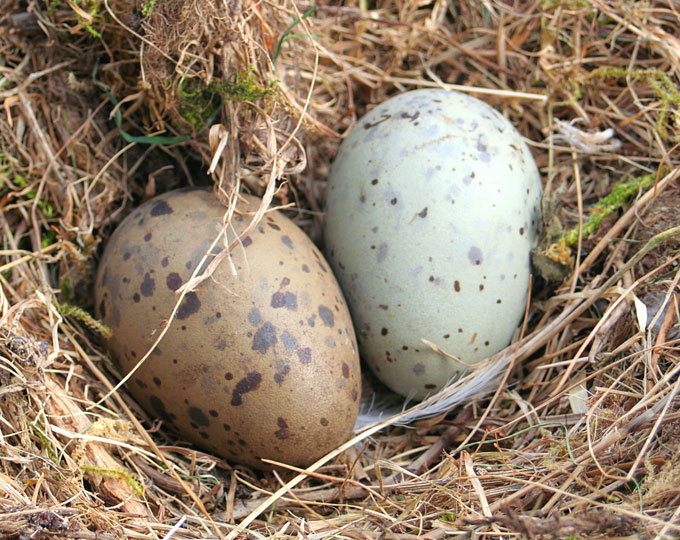
Researchers at Canada’s National Wildlife Research Centre and multiple Canadian universities have detected what may be traces of second-generation brominated flame retardants in gulls’ eggs from colonies across the Great Lakes. The substances were found in higher levels in an industrial area.

Health hazards of certain polybrominated diphenyl ethers (PBDEs) have attracted enough scrutiny in the last decade that the fire-retardant industry has largely phased out three chemicals within the PBDE family—penta-, octa-, and deca-BDA—and replaced them with other brominated substances, such as tetradecabromodiphenoxy benzene. Currently marketed as Saytex 120, this chemical was thought to be safer than the penta-, octa-, or deca-BDAs because it contains 14 bromine atoms, so it is both heavy and involatile, giving it less potential for bioaccumulation.


Researchers hypothesize that when the flame retardant hits wastewater streams, either microbial degradation or a sun-catalyzed reaction causes it to lose bromine atoms, increasing its bioaccumulation potential and potential subsequent health hazards.


Published December 31, 1969

(2011, November 29). "Safe" Flame Retardants Show Bioaccumulation Potential. Retrieved from https://www.buildinggreen.com/departments/newsbrief

Add new comment

To post a comment, you need to register for a BuildingGreen Basic membership (free) or login to your existing profile.

'Biggest Losers' Unveiled in Battle of Energy Star Buildings

News Brief

'Biggest Losers' Unveiled in Battle of Energy Star Buildings

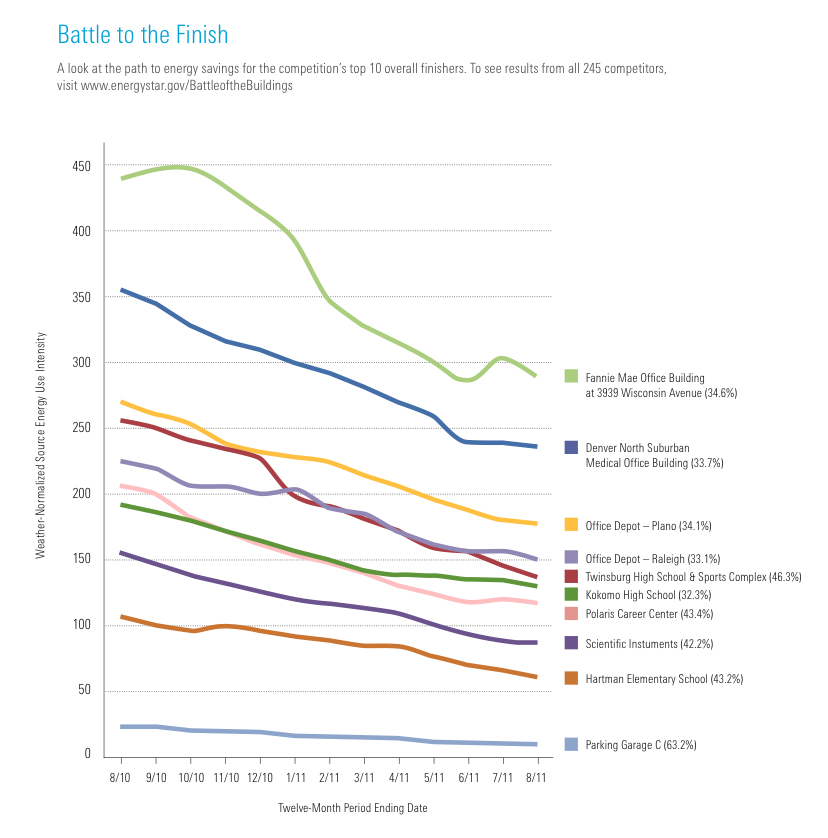
The second Energy Star National Building Competition, titled “Battle of the Buildings,” has released 2011 results, with the top finalist chalking up a 63.2% reduction in energy use.

According to the U.S. Environmental Protection Agency (EPA), sponsor of the contest, the 245 participating teams saved a total of $5.2 million on utility bills during the Battle of the Buildings. The buildings saved 240 million kBtus of energy during the contest year, preventing release of 30,000 metric tons of CO2—comparable to the annual emissions associated with powering 3,600 homes.

The winning building was a parking garage at the University of Central Florida. EPA acknowledged that parking garages and warehouses “may not present the same challenges as occupied buildings, but they are significant because of the sheer number of these facilities.” Not only does the winning building remind us that “these buildings should not be forgotten,” says EPA, but participating in the Battle of the Buildings also catalyzed other changes at the university, such as an aggressive after-hours lighting schedule and recommissioning throughout the campus. In addition to reducing energy use intensity (EUI) by more than 60% in the building, the university saved $34,907 in utility bills simply by replacing 150-watt sodium light fixtures with T-5 fluorescents and 400-watt fixtures with LEDs.

Twinsburg High School & Sports Complex in Twinsburg, Ohio, took second place in the competition by reducing EUI 46.3%, resulting in utility savings of $505,323. Twinsburg also took first place in the K–12 school category.

Scientific Instruments in West Palm Beach, Florida, took home the prize for office buildings by reducing 42.2%. Office Depot in Plano, Texas, was the top retail building, with a 34.1% reduction in EUI. St. Mark’s Hospital in La Grange, Texas, got the cleanest bill of health for hospitals by cutting 22.7%. The top house of worship, with a 17.9% reduction, was the First Unitarian Society of Minneapolis.

Although the official contest period went from May through October 2011, the final results compared two full years of energy use.

For more information:

Battle of the Buildings website



Published December 31, 1969

(2011, November 3). 'Biggest Losers' Unveiled in Battle of Energy Star Buildings. Retrieved from https://www.buildinggreen.com/departments/newsbrief

Add new comment

To post a comment, you need to register for a BuildingGreen Basic membership (free) or login to your existing profile.

EDA Announces Grant Winners for i6 Green Challenge

News Brief

EDA Announces Grant Winners for i6 Green Challenge

The U.S. Economic Development Administration (EDA) has announced grant recipients for the i6 Green Challenge, which aims to spur economic development by creating green jobs. More than $12 million was awarded to six groups working on the common goal of expediting the transition from green technology development to commercial implementation.

EDA i6 grants support the use of a proof-of-concept model aimed at technology-driven economic development that helps build a green economy. Goals for the six different projects are diverse, but generally focus on facilitating exchange of information and ideas between researchers, entrepreneurs, and businesses; connecting new technologies to testing facilities; and accelerating the movement of green technologies from ideas to commercially viable products or services.

For example, grant recipient Igniting Innovation Cleantech Acceleration Network will bring together scientists and entrepreneurs to work on commercializing research begun at several Florida universities on solar energy, biofuels, green building technologies, and smart grid technologies. For i6 Green program information and specific regional projects, see www.eda.gov/i6.
Published December 31, 1969

(2011, November 1). EDA Announces Grant Winners for i6 Green Challenge. Retrieved from https://www.buildinggreen.com/departments/newsbrief

Add new comment

To post a comment, you need to register for a BuildingGreen Basic membership (free) or login to your existing profile.

Green Home Appraisals Move Forward

News Brief

Green Home Appraisals Move Forward

Home appraisals have traditionally ignored the value added by green building features, but a new form would aid appraisers in documenting green features—particularly energy-saving equipment and assemblies. The form is an optional addendum to Fannie Mae Form 1004, the most widely used appraisal form for mortgage lending purposes, and provides space for detailed descriptions as well as value calculations and analysis.

Homeowners should not necessarily expect value calculations to be equal to initial investments in green features, however: local real estate markets drive appraisals. Quantifiable features like energy savings from efficient appliances and HVAC equipment, solarphotovoltaic (PV) and hot water systems, and high-performance windows will be valued based on the time frame of their cost savings. Other features, such as low-VOC carpeting or FSC-certified flooring, will add value only if there is precedent within the regional market.

Release of the form follows the Appraisal Institute’s training program for valuing green attributes in buildings (see “Valuing Green—Appraisals to Include Environmental Features,”

EBN June 2011). To download the addendum forms, go to www.appraisalinstitute.org.

Published December 31, 1969

(2011, November 1). Green Home Appraisals Move Forward. Retrieved from https://www.buildinggreen.com/departments/newsbrief

Add new comment

To post a comment, you need to register for a BuildingGreen Basic membership (free) or login to your existing profile.

Consumer Electronics Outpace Appliances as Global Warming Contributor

News Brief

Consumer Electronics Outpace Appliances as Global Warming Contributor

A report published in

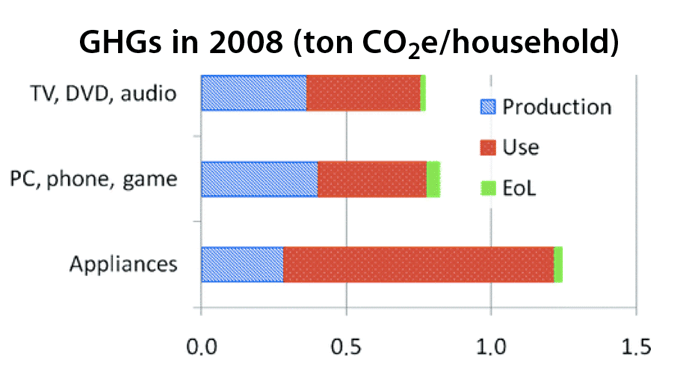
Environmental Science & Technology suggests that, as a group, consumer electronics are responsible for more greenhouse gas emissions than household appliances are. Researchers at the Norwegian University of Science and Technology used life-cycle assessments, including emissions during manufacture, in their study.

Factoring in the global supply chain tipped the balance toward electronics, which individually consume far less energy than appliances during operation but are more numerous, are replaced more frequently, and come with a larger amount of embodied carbon emissions from manufacturing. End-of-life emissions for electronics and appliances are small compared to emissions from production and operation but still weigh heavier on electronics due to their more frequent replacement.

The researchers also stressed the importance of the type of energy source used to power manufacture and operation, which can have a significant impact on emissions calculations. While this study sheds light on the emissions from household electronics, it is worth noting that appliances themselves are increasingly just larger electronics, many of which do not last as long as appliances built in previous generations.

Published December 31, 1969

(2011, November 1). Consumer Electronics Outpace Appliances as Global Warming Contributor. Retrieved from https://www.buildinggreen.com/departments/newsbrief

Add new comment

To post a comment, you need to register for a BuildingGreen Basic membership (free) or login to your existing profile.

EU May Be Underestimating Biofuels GWP

News Brief

EU May Be Underestimating Biofuels GWP

A committee of 19 scientists and academics has issued a draft opinion for the European Environment Agency criticizing the European Union’s method for calculating reductions in greenhouse gas emissions from the use of biofuels. They charge that the European Union has failed to fully take into account the carbon sequestration and storage potential of land left in its natural state instead of being repurposed to grow biofuels.

For example, if a forest is replaced with a biofuel crop, the carbon emission reductions associated with using biofuels instead of fossil fuels would be compromised by the lost carbon storage and sequestration potential of the preexisting forest. While this example may represent an extreme case, any land repurposed for biofuel production must take into account the previous land use’s carbon sequestration and storage potential to accurately predict the reduction in GWP from biofuel use.

This finding could ultimately result in a reduction in forecasts for the amount of environmentally viable energy available from biofuel crops in the future—something that could impact climate change models as well as farmers and businesses currently investing in biofuel production. To read the committee’s ”Opinion on Greenhouse Gas Accounting in Relation to Bioenergy,” go to www.eea.europa.eu.
Published December 31, 1969

(2011, November 1). EU May Be Underestimating Biofuels GWP. Retrieved from https://www.buildinggreen.com/departments/newsbrief

Add new comment

To post a comment, you need to register for a BuildingGreen Basic membership (free) or login to your existing profile.

Berkeley Breakthrough Opens Potential for "Smart Windows"

News Brief

Berkeley Breakthrough Opens Potential for "Smart Windows"

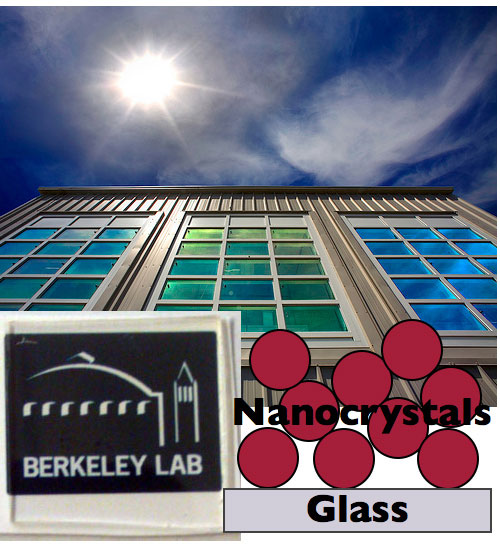
Researchers at Lawrence Berkeley National Laboratories have developed a technology that prevents solar heat gain without blocking visible light, allowing for “smart windows” that can respond to outdoor conditions without a visible change in the window.

At present, electrochromic window coatings can block near-infrared radiation, which causes heat gain, but only by darkening the window at the same time; this can lead to increased use of indoor lighting and offset the energy benefits of smart windows. The new technology uses a transparent nanocrystal coating of indium tin oxide—a semiconductor used in flat-screen TV displays.

The coating could allow for the creation of smart windows programmed to work in tandem with HVAC and lighting systems by selectively allowing heat to pass and always allowing light to pass—thereby reducing heating, cooling, and lighting loads.

Researchers also reported that the new coating requires less electricity in order to work compared with typical electrochromic coatings, making it more efficient in its own right. For more information, see www.newscenter.lbl.gov

Published December 31, 1969

(2011, November 1). Berkeley Breakthrough Opens Potential for "Smart Windows". Retrieved from https://www.buildinggreen.com/departments/newsbrief

Add new comment

To post a comment, you need to register for a BuildingGreen Basic membership (free) or login to your existing profile.