Low-Slope Roofing: Prospects Looking Up

Feature

Low-Slope Roofing: Prospects Looking Up

From an environmental standpoint, the low-slope roofing on commercial and industrial buildings is a big problem. (“Low-slope” roofing is often incorrectly called

flat roofing—it nearly always has a slight pitch). For starters, there is a lot of it. No one in the industry seems to know how much low-slope roofing exists in the United States, but back-of-the-envelope calculations by

EBN indicate that the nation’s 4.8 million

commercial buildings (not including industrial or agricultural buildings) have on the order of 1,400 square miles (3,600 km2) of roofing (mostly low-slope), an area larger than the state of Rhode Island. In the U.S., we spend $13 billion dollars a year on commercial roofing (1996 data), 75% of that on reroofing and 25% on new construction.

Low-slope roofing has an average life of about 20 years—often considerably less. Some studies have indicated an average life of only 12 years for the most common roofing types. During reroofing, conventional practice is not only to remove and landfill the old roofing, but also trash the rigid insulation that is usually an integral part of the roofing—and can account for 75% of the volume of roofing waste. Roofing waste is a significant portion of the construction and demolition waste, though detailed statistics are not available.

Other significant environmental impacts of low-slope roofing include the pollutants released from hot-melt asphalt built-up roofing systems, life-cycle concerns about materials used in manufacturing or disposing of the roofing, and the tremendous building damage resulting from failed roofs.

While the ideal low-slope roofing materials and systems may not exist yet, we can do a lot better, from an environmental standpoint, than conventional practice today. This article provides an overview of low-slope roofing and addresses options for reducing environmental impacts of these roofs. We look at both some tried-and-true options for creating environmentally better roofs, such as the protected-membrane system, and some newer ideas, such as the green (planted) roofs that are catching on in Europe.

A Brief History of Low-Slope Roofing

Prior to the late 1800s, most roofs were fairly steeply pitched. A steep roof (pitch greater than about 3:12) has numerous advantages: sheds rain easily; is highly forgiving; doesn’t have to be fully watertight; is generally able to vent water vapor and thus release trapped moisture; and can be quite inexpensive. Overlapping wood shakes, slate shingles, metal panels, even bundled grass (thatch) can function very effectively as long as the roof is steep enough that rain will flow off before wind or other forces can drive it through the roofing, causing leaks.

As the industrial revolution got under way in the mid-1800s, however, it made sense to build larger buildings. The wider the building, the more expensive it is to build a pitched roof needed to shed rain effectively. By keeping the roof flat—or essentially flat with a very low slope—cost and wasted space could be significantly reduced. The challenge was (and is) that a low-slope roof has to be

waterproof—as opposed to merely being able to shed rain. A continuous, monolithic membrane is needed to keep rainwater out.

The first low-slope roof membranes appeared in the 1840s. Large square sheets of sheathing paper used in boat building were treated with a mixture of pine tar and pine pitch and laid out on the roof between layers of a bitumen made from coal tar (then a waste product from coal gas production, now a by-product of coking, a process in steel making). Coal tar soon replaced the pine tar as the saturant, because it was more fluid. Then

rolls of felt replaced the square sheets that had to be hand-dipped in saturant. Multiple layers could be laid quickly, providing a more durable roof surface. The built-up roof was born.

By the end of the 1800s, asphalt began to appear as a competitor to coal tar pitch, both as felt saturant and mopping bitumen. (Asphalt is the residue remaining after higher-value products are extracted from petroleum.) Asphalt was both more versatile than coal tar—with a wider range of viscosities—and less expensive. Paper (organic) felts began to be challenged by asbestos felts in the 1920s, then fiberglass felts after World War II. The multi-ply, hot-mopped, built-up roofing (BUR) system, with a few material variations, held a virtual monopoly on low-slope roofing until the 1960s, when modified bitumen and single-ply roofing membranes appeared.

Low-Slope Roofing Today

The most common of today’s mix of low-slope roofing types can be divided into three broad (and sometimes overlapping) categories: built-up roofing; modified bitumen; and single-ply.

These are described very briefly below, including discussion of environmental characteristics. Low-slope metal roofing is addressed later. Other options, such as spray polyurethane foam, are not covered in this article. The table at left shows the market share of different low-slope roofing materials in the U.S.

Built-Up Roofing

Built-up roofing (BUR) is the oldest type of low-slope commercial roofing. While it has gradually lost market share to newer, more advanced materials, BUR still represents nearly a quarter of the commercial roofing industry. (In some areas, such as Chicago, BUR is actually making a comeback, according to roofing consultant Steve Shull, of e-Roof, Inc., following disenchantment with some of the newer systems.) Typically, four plies of felt are applied between coatings of asphalt or coal-tar bitumen heated to between 400°F and 500°F (205°C-260°C). The hot bitumen is generally mopped onto the roof surface by hand. The top coating of bitumen is the

flood coat, and aggregate is embedded in it before it cools. The aggregate provides protection from intense sunlight, hail, and foot traffic. It also increases the roof’s reflectivity to some extent, improves fire resistance, and helps resist wind uplift. With insulated roof assemblies, BUR is generally adhered to the insulation.

From an environmental standpoint, heating and spreading the hot-melt bitumen releases VOCs and particulates, which are responsible for the strong smell of asphalt during roofing. In addition to volatization of the bitumen, a standard 450-gallon (1,700 l) kettle used for heating bitumen on the roof uses about 25 gallons (95 l) of propane or kerosene per day, adding to the emissions. BUR roofing has only moderate durability. The industry rule-of-thumb is that each ply provides about five years of expected roof life—thus for a four-ply roof a 20-year life is expected. BUR becomes brittle at low temperature and cannot expand readily to accommodate movement of the building. During reroofing, both insulation and BUR membrane are typically landfilled. The weight of the BUR membrane is generally about 2-1 ⁄2 pounds/ft2 (12.2 kg/m2), not including surface aggregate or insulation.

Modified Bitumen Roofing

Modified bitumen roofing is similar to BUR, except that a polymer is mixed with the asphalt bitumen to produce a more flexible membrane that can achieve the necessary performance with fewer plies (typically two or three).

Modified bitumen roofing first caught on in Europe where, in some countries, it now holds as much as 90% of the market share. There are two basic types of modified bitumen roofing: those made with atactic polypropylene (APP) as the modifier; and those made with styrene-butadiene styrene (SBS) as the modifier. (Technically, APP is a

thermoplastic polymer, while SBS is a

thermoset plastic or elastomer.) Modified bitumens are typically sold in rolls that can be applied either in a traditional hot-mopped process, or with a torching process with welded edges and laps. Recently, polymer-modified bitumens have also become available as the mopping bitumen itself.

Compared with BUR, modified bitumen roofing is significantly more flexible. In fact, even with conventional BUR, modified bitumen is often used for the flashing details. These details may also increase the membrane life by taking the stress of building movement. Modified bitumen membranes are usually quite thick (120-180 mils or 3.0-4.6 mm), and with the tough cap sheet, they have nearly as much puncture and impact resistance as built-up roofs with aggregate surfaces—and more resistance than smooth-surfaced BUR. Some modified bitumens have significant recycled content (see sidebar).

Single-Ply Membranes

As the name implies, single-ply roofing is just a single, flexible, waterproof membrane. The simplicity of installation and the absence of smelly, smoking, hot-mopped asphalt have spawned an active search for effective, durable single-ply membranes. While there continues to be active research on these membranes, a collection of several materials now comprise roughly 35% of all commercial low-slope roofing in the U.S.

Among the first single-ply roofing membranes were neoprene rubber, vulcanized butyl, polyvinyl fluoride, and polyisobutylene (PIB). Sometimes these materials were fabricated onto asbestos-felt backing. Single-ply membranes were introduced primarily for very complex roofs with unusual geometries where hot-mopped BUR was difficult to apply. These have largely been replaced by ethylene propylene diene monomer (EPDM), polyvinyl chloride (PVC), chlorosulfonated polyethylene (CSPE or Hypalon), and polyolefin.

EPDM Membranes

EPDM is a type of synthetic rubber. It is a fully vulcanized or

thermoset elastomer. Carbon black is typically added for UV light resistance and strength, though a less-durable white EPDM is also available. Because it is fully vulcanized, seams cannot be welded with heat or solvents that partially dissolve the polymer; overlaps have to be sealed with adhesive. EPDM is highly elastic—it can be stretched more than 200% before reaching breaking strain, compared with just 2% for BUR. The material is somewhat susceptible to chemical attack from oils and fats, but has excellent ozone and UV resistance. EPDM does not contain chlorine or other halogens, which is an environmental advantage from a materials standpoint, but this results in lower fire resistance than halogenated single-ply membranes. For adequate fire resistance, a surface coating of ballast is generally required. As with other thermoset plastics, EPDM is not recyclable into new membrane.

PVC Membranes

PVC is a thermoplastic, making it fully weldable both during installation and for any necessary repairs—and welds can be as strong as the membrane itself. Flexibility is provided by adding plasticizers to the membrane. Popularity has grown significantly since PVC roofing was first introduced in the 1960s. Some early unreinforced PVC roofing membranes had premature failures, so most products sold today are reinforced with polyester or fiberglass. Loss of the membrane’s plasticizers can also result in premature failure. PVC is most commonly sold in white, but gray and a whole palette of brighter colors are also available from some manufacturers.

While PVC roof membranes have a lot going for them, they also have some problems. From an environmental standpoint, both the PVC itself is considered a problem (because of potential dioxin generation during manufacture, disposal, or accidental fires), and the plasticizers that are added to provide flexibility are potentially hazardous. The most common phthalate plasticizers, including DEHP or dioctyl phthalate, are suspected of being endocrine disrupters.

Some of the strongest opposition to PVC roofing comes from those concerned about fire. A letter obtained by

EBN that was sent to the Concord (Massachusetts) School Board by Richard Duffy, Director of the Department of Occupational Health and Safety of the International Association of Fire Fighters, expressed strongly worded concern about PVC roofing in the advent of a fire. “The International Association of Fire Fighters, which represents fire fighters throughout the United States and Canada, is concerned about the short- and long-term health hazards posed by exposure to combustion by-products of PVC fires.” Duffy referred to two hazards. First is the immediate risk of exposure to hydrogen chloride gas, a highly toxic gas that can cause skin burns and damage to the respiratory tract. “Exposure to a single PVC fire can cause permanent respiratory disease,” he said in the letter. The second hazard is the production of dioxin. While only small amounts of dioxin may be formed from burning PVC, according to Duffy, “it is one of the most toxic substances known to science.” Dioxin is a known human carcinogen and has been linked to reproductive disorders, immune suppression, endometriosis, and other diseases.

Despite these concerns, PVC roofing has made its way into some leading-edge “green” buildings, including the Herman Miller SQA Building in Holland, Michigan designed by William McDonough + Partners.

Russell Perry, AIA, of the firm explained that his company is “looking forward eagerly to a PVC-free future,” but in the meantime budget and performance requirements have sometimes meant using PVC. When they designed the Herman Miller building, he told

EBN, PVC “looked like the best alternative we had.” According to Perry, Bill McDonough designed the building so that a green (vegetated) roof could be retrofit onto it in the future (see photo below).

CSPE or Hypalon Membranes

Chlorosulfonated polyethylene, or CSPE (known commonly by the tradename Hypalon, is a white polymer that is often marketed for its energy-saving reflectivity (see page 15). The chemistry of CSPE is somewhat unique, in that it is installed as a non-vulcanized or uncured elastomer; then cross-linking occurs upon exposure to heat and moisture, and the plastic converts into a fully vulcanized or cured thermoset elastomer. CSPE has excellent weather resistance, even in the typical high-reflectivity white. Fire resistance is provided by the chlorine in the elastomer formulation. While PVC has received the most attention from environmentalists, the chlorine in other plastics, such as CSPE, is just as big a concern, according to Charlie Cray, a toxics campaigner with Greenpeace.

Flexible Polyolefin Membranes

Due in part to environmental and health concerns about PVC, a number of manufacturers have begun producing non-chlorine-based, thermoplastic roofing membranes. Generically, this type of membrane is referred to as flexible polyolefin (FPO) or thermoplastic olefin (TPO). Polyolefin refers to a class of polymers comprised primarily of polyethylene and polypropylene. While PVC membranes obtain their flexibility with plasticizers, FPO or TPO membranes achieve their flexibility through the copolymers; there is no way for the plasticizer to leach out, as sometimes has occurred with PVC (resulting in brittleness over time). As with most PVC membranes, fiberglass or polyester reinforcement is used with these membranes.

Sarnafil, one of the leading PVC roofing manufacturers, with U.S. operations based in Canton, Massachusetts, introduced what they refer to as FPO roofing membrane in Europe around 1991 and in the U.S. in 1996. Sarnafil T membrane is a specially blended mix of copolymers and terpolymers of polyethylene. The product is recommended by the manufacturer only for ballasted roofing applications, however, according to vice-president Brian Whelan. Without chlorine or another halogen, the FPO membrane doesn’t pass the U.S. fire tests required by Factory Mutual and Underwriters Laboratory, so the stone or concrete paver ballast is required above it. Whelan told

EBN that most other producers of FPO add bromine to the chemical formulation to meet the fire performance requirements, but that Sarnafil will not do this because of environmental concerns about bromine. Bromine makes it more difficult to recycle polyolefin, and it may decrease the life of the product. Cray of Greenpeace told

EBN that bromine probably has similar—and perhaps even worse—environmental problems as PVC, though he did not know what quantities of the element are added for fire retardancy in polyolefin membranes. While Sarnafil T represents just a few percent of Sarnafil sales (the rest being PVC membrane), Whelan says that their FPO product should perform at least as well as PVC in a ballasted application. “If there’s a weakness to PVC,” said Whelan, “it’s in ballasted roofs.” He expects that in a ballasted or protected-membrane roof, FPO should last 20 to 30 years.

Another company, GenFlex Roofing Systems (previously General Tire), which has been producing EPDM roofing membranes since 1980 and PVC roofing membranes since 1984, introduced a TPO membrane in January 1997. Already, according to Glenn Orn of the company, TPO sales are expected to surpass PVC this year, and his company believes that TPO will eventually replace both PVC and EPDM. Unlike Sarnafil, GenFlex adds a fire retardant to their TPO formulation (believed to be bromine), so that it passes UL and Factory Mutual fire testing and can be used in exposed (unballasted) applications.

Concerns about PVC and the emergence of polyolefins have not gone unnoticed by industry giant Firestone, which manufactures a wide range of BUR, modified bitumens, and single-ply membranes. The company recently cancelled plans to build a multi-million-dollar PVC roof membrane plant, reportedly due to life-cycle concerns about PVC and how those might affect the market.

Membrane Attachment Options

Hot-mopped built-up roofing and modified bitumen membranes provide their own attachment—the melted asphalt, coal tar, or modified asphalt serves as the adhesive. Not so with single-ply membranes. For single-ply membranes, the options are gluing the membrane to the insulation or roof deck, mechanically fastening the membrane, or leaving it unattached and holding it in place with rock or concrete-paver ballast. From an environmental standpoint, mechanical or ballasted attachment options are generally preferable to the use of adhesives—it does not result in VOC emissions from the adhesive, and the membrane can be removed and recycled more easily when it fails or when the roof needs to be modified.

Some mechanical fastening systems for single-ply membranes provide attachment without actually penetrating the membrane. The highly elastic membrane lies over special fittings, and caps are screwed on, sandwiching the membrane in the middle and holding it in place.

When ballast is used, it must be chosen to avoid damage to the material immediately underneath. The weight of ballast required depends on the local wind conditions. The use of

interlocking concrete pavers can reduce the total weight needed if the interlocking system helps prevent uplift.

The downside to a loose-laid or mechanically fastened membrane is that it is more difficult to identify the origin of roof leaks. Mark Rylander, AIA, of William McDonough + Partners, notes that a ceiling leak inside a building may be 30 feet (9 m) from the actual roof leak with single-ply membranes—particularly those that are loose-laid or mechanically fastened. This concern has brought some architects and specifiers back to BUR and modified bitumen roofs, after dealing with problems with single-ply products.

Environmentally Responsible Low-Slope Roofing

Standard low-slope roofing has little going for it from an environmental standpoint. Most materials have a limited life, after which they contribute significant waste to landfills—not only the roofing material itself, but also the insulation that is destroyed removing the roofing membrane. The most common roofing materials are black, absorbing solar energy and thus increasing the cooling loads in buildings. And some of the roofing materials introduced to solve the above problems—especially PVC formulations—have a whole set of environmental concerns related to the manufacture and disposal phases of their life cycle.

The ideal low-slope roofing material, relative to the environment, probably does not exist yet, but that doesn’t mean that we can’t do a lot better than conventional practice today. Below are some strategies for producing greener, more environmentally responsible roofs.

Protected-Membrane Roofing

The protected-membrane roof (PMR)—also commonly referred to as the insulated roof membrane assembly (IRMA), a name given to it by Dow Chemical, which held a patent on the system until that patent expired in the 1970s—has a number of very significant environmental and performance features going for it.

Here’s how a protected-membrane roof works: The waterproof roof membrane is applied directly on the structural roof deck, rigid insulation (usually extruded polystyrene) is installed on top of this membrane, and the insulation is held in place with ballast (aggregate or concrete pavers). A drainage composite layer provides drainage between the roof membrane and insulation, and rainwater or snowmelt runs off through drains. Any type of membrane can be used with a PMR: conventional hot-mopped BUR, modified bitumen, or a synthetic single-ply membrane.

An important benefit is that the insulation protects the membrane from temperature extremes, freeze-thaw cycling, UV degradation from direct sunlight exposure, roof traffic, hail, and stress concentrations over insulation joints, all of which shorten the life of plastic and elastomeric materials in conventional systems (membrane above roof insulation).

Protected-membrane roofs have been around more than 30 years. Canada, the world leader in PMR technology, began actively promoting this approach in 1965, and it is well accepted today. In 1969, the University of Alaska adopted PMR as its primary roof specification, even at its Fairbanks campus where the 99% winter design temperature is -53°F (-47°C)! By carefully insulating the roof drains, the University’s roofs remain free of ice build-up even in this extreme climate.

Dow Chemical originally developed the PMR system in the 1960s and markets Styrofoam Roofmate® specifically for this application. Extruded polystyrene (XPS) is the insulation material of choice for protected-membrane roofs, because of its very low moisture absorbency (the insulation in a protected-membrane roof can remain wet for long periods of time) and high compressive strength. Unfortunately, in North America all XPS is made with ozone-depleting HCFC-142b; in European countries that have phased out HCFCs, Dow Styrofoam is now made with CO2 as the blowing agent.

Foamglas, made by Pittsburgh Corning, can also be used with PMR systems. Foamglas is a 100% inorganic glass material that appears quite attractive from a materials standpoint, but it is fairly energy intensive to produce and quite expensive (about three times the cost of XPS). There is also some concern with Foamglas that it could be damaged by freeze-thaw action.

From an environmental standpoint, one of the outstanding features of the PMR system is the ability to reuse the insulation when a membrane failure necessitates reroofing. Re-use of insulation is easy because the insulation is rarely if ever today bonded to the membrane (either by adhesives or hot bitumen). The insulation is loose-laid on the membrane and held in place with ballast. If the insulation deteriorates while the membrane remains in good shape, it can be replaced with no disruption to the building, because the membrane is not affected.

One downside in some climates is the potential for plant and fungus growth at the membrane surface. Vegetation may grow up through the paver joints or stone ballast, and the roots in some cases may damage the membrane. The use of a drainage layer between the insulation and membrane has been found to reduce this problem.

Low-Slope Metal Roofing

Metal roofing is often specified as a highly durable and readily recyclable alternative for commercial roofing. The problem with metal roofing for commercial buildings has been that metal roofing was only practical for steeper slopes (generally greater than 3:12 pitch)—until recently, that is. Manufacturers of metal roofing now offer low-slope systems that work at pitches as low as

1 ⁄ 4” in one foot (0.25:12 or 2%), which is a typical pitch for low-slope commercial roofs. To remain watertight at such a low pitch, the standing seam for the roofing has to be specially designed to prevent water penetration. Roofing consultant Steve Hardy, of Moisture-Tech in Seattle, believes that metal roofing will ultimately prove one of the most environmentally friendly low-slope roofing alternatives.

Standing-seam metal roofing typically costs significantly more than conventional membrane roofing, but longer life and lower maintenance requirements often brings the life-cycle cost below that of membrane roofing. Even the first cost can be competitive, however, if the roofing eliminates the need for a structural roof deck. While most architectural panel roofing systems require solid backing, low-slope metal roofing is all structural, according to Steve Shull. The Span-Lok® roofing system from AEP-SPAN, for example, can be used at pitches as low as 0.25:12 and is capable of spanning up to 5 feet (1,500 mm). Shull suggests that it no longer makes sense to look only above the deck. “Look at the whole functional system,” he says. Shull argues that professionals in the roofing industry need to be proactive and knowledgeable in energy, rainwater management, and structural issues to maximize value to their clients.

Reflective Roofs

Conventional low-slope roofing absorbs a lot of sunlight. The solar-heated roof surface contributes both to the cooling load of the building (by conducting heat through to the interior) and to the

urban heat island effect—a localized warming in urban areas that increases cooling loads in all buildings. If roofs can be made more reflective (higher albedo), those problems can be reduced, which will cut energy consumption.

According to the U.S. Environmental Protection Agency, approximately $40 billion is spent annually to cool buildings—one sixth of all electricity generated in the U.S. In low-rise commercial buildings, heat gain through the roof may account for more than 50% of the total cooling load. With conventional low-slope roofs, it is not unusual for there to be a 70°F (39°C) difference in temperature between the roof surface and the ambient air temperature, which drives conductive heat gain into the building. The problem is exacerbated when the ceiling plenum serves as the conditioned air supply for the building, a very common strategy in commercial buildings. (Using such a plenum for conditioned air supply is also a significant cause of indoor air quality problems in buildings, particularly if volatized chemicals from the roofing make their way into the plenum.)

Highly reflective roofs can reduce cooling costs in commercial buildings by as much as 50%, according to the Environmental Protection Agency’s Energy Star Roof Products Program.

Data collected by Lawrence Berkeley National Laboratory (LBNL) showed dramatic reductions in roof surface temperatures and air conditioning costs after commercial buildings were retrofit with reflective roof coatings (see Table 2).

It is not only the reflectivity, or albedo, of a roof surface that determines how much it will heat up. The

emissivity of the surface also plays an important role.

Some materials with very high reflectivities, such as bright metal roofing, have very low emissivities (see Table 3). Low emissivity prevents the heated surface from re-radiating that energy, so the surface stays hot and heat conducts downward. In other words, it is possible for a dark roofing material to be cooler than another roofing material that is lighter in color and more reflective. To account for both of these parameters (reflectivity and emissivity), LBNL researchers have come up with the

solar reflectance index (SRI), as shown in Table 3. Paul Berdahl of LBNL told

EBN that SRI values are only approximate; wind conditions play an important role in determining the relative significance of the two parameters. When it’s windy, the emissivity of the roof is less significant.

Most low-slope roofing today is black or nearly black, with extremely low reflectivity and low SRI values. Some of the single-ply membranes, on the other hand, have excellent reflectance. EPDM, the most widely used single-ply roof membrane, is normally black. A white formulation of EPDM is available but not recommended because of durability problems. PVC is the most common reflective roof membrane today, though CSPE (Hypalon) and flexible polyolefins are also used.

For existing roofs, there are various spray-on or roll-on reflective coatings that can be used. Most common among these are acrylic coatings, which are essentially thick, specially formulated paints. Most offer the benefits of reflectivity as well as

some level of protection against weather. Most spray-on reflective coatings do not serve as the waterproof membrane, though some do.

Reflective roofing will gain a lot of attention when EPA’s Energy Star Roof Products program is formally unveiled at the National Roofing Contractors Association conference in Phoenix on February 7-10, 1999. The Memorandum of Understanding was finalized for this program in late October, and EPA is working to sign up manufacturer partners. To comply with the program (allowing an Energy Star label to be used in marketing the roofing products), the initial reflectivity of roofing products must be greater than or equal to 0.65, and it must be able to maintain reflectivity of 0.50 three years after installation under normal conditions. (Emissivity is not considered in the standards.) Rachel Schmeltz, program manager for the new EPA program, estimates that 10% to 15% of roofing products on the market would comply with the standards.

Green Roofs

Perhaps the most exciting development with low-slope roofing is the “green roof.” Green roofs, or living roofs, as the name implies, are planted with vegetation. In essence, these are protected-membrane roofs with soil and plantings (as well as insulation) installed above the membrane. While a fairly novel concept in commercial roofing in this country, green roofs actually have a long history. The first used birch bark as the membrane with sod on top of it. Because the membrane was not highly watertight, however, this primitive green roof design only worked if there was enough pitch. Beginning in the 1970s, green roofs have been used to a limited extent—primarily on underground or heavily bermed buildings. In parts of Europe, green roofs are widely used with both residential and commercial buildings.

To work on a commercial building, the green roof has to be very carefully designed and built. American Hydrotech and Soprema are the most active participants in green low-slope roofing in North America today, with Soprema having primarily a Canadian presence. Gensler Associates of San Francisco and William McDonough + Partners teamed up to design a green roof for the 190,000 square-foot (17,650 m2) GAP office building in San Bruno, California, completed at the end of 1997.

The building has 70,000 square feet (6,500 m2) of green roof. The project used a two-ply SBS-modified bitumen roof membrane by American Hydrotech, the U.S. leader in green roofing. Hydrotech’s MM6125-EV modified bitumen was chosen because of its minimum 25% post-consumer recycled content (including recycled rubber and petroleum). Their standard modified bitumen (MM6125) has a minimum 10% recycled content. The roof section included 4” (100 mm) of Dow Styrofoam®, filter fabric, 3” to 4” (75 mm to 100 mm) of soil, and plantings of native grasses.

More recently, American Hydrotech has affiliated with ZinCo GmbH of Germany to offer a more comprehensive Garden Roof™ system.

Such a system was recently installed on the 75,000 square-foot (7,000 m2) Mashantucket Pequot Museum & Research Center in Mashantucket, Connecticut. This system includes the same high-recycled-content modified bitumen membrane, plus several other key components provided by ZinCo to ensure long-lasting performance (see figure). Of these additional components, Floradrain is most interesting. It is a 2-1 ⁄ 4”-thick (57 mm) egg-crate-like material made from 100% recycled polyethylene. The depressions in the Floradrain retain water, while also permitting runoff of very heavy rainfall.

All these roofing components add considerable thickness to the roof—about 8” (200 mm), exclusive of the soil (but including insulation), and add considerably to the roof cost. Matthew Carr, the Garden Roof Product Manager for American Hydrotech says that with the thicker soil system (called an

intensive Garden Roof), the total installed roofing cost should be $15-$20/ft2 ($160-$215/m2). With a shallow-soil roof designed for grasses, sedums, and wildflowers only (as used in the GAP building), the total installed cost should be $10-$15/ft2 ($110-$160/m2). These costs do not include the additional structural requirements needed to carry the increased roof load.

Despite the high cost, Carr reports a great deal of interest in green roofs, particularly at a recent landscape architects convention in Portland, Oregon. The primary driver, he told

EBN, is stormwater detention. Such a roof can detain 50%–70% of the rainfall from a typical storm event, he said. Officials in Portland are very interested in figuring out a way to incentivize green roofs in the city as a way to reduce stormwater flows.

If Germany is any indicator of trends, green roofs could become very common. Many municipalities in Germany now mandate that with any new development, at least 50% of the site must be covered with vegetation at project completion. The easiest and least expensive way to comply with that is often to build green roofs. The German regulations are driven primarily by stormwater control and air purification provided by vegetation.

New Membrane Materials

While the environmentally aware designer should certainly consider the various

system solutions for environmentally responsible roofing, there will be continuing developments in membrane materials as well. The polyolefin products described above will likely continue to evolve, and they may well replace PVC and EPDM. Polyolefin manufacturers may find ways of meeting UL and Factory Mutual fire performance standards without sacrificing recyclability or durability.

Meanwhile, there is exciting research being conducted on another class of polyolefins. Chemical engineer David Highfield, president of CHEMECOL in Charlotte, North Carolina and previously affiliated with McDonough Braungart Design Chemistry (after 25 years with Armstrong and Exxon), has been working on drop-in replacements for PVC since 1992. He has focused most of this work on a class of chemicals called metallocene polyolefins. Specialized catalysts allow metallocene polyolefins to be made with highly specific design properties. Applications are being investigated by his company for a wide range of building products, including flooring, wallcovering, and roofing. At a recent Boston symposium on PVC alternatives, Highfield claimed that metallocene polyolefin roofing would be able to satisfy all standard fire tests for both exposed and ballasted applications without any halogens (chlorine, bromine, etc.) or plasticizers.

Final Thoughts

Commercial roofing remains a challenge for architects, developers, and building owners who want to create more environmentally responsible buildings, but reasonable options are emerging. Look for continued evolution of polyolefin membranes, for example, as alternatives to PVC and EPDM. When possible, consider one of the leading-edge roofing strategies, such as green roofing, rainwater catchment, and power generation. Also, look for greater use of low-slope metal roofing systems. And remember to pay attention to the big picture. In the selection of roofing materials, Steve Shull stresses the importance of considering the whole roof system right from the start. “Rather than focusing on the detail of what deck, membrane, or insulation type is environmentally preferred, it should first be determined what design type offers the fewest environmental impacts.”

By making environmental performance a priority in roofing design and material selection, we can dramatically reduce the overall environmental impact of our commercial building stock. Roofing isn’t as glamorous a part of buildings as floor tile or interior finishes, but it is critically important in terms of the overall environmental impact.

For more information:

National Roofing Contractors Association

O’Hare International Center

10255 W. Higgins Road, Suite 600

Rosemont, IL 60018

708/299-9070; 847/299-1183 (fax)

www.roofonline.org (Web site)

Rachel Schmeltz, Program Manager

Energy Star Roof Products Program

Office of Air and Radiation

U.S. Environmental Protection Agency

Washington, DC 20460

888/star-yes, 202/564-9124

schmeltz.rachel@epa.gov (e-mail)

www.energystar.gov (Web site)

American Hydrotech, Inc.

303 East Ohio Street

Chicago, IL 60611

800/877-6125

312/337-4998; 312/661-0731 (fax)

804/378-6125 (Matt Carr, Garden Roof product manager)

www.hydrotechusa.comBrian Whelan, Vice President

Sarnafil Roofing & Waterproofing Systems

100 Dan Road

Canton, MA 02021

781/828-5400; 781/828-5365 (fax)

www.sarnafilus.com (Web site)

webmaster@sarnafilus.com (e-mail)

Steve Shull

e-Roof, Inc.

835 Cedar Terrace

Deerfield, IL 60015

847/405-9808; 847/405-9864 (fax)

e-Roof@worldnet.att.net (e-mail)

Published October 1, 1998

(1998, October 1). Low-Slope Roofing: Prospects Looking Up. Retrieved from https://www.buildinggreen.com/departments/feature

Linoleum: The All-Natural Flooring Alternative

Light Pollution: Efforts to Bring Back the Night Sky

Radon and Other Soil Gases: Dealing with the Hazards from Below

Feature

Radon and Other Soil Gases: Dealing with the Hazards from Below

Though radon is the most serious threat overall, there are many other soil gases that builders of environmentally responsible buildings should be aware of.

Published July 1, 1998

Energy Star Programs: Uncle Sam's Partnerships for Energy Efficiency

Structural Insulated Panels: An Efficient Way to Build

Feature

Structural Insulated Panels: An Efficient Way to Build

Structural Insulated Panels (SIP), have been around since the 1950s but only began making inroads into the construction industry in the 1980s.

Published May 1, 1998

Thermal Mass and R-value: Making Sense of a Confusing Issue

Feature

Thermal Mass and R-value: Making Sense of a Confusing Issue

Background on the physics of heat transfer to help understand the relationship between thermal storage and heat flow, and when this information is relevant and how it should be used in building design. 

The advertisement promises R-30 from a lightweight masonry block wall system. Log home product literature claims that log walls insulate as well as fiberglass because of the thermal mass. Salesmen at a trade show argue that a new fiber-cement building system achieves R-28 even though the “tested” R-value comes in at only R-16.

What’s going on here? Do these claims of “effective R-values” that greatly exceed the widely published R-values for high-mass materials hold up? Just what effect does thermal mass have on the energy performance of an exterior wall system? The issue of thermal mass and its effect on the energy performance of buildings is one of the most confusing issues facing designers, builders, and buyers of buildings today. This article tries to sort out these mysteries, providing enough background on the physics of heat transfer to understand the relationship between thermal storage and heat flow, and then explaining when this information is relevant and how it should be used in building design. This article does not address the use of thermal mass inside a building, where it can store heat (or coolth) and even out temperature fluctuations.

Understanding Heat Transfer

Heat flows by three mechanisms: conduction, convection, and radiation.

  • Conduction is the molecule-to-molecule transfer of kinetic energy (one molecule becomes energized and, in turn, energizes adjacent molecules). A cast-iron skillet handle heats up because of conduction through the metal.
  • Convection is the transfer of heat by physically moving the molecules from one place to another. Hot air rises; heated water thermosiphons; our forced-air heating systems work by moving hot air from one place to another.
  • Radiation is the transfer of heat through space via electromagnetic waves (radiant energy). A campfire can warm you even if there is wind between you and the fire, because radiation is not affected by air.

With buildings, we refer to heat flow in a number of different ways. The most common reference is “R-value,” or resistance to heat flow. The higher the R-value of a material, the better it is at resisting heat loss (or heat gain). U-factor (or “U-value,” as it is often called) is a measure of the flow of heat—thermal transmittance—through a material, given a difference in temperature on either side. In the inch-pound (I-P) system, the U-factor is the number of Btus (British Thermal Units) of energy passing through a square foot of the material in an hour for every degree Fahrenheit difference in temperature across the material (Btu/ft2hr°F). In metric, it’s usually given in watts per square meter per degree Celsius (w/m2°C)

R-values are measured by testing laboratories, usually in something called a guarded hot box. Heat flow through the layer of material can be calculated by keeping one side of the material at a constant temperature, say 90°F (32°C), and measuring how much supplemental energy is required to keep the other side of the material at a different constant temperature, say 50°F (10°C)—all this is defined in great detail in ASTM (American Society of Testing and Materials) procedures. The result is a steady-state R-value (“steady-state” because the difference in temperature across the material is kept steady). R-value and U-factor are the inverse of one another: U = 1/R. Materials that are very good at resisting the flow of heat (high R-value, low U-factor) can serve as insulation materials. So far, so good.

Materials have another property that can affect their energy performance in certain situations: heat capacity. Heat capacity is a measure of how much heat a material can hold. The property is most significant with heavy, high-thermal-mass materials. As typically used in energy performance computer modeling, heat capacity is determined per unit area of wall. For each layer in a wall system, the heat capacity is found by multiplying the density of that material, by its thickness, by its specific heat (specific heat is the amount of heat a material can hold per unit of mass). Water has a specific heat of 1 Btu/lb.°F (1.9 kJ/kg°C), while most building materials are around 0.2 to 0.3 Btu/lb.°F (0.4 to 0.6 kJ/kg°C).

If there are various layers in the wall, total heat capacity is found by adding up the heat capacities for each layer (drywall, masonry block, and stucco, for example). In the following section, we will examine how the heat capacity of materials can affect the energy performance of buildings.

“Mass-Enhanced R-Value”

When people refer to the “mass effect” or “effective R-value,” they are generally referring to the ability of high-mass materials, when used in certain ways, to achieve better energy performance than would be expected if only the commonly accepted (steady-state) R-value or U-factor of that material were considered. Let’s take a look at a typical use of one of these high-mass materials in a wall system. When one side of the wall is warmer than the other side, heat will conduct from the warm side into the material and gradually move through it to the colder side. If both sides are at constant temperatures—say the inside surface at 75°F (24°C) and the outside surface at 32°F (0°C)—conductivity will carry heat out of the building at an easily predicted rate. As described above, this steady-state heat flow is what most test procedures for determining R-value measure.

In real-life situations, however, the inside and outside temperatures are not constant. In fact, in many parts of the country, the driving force for conductive heat flow (remember, heat always moves from warmer to colder) can change dramatically or even reverse during the course of a day. On a summer afternoon in Albuquerque, New Mexico, for example, it might be 90°F (32°C) outside, and the outside wall surface—because it has a dark stucco—might be even hotter. It’s cooler inside, so heat conducts from the outside surface of the wall inward. As night falls, however, it cools down outside. The air temperature may drop to 50°F (10°C). The driving force for heat flow changes. As the temperature difference across the wall is reversed, the heat flow is also reversed—drawing heat back towards the outside of the building. As a result of this modulating heat flow through a high-heat-capacity material, less heat from outside the building makes its way inside. Under these conditions, the wall has an effective thermal performance that is higher than the steady-state R-value listed in books (such as ASHRAE’s Handbook of Fundamentals). This dynamic process is what some people call the “mass effect.”

Another common scenario is when the outside temperature fluctuates but never crosses the indoor setpoint temperature. In this case, the direction of heat flow never changes, but the thermal lag or time delay in heat flow can still be beneficial by delaying the peak heating or cooling load. For example, if the outdoor temperature in Miami peaks at 95°F (35°C) at 5:00 on a summer afternoon, but it takes eight hours for the heat to travel through the wall, the effect of that peak temperature won’t be felt inside the building until the middle of the night. Because most cooling equipment operates at higher efficiency if the outdoor air temperature is lower and because nighttime thermostat settings may be higher (at least in commercial buildings), potentially significant savings can result. Not only can total cooling energy be reduced, but peak loads can also be reduced. This can lead to smaller (and less costly) mechanical systems and lower demand charges for electricity. This time lag effect can save energy and money, but note that it does not affect the total amount of heat flowing through the wall.

As noted above, the amount of heat flow through a wall is reduced by the use of thermal mass when the temperatures fluctuate above and below the desired indoor temperature, so under these conditions a material might have a “mass-enhanced” R-value that is greater than its steady-state R-value. To estimate this mass-enhanced R-value for a given high-mass material in a particular climate, researchers at Oak Ridge National Laboratory measure the thermal performance of a high-mass wall under  dynamic conditions, in which the temperature on one side of the wall is kept constant and the temperature on the other side is made to fluctuate up or down. With this measured heat flow under dynamic conditions as a basis, they then use computer modeling to arrive at steady-state wall R-values that would be required to achieve comparable overall energy performance under various climate conditions. Those results are what we are calling the “mass-enhanced R-values” for the high-mass material under the modeled conditions. (Others refer to this as the effective R-value, a term that can be misleading.) The multiplier obtained by dividing the mass-enhanced R-value of a material in a given climate by its steady-state R-value is referred to by Oak Ridge researchers as the Dynamic Benefit for Massive Systems (DBMS).

When is Mass-Enhanced R-Value Significant?

The mass effect is real. High-mass walls really can significantly outperform low-mass walls of comparable steady-state R-value—i.e., they can achieve a higher “mass-enhanced R-value.” BUT (and this is an important “but”), this mass-enhanced R-value is only significant when the outdoor temperatures cycle above and below indoor temperatures within a 24-hour period. Thus, high-mass walls are most beneficial in moderate climates that have high diurnal (daily) temperature swings around the desired indoor setpoint.

Nearly all areas with significant cooling loads can benefit from thermal mass in exterior walls. The sunny Southwest, particularly high-elevation areas of Arizona, New Mexico and Colorado, benefit the most from the mass effect for heating. In northern climates, when the temperature during a 24-hour period in winter is always well below the indoor temperature, the mass effect offers almost no benefit, and the mass-enhanced R-value is nearly identical to the steady-state R-value. The ASHRAE Handbook of Fundamentals lists “mean daily temperature range” data for hundreds of U.S. climates in the chapter on climate data. These values can be helpful in figuring out how significant mass-enhanced R-value might be for a particular climate, but they do not tell the whole story; also significant is the percentage of days during the heating and cooling seasons when the outdoor temperature cycles above and below the indoor temperature.

Do We Need Mass-Enhanced R-Value Ratings?

Clearly, high-mass materials used in exterior walls perform better than would be expected based solely on their steady-state R-values. But the actual thermal performance is highly dependent on where the building is located. Manufacturers of these materials rightly want to take credit for this improved performance, but how can that be done in a way that doesn’t exaggerate performance for parts of the country where the mass effect benefit just isn’t there? “Right now, we don’t have a system that forces people to deal with calculations in a constant way,” says Bruce Wilcox, P.E., of the Berkeley Solar Group, who has done extensive modeling of mass effects for the Portland Cement Association and others.

All sorts of claims are being made about mass-enhanced R-value (usually called “effective R-value”) with little standardization. The first step needs to be consensus on how the mass effect should be accounted for in testing and modeling. Jeffrey Christian at Oak Ridge National Laboratory has been developing and refining the method of dynamic thermal analysis and simulation described above. This is the most extensive effort to date to quantify the mass effect. Christian’s group, with the help of Bruce Wilcox and others, also developed thermal mass tables for the Model Energy Code in the late 1980s that can be used to account for the thermal mass benefits of high-mass building materials in wall systems.

The next step, suggests Christian, might be to formalize the testing and simulation procedures through development of ASTM standards. Establishment of an ASHRAE committee to address the mass effect may also be in the works. To ensure that such standards would be applied in a consistent manner, Wilcox suggests that applicable industries might have to set up some sort of council, perhaps modeled after the National Fenestration Rating Council (NFRC), which enforces consistent reporting of window energy performance. Such a “Thermal Mass Rating Council” might oversee standards relating to how mass effect and mass-enhanced R-value are reported. Wilcox remains leery of the whole concept of mass-enhanced R-value—not that the effect exists, but whether it can be used clearly with building materials. “I don’t know if there’s any way to make it a property of the material,” he told  EBN, “It’s a property of the system.” There are a lot of questions to sort out, such as how many climates need to be modeled: are six enough, as Oak Ridge researchers have used, or do we need 20? Would such a system take credit for time delays in heat transfer, or just actual reductions in the amount of heat that moves through? Who will pay for all the research to make this happen? Are the industries that sell high-mass materials large enough to support a Thermal Mass Rating Council and the additional research needed on these issues?

Final Thoughts

High-mass building materials can offer significant energy benefits in exterior walls. The benefit may be primarily in the shifting of peak load conditions or in an actual reduction in overall heat gain or loss. These benefits are highly dependent upon where the building is located, how it is designed, and how it is operated. How we should give credit—in terms of energy performance—for high-mass building materials is still very much open for debate. Until standardized procedures for determining the regional significance of the mass effect are widely applied, there will likely be continued confusion and continued exaggeration regarding the energy benefits of thermal mass. Oak Ridge researchers and companies such as Agriboard Industries are helping to bring these issues into public awareness, but a great deal of work remains to be done.

For more information:

Jeffrey Christian
Oak Ridge National Laboratory
Bldg 3147, P.O. Box 2008
Oak Ridge, TN 37831-6070
423/574-5207, 423-574-9338 (fax)

Barry Sullivan
Agriboard Industries, L.C.
P.O. Box 645
Fairfield, IA 52556
515/472-0363, 515/472-0018 (fax)

Portland Cement Association
5420 Old Orchard Road
Skokie, IL 60077
847/966-6200

Bruce Wilcox, P.E.
Berkeley Solar Group
58 Calvert Court
Piedmont, CA 94611
510/601-7475, 510/601-7415 (fax)


Published April 1, 1998

Getting to Know a Place: Site Evaluation as a Starting Point for Green Design

Feature

Getting to Know a Place: Site Evaluation as a Starting Point for Green Design

The National Wildflower Research Center outside of Austin, Texas blends beautifully with the land on which it sits—a cluster of buildings connected by rich landscapes of native plants; rainwater harvesting to minimize depletion of the threatened Edwards Aquifer; walking paths through meadow, prairie, and woodland ecosystems; and carefully designed parking areas to filter and purify stormwater before it seeps into the ground. A thousand miles northeast and like many subdivisions outside Chicago, Prairie Crossing is being built on productive farmland. But unlike most, the homes here are clustered on just a small portion of the land, the rest being used in active agriculture or restored to the native tall-grass prairie that once existed here. And on the rugged Big Sur coast, Post Ranch Inn—the first commercial development in decades in what is one of the nation’s most anti-development areas—blends seemlessly into the environment, its modules of lodging rooms half-buried and barely visible to either hiker or the extreme winds that pound the hillside.

What these places share is a connection to the site. Their designs were integrated into the local ecosystem after careful study of what was there and how the natural beauty and health of that ecosystem could be protected, restored, and celebrated. This link between development and the land is all-too-often neglected. Indeed, landscape design is often an afterthought, a plan addressing which shrubs to plant that is developed after the building is completed (budget permitting), with total disregard for what the original building site offered to start with and what its ecosystem calls out for.

This article addresses what should be the first step in most green building projects (certainly those on “greenfield” sites): getting to know a place. This component of the development process should include, whenever possible, a landscape architect or designer. With or without such specialists, however, it is important for all players on a development team to recognize the importance of site evaluation and to understand the site planning and design priorities that emerge from this site evaluation. As landscape architect Walt Cudnohufsky, founder of The Conway School of Landscape Design, points out, we need to “give the environment a voice.” The following pages will introduce this topic, outline key components, and provide simple checklists that can serve as a starting point for ecologically integrated building and landscape design.

Landforms


The underlying physical nature of a site—geology, soils, topography, surface waters, and groundwater—informs the building and landscape design in many important ways, ranging from protection of wetlands to decisions about foundation design and wastewater treatment options.

Much of this information is now digitally available in a standardized GIS (Geographic Information System) format that can be used in many CAD software programs.


Geology


The underlying geology of a site influences topography, depth to bedrock, soil composition and fertility, drainage, subsurface water, and vegetation types. While soils are more direct in their influence on vegetation and land uses, a great deal can be learned from an area’s geology, and it makes a good starting point in site investigations. Examine geological maps produced on state or regional scales by the U.S. Geological Survey (USGS). Consider visiting a nearby college or university offering a geology program; use the library or speak to a professor to learn more about the geology of your region.


Topography

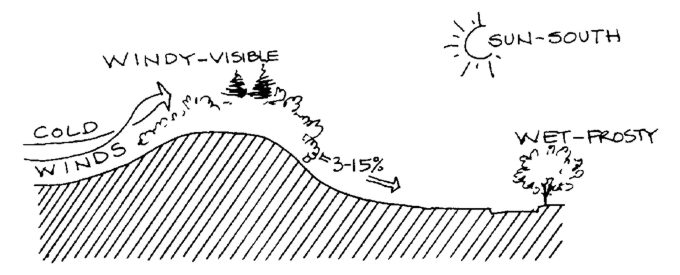
Steep slopes are susceptible to erosion and are best protected from development. Just how steep a slope can be before erosion becomes a significant concern depends on the soils; slopes in excess of 30% are rarely developable, and even 15% will be too steep for some soils. On the other hand, flat parcels of land do not offer as good drainage and they are often better used for agriculture, parking, and recreation. Pockets of low-lying land may be ecologically important (and fragile) wetlands.

Slope is usually described as “percent grade.” This is the ratio of rise over run, given as a percentage; in other words, a 45° slope would have a 100% grade. USGS topographic maps usually do not have high enough resolution to show site-specific topography clearly. Contour maps derived from digital, aerial

orthophotos can offer more detail, but are not available for all locations. It is often advisable to have a more detailed and accurate field survey performed of the property, or at least those portions of the property to be developed.


Soils


Soils are created by the breakdown of bedrock and sediments, by the deposition of organic matter from above, and by the action of living organisms and natural forces (water and wind) in mixing and modifying those components. Properties of soil determine how readily moisture can seep into the ground, whether expansion with moisture will cause foundations to buckle or crack, how significant a concern soil compaction is (risk of construction damage to trees), and what sort of plantings will prosper with what level of care.

Excellent information on soils is usually available from the federally funded Natural Resources Conservation Service (previously the Soil Conservation Service). NRCS publishes highly detailed, county soil maps that are available from state or county NRCS offices or from county agricultural extension offices. On these maps—superimposed on aerial photographs—soils are delineated and classified according to a widely accepted system that relates the physical properties of the soil to its development potential and constraints. Such information as depth to bedrock and depth to the water table can be learned from the maps and explanatory text. An experienced landscape architect, civil engineer, or soils technician can use this information to provide valuable guidance to the site planning process, determining appropriate locations for buildings, septic system drainage fields, stormwater infiltration beds, driveways, etc.


Hydrology

Surface waters, wetlands, and groundwater are critically important. Surface waters and wetlands, including ponds, streams, seasonal (vernal) ponds, and estuaries, tend to be our richest and most diverse ecosystems, and they can easily be damaged by development. Groundwater is a resource that may have only minimal direct impact on a particular site being developed, but its purity is an important issue downslope where it seeps to the surface or is pumped out of the ground as potable water.

All surface waters and wetlands on a site being considered for development should be mapped. Hydrologic maps may be available from USGS, NRCS, or a local planning agency. National Wetlands Inventory mapping is also available, showing significant wetland areas. All of this hydrologic mapping information, however, is quite general; more detailed information should always be collected through on-site investigations. The most difficult of these are detailed wetland inventories, because wetlands may not be as obvious as other surface waters. There are various definitions of wetlands that are used by different agencies. In general, wetlands have one or more of the following characteristics: the presence of water on the surface (usually relatively shallow) for all or part of the year; the presence of distinctive, recognizable soils, usually with high organic content or anearobic conditions; and the presence of vegetation that is adapted to—and indicative of—wet soils, surface water, and/or flooding. Very often, wetlands are subdivided into several classifications. A hydrologic map should show all surface waters as well as wetlands, divided into subtypes when possible. Wetlands delineation is generally required by regulatory bodies.

General information on groundwater can be obtained from geologic, hydrologic, or soils maps, but as with the surface waters and wetlands maps, these will rarely be very precise. Data on drilled wells in the area might also be available from the state or county. Knowing the depth and recharge rate of drilled wells in your area will help you get a sense of what you can expect on your site. If extremely deep wells with very low recharge rates are the norm, for example, that might suggest that such strategies as xeriscaping and rainwater catchment should be considered.


Vegetation


Vegetation is both a highly visible component of most landscapes and an excellent indicator of soils, wetlands, and trends that are affecting the land, such as air pollution, impaired drainage, soil disturbance, or runoff of road salt along highways. Through careful analysis of vegetation on a site, it is often possible to determine what the past level of disturbance has been and what the native vegetation might have been like prior to European settlement, though the latter may be difficult to discern based solely on analysis of what’s there today.

This information can be used to plan a strategy for protecting or restoring native ecosystems that will support healthy and productive biodiversity on the site. It can also be used to figure out where buildings and roadways would be most appropriate. Building placement may make the most sense on ecologically damaged areas of a site, for example, or where natural shading will help reduce cooling loads. Vegetation can also have a significant impact on views, wind blockage, the microclimate, sound control (here the effect is less than a lot of people assume), and even property values—a single large shade tree left on a building lot can enhance the value of a new home by thousands of dollars (see

EBN

Vol. 4, No. 1, p. 4).

Any detailed evaluation of a site should include a careful inventory of vegetation. Vegetation can be classified in a number or ways, including floristic (classification by species), and physiognomic (classification by form and function—forest, woodland, grassland, etc.). Often, the vegetation analysis will categorize the vegetation types into different levels, each based on a different classification type. A very detailed vegetation inventory might also include mapping of individual trees. At the 1600- acre (647 ha) Haymount development south of Washington, D.C., which should ultimately include more than 4,000 housing units along with commercial development, all trees over 18 inches (450 mm) in diameter were mapped in an effort to figure out where development would have the least impact. Existing trees over 6 inches (150 mm) in diameter may only be removed with permission of the Town Architect’s office, according to the plan. Very generalized vegetation maps might be available locally or regionally, based on satellite analysis or aerial photographs. Also, critical habitat maps showing approximate locations of endangered or threatened plant species may be available from a state or regional agency.

On many sites, particularly those where extensive disturbance has occurred, the vegetation will be dominated by introduced (or invasive) plant species. Most ecological landscaping professionals argue that native vegetation is preferable to nonnative vegetation, because it is part of an established ecosystem. But agricultural uses of land are also important, and preserving agricultural lands may be a high priority for many green development projects.


Wildlife Habitat


Providing for wildlife habitat should be an important consideration with most green development projects—certainly for any in rural locations, but even for urban sites. Strategies to protect and enhance wildlife habitat go hand-in-hand with strategies to protect native vegetation and wetlands. But with wildlife habitat, the issues are often geographically broader. To provide for wildlife habitat on a particular site, it is usually necessary to examine how that site relates to the surrounding land. Because wildlife naturally moves from one place to another foraging for food and breeding, there is significant concern about habitat fragmentation. An important goal of land-use planning on a regional as well as site-specific level is to provide
contiguous wildlife corridors. Roadways and even a line of low-density development can provide imposing barriers to wildlife movement, whether white-tailed deer, box turtles, or songbirds.

Your state wildlife or fish-and-game agency may have information on wildlife habitat, but the emphasis of that research is often on game species, such as deer, wild turkey, and bear, rather than less prominent wildlife. Many states also maintain offices that address nongame wildlife, including threatened species. If that sort of information is not available from a government agency, contact your state office of The Nature Conservancy, which may compile information on threatened habitat. It is worth noting here that even urban areas can offer significant wildlife habitat. Some of the most important migratory waterfowl stopover locations are within city limits of places like Philadelphia, and ecologically rich stream corridors run through many cities.


Climate and Microclimate


Information on the local climate—temperature, insolation (solar radiation), wind, and precipitation—is critically important for the energy design of buildings. It can also be used in planning appropriate landscape plantings on a site.


Temperature

There are various types of temperature data we can use.

Design temperatures (the reasonably expected minimum winter temperature and maximum temperature) are needed to size mechanical equipment.

Heating degree-day and

cooling degree-day information tells us the overall magnitude of the heating and cooling seasons, or portions thereof. Degree-days are computed by averaging high and low temperatures each day and calculating the difference from a base temperature—in the I-P system, the standard base temperature is 65°F for heating and 75°F for cooling.

Design temperatures, as well as both monthly and annual degree-day averages, are widely available for hundreds of locations around the country. For U.S. locations, the most accessible data is from the National Climate Data Center of the National Oceanographic and Atmospheric Administration, NOAA (http://www.ncdc.noaa.gov/). Local heating degree-day information is usually available from fuel oil or propane gas companies, which use it for scheduling fuel deliveries. While these sources of temperature information are very useful, keep in mind that there can be significant variations based on elevation, topography, and microclimate. Temperatures drop with elevation (adiabatic cooling) by about 3-5°F for every 1000 feet (1.7-2.8°C per 1000 m) of elevation rise, for example, but this can be offset by the tendency of cool, dense air to flow down hillsides and collect in low-lying pockets. Orientation of a slope (aspect) also affects temperature: south-facing slopes are considerably warmer than north-facing slopes because they receive more solar radiation.

Related to temperature is information on the growing season. This can include the average dates of first and last killing frosts and the U.S. Department of Agriculture (USDA) “Plant Hardiness Zone Map,” which is widely published in garden books.


Insolation and solar access


Availability of sunlight is determined both by the regional climate and by characteristics of the particular site. Regional insolation or solar radiation data is available for several hundred cities in the U.S. from the National Renewable Energy Laboratory (http://rredc.nrel.gov/solar/), and may be available from other sources, such as nearby universities and research laboratories.

Look for measured or averaged data for horizontal surfaces in Btus/square foot or Watt-hours/square meter. Information on percent sunshine or cloud cover may also be available from some sources.

Evaluating solar access is a very different process than finding out how much sunshine is available regionally. Solar access varies widely on a particular site, depending on orientation, slope, nearby topography (hills, mountains), and vegetation on the site. Relative to building design, solar access generally refers to access to the sun’s apparent path across the southern sky (in the northern hemisphere). Various devices were developed during the 1970s to simplify the task of determining solar access on a particular site, a few of which are still on the market. Solar access can often be modified significantly by shifting the planned location of a building or removing trees to the south of a building site.


Wind

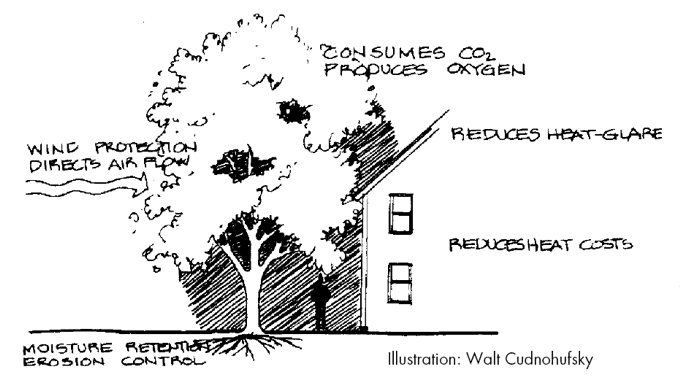
Wind can be both beneficial and detrimental to the energy performance of a building, and it can determine to a great extent appropriate locations for landscape plantings. From a building standpoint, plantings can shield a building from cold winter winds, or help channel cool summer breezes into a building, helping reduce air conditioning requirements. Throughout much of North America, prevailing winds are from the west. However, even though prevailing winds may be predominantly from one direction, there are usually significant periods of time when the winds are blowing from a different direction. Plus, there is significant local variation as a result of mountains, hills, river valleys, even buildings and roadways.

Wind data is available from weather stations, airports, and some universities and research laboratories. The nearest wind data collection point will provide valuable information, as long as local (microclimate) variation is considered. One of the most useful pieces of information on wind is a wind rose. This shows graphically the amount of time prevailing winds are from the 16 subdivisions of a compass (N, NNE, NE, ENE, etc.). To be most useful, try to obtain wind rose data for different seasons, so you can see whether the prevailing winds change seasonally. For a particular site, anecdotal information from neighbors can be particularly useful. Or, wind data can be collected on-site over a period of time—because of seasonal differences, monitoring wind for a full year is ideal.


Precipitation


Unless you’re on an island with highly variable precipitation patterns—there are places in Hawaii where rainfall varies from 400 inches (10 m) per year to less than 20 (50 cm) within just a few miles—you can usually get a fairly accurate picture of precipitation averages and seasonal patterns from collection stations in the region or from the National Climate Data Center. Along with knowing total precipitation, it is important to understand how that precipitation typically falls. Is it seasonal, with 90% usually falling in the winter wet season? Does it arrive in a few deluges interspersed by long periods of drought? This information, referred to as

intensity-duration-frequency (IDF) curves, is available from the U.S. Weather Bureau (Technical Paper No. 40) and the National Oceanographic and Atmospheric Administration (Hydro-35). State highway departments and NRCS offices may be other sources of precipitation data.

Knowing the expected quantity and nature of precipitation will help you decide on appropriate plantings around the planned building(s) and also help you establish priorities regarding water conservation, graywater use for landscaping, and rainwater harvesting. In arid regions, for example, xeriscaping will be a higher priority than in wetter areas. Rainwater catchment makes sense in areas with moderate rainfall—little enough that water is a highly valued resource, but enough (and spread out enough) that it can be depended on for the planned uses. According to some experts, rainwater harvesting makes the most sense when precipitation is between 15 and 30 inches (40-80 mm) per year. If storm events are severe but spread far apart, the landscape plan needs to address stormwater management and infiltration very carefully to avoid significant downstream impacts. Finally, in colder climates, expected winter snowfall needs to be considered relative to building design and plantings.


Humidity

The final climatic condition we will address here is relative humidity—how much moisture is in the air relative to the maximum amount that the air could hold. In buildings, humidity is an important determinant of comfort and a condition that needs to be considered in selecting cooling strategies and equipment. In low-humidity areas, for example, evaporative coolers provide a cost-effective air conditioning strategy, but they don’t work well in humid climates. Similarly, the strategy of opening a building up at night and closing it during the day in the summer for natural cooling is less effective in very humid areas where moisture-laden nighttime air can result in mildew problems or require use of dehumidification equipment.


History of the Land Use


While this article focuses primarily on physical, climatological, and ecological aspects of a property, the historical influences can also be an important factor in site planning and design decisions. Past human influences need not be ignored; in some cases they should even be celebrated. What existed on the site previously? Is there evidence of previous settlement? What stories do the old stone walls winding through a New England woodland tell? What is the history of an adobe home ruins on a Southwest mesa? There may have been wisdom in the way an early carriage path crossed a piece of land, as evidenced by an ancient row of trees and subtle depression in a hillside. The placement and orientation of early settlers’ homes, as evidenced by the remaining ruins, can tell us volumes.

Information on the history of a piece of land can be elusive but fascinating. It can take you to early land deeds, discussions with old-timers still in the area, published histories of the region, historical society libraries, and on-site investigations. A number of prominent green development projects have made extensive use of archaeological investigations to learn about the history of the land use, even prior to European settlement.


Aesthetics and Views


Along with considering orientation and building siting from an energy standpoint, we need also to consider views that the building will provide. Green building is, in part, about celebrating nature.



Designing a building to make it easier for the occupants to appreciate their surroundings may increase their motivation to protect or restore the land around them. How will the building placement on a property impact the views and aesthetics of the land? When Brattleboro, Vermont landscape architect Monroe Whitaker, of Stevens Consulting Engineers, walks a piece of land with property owners planning to build, he always asks what it is they particularly like about the property. Very often he finds that it is the views of the land. When they get to the point of siting a home on the land, he asks them to think about how that building will affect their appreciation of the land. It is not uncommon for him to find that the envisioned home will destroy just what the property owners most love about the land—because the house would sit right in the middle of the open meadow that dominates the viewscape. Through this envisioning process, Whitaker helps them find a building site that will preserve the aesthetic qualities of the land that initially attracted them to it. Walking the land—in all times of day and year—is the best way to learn what it holds from an aesthetic standpoint.


Toxics Inventory


On any piece of land where there has been significant use over the past hundred years, it is a good idea to investigate whether toxic materials might be present. Old farm dumps can contain corroding barrels of highly toxic pesticides. Old autos can leak oil, gasoline, antifreeze, and other fluids into soils, surface waters or groundwater. An abandoned electrical transformer could be leaking PCBs. Discarded automobile batteries can release lead into the environment. In extreme cases, the discovery of hazardous waste on a property can result in thousands of dollars of expense in clean-up.

Inventories of known hazardous sites exist and are available from state agencies that deal with pollution control. Unfortunately, most of the farm dumps and other minor sources of toxics are not documented in published inventories. In most cases, a careful walking of the land will determine whether there is enough concern about toxics to warrant a more thorough investigation. If there are no apparent signs of a dump, past industrial activities, or other red flags, then it is probably not necessary to go any further. If areas of potential concern do show up, they should be investigated by a qualified environmental engineer. If remediation is necessary, the environmental engineer should be able to advise you on how to proceed, and put you in touch with relevant agencies to help you come up with a workable plan. (More complete discussion of development on brownfield sites will be provided in a future issue of

EBN.)


Integration with Surrounding Region

A building site is not an entity unto itself, but rather part of a broader built and unbuilt environment. An important part of site assessment is examining how this particular property—and the buildings on it—will relate to surrounding sites and the region. Cudnohufsky stresses that part of the analysis of a site needs to be its connection with the area. “Don’t forget to look outward from the site,” he told

EBN. “There is a different relationship on each boundary of the property.” Consider the connection with nonfragmented wildlife habitat on abutting lands, protection of regional surface waters and wetlands, and integration with regional transportation systems that provide alternatives to automobile travel. Are there bicycle trails and pathways that can be linked to? Are there public transit options that people living or working at the site can use?

To examine local and regional planning issues, contact a town, county, or regional planning agency and get hold of relevant planning documents, such as a town plan or regional plan. Talk to the planning director for the municipality, if there is one, or attend meetings of the planning commission with jurisdiction to get a sense of their priorities relative to planning. Not only can this help you figure out how to make sure your project will fit into the surrounding area better, but it can streamline approvals that may be required for your particular project.


Regulatory Constraints


The best plans for a green development project may not pass muster with local zoning regulations. Very often, the strategies that make the most sense from an environmental standpoint—such as clustering buildings on a small portion of a site and keeping the rest undeveloped—do not comply with zoning regulations. Therefore, a careful examination of relevant land-use regulations should occur while site planning and design are proceeding. The local zoning administrator or planning office staff can generally help you in interpreting these regulations. It often makes sense, however, especially for larger, more complex projects, to hire a qualified landscape architect or civil engineer for help in understanding and complying with (or seeking exemption from) relevant regulations.


The Next Step: From Site Evaluation to Site Plan

Collecting information about a potential building site is only the first step. From this information can evolve a site plan and specific building design elements that are based on what the land offers—both opportunities and constraints. Cudnohufsky suggests carrying out three different mental tasks in the process of getting to know a place:


inventory components of the site (find out what is there),

describe each key component of that inventory with the aim of discovery or seeing as fully as possible (largely adjectives), and

interpret the discoveries separately in light of your prime aim or programmatic goal. Through this, he says, “you begin to see solutions that are in concert with the process.” He might use this process as follows:

•Inventory: Grove of mature red oaks.

•Description: 12 trees, 15 to 20 feet apart, 70 to 80 feet tall with unified canopy, densely branched with sculptural interest, good health, 28” to 45” caliper, low branching, dense and uniform foliage.

•Interpretation: Retain, protect to drip line during construction, and feature as central element in proposed medical center courtyard.

To be most effective, site evaluation should have a finished product. Create a map or series of maps, and summarize major findings in writing. This will make the information more usable in the discussion and decision-making processes. Finally, the importance of bringing in a landscape architect or designer very early in the overall planning and design process cannot be overstated. The land should inform the building design and landscaping plan right from the beginning.


Published March 1, 1998

New Hampshire House Pushes the Energy Performance Envelope

Access Floors: A Step Up for Commercial Buildings