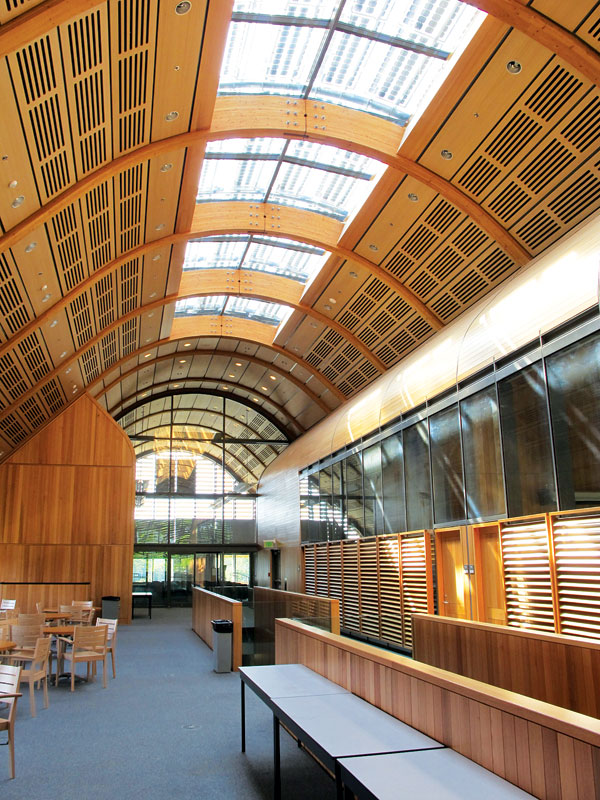
There are over five million commercial buildings in the U.S., and every one of them is wasting energy. Where energy is wasted, safety problems, health hazards, and comfort issues often exist. Where we find energy efficiency, we also tend to find lower operating costs and greater real estate value.
Despite these fundamentals, getting many owners to improve their buildings’ energy performance can be difficult. Commercial building owners are business owners and seek a business case for investing in their buildings. Proponents of energy investments, such as engineers and manufacturers reps, need to quantify potential savings in terms of payback periods, return on investment (ROI), or other economic tools favored by the owner.
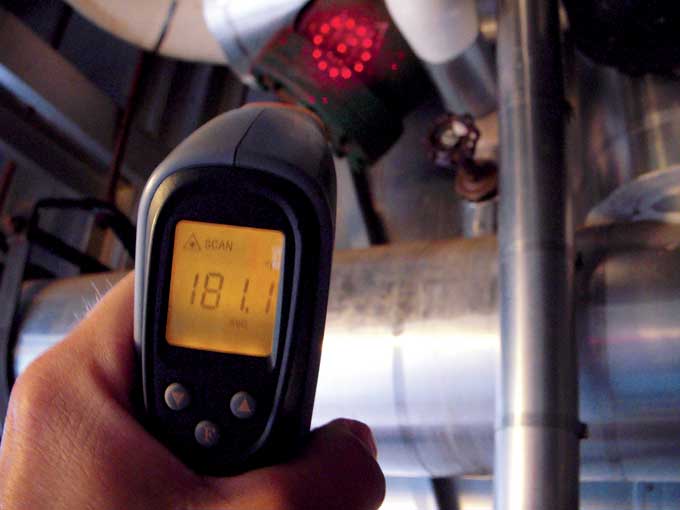
Making a business case for energy investments is getting easier. Equipment installed in buildings at new construction or as retrofits—such as smart utility meters, equipment controls, and building automation systems—makes it possible to cost-effectively benchmark the performance of systems and assess the impact of improvements at the building, system, and equipment levels. Hand-held instruments and data loggers can be used to make periodic measurements or to establish trends over discrete time periods to provide data where the controls can’t reach.
These tools and technologies are being applied in the field of commissioning, which has taught us that making sure a new building works properly at the start and that it is set up to work properly for a long time leads to fewer problems and reduced costs. Measurements and trending data from commissioning provides quality assurance for the construction process, and benchmarking data and documentation for assisting with recommissioning the building in the future.
What about existing buildings? The field of retrocommissioning, RCx for short, applies the commissioning process, tools, and technologies to buildings that were not commissioned when first built. In this article, we’ll explore what retrocommissioning is and how to put it to work successfully in commercial buildings, including for whole buildings and in an energy-focused context. With this article, owners, facility managers, and others will gain exposure to the varieties of RCx services available to them and how RCx projects are performed.
What is Retrocommissioning?
Ideally the RCx process has the same whole-building scope often used when commissioning new buildings, such as inspecting and testing HVAC, electrical, lighting, plumbing, and life-safety systems, and the building envelope. It also checks that documentation is complete and that operators are trained in maintaining long-term performance.
Market forces trim the scope of RCx in many cases to focus on energy-only benefits. In those cases, RCx resembles beefed-up energy audits. There are downsides to that, as explored in this article, but for the most part, even energy-focused RCx provides enough benefits to fuel the RCx market to the point where it’s badly in need of capable providers.
Retrocommissioning is a cousin to other forms of commissioning that also focus on existing buildings. In recommissioning the commissioning process is applied to buildings that were commissioned when new or retrocommissioned at some point. Ongoing commissioning provides for regular or continuous monitoring, assessment, and maintenance of facilities.
RCx and Big Buildings
The RCx market generally applies to big buildings because of economies of scale. Fixing large buildings is more cost-effective than fixing small buildings in terms of energy savings and the billable hours and expenses of RCx providers. Larger buildings also tend to have serviceable building automation systems founded on digital controls rather than pneumatic (compressed air) controls, which lack the programming capabilities needed to set the schedules, program the sensors and controllers, and generate the trending data that make RCx cost-effective and make resulting improvements last.
As Jay Santos, principal at Facility Dynamics Engineering, explains, “What tends to need fixing on a small rooftop unit or air handler tends to need fixing on the larger ones, and the costs are similar. But the savings are much greater for the bigger systems,” he says. “That’s why it’s not unusual for retrocommissioning to focus on buildings 50,000 ft2 and above.”
An extensive research project on commissioning and retrocommissioning performed by Lawrence Berkeley National Laboratory (LBNL) in 2009 found that the average RCx project cost $0.30/ft2, yielded an energy savings of 16%, and had a payback of 1.1 years. While the report did not find a correlation between building size and energy results, it did find that the more complex the building, the larger the energy savings and thus the better financial performance of the RCx process. Santos puts this data in perspective: “Good candidates for high energy savings from retrocommissioning are complex facilities that use a lot of energy, such as laboratories, hospitals, and data centers. They have high air changes, complex controls, and quality facility staff who take great care of their facilities.”
Complexity a factor
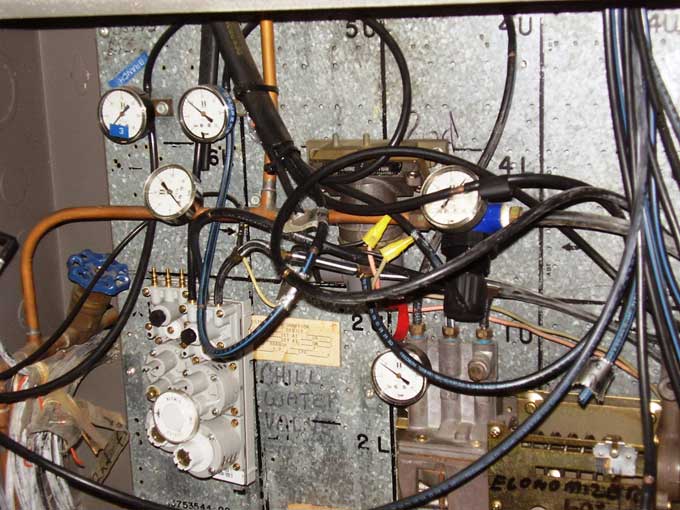
When they’re working well, the mechanical, electrical, controls, and other building systems are complex enough. But if (or when) an operator leaves a valve in the wrong position or makes a programming error in one of the hundreds of software programs running in a building, it could cause ripple effects that lead to wasted energy and shorter equipment life.
There might be dozens of these types of problems in a building at one time, all interrelated, and many of them might have been there since the building was first constructed and occupied. For example, a thermostat set point of 72°F might be met by having the chiller over-cool the air, which consequently requires the boiler to heat it before delivering it to the space. This is called simultaneous heating and cooling, and there are a dozen or more conditions under which it can occur—none of which are visible unless specifically checked for.
RCx providers may also find where it’s cost-effective to add variable-speed drives, use different types of filters for greater efficacy at lower cost, or make substantial changes to building automation systems. Such upgrades or retrofits are enhancements to systems that were not originally in the design or construction but are fairly common in RCx projects.
The RCx process might also find that a chiller needs replacing, or that it is cost-effective to totally replace the lighting systems. Such projects can take months to approve and accomplish, and they can disrupt several building systems. While RCx projects may help identify these opportunities, they don’t typically include such capital improvements. (See the table for services that may be in the RCx scope.)
RCx guidelines

Guidelines exist that outline RCx from several perspectives and to varying levels of detail. Of these, the National Environmental Balancing Bureau (NEBB) standard is the most highly structured. It’s a good document to have, even if you are not a NEBB-certified provider.
Most RCx firms will develop their own processes over time along with software tools, forms, and checklists to help implement them. In addition, the Building Commissioning Association (BCA) and the California Commissioning Collaborative (CCC) have libraries of sample contracts, checklists, and forms to help new RCx practitioners get started. These documents also give building owners resources for understanding more about the services they are contracting to help better manage expectations and the process.
No matter which set of guidelines you’re following, retro-commissioning may seem like standard operating procedure, or what should be standard. But it’s not. Veteran RCx provider and trainer David Sellers, P.E., seniorengineer with Facility Dynamics Engineering in Portland, Oregon, put it this way: “RCx is what, 30 years ago, we called ‘operating the building properly.’ When we retrocommission a building, we essentially get the building to where it needs to be and we set it up for ongoing commissioning so it’s easier for the operators to keep it running well.”
So what happened to operating the building properly? According to Sellers, “We have convinced ourselves that we can build and maintain a complex working building for less than the real cost.” RCx, then, is an added process that is needed to do what operators used to be able to accomplish with sufficient budgets and management support, at a time when the systems themselves were generally less complicated.
Planning and persistence
If an RCx project is not initiated with clarity and wrapped up in such a way that fixes and improvements are perpetuated over time, it is doomed to fail.
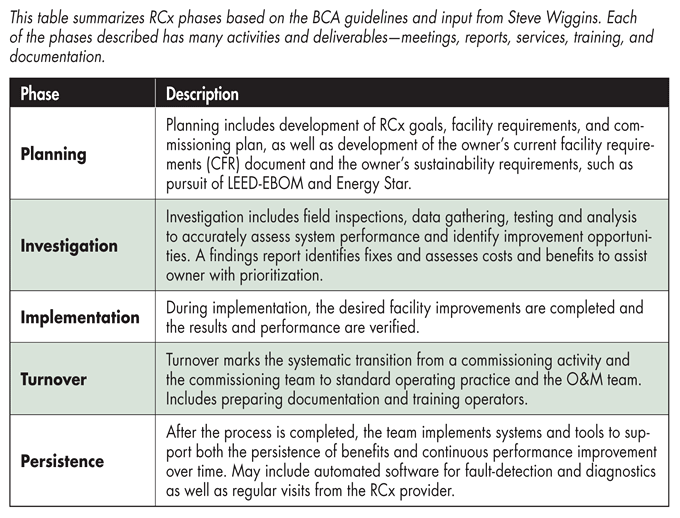
In the planning phase, RCx providers should pay particular attention to the current facility requirements. Without them, the owner and RCx provider cannot know whether the RCx process has left the building working properly.
Steve Wiggins, associate partner at Newcome & Boyd and past president of NEBB, swears by current facility requirements and says they’re easy to create: “[They] can be as simple as a bulleted list of systems and areas in the building and descriptions of what needs to be done for each space.” He noted, “I like to use a floor plan of the facility and meet with occupants on a space-by-space basis to discuss what they need and what any special requirements are.”
That’s the start of the process. Later comes persistence—making RCx results last. Says Santos: “RCx providers should ask themselves, ‘What will I change so I don’t have to do this again?’ If they don’t put the answer to that question in the scope of work, then it’s not worth doing at all. The expense of making a change and not setting it up for persistence can be more expensive than not making the change at all.” Sellers puts it another way: “Several of us often joke that [without persistence measures] we save the same energy every couple of years.”
Persistence measures range from documentation of fixes and training operators to maintain them to installing automated fault-detection and diagnostics software tied into building automation systems. Strategies depend on how hard it is to track a fix, how much it costs to do so, how reliable and robust the persistence strategy is, and what the owner is willing to pay for.
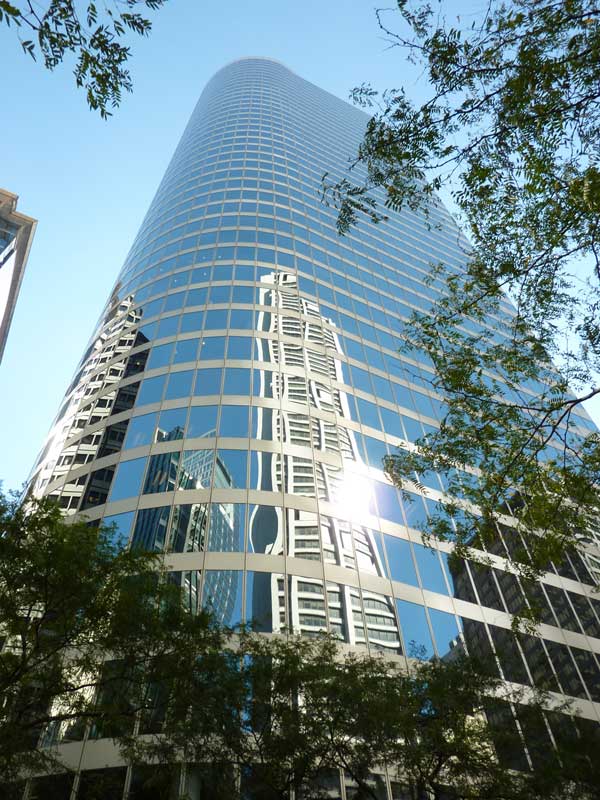
Commonwealth Edison (ComEd) in Chicago, now part of Exelon, is experimenting with persistence measures in two of its retrocommissioned buildings. In one building, daily and weekly summary reports on RCx fixes are being generated by the building automation system. The RCx provider visits the facility about once a week to look at the data and talk to operators to see how things are going, making tweaks as necessary and identifying new RCx opportunities. In another building, an automated diagnostics package trends a broader range of parameters beyond the energy fixes that have been made to date, and uses software filters to look for and report potential problems. Operators within the owner’s team then make the fixes. “We want to see which of these methods provides the biggest bang for the buck,“ said Ryan Stoianowski, senior program manager for retrocommissioning at ComEd.
Another persistence measure, supported by ComEd and other utilities, is mandating that at least one operator per site involved with an RCx program take an eight-class building operator certification course. “The course costs $1,250 in tuition, and we rebate $450. We are evaluating its specific impact, but we like what we’ve seen thus far,” said Stoianowski.
Dan Reese, senior program manager at Portland Energy Conservation, Inc., says that persistence approaches are often being wired into incentive programs for utilities. Customers receive incentives if they prove projects are still performing well six months to a year after being installed and commissioned.
Energy Star and LEED-EBOM
It is essential for RCx providers to nail down any sustainability documentation requirements during the planning phase. Two such programs are the U.S. Environmental Protection Agency’s (EPA) Energy Star program and the LEED for Existing Buildings Operations & Maintenance (LEED-EBOM) rating system.
Energy Star
Assessing the performance of a facility using EPA’s benchmarking software, Portfolio Manager, to calculate a score for the building, is a common and effective practice. The score will range from 1–100; at 75 and over, the building is performing better than 75% of the buildings in the U.S. that are of similar type, size, occupancy, and climate location. These buildings are qualified to take the next steps toward earning an Energy Star label. Below 75, energy conservation actions will be required for the building to be eligible for an Energy Star label.
LEED-EBOM
LEED-EBOM certification offers up to four points in its Energy and Atmosphere section for the planning and implementation phases of “existing building commissioning.”
The intent of EA Credit 2.1: Investigation and Analysis, is to “develop an understanding of the operation of the building’s major energy-using systems, options for optimizing energy performance and a plan to achieve energy savings,” through a systematic process. That process can be either commissioning or an energy audit. In EA Credit 2.2: Implementation, potential improvements identified must be implemented.
LEED’s requirements are energy-focused and essentially equate commissioning to energy audits. In doing so, LEED’s approach represents a significant reduction in scope of “true” RCx—whole-building commissioning of a non-commissioned existing building.
RCx Providers and Teams
BCA guidelines define RCx providers based on their skills, encompassing everything from written and verbal communication skills to engineering knowledge; and on their hands-on experience with building systems commissioning, performance, start-up, balancing, troubleshooting, and more.
Like every other profession, there are bad, good, and great practitioners. The bad ones might simply be new or have a small subset of the skills and experience needed. Good providers have a broad range of skills and experience. Great RCx providers have all that plus an insatiable curiosity and a mastery of working with a variety of information sources on the fly, under time and other demands.
As Sellers explains in one of his training presentations, consider what happens when an RCx provider walks into a plant room and his or her glasses fog. It’s a bad sign if they just wipe them off and move on. It’s better if they find the source of the moisture (perhaps a steam leak) and include it on a findings report. It’s a great sign when they’ll find the leak, troubleshoot it to its cause, and then engineer a solution complete with assessments of energy and non-energy benefits.
Certified RCx providers
If you’re looking to credentials to help distinguish a great provider, you may be excused for having some confusion. There are at least six different certifying bodies that provide training, testing, and credentialing programs for commissioning providers in the U.S. Some are simply based on courses and testing, while others require references from past projects and documentation of leadership, not just involvement.
Owners or representatives hiring a provider and relying in any part on credentials should at least distinguish the easier credentials from the tougher ones. The California Commissioning Collaborative (CCC) website www.cacx.org has a page devoted to outlining the key features of each.
Many of the most experienced RCx providers don’t have commissioning certifications, however. Some say they don’t need them to get work. Others eschew certifications on principle, saying they lower the bar for entry into the profession, devaluing the value of experience. Indeed, among the most important factors are experience with the specific types of buildings and building systems that the RCx provider will encounter, and the skills of the whole team the provider firm is assembling for the project.
Team support
RCx providers are only one component of a project team. Team members usually include:
• Commissioning firm (lead RCx provider and assistants)
• Building owner or owner’s representative
• Building manager and staff
• Design professionals
• System specialists
• Installing contractors
• Manufacturers’ representatives
• Maintenance service contractors
• Controls contractors
Energy Versus Whole-Building Scope
Some practitioners take a hard stand that RCx has a whole-building scope; it’s about making buildings work properly. “Any energy savings is icing on the cake,” said Wiggins. These whole-building RCx providers tend to look critically at energy-focused utility rebate programs.
“One of my greatest concerns is that the current energy focus of RCx will effectively damage the market, as what has happened with new-building commissioning,” said Wiggins. “If we don’t distinguish RCx from energy audits, we’ll confuse the client base about what true RCx is.”
Wiggins’ concern, shared by other providers, is that if an owner is introduced to the RCx concept through an energy-focused utility rebate program, they might miss having their fire-protection, plumbing, and security systems looked at. The non-energy benefits of having those systems fixed and documented, and having the operators trained to maintain them, could far exceed the benefits realized by the energy-focused RCx system. Furthermore, the more extensive whole-building processes may have found additional savings, with the cost for having the whole-building RCx project could still have been paid for by the energy fixes. Reese, however, counters that utility programs encourage RCx providers to use the utility programs as opportunities to sell owners upgraded services, such as RCx with a larger scope.
Another issue is that utility-based RCx programs can be built to ignore some savings completely (such as gas-related opportunities if the utility is electricity-only), and prioritize specific types of fixes (such as controls measures) based on payback windows. For example, opportunities paying back in less than one year could be up to the owner to fix, and might not even be documented by the RCx team. Will operators ever make the fixes with less-than-one-year payback, and will persistence measures be put in place to see them through the long term?
Sometimes narrowly conceived RCx can expand. Sellers recounts a project in which “the only reason we were in there doing RCx was because the operators were able to make it more palatable via the utility program.” But Sellers was able to convince the owner to make further changes. “We were able to use RCx trending techniques to convince the owner that it would be a good business decision to add a second chiller to a facility that had 1,200 tons of chiller capacity but a cooling load of 1,500 tons,” he said. “In addition to the capacity, the second chiller provided redundancy. Meanwhile, that and other improvements started to show up in the utility bills and persist. This led to more money from the owner for more measures.”
Even without treating the whole building, many utility rebate programs are claiming potential savings of 5%–20%, figures Reese says are accurate. “In one of our California utility programs, we’re seeing an average of about 8% electric savings. Buildings are minimally 100,000 ft2, so 8% can add up to a lot of energy savings. About 75% of the measures implemented in this program have individual paybacks of less than two years; 60% under one year.”
Final Thoughts
The field of retrocommissioning has its roots in how buildings used to be properly operated by staffs with adequate budgets, training, and management support. But those days seem to be gone, and the high-tech equipment, systems, and controls that are now being installed in buildings require skills and experience that challenge design engineers, operating staffs, and maintenance contractors. While some owners invest wisely in their buildings for lowest life-cycle costs, optimal asset value, and reduced environmental impacts, others cut corners and costs by deferring maintenance and generally allowing staffs and assets to degrade.
Retrocommissioning offers benefits to both classes of owners and buildings. It’s about making the building work properly, and there’s always room for improvement.
Editor’s Note: Michael Ivanovich, our guest author for this month’s feature article, is president of the Ivanovich Group in Oak Park, Illinois, and previously the editor-in-chief of HPAC Engineering and Consulting-Specifying Engineer. This article was produced in collaboration with the Building Commissioning Association (BCA) with support from BetterBricks (www.betterbricks.com), the commercial building initiative of the Northwest Energy Efficiency Alliance, which is supported by Northwest electric utilities.