
Championing the
Changemakers
BuildingGreen champions the changemakers in sustainable design and building, with trusted insight, unparalleled education, and communities that are transforming the industry.
Log in to your profile

Image: Piranka

Product Guide
Choosing products for LEED compliance?
The products in the collections listed below contribute to the requirements of LEED in the credit categories listed below. You can also view all our product collections that are LEED-related here.
Interested in setting a higher bar? Some products that help earn LEED points don't meet our... Read more
News Brief
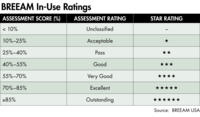
The forebear of all green building rating systems, LEED included, is arriving from the U.K. as an accessible alternative.
Before there was LEED, there was BREEAM.
While the LEED rating systems might have more buzz, the Building Research Establishment Environmental Assessment Methodology is the world’s oldest and most widely used green building rating system. Created in 1990 by the Building Research Establishment (BRE) in the U... Read more
Blog Post
We took the best PSA tapes from our last round of testing and worked them over on rough OSB and window flanges. One tape worked no matter what.
Flashing tapes are critical to many if not most wall assemblies that are currently being built. Therefore the durability of these pressure-sensitive adhesive (PSA) tapes is critical to the durability of those assemblies. So it may come as a surprise that no one really knows how long they last.
That’s why we’ve been field-testing tapes... Read more
Explainer
Phthalates are used as plasticizers in vinyl. Some are toxic, some less so—yet many manufacturers are avoiding them altogether.
We commonly talk about “vinyl” flooring, wallcoverings, and upholstery. But these materials, while mostly made of PVC, also contain a relatively high percentage of plasticizer—up to 40% or 50%, depending on the product. Plasticizers are added to the rigid PVC to make it flexible. Conventional plasticizers are almost universally a type of... Read more
Product Review
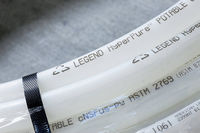
HyperPure PE-RT drinking water piping is a new take on flexible polyethylene tubing.
Copper, chlorinated PVC (CPVC), and cross-linked polyethylene (PEX) all have advantages for potable water piping, but each also comes with environmental life-cycle tradeoffs.
Rigid polypropylene products are an attractive alternative because of their lower impact and cleaner chemistry. Now there’s a promising flexible alternative as... Read more
News Analysis

Though only a year old, LPC has its first two entry-level certifications: Owens Corning insulation and Sirewall rammed earth.
The International Living Future Institute (ILFI) has announced the first two building products certified under the requirements of its Living Product Challenge (LPC). The products—fiberglass insulation and a rammed earth system—each earned Living Product Imperative Certification at ILFI’s May 2016 Living Future conference in Seattle.
... Read more
News Brief

The Brock project team achieved Living Building Challenge certification and survived to tell this story.
The Living Building Challenge (LBC) has a strict ban on greenfield development, with one exception. It allows for buildings in previously undeveloped—even ecologically sensitive—locations when they are there to help people learn about the place. As a facility that’s all about caring for and teaching people about nature, the Chesapeake Bay... Read more
Feature
We’re at a tipping point in insulation, flooring, textiles, and other product categories. Here’s what to spec and what to avoid.
We all want to eat right, but we also need to watch our budgets. Most of us want to buy healthful, responsibly produced food but can’t always find or afford the most sustainable option.
Enter the Dirty Dozen and the Clean Fifteen. These lists from Environmental Working Group (EWG) identify 12 types of produce with the greatest pesticide... Read more
Product Review

Winners of an annual DOE competition represent some of the best LED lighting for decorative pendants, downlights, and healthcare.
LED lighting is now ubiquitous—a good thing for energy efficiency, but it poses a challenge. With so many products and manufacturers to choose from, how do you know which products will last? Which ones will perform as expected or even exceed expectations?
The Next Generation Luminaires (NGL) Design Competition strives to answer these... Read more
News Brief
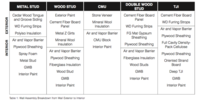
When you look at the whole assembly, it can change how you see the materials. Here XPS and fiberglass come out ahead, and SPF behind.
Rarely is anything in the built environment made of a single product. “So why do we approach materials research and selection at the product level?” a new study conducted by Re:Vision Architecture asks.
Report authors Christopher Lee, project manager, and Nicole Campion, sustainability researcher for Re:Vision, present an alternative,... Read more
News Brief
Energy efficiency is a prime investment in an era of rapid urbanization, saving $2 for every $1 invested, according to a new report.
In the next 15 years, we have a choice: to lock our world into another century of building inefficiency, or to blaze another path. By 2030, an area equal to roughly 60% of the world’s current total building stock will be built or rebuilt in urban areas, according to the World Resources Institute (WRI), and those buildings will define our cities... Read more
News Analysis
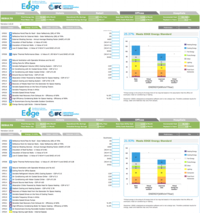
With this quick-start design tool, architects choose materials and strategies based on ROI as well as sustainability.
A Portuguese architect was recently hired to design a hotel. He made all the right decisions to get the quickest payback in energy savings for a building located in Portugal.
The problem? This hotel was located on the coast of Senegal. The “imported” design specified double-glazed windows—standard for southern Europe but a questionable... Read more
Product Review
DensElement, a variation on the popular DensGlass sheathing, cuts down on the most expensive step of applying the air barrier: applying the air barrier.
Continuous air and water barriers are labor-intensive to install and vulnerable to human error during construction. Installations are subject to all kinds of problems, starting with poor design and culminating in every imaginable installation error. With its DensElement Barrier System, Georgia-Pacific Gypsum is the latest... Read more
Explainer
Lumber Liquidators will pay millions for importing illegal wood products. Could architects or contractors be fined for buying them?
The oak flooring you specified took habitat from the endangered Amur tiger. That maple cabinet veneer was stolen from a U.S. National Park. And the cedar decking you just installed was felled in a protected rainforest.
Or was it?
If you don’t know whether those scenarios could... Read more
Product Review
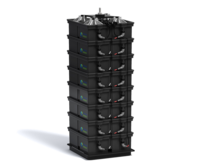
Aquion offers high-performance “saltwater” energy storage without lead, sulfuric acid, or flammable lithium salts.
Editor’s note December 3, 2019: Aquion is currently emerging from Chapter 11 bankruptcy, which has caused an interruption in its ability to manufacture the product and provide tech support. See the company’s FAQ for more.
For the last 50 years, saltwater batteries have been the stuff of middle school... Read more
Feature

Whether you call it a charrette, a workshop, or simply a meeting, these suggestions from experts will make your next event more fun and productive.
A design team can enable real progress by setting aside a day or longer for a focused workshop. Or it could just waste a lot of high-priced time.
You can break down barriers and build a functioning team if you bring together people in different roles who don’t usually get to talk with one another. Or... Read more
Blog Post

Biomimicry experts explore resilient design from environmental, social, and economic perspectives.
Could imitating nature help us survive climate change?
That was the question asked by Biomimicry 2016: The Road to Resiliency, a March 2016 conference held in Irwindale, California and organized by Verdical... Read more
News Analysis
It’s outcomes that matter in the new performance path for certifying existing buildings.
Existing building projects can now prove compliance with a good chunk of LEED credits by earning a certain score through the LEED Dynamic Plaque.
The alternative compliance path, which is being piloted for the LEED v4 Building Operations and Maintenance (LEED-EBOM) Rating System, allows teams to use... Read more
News Analysis
LEED addenda for April 2016 add BIFMA, C2C Material Health, Declare, and the Globally Harmonized System for classifying chemicals.
A Declare label now counts under LEED v4, along with a number of other new options.
The product disclosure program managed by the International Living Future Institute (ILFI) is one of a handful of ingredient transparency tools that comply with the “disclosure” option of the material ingredients credit (... Read more
News Analysis

From a lab to a museum to a grocery store, this year’s COTE Top Ten awards showcase impressive energy savings in buildings with intensive energy usage.
The American Institute of Architects’ Committee on the Environment (COTE) Top Ten projects for 2016 show an impressive move toward higher performing buildings, with four of ten projects showing predicted or actual net-zero or net-positive energy use.
The winning projects were mostly designed when the... Read more


