
Championing the
Changemakers
BuildingGreen champions the changemakers in sustainable design and building, with trusted insight, unparalleled education, and communities that are transforming the industry.
Log in to your profile

Image: Piranka

April Fools
It’s a win-win for winners, says Rick Fedrizzi, of the LEED Effort certification—an answer to concerns about v4’s excessive rigor.
First it delayed mandatory registration under LEED version 4 (LEED v4). Now the U.S. Green Building Council (USGBC) has announced a new program that should further appease concerns about what some have called the “excessive rigor” of the new rating system. The program, which effectively adds a fifth level of certification below... Read more
April Fools
Why are you taking survival advice from a bunch of pencil jockeys? It’s time to start listening to the pros.
When I first heard about resilient design, I thought, “Now here’s something I can get behind.” I can’t go into a building anymore without noticing about a hundred different vulnerabilities, so I was glad to hear people were finally talking about this stuff.
But then I started reading their standards and... Read more
April Fools

With the news that February broke global temperature records, the Prince of Darkness “can hold back no longer.”
April 1, 2016
Satan, Overlord of the Underworld, came out in favor of Green Party presidential candidate Jill Stein, M.D., at a press conference in Death Valley, California, this morning. This is a historic event, commentators say, as it represents the first time the Great... Read more
Blog Post
You and your boss don’t really collaborate. Neither do you and your employee, or you and your supplier.
You might work collaboratively, but ultimately one of you has power and authority over the other. Real, substantive collaboration—getting people to cooperate without power and authority—takes a lot of work, and so you only want to... Read more
Explainer

Do you know how hot or cold your building would be if the power went out? You could be using thermal modeling to find out.
Why live in Phoenix over Miami, even if it’s a bit hotter? As any retiree will tell you, it could be 90°F in Florida and 99°F in Arizona, and Phoenix with its dry air would still feel more comfortable.
The metric standard effective temperature (SET) has long been used in ASHRAE Standard 55 for Thermal... Read more
Product Review

A complex supply chain makes finding sustainable textiles for furnishings, draperies, panel fabrics, and other applications a challenge, but there are shortcuts.
In our series of articles beginning with A Guide to Selecting Sustainable Textiles, we detailed some of the obstacles to finding an environmentally responsible contract textile. For one thing, upholstery, draperies, panel fabrics, and other textiles can be made from many different natural and synthetic fiber types, and... Read more
Product Review

You don’t have to choose between recycled tires and natural grass for athletic surfaces. There’s a spectrum of good options in between.
The possible health risks associated with playing on artificial turf with crumb-rubber infill are getting a lot of media attention. Just last month, three federal agencies in the U.S. agreed to identify and fill research gaps about the controversial material, which is made primarily from used car tires. Their work could be... Read more
Feature

As rating systems from LEED to RELi lay out key design steps for resilient design, it’s still up to project teams to bring critical perspective.
Updated May 27, 2025; updates by Elene Drosos
Hurricanes, tsunamis, wildfires, and other disasters have drawn attention to resilient design mostly by showing us what not to do in the built environment. We’ve come a long way in a short time, and today we’re on the cusp of having metrics and rating... Read more
News Analysis
Want to get your neighborhood from here to there—where “there” is more social justice, environmental health, and economic growth? You’ll need directions.
It’s becoming clearer that we need to address energy, water, land use, environmental justice, and other green building issues within whole communities. Meanwhile, most of the work still happens one building at a time. We need to jump scales—at scale—but how?
The EcoDistricts Protocol, currently in draft... Read more
Op-Ed

Kirsten Childs 1944–2016
Kirsten Childs, ASID, died on January 13, 2016, outside Philadelphia following a three-year battle with cancer. In her role as an interior designer, Childs was an early leader in the green building movement and one of the first to advocate for the idea that green also means healthy. She was a pioneer in the development of... Read more
Feature Short
You can avoid the most toxic textile treatments with proper fabric selection and maintenance.
A textile is only sustainable if it lasts, and designers looking to prolong the life of their furniture or drapery—whether to save the environment or simply to prevent callbacks—typically turn to surface treatments. This alchemy of chemical coatings promises to repel stains, stop fire, and prevent the spread of disease. It sounds too good to be... Read more
Explainer

Per- and polyfluoroalkyl substances increase product longevity. Though these PFAS don’t last forever on our textiles and carpets, they do stick around in our bodies.
Teflon flu: that’s the name workers at a DuPont plant in West Virginia gave to the vomiting, fevers, and other symptoms they had when exposed to high levels of PFOA, a variety of per- and polyfluoroalkyl substance (PFAS) made at the factory. As explained in January 2016 by Nathaniel Rich in the New York Times, public discovery... Read more
Feature
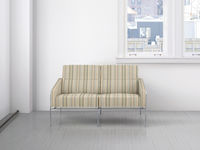
Textiles’ good looks hide an ugly environmental legacy, but there are five straightforward ways to make responsible design choices.
Textiles can make a space what it is. Through a carefully chosen combination of texture, color, and pattern, they create a feel of opulence, coziness, or no-nonsense practicality. They can encourage a spirit of play and creativity or one of contemplative silence. Found as woven or non-woven fabrics,... Read more
Op-Ed

We’re finally getting vital toxicity information about building products. But let’s remember that sustainability is about more than avoiding health hazards.
For years we advocated for alternatives to formaldehyde-based binders in fiberglass insulation. Then in 2008, Knauf made a huge breakthrough, unveiling its EcoBatt fiberglass insulation with Ecose biobased binder. This was clearly the beginning of the end for formaldehyde binders.
But we couldn’t fully... Read more
Product Review

Is rubber flooring sustainable? The jury is still out on most products, but nora and Artigo offer the best on the market.
Rubber flooring has attractive sustainability features, yet the chemistry of rubber manufacturing can be problematic. We took a hard look at the rubber flooring industry and found two manufacturers whose products stand out as the greenest in this tricky category.
Green attributes of rubber flooring... Read more
News Analysis

Rubber flooring is getting greener overall, but tire-derived products are still an iffy proposition.
The media exploded last year with panic about the use of crumb rubber as infill in artificial turf fields, which are coming under renewed scrutiny due to hints of a link (as yet anecdotal) between these fields and incidents of cancer among young soccer goalies. Few reports have mentioned, though, that this very same material is... Read more
Feature Short

Standard textiles can have a toxic, devastating impact on our environment. Your project can do better.
The global textile industry has a poor environmental record.
It takes 200 tons of water to produce 1 ton of textiles, according to the Natural Resources Defense Council (NRDC). Textile dyeing and finishing are responsible for 17% to 20% of the world’s industrial water pollution, the World Health Organization estimates... Read moreFeature Short
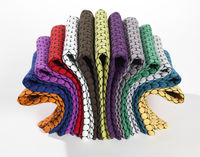
Textile standards and certifications look at fiber production, life cycle, chemistry, and more, but in the U.S. they are just gaining traction.
With all the different fibers, chemicals, dyes, and coatings used for textiles coming from all over the world, assessing the sustainability of a textile is nearly impossible for most designers.
Many turn to certifications to simplify the decision process, but which ones should you trust? There are standards that look at... Read more
News Analysis
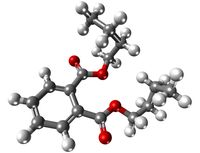
SVOCs like phthalates are released into the air, according to a new study, so you’re breathing and absorbing them, not just eating them.
Conventional wisdom has had us focusing on volatile organic compounds (VOCs) as a top priority for indoor air quality. Designers who know about them at all probably consider semi-volatile organic compounds (SVOCs) and non-volatile compounds as lower priorities.
That’s because VOCs can instantly vaporize... Read more


