EPA Finds Coal Fly Ash Safe in Concrete and Gypsum Wallboard

News Brief

EPA Finds Coal Fly Ash Safe in Concrete and Gypsum Wallboard

A new study supporting the encapsulated use of fly ash in building products is a strong clue as to how EPA might shape pending regulation.

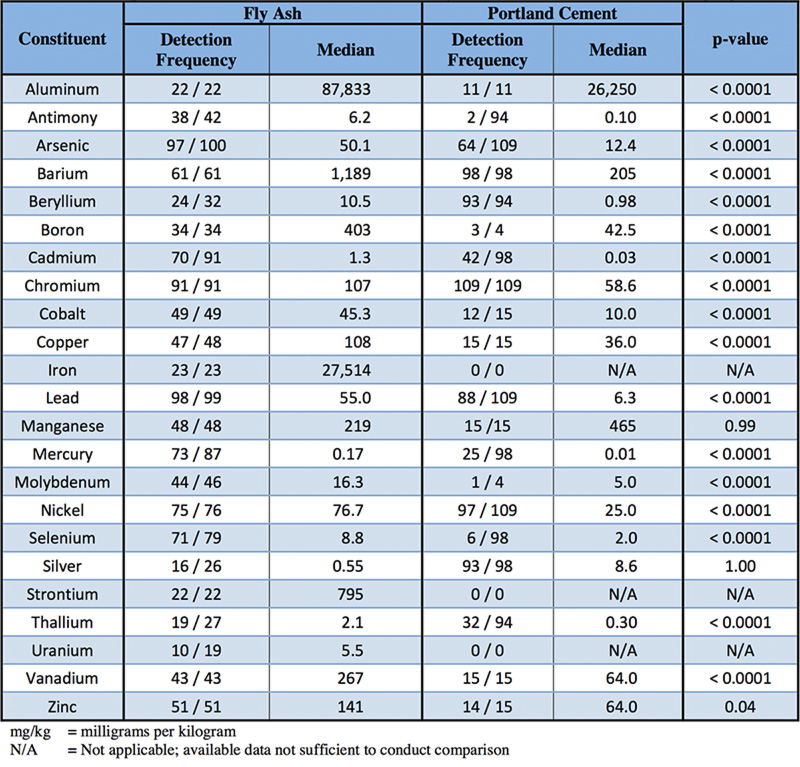
Although concentrations of these potentially toxic elements are in most cases higher in cement with fly ash than in portland cement, EPA has determined there is little risk of dangerous exposure.

Source: U.S. EPA

UPDATE 12/20/14: EPA issued its final rules, and as expected, found coal ash safe to use in building materials, and declined to categorize it as a hazardous waste.

As the December 2014 deadline draws near for the U.S. Environmental Protection Agency (EPA) to finalize regulations for fly ash—a byproduct of burning coal—the agency released a study offering evidence that the material is safe for use in concrete and gypsum wallboard.

Using a methodology that has become the EPA standard for evaluating products containing fly ash, the study found that concentrations of 18 constituents of potential concern were higher in cement with fly ash than in portland cement, and the lowest mercury emanation rate measured for gypsum wallboard with fly ash was three times higher than the highest rate for mined gypsum wallboard. However, after an exposure review and screening assessment, the report finds that the increased concentrations are still “below relevant regulatory and health-based benchmarks” and concludes that EPA supports the “beneficial use” of fly ash in these products.

Using fly ash in concrete offsets greenhouse gas emissions, and diverting it for use in other products means less of it is dumped into landfills, where toxic substances may leach into groundwater (see “Reducing the Environmental Impacts of Cement and Concrete”). However, some say even the latest EPA study fails to put their concerns over health impacts to rest. In a recent statement, The Healthy Building Network warns that the methodology discounts high levels of mercury, was not properly peer reviewed, and fails to investigate exposures that might occur during manufacturing and installation, or after disposal.

The study does not address fly ash used in products like ceiling tiles or carpet backing—other common uses in which the fly ash is not as clearly encapsulated (see EBN’s Position on Fly Ash”).


Published December 31, 1969

(2014, April 2). EPA Finds Coal Fly Ash Safe in Concrete and Gypsum Wallboard. Retrieved from https://www.buildinggreen.com/departments/newsbrief

Add new comment

To post a comment, you need to register for a BuildingGreen Basic membership (free) or login to your existing profile.

Urban Green Opens Call for EBie Awards

News Brief

Urban Green Opens Call for EBie Awards

Submission entries are now open for the EBie Awards, which recognize those who make existing buildings more sustainable.

Organized by Urban Green Council, this year’s EBie Awards celebration will be held June 9, 2014 at the Hard Rock Café Theater in New York City. It’s a night that Urban Green likens to the Oscars, with a twist: guests pause for a photo shoot on a green carpet, and the gushing acceptance speeches come from building operators, facility managers, engineers, and other building professionals.

The submission period is now open for the third round of these annual awards, which recognize individuals for making great strides in greening up existing buildings.

Recipients are honored for their often-thankless work of improving the energy and water use of existing buildings. The categories range from the Smooth Operator (for excellence in operations and maintenance) to the Verdant Brainiac (for green renovation innovation). Last year’s winners included John Barnes of SL Green Realty Corp for upgrading the HVAC system at 360 Hamilton Avenue in White Plains, New York, and John Lalley for a lighting retrofit at the Davis & Warshow Distribution Center in New York City. Although Urban Green is the New York City chapter for the U.S. Green Building Council, entrants are welcome from anywhere in the U.S.

Entry forms must be submitted online, and scoring is based on savings reflected by source energy use intensity scores registered through EPA’s Portfolio Manager. Submissions are due March 20, 2014.

For more information:

EBies

www.ebies.org/about


Published December 31, 1969

(2014, March 10). Urban Green Opens Call for EBie Awards. Retrieved from https://www.buildinggreen.com/departments/newsbrief

Add new comment

To post a comment, you need to register for a BuildingGreen Basic membership (free) or login to your existing profile.

EPA Challenges Hotels to Reduce Water Use

News Brief

EPA Challenges Hotels to Reduce Water Use

A collection of resources, from webinars to tracking tools, is promised to hotels that take on the H2Otel challenge to cut water consumption.

The U.S. Environmental Protection Agency (EPA) recently launched the WaterSense H2Otel challenge, a national program specifically targeted at reducing water use in hotels.

Companies participating in the program will pledge to assess their water use and savings opportunities, upgrade to more efficient equipment, and track their progress. To assist hotels in these efforts, EPA has developed educational webinars and tools based on its online guide WaterSense at Work: Best Management Practices for Commercial and Institutional Facilities. It will also provide an online calculator to estimate payback periods for common water-saving upgrades and develop outreach materials that hotels can use to publicize their efforts.

In the U.S., hotels account for approximately 15% of all water used in commercial facilities, according to the American Water Works Association. Though recent research suggests green hotels don’t yet bring in higher revenue, EPA says the program helps position hotels to “meet the growing customer demand for green lodging” and realize operational savings. Implementing water-efficient practices, such as installing WaterSense-labeled products in guest rooms, landscaping to use water more efficiently, and upgrading kitchen equipment, can help hotels decrease operating costs by approximately 11%, energy use by 10%, and water use by 15%, according to industry estimates.

For more information:

EPA WaterSense

epa.gov/watersense


Published December 31, 1969

(2014, March 3). EPA Challenges Hotels to Reduce Water Use. Retrieved from https://www.buildinggreen.com/departments/newsbrief

Add new comment

To post a comment, you need to register for a BuildingGreen Basic membership (free) or login to your existing profile.

Researchers Find Holes in Climate Argument for Natural Gas

News Brief

Researchers Find Holes in Climate Argument for Natural Gas

Methane leaks make natural gas a poor choice for vehicle fuel but still better than coal for power generation over a 100-year period.
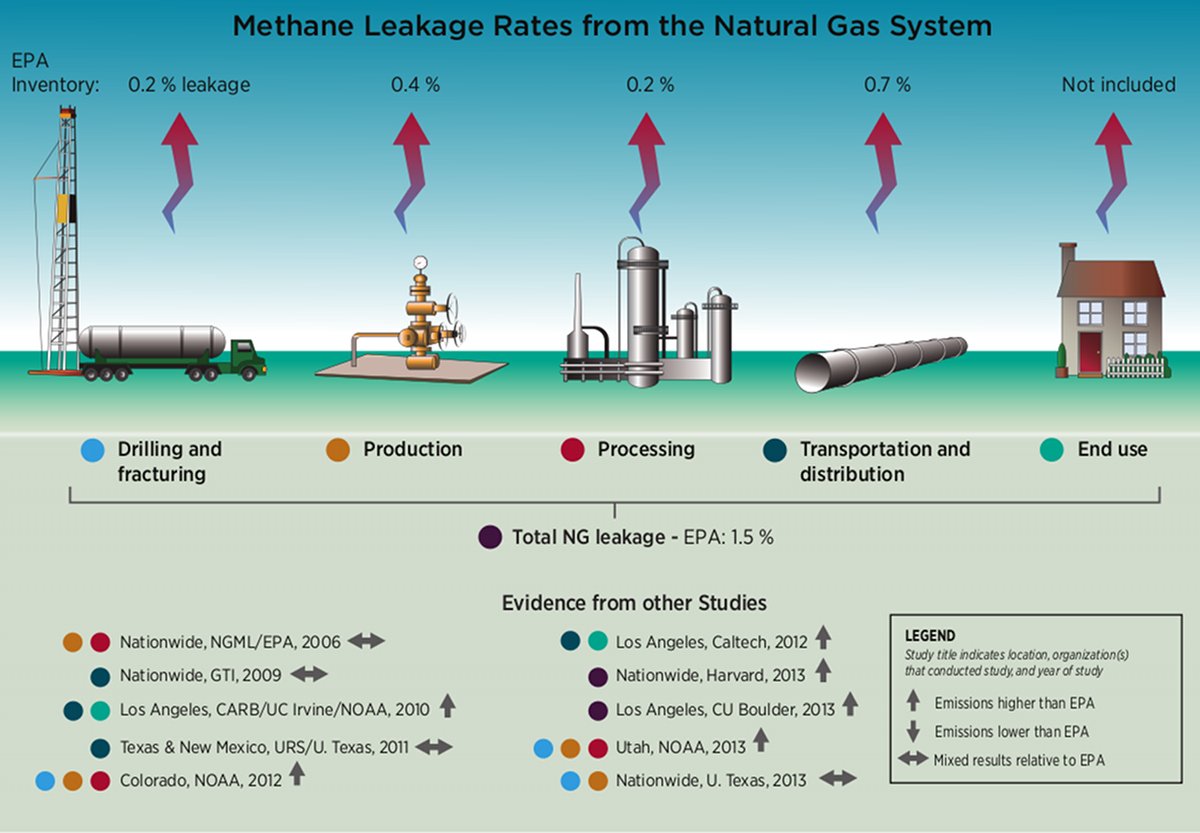
A new study suggests federal regulators have grossly underestimated the climate impact of natural gas.

The team of researchers, whose findings were published in the journal Science, analyzed 20 years’ worth of studies measuring actual emissions from and near natural gas facilities. The fuel is mostly methane, a powerful greenhouse gas that has a 20-year global warming potential (GWP) 85 times that of CO2 and a 100-year GWP 30 times that of CO2.

Standard estimates by the U.S. Environmental Protection Agency (EPA) of overall U.S. methane emissions are off by about 50%, according to lead researcher Adam Brandt, Ph.D., assistant professor at Stanford University. And the agency’s estimates of the natural gas industry’s emissions are based on assumptions about 1990s technology and infrastructure, leading the research team to suggest leakage rates up to 10% higher than EPA’s estimates from production and processing.

Substituting these higher leakage rates in life-cycle assessments comparing different fuels, the authors suggest that, from a climate perspective, diesel is a better vehicle fuel than natural gas. But over a 100-year period, natural gas likely still wins out as a substitute for coal in power plants.
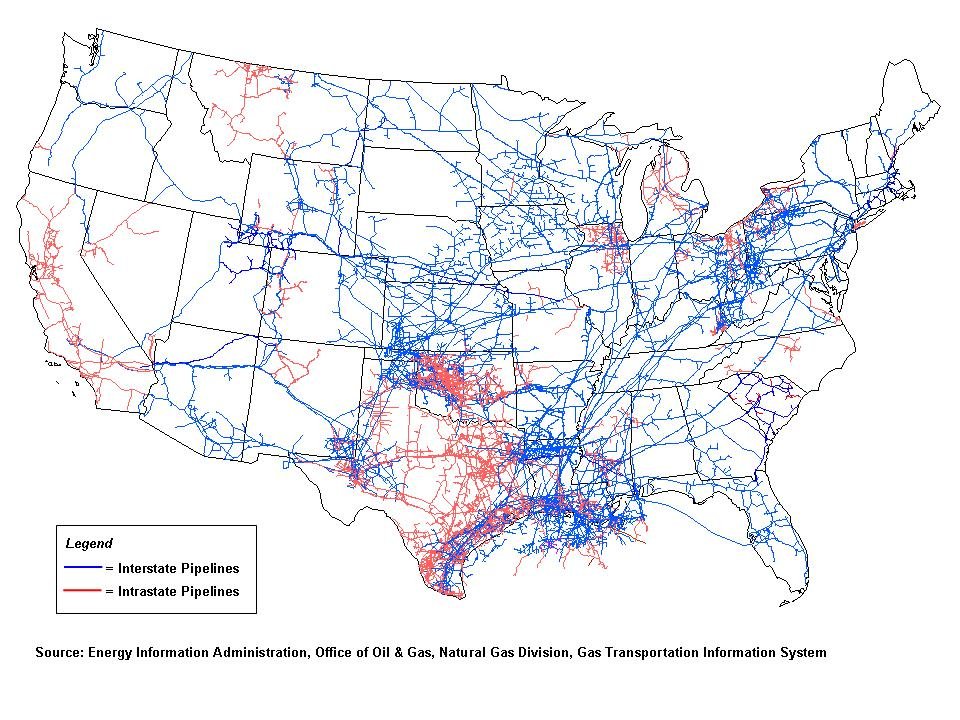
Brandt sees a silver lining to the news of the industry’s excess emissions: because the excess comes primarily from unintentional leaks from old wells, corroded pipes, and faulty storage tanks, most of these emissions could be controlled. Since leaks cost money, “hopefully the technology can get cheap enough for the industry to do this on its own,” Brandt said in a video on the Stanford website.

However, the paper concludes, “If natural gas is to be a ‘bridge’ to a more sustainable energy future, it is a bridge that must be traversed carefully: diligence will be required to ensure that leakage rates are low enough to achieve sustainability goals.”

For more information:

Stanford University

news.stanford.edu

Published December 31, 1969

(2014, March 3). Researchers Find Holes in Climate Argument for Natural Gas. Retrieved from https://www.buildinggreen.com/departments/newsbrief

Add new comment

To post a comment, you need to register for a BuildingGreen Basic membership (free) or login to your existing profile.

Pesticides from Forestry Runoff Pollute Farm Bill

News Brief

Pesticides from Forestry Runoff Pollute Farm Bill

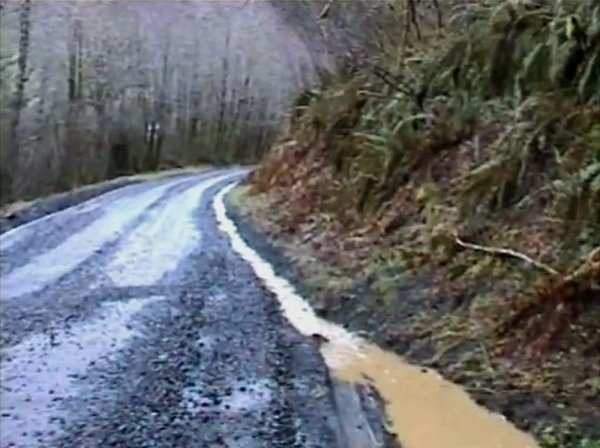
EPA cannot limit chemical or sediment runoff from logging operations, thanks to the 2014 Agricultural Act, better known as the Farm Bill.

Farm subsidies and food stamps are two of the biggest programs in the so-called Farm Bill, but the legislation regulates many other issues, including forestry practices. And the latest version (signed into law February 19 as the Agricultural Act of 2014) includes a pesticide exemption and other benefits for logging companies, as reported by Lee Fang of The Nation.
The Act explicitly limits the authority of the U.S. Environmental Protection Agency (EPA) to regulate sediment discharges or other runoff from a variety of forestry activities, including harvesting, pest control, road building, or fertilizer applications. It does this by amending a key section of the Clean Water Act intended to reduce pollutant discharges into waterways by industry, municipal wastewater facilities, and agricultural operations.

Although EPA has typically not required permits for wastewater pollution from logging operations under the Clean Water Act, the Northwest Environmental Defense Center had been fighting a legal battle to change that. The new legislation will prevent EPA from doing so.

A number of forestry product companies and associations (including all six companies represented as “economic sector” groups on the board of the Sustainable Forestry Initiative) lobbied to include the new exemption. Other trade associations supportive of the exemption included the Biomass Thermal Energy Council, the Pellet Fuels Institute, the Hardwood Plywood and Veneer Association, and the Treated Wood Council.

Published December 31, 1969

(2014, March 3). Pesticides from Forestry Runoff Pollute Farm Bill. Retrieved from https://www.buildinggreen.com/departments/newsbrief

Add new comment

To post a comment, you need to register for a BuildingGreen Basic membership (free) or login to your existing profile.

Seattle's Energy Hogs Built in 1960s to 1980s

News Brief

Seattle's Energy Hogs Built in 1960s to 1980s

Energy reporting in the Emerald City reveals 41% of large buildings are Energy Stars, while the most wasteful buildings could save millions on energy bills.

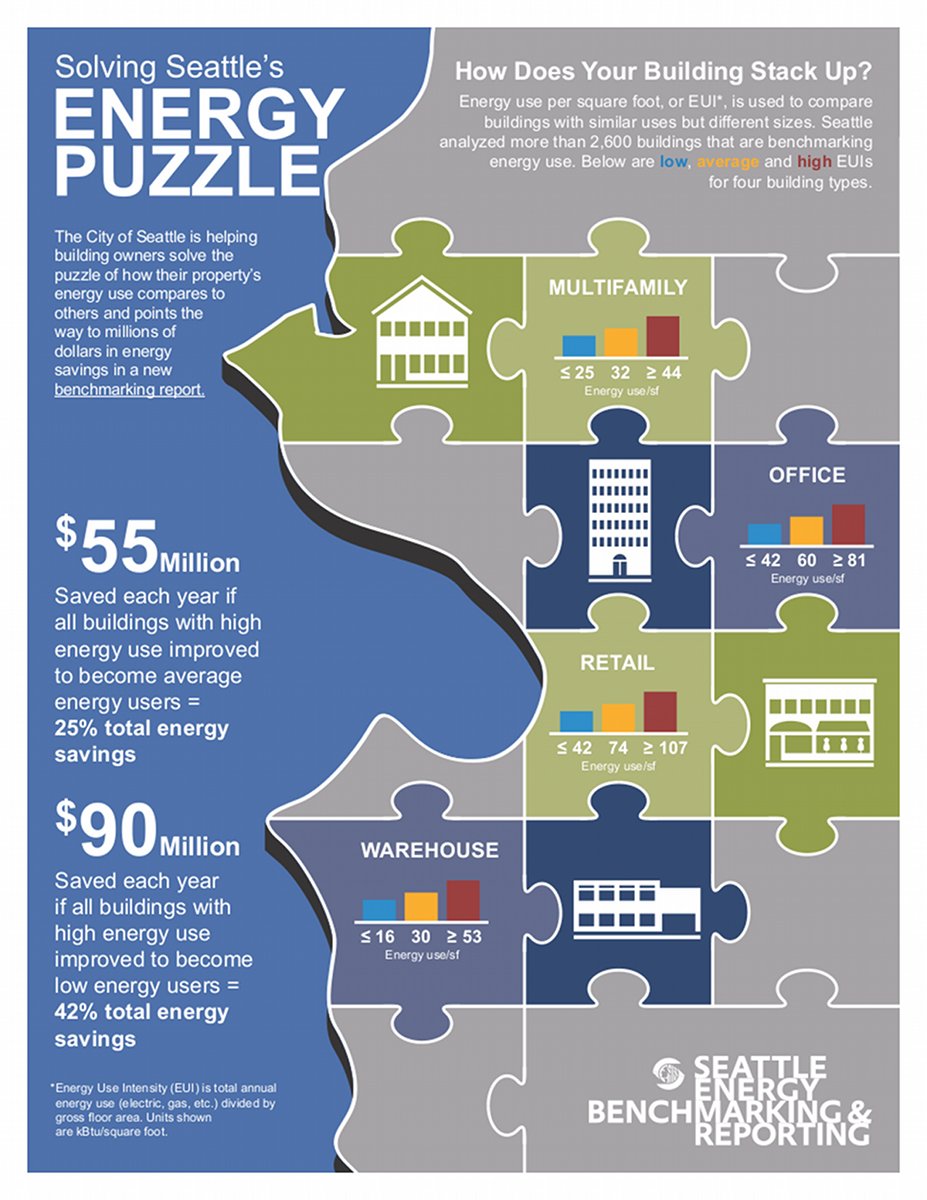
Owners of the worst-performing buildings in Seattle could save $55 million a year by reducing their energy use 25%, according to a report released by the City. Seattle is one of a handful of municipalities in the U.S. that mandate annual building benchmarking and disclosure (see “Energy Reporting: It’s the Law”).

Among those cities, Seattle claims the highest compliance rate: 93% of building owners required to disclose actually did so in 2012, making data available from 2,600 commercial and multifamily buildings 20,000 ft2 and larger. The report found that just 18% of those buildings had Energy Star certification, even though 41% would qualify for certification due to benchmarking scores of 75 or higher (meaning they perform better than 75% of U.S. buildings of the same type). In fact, Seattle buildings overall had a mean Energy Star score of 68.

Grocery stores, hospitals, and courthouses showed the highest median energy use intensity (EUI)—with supermarkets topping 215 kBtu/ft2—while the median EUI for multifamily housing (at 31.9) was almost as low as that of warehouses (30.4).

Office buildings were in between, with a median EUI of 59.7, though results varied by age. “Office building energy performance was worst for mid-century buildings built between the 1960s and 1980s,” the report states, “but better for those constructed earlier and for those built since 2000.”

For more information:

Seattle Building Energy Benchmarking Report

seattle.gov

Published December 31, 1969

(2014, March 3). Seattle's Energy Hogs Built in 1960s to 1980s. Retrieved from https://www.buildinggreen.com/departments/newsbrief

Add new comment

To post a comment, you need to register for a BuildingGreen Basic membership (free) or login to your existing profile.

Biggest Trees Sequester the Most Carbon, Study Reveals

News Brief

Biggest Trees Sequester the Most Carbon, Study Reveals

Findings contradict years of speculation that young trees gain mass faster than older ones—a common excuse for clear-cutting.

Large trees gain mass—and sequester carbon—at a much higher rate than small trees, a new study from the U.S. Geological Survey (USGS) reveals. Scientists took their own measurements but also used large amounts of existing data from other research to learn more about the growth rates of more than 400 species of trees. Almost all of the species (97%) saw faster growth rates among their largest trees, according to Nathan Stephenson at USGS.
The findings run counter to what Stephenson calls a myth about older trees—that they store huge amounts of carbon but don’t continue to sequester more carbon at a very high rate. On the contrary, he told Nature reporter Jeff Tollefson, “Trees have the equivalent of an adolescent growth spurt, but it just keeps going.”

Some logging companies have used this “myth” as a reason to harvest old-growth trees.

The practical implications of the findings are not yet clear, however. Stephenson says that young forests as a whole do sequester carbon at higher rates than old forests, simply because there are so many more trees. But, writes Tollefson, “the research could help scientists to develop better models of how forests function and their role in regulating the climate.”

For more information:

Nature News

nature.com/news

Published December 31, 1969

(2014, March 3). Biggest Trees Sequester the Most Carbon, Study Reveals. Retrieved from https://www.buildinggreen.com/departments/newsbrief

Add new comment

To post a comment, you need to register for a BuildingGreen Basic membership (free) or login to your existing profile.

"Green Lease Leaders" Program to Recognize Brokers

News Brief

"Green Lease Leaders" Program to Recognize Brokers

Firms and brokers that offer leases meeting sustainability criteria will be recognized in an effort to get tenants and landlords collaborating to save energy.

Applications are now open for Green Lease Leaders, a program that establishes a standard for green lease programs and honors firms and brokers that successfully implement it.

Developed by the Institute for Market Transformation (IMT) and the U.S. Department of Energy’s (DOE) Better Buildings Alliance, the Green Lease Leaders program is designed to help tenants and landlords work together to save energy by encouraging them to set sustainability conditions in the lease. To be recognized as a Green Lease Leader, a landlord’s or broker’s lease agreement must include a tenant cost-recovery clause, which rewards the tenant for making energy-efficient capital improvements, and incorporate a minimum of three other provisions. Examples include requiring tenant disclosure of monthly utility data or setting sustainable operation and maintenance rules. Another set of requirements applies to a tenant lease.

“These requirements set a new standard for commercial leasing by providing a uniform definition for what characterizes a green lease, and each of the requirements aids in making a lease more equitable between landlord and tenant so that they share both the costs and benefits of improved energy performance,” said Cliff Majersik, executive director for IMT.

Applications will be open until April 8, 2014, and the first group of recognized firms and brokers will be announced at DOE’s Better Buildings Summit in Washington, D.C.

For more information:

Green Lease Leaders

greenleaselibrary.com/


Published December 31, 1969

(2014, February 3). "Green Lease Leaders" Program to Recognize Brokers. Retrieved from https://www.buildinggreen.com/departments/newsbrief

Add new comment

To post a comment, you need to register for a BuildingGreen Basic membership (free) or login to your existing profile.

Phthalate Exposure Persists Despite Regulations

News Brief

Phthalate Exposure Persists Despite Regulations

Plasticizers known to be highly toxic decreased in a nine-year study, but tests showed elevated levels of less-scrutinized substitutes.

People in the U.S. can rest a little easier about three toxic phthalates being phased out of consumer goods, reports Lindsey Konkel of Environmental Health News—but levels of other phthalates have gone up, in some cases dramatically. These chemicals are used as plasticizers to make vinyl products flexible and also appear in personal care products such as shampoo and fingernail polish.
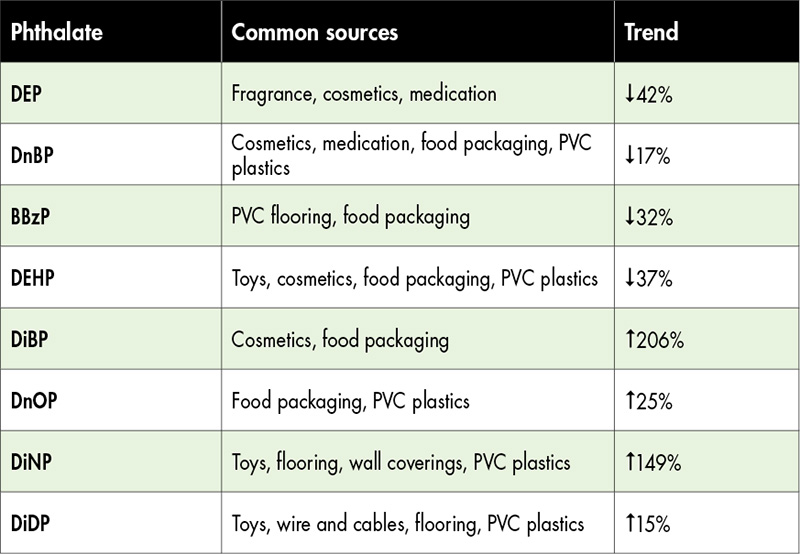
A research team led by Ami Zota, Sc.D., found that exposure to three phthalates banned in U.S. children’s products in 2008 (BBzP, DnBP, and DEHP) had decreased among all age groups, but that exposure to substitutes had increased—more than doubling in the case of DiBP (Diisobutyl phthalate), a chemical used in cosmetics and food packaging that has not undergone scrutiny like many other phthalates. An assessment of DiBP by the U.S. Environmental Protection Agency in 2000 was inconclusive due to lack of data, while a hazard assessment seven years later by the Australian Department of Health and Ageing had little more information but noted possible reproductive and developmental effects in exposed rats.

Exposure to diisononyl phthalate (DiNP), a common substitute for toxic plasticizers used in vinyl wallcoverings and other PVC products, increased 149%. The State of California recently listed DiNP as a carcinogen (see “The PVC Debate: A Fresh Look”).

“These findings are not as reassuring as they could be,” epidemiologist Joe Braun, Ph.D., told Konkel, because widespread phthalate exposure continues despite regulatory action and public health campaigns.

“Temporal Trends in Phthalate Exposures: Findings from the National Health and Nutrition Examination Survey, 2001–2010” was published in Environmental Health Perspectives and is available online.

Published December 31, 1969

(2014, February 3). Phthalate Exposure Persists Despite Regulations. Retrieved from https://www.buildinggreen.com/departments/newsbrief

Add new comment

To post a comment, you need to register for a BuildingGreen Basic membership (free) or login to your existing profile.

EPA to Tighten Pollution Rules for Wood Heaters

News Brief

EPA to Tighten Pollution Rules for Wood Heaters

The new regulations will slash particulate emissions from woodstoves, wood hydronic heaters, pellet stoves, and masonry heaters.

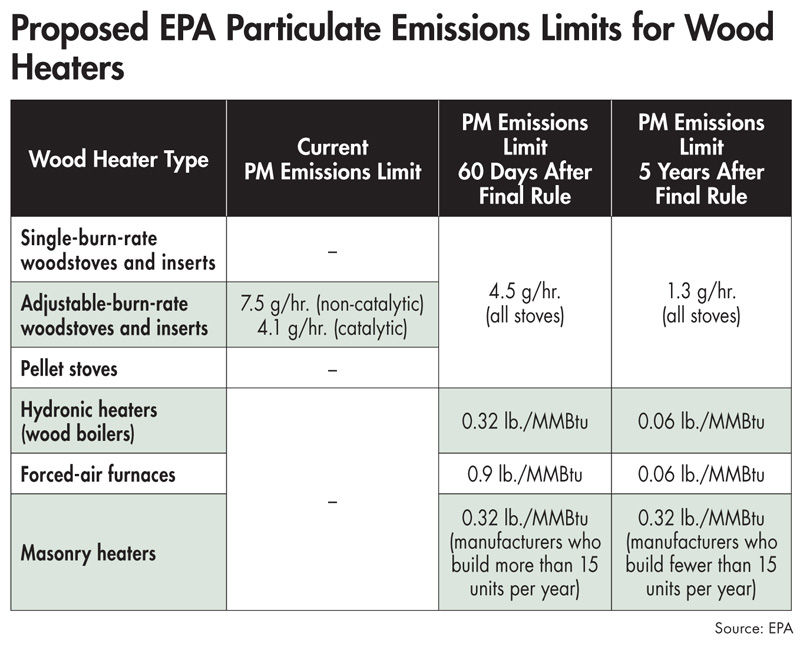
For the first time in decades, the U.S. Environmental Protection Agency (EPA) has proposed updated emissions standards for new wood heaters. The new rules would reduce particulate emissions from wood heaters an estimated 80% and would also greatly expand the categories regulated by EPA.


Under the proposed regulations, new wood heaters would have to meet emissions standards in a two-step process, with a small reduction in emissions within 60 days after the final rule is published and a much larger reduction in emissions within five years.

Current EPA standards, issued in 1988, apply only to adjustable-burn-rate woodstoves (those designed to allow airflow changes) and woodstove inserts. The new standards would also apply to single-burn-rate woodstoves (which pollute more because they don’t allow for airflow adjustments; these are commonly called “EPA-exempt” stoves) and to various new types of wood heaters—pellet stoves as well as wood-fired hydronic heaters, forced-air furnaces, and masonry heaters.

EPA is also seeking comment on regulation of emissions from new fireplaces, which are not considered heaters.

Once finalized, the rules will go into effect in 2015, with full compliance phased in over five years.

For more information:

U.S. Environmental Protection Agency

epa.gov

Published December 31, 1969

(2014, February 3). EPA to Tighten Pollution Rules for Wood Heaters. Retrieved from https://www.buildinggreen.com/departments/newsbrief

Add new comment

To post a comment, you need to register for a BuildingGreen Basic membership (free) or login to your existing profile.