More Proof That Housecats Are Birds' Biggest Enemy

News Brief

More Proof That Housecats Are Birds' Biggest Enemy

Bird-safe glass is worthwhile, but keeping cats indoors would prevent far more songbird deaths.

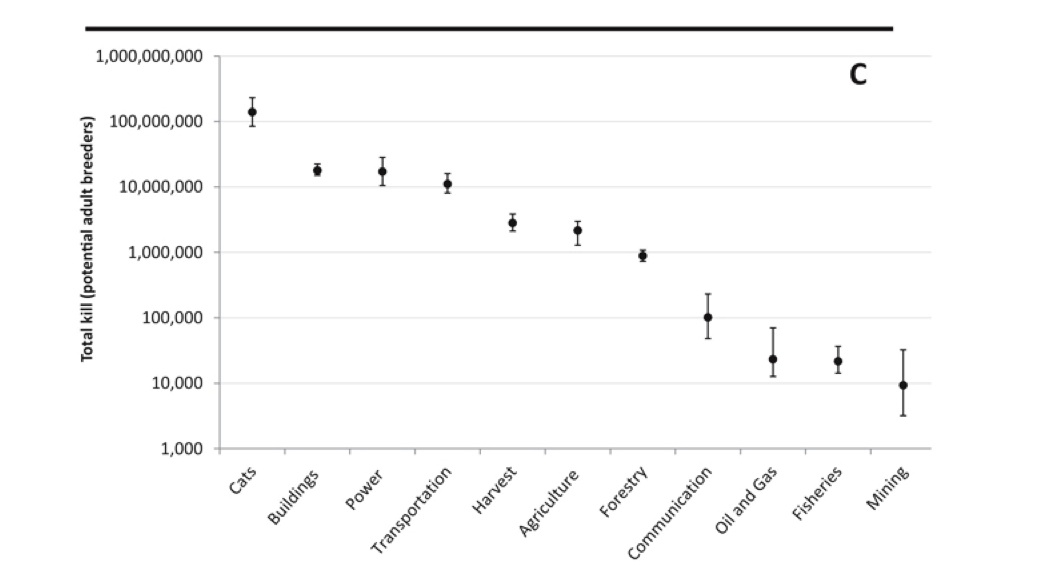
A new study finds an estimated 105–348 million birds in Canada each year are killed by domestic cats, making these pets and their feral compatriots the biggest human-related threat to wild birds—more lethal by far than large office buildings and wind turbines, which sometimes take the blame.

Researchers calculated that collisions with residential and low- to mid-rise buildings account for 24.8 million bird deaths, and tall buildings claim another 64,000—not an insignificant figure, especially when these deaths could be prevented with shading features or window film. Wind turbines were responsible for just 16,700 bird fatalities—about 13 birds a year per turbine in Canada—while the average feral cat there kills 24 to 64 birds annually. Although only about 25% of cats in Canada are feral, this group likely kills 59% of the birds that succumb to feline predation, suggesting a need to both keep cats indoors and to spay or neuter pets.

The study, published in Avian Conservation & Ecology provides firm figures that give more credence to similar findings by researchers in the United States. Although the most recent estimate of birds killed by cats in the U.S. is ten times higher than this estimate in Canada, researchers say this difference is in line with a higher human population and a larger number of feral cats.

Published December 31, 1969

(2013, December 2). More Proof That Housecats Are Birds' Biggest Enemy. Retrieved from https://www.buildinggreen.com/departments/newsbrief

Add new comment

To post a comment, you need to register for a BuildingGreen Basic membership (free) or login to your existing profile.

Sefaira Plug-In Integrates Energy Analysis Directly into SketchUp

News Brief

Sefaira Plug-In Integrates Energy Analysis Directly into SketchUp

Sefaira introduces new software that models a building’s energy use while architects are still drafting initial designs.

Sefaira recently unveiled its new plug-in for SketchUp that provides real-time energy analysis for the conceptual stage of building design; Sefaira claims the tool will allow architects to make early performance-enhancing decisions about form, orientation, and façade design without requiring expertise in energy modeling.

After the user selects a location, the extension software uses corresponding weather data to deliver immediate analysis of a design’s energy use—broken down by heating, cooling, lighting, and plug loads—and graphically shows the heat gains and losses of the building. By highlighting the elements of design that are most responsible for poor performance, the program guides architects toward making targeted adjustments from the outset of the design phase, when their impact on building performance can be greatest (See “Energy Modeling: Early and Often”).

The plug-in operates directly within SketchUp so that architects don’t have to interrupt their design process to perform scenario comparisons, claims the company, but it utilizes Sefaira’s cloud-based engine for real-time analysis. Customers pay a subscription fee to use the tool.

For more information:

Sefaira

sefaira.com/sefaira-for-sketchup


Published December 31, 1969

(2013, December 2). Sefaira Plug-In Integrates Energy Analysis Directly into SketchUp. Retrieved from https://www.buildinggreen.com/departments/newsbrief

Add new comment

To post a comment, you need to register for a BuildingGreen Basic membership (free) or login to your existing profile.

Winning Designs of AIA Contest to Be Used in Post-Storm Recovery

News Brief

Winning Designs of AIA Contest to Be Used in Post-Storm Recovery

The American Institute of Architects’ (AIA) recently announced the winners of its “Designing Recovery” contest, a design competition that judged resilient house plans for New York City, New Orleans, and Joplin, Missouri.

An elevated bungalow by the Canadian architecture firm Sustainable. TO Architecture + Building took first place for the New York division, featuring a “flood-proof” foundation and a split roof with clerestory windows for passive heating through solar gain. The house is also economical, says the firm, as materials for the building cost less than $50,000.

GOATstudio LLP designed the winning proposal for New Orleans based on a traditional “shotgun house” model. The home has an elevated finished floor seven feet (2.1 m) above ground and a steel roof that “turns and wraps the southern exterior wall for additional sun protection,” helping to maintain livable temperatures in case of a power outage, according to AIA.

The tornado-resilient “Core House” by Q4 Architects won in the Joplin category for its safe house that is built inside of a larger perimeter house. The safe house is constructed of anchored concrete masonry units and includes a rainwater harvesting system designed to support a family for an extended period of time until rebuilding would be possible.

“All of the entries that are feasible to construct will go into production in the corresponding communities,” according to an AIA press release—not just the winning designs. Partner organizers of the contest include Architecture for Humanity, Make It Right, the St. Bernard Project, and Dow Building Solutions.


Published December 31, 1969

(2013, November 1). Winning Designs of AIA Contest to Be Used in Post-Storm Recovery. Retrieved from https://www.buildinggreen.com/departments/newsbrief

Add new comment

To post a comment, you need to register for a BuildingGreen Basic membership (free) or login to your existing profile.

Efficiency Gains Credited for Downward U.S. Energy Consumption

News Brief

Efficiency Gains Credited for Downward U.S. Energy Consumption

NRDC reports energy use has dropped below 1999 levels in a “remarkable turnaround” driven by efficiency innovations—but there’s more to do.

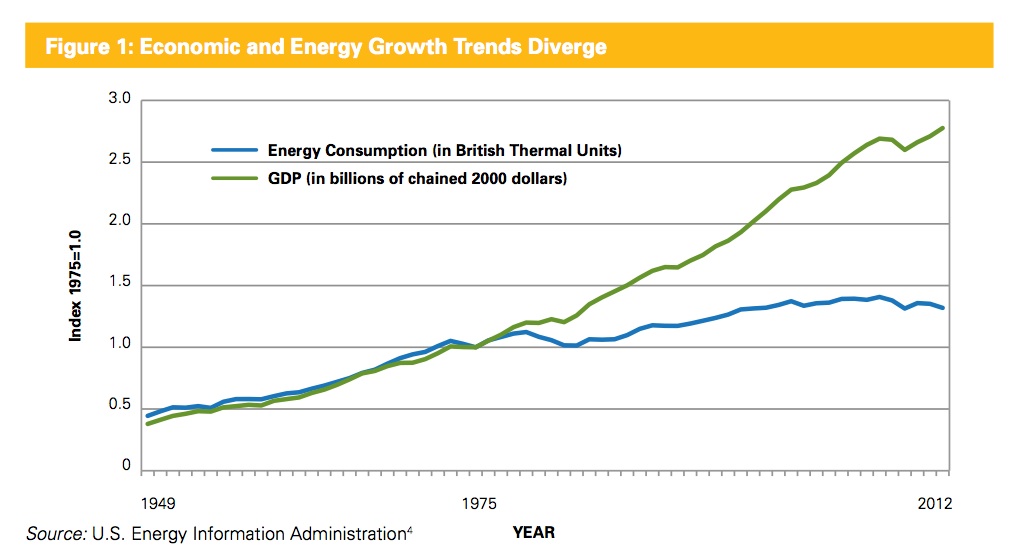
A new report from the Natural Resources Defense Council (NRDC) declares that United States energy use peaked in 2007 and continues to trend downward, primarily due to energy efficiency. Jubilantly titled “America’s (Amazingly) Good Energy News,” the analysis shows total U.S. energy use in 2012 was below 1999 levels even though the economy grew by more than 25% (adjusted for inflation) during that period.

Having more than doubled the economic productivity of oil, natural gas, and electricity in the last 40 years, the report finds, energy productivity gains have “exceeded the contribution from all new supply resources in meeting America’s growing energy needs.” Total energy used per dollar of goods produced, gasoline per mile driven, and the cost of energy services are all down, and for the first time in modern history, electrical usage is decoupled from population growth; from 2000 to 2012, the population grew at an average annual rate of about 1%, while the electrical consumption increased at half that rate.

The report does not address whether exported manufacturing processes could be influencing energy consumption figures, but it does say more cuts are still needed. The NRDC concludes that the U.S. is on track to meet President Obama's target of reducing carbon emissions 17% by 2020 relative to 2005 levels, but it calls on regulators to tighten standards for buildings and equipment, so further efficiency gains can be realized.

Published December 31, 1969

(2013, November 1). Efficiency Gains Credited for Downward U.S. Energy Consumption. Retrieved from https://www.buildinggreen.com/departments/newsbrief

Add new comment

To post a comment, you need to register for a BuildingGreen Basic membership (free) or login to your existing profile.

Organization Wants Architects to Be Sustainability Leaders

News Brief

Organization Wants Architects to Be Sustainability Leaders

The American Institute of Architects (AIA) hopes to open doors for architects by prioritizing energy, materials, human health, and resilience.

The American Institute of Architects (AIA) is set to implement the recommendations of a recently published report that aims to position architects as leaders in emerging sustainability trends. The Sustainable Leadership Opportunity Scan, written by Mary Ann Lazarus, FAIA, outlines steps for AIA through 2016 that it argues will unlock opportunities for architects in the areas of energy, material selection, human health, and resilience.

After conducting surveys and interviews with more than 40 different building-related organizations, Lazarus identified AIA’s 2030 energy goals and the ability to make material selections based on life-cycle criteria as two core issues for architects. She also notes designing for improved health and resilience as two emerging issues.

To better align AIA resources to support these areas of focus, the report recommends developing a database to increase reporting on progress toward AIA’s 2030 net-zero goals and creating an educational curriculum focused on material content. To address emerging issues, the report suggests hosting resilience trainings and expanding the Building Research Information Knowledgebase (BRIK), an archive of peer-reviewed papers and case studies on building design and performance.

The AIA board validated the report’s recommendations prior to its release and has agreed to move forward with implementation, subject to budget approvals.

Published December 31, 1969

(2013, November 1). Organization Wants Architects to Be Sustainability Leaders. Retrieved from https://www.buildinggreen.com/departments/newsbrief

Add new comment

To post a comment, you need to register for a BuildingGreen Basic membership (free) or login to your existing profile.

L.A.'s Urban Farming Ordinances Lack Cohesion

News Brief

L.A.'s Urban Farming Ordinances Lack Cohesion

A new guide tries to make sense of city ordinances so more can build chicken coops in Hollywood and grow veggies in Pasadena.

Students from the University of California–Los Angeles (UCLA), have mapped the location of more than 1,200 formal urban agriculture sites and deciphered ordinances and regulations from L.A.’s 88 cities, hoping to foster the burgeoning urban agriculture movement in their county. Their assessment—available on the website Cultivate L.A.—is the first tool of its kind, showing whether chickens are allowed in Hollywood or goats in Beverly Hills.

Researchers found 87% of L.A.’s cities regulate animal farming, and only 25% regulate fruits, vegetables, and other flora, but lack of regulation wasn’t the only problem, according to the report: varying terminology or conflicts with zoning regulations often make ordinances hard to interpret. The researchers developed a regulation reference chart summarizing permitted and prohibited uses in each city and recommend that policymakers adopt universal definitions and take a cohesive stance on agricultural policy for further clarity.

The assessment also includes a comprehensive map of the county’s formal urban agriculture sites. School gardens make up the majority of L.A. County’s urban agriculture activity, numbering 761 sites, while community gardens top 100. The inventory has already attracted advocates like the Los Angeles Food Policy Council, which aims to create a more seamless infrastructure and support system for urban agriculture, and the UCLA Cooperative Extension, which hopes to develop more targeted education programs.

“Much of the existing discussion and promotion of urban agriculture has focused on the qualitative benefits and ambitions of the movement,” said Carol Goldstein, a lecturer in urban planning at UCLA. This study offers quantitative data that could guide urban agriculture efforts across the country.


Published December 31, 1969

(2013, November 1). L.A.'s Urban Farming Ordinances Lack Cohesion. Retrieved from https://www.buildinggreen.com/departments/newsbrief

Add new comment

To post a comment, you need to register for a BuildingGreen Basic membership (free) or login to your existing profile.

Diesel Exhaust Throws Honeybees Off the Scent

News Brief

Diesel Exhaust Throws Honeybees Off the Scent

Scientists find NOx pollution from vehicles can change the chemical makeup of flowery odors, affecting bees’ ability to find food.

New research suggests diesel exhaust fumes change the scent of at least one flower that honeybees often frequent, making it more difficult for them to forage for nectar and possibly contributing to their decline.

Scientists from Britain’s University of Southampton combined eight chemicals found in the scent of the yellow oilseed rape flower and exposed samples to both clean and exhaust-filled air. Four of the flower chemicals reduced in volume when they mixed with the nitric oxide and nitrogen dioxide gases of diesel fumes, and two became undetectable within a minute, changing the chemical profile of the smell. When honeybees were exposed to a blend without the two chemicals that had most diminished, they were roughly half as likely to extend their tongues in search of nectar than they were for the full mixture.

While authors acknowledge that field observations are needed to establish that the same phenomenon happens in a natural environment and with other flower species, they also suggest that “degradation of an odor source by pollution is likely to be more pronounced at a distance from the flower,” making it even more likely that diesel’s reactive chemicals would hamper flower recognition outside the lab.

In the context of ongoing honeybee colony collapse and studies about the effects of a loss of pollination services, the authors conclude that diesel pollution, which can come from heavy equipment, generators, or diesel trucks and cars, could be “detrimental to pollinator health, particularly in conjunction with other stressors.”

Published December 31, 1969

(2013, November 1). Diesel Exhaust Throws Honeybees Off the Scent. Retrieved from https://www.buildinggreen.com/departments/newsbrief

Add new comment

To post a comment, you need to register for a BuildingGreen Basic membership (free) or login to your existing profile.

USGBC Finds Earth's "Greenest Schools" in Hong Kong and Kenya

News Brief

USGBC Finds Earth's "Greenest Schools" in Hong Kong and Kenya

The two recipients of the “Greenest School on Earth” award both use innovative sustainability practices to serve disadvantaged schoolchildren.

The Center for Green Schools at the U.S. Green Building Council (USGBC) recently deemed two schools winners of its “Greenest School on Earth” Award for 2013. The Uaso Nyiro Primary School in Laikipia, Kenya, and the Sing Yin Secondary School in Hong Kong have each been awarded $5,000 to advance a new or ongoing sustainability project.

Located in an area beset by insufficient access to clean water and in which 25% of the community lives on less than $1.25 per day, the Uaso Nyiro school stores and filters clean water for 300 children year round with a rainwater system that harvests 350,000 liters per year. The building, designed by PITCHAfrica, utilizes local construction techniques and materials and was built for the same cost as the area’s typical four-classroom bunker-style school, but it includes protected gardens for food cultivation, teacher rooms, and a courtyard theater. School attendance has risen from 70% to 90% since its start, while instances of waterborne disease have “dropped to zero,” according to officials.

Sing Yin faces very different environmental challenges in its urban setting of Hong Kong, including dangerous air pollution levels and a severe waste-management problem. Programs such as low-carbon cooking and the importance of recycling are listed on the school’s website for the largely low-income student body. The school also features two green roofs, an organic farm, and an aquarium, providing a connection to nature the students might otherwise lack.

“We selected both of these schools because of what they say about the scale and scope in the movement,” said Rick Fedrizzi, founding chair of USGBC. “They demonstrate that, across the world, from community to community and from city to village, where we learn matters.”

For more information:

The Center for Green Schools

centerforgreenschools.org

 

Published December 31, 1969

(2013, November 1). USGBC Finds Earth's "Greenest Schools" in Hong Kong and Kenya. Retrieved from https://www.buildinggreen.com/departments/newsbrief

Add new comment

To post a comment, you need to register for a BuildingGreen Basic membership (free) or login to your existing profile.

Campaign Calls on Local Leaders to Enact Resilience Policy

News Brief

Campaign Calls on Local Leaders to Enact Resilience Policy

More than 80 mayors and local officials have committed to advancing resilient principles in their communities, and numbers are expected to grow.

A new campaign called Resilient Communities for America (RC4A) is drawing on the power of mayors and other local officials to make communities across the nation more resilient. Quickly gathering momentum, the campaign has already collected more than 80 signatories since its launch in June 2013 and has the support of the ICLEI, the National League of Cities (NLC), the World Wildlife Fund (WWF), and the U.S. Green Building Council (USGBC).

The campaign promotes strategies that include transitioning to renewable energy sources, upgrading critical infrastructure, and diversifying local economies. Supporting partners are currently working on building a more specific policy agenda for leaders to create “customized, place-based policy platforms,” according to USGBC’s Jason Hartke, vice president of national policy and advocacy. Tools and resources will also be organized on an online platform that ICLEI will maintain.

Recently commanding a national stage at USGBC’s National Leadership Speaker Series, Kevin Johnson, the mayor of Sacramento, California, and national chair of RC4A, urged fellow mayors and county leaders to join the resiliency movement, and Hartke expects the RC4A campaign to gain even more exposure at the National League of Cities’ annual meeting in November 2013. “Ultimately, the campaign won’t be judged by the echo chamber of Washington, D.C.,” Hartke told EBN.Local leaders, who have the most control over building codes, incentives, and zoning,” he said, “are in a unique position” to promote greater resilience.


Published December 31, 1969

(2013, November 1). Campaign Calls on Local Leaders to Enact Resilience Policy. Retrieved from https://www.buildinggreen.com/departments/newsbrief

Add new comment

To post a comment, you need to register for a BuildingGreen Basic membership (free) or login to your existing profile.

Wind Power A Better Energy Investment Than Storage

News Brief

Wind Power A Better Energy Investment Than Storage

It’s energetically cheaper to waste wind energy than to build batteries to store it, according to a new study.

Although batteries make sense for storing solar energy—compensating for intermittent production that does not always align with peak demand—it’s more energy-efficient to simply put up more wind turbines rather than store their excess production, a new study published in Energy and Environmental Science suggests.

Stanford University researchers compared the energy investment needed to build different wind and solar storage technologies and then evaluated energy stored on electric energy invested (ESOIe), the ratio of electrical energy stored over the lifetime of a storage device to the amount of embodied electrical energy required to build the device. Compressed-air energy storage and pumped-storage hydroelectric systems both had ESOIe values of more than 700 kWh:1 kWh, while lithium batteries had a much lower ratio of 32kWh:1 kWh.

But if building the large facilities needed for pumped hydro or compressed air storage is not an option, the study concluded, battery storage makes sense for solar energy storage but not for wind. That’s because of the higher embodied energy of photovoltaics, due in large part to the intensive process of purifying silicon. For wind, the authors conclude, “Attempting to salvage energetically cheap power…using energetically expensive batteries is wasteful from a societal perspective.” Building enough turbines (or more transmission lines) to meet demand at lowest production may create massive surpluses that go to waste at high production, but it would still be more energetically efficient than using current battery technology, according to the study.

The researchers prefaced their conclusions by acknowledging that energy storage has other auxiliary functions that should be taken into account, such as stabilizing the electric grid and providing back-up power.

Published December 31, 1969

(2013, November 1). Wind Power A Better Energy Investment Than Storage. Retrieved from https://www.buildinggreen.com/departments/newsbrief

Add new comment

To post a comment, you need to register for a BuildingGreen Basic membership (free) or login to your existing profile.