U.S. Proposes Efficiency Standards for Furnace Fans

News Brief

U.S. Proposes Efficiency Standards for Furnace Fans

The first-ever Department of Energy standard for this hidden energy hog aims for a 40% reduction in energy use.

Switching from a furnace fan with a permanent split capacitor (PSC) motor to one with a constant-torque brushless permanent magnet (BPM) motor would improve efficiency to the level of the standard, according to the Appliance Standards Awareness Project. BPM motors are able to achieve high efficiencies at multiple airflow settings, which is particularly beneficial for use with HVAC systems where higher airflows are required for cooling.

Projected to reduce CO2 emissions by 430 million metric tons in the next 30 years, the new rule is part of the Obama administration’s renewed effort at preventing 3 billion metric tons of CO2 emissions by 2030. Initially delayed from being listed in the Federal Register because of the federal shutdown, the standard still must undergo a period of public comment and be finalized before a December 2013 deadline set by Congress.

Published December 31, 1969

(2013, November 1). U.S. Proposes Efficiency Standards for Furnace Fans. Retrieved from https://www.buildinggreen.com/departments/newsbrief

Add new comment

To post a comment, you need to register for a BuildingGreen Basic membership (free) or login to your existing profile.

Overhaul of ASHRAE 90.1 Brings New Requirements

News Brief

Overhaul of ASHRAE 90.1 Brings New Requirements

The 2013 energy standard will require more stringent equipment efficiencies and lighting thresholds.

The recently published 2013 version of ANSI/ASHRAE/IES 90.1 includes significant revisions to building envelope, lighting, and mechanical appliance requirements, making the standard 40%–50% more stringent than the 2004 version, according to ASHRAE.

Containing more than 100 changes from the previous 2010 version, the standard’s fenestration requirements now include double glazing in many climates and establish a minimum visible transmittance/solar heat gain coefficient (VT/SHGC) ratio to allow daylighting with minimum solar gain. Minimum efficiencies are increased for chillers, heat pumps, and air conditioners, as well as being established for fans for the first time.

In lighting, “the focus in the 2013 standard was not just on lowering interior lighting power densities but on finding ways to achieve savings by adding more controls and daylighting requirements” according to Rita Harrold, director of technology for the Illuminating Engineering Society of North America. The standard thus includes more stringent space-by-space lighting power density limits and thresholds for top lighting.

Standard 90.1 acts as a benchmark for commercial building energy codes and can apply to all but low-rise residential buildings. It will likely take a few years to become widely used: ASHRAE 90.1-2010 is referenced in LEED version 4, which comes out in November 2013, and 90.1-2007 and 90.1-2004 are still commonly used in local building codes.

For more information:

ASHRAE’s Online Bookstore

Published December 31, 1969

(2013, November 1). Overhaul of ASHRAE 90.1 Brings New Requirements. Retrieved from https://www.buildinggreen.com/departments/newsbrief

Add new comment

To post a comment, you need to register for a BuildingGreen Basic membership (free) or login to your existing profile.

BPA, Phthalates Won't Be EPA Chemicals of Concern

News Brief

BPA, Phthalates Won't Be EPA Chemicals of Concern

EPA withdraws two chemical safety proposals lost in limbo for years.

The U.S. Environmental Protection Agency (EPA) recently withdrew two proposed rules regulating chemicals that it had submitted to the White House’s Office of Information and Regulatory Affairs several years ago. EPA says the rules are being addressed in other ways, but the Environmental Defense Fund and others see the recent action as a symptom of limited authority under the 1976 Toxic Substances Control Act (TSCA).

The first rule would have added eight phthalates—semi-volatile organic compounds and reproductive toxicants that are used to make PVC flexible—to EPA’s list of “chemicals of concern,” but EPA has instead designated them for further analysis. (So-called chemicals of concern are those with an EPA action plan for risk management; those undergoing further analysis are listed as TSCA Work Plan chemicals.) EPA has also eliminated polybrominated diphenyl ethers (PBDEs), carcinogenic and bioaccumulative compounds formerly used as flame retardants, from its chemicals of concern list, along with bisphenol-A (BPA), a component of epoxy resins that poses health risks as an endocrine disruptor and possible obesogen.

The second rule was designed to increase product transparency by preventing any chemical associated with health and safety studies from being eligible for confidential “trade secret” status unless protected under patenting rules.

The proposals sat for White House approval for three and two years respectively, though the process is supposed to take 90 days. The holdup drew the critical eye of watchdog groups and garnered support for the Chemical Safety Improvement Act of 2013, a proposed overhaul of TSCA.

Published December 31, 1969

(2013, November 1). BPA, Phthalates Won't Be EPA Chemicals of Concern. Retrieved from https://www.buildinggreen.com/departments/newsbrief

Add new comment

To post a comment, you need to register for a BuildingGreen Basic membership (free) or login to your existing profile.

Palo Alto Requires New Homes to Be Electric-Car Ready

News Brief

Palo Alto Requires New Homes to Be Electric-Car Ready

Changes to the city’s building code will require wiring for a standard electric car charging station.

An ordinance that requires new homes to be pre-wired for electric vehicles was recently adopted in Palo Alto, California—the city with the nation’s most electric cars per capita and home to Tesla Motors.

Once the ordinance is finalized, new homes will be required to include wiring for 240V Level 2 charging stations, amounting to an added cost of approximately $200. However, the investment is small compared to retrofitting the wiring in existing homes, which ranges from $500 to $1,000.

The mandate is part of a broader package of proposals that also includes streamlining the permitting process for installing a charger at a residential or commercial building. “As community members and businesses begin to transition from fossil fuel vehicles to electric vehicles, it is important that our ordinances and policies not only support this transition, but encourage it,” wrote the mayor and other city leaders in a memo urging the council to approve the ordinance.

The change comes shortly after Palo Alto approved a citywide “carbon-neutral” energy portfolio in March, ensuring every resident’s electricity is supplied by renewable energy sources or offset by the purchase of renewable energy credits.

Published December 31, 1969

(2013, November 1). Palo Alto Requires New Homes to Be Electric-Car Ready. Retrieved from https://www.buildinggreen.com/departments/newsbrief

Add new comment

To post a comment, you need to register for a BuildingGreen Basic membership (free) or login to your existing profile.

Got Light Scoops? New Design Guide for the Latest in Daylighting

News Brief

Got Light Scoops? New Design Guide for the Latest in Daylighting

Light scoops can outperform conventional skylights, but more factors go into their design. A new guide is here to help.

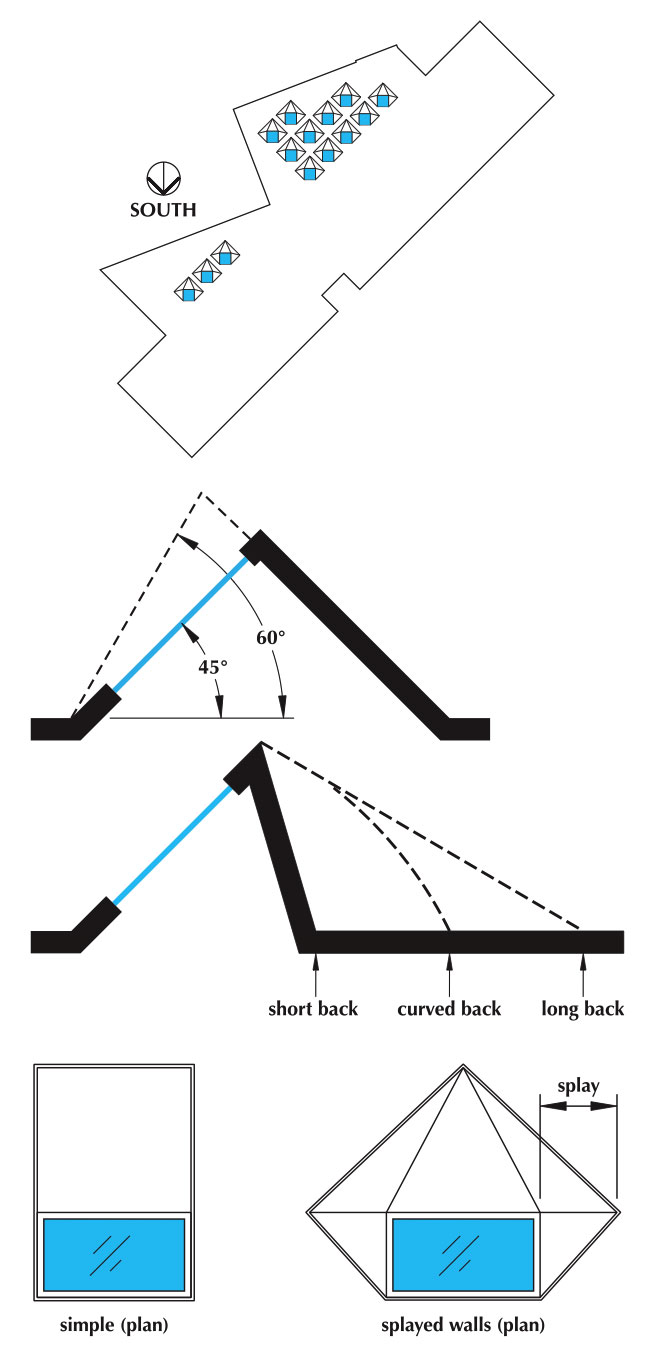
The Lighting Research Center (LRC) at Rensselaer Polytechnic Institute recently released a design guide for light scoops—skylights that provide more strategic light through daily and seasonal fluctuations than conventional skylights do.

Particularly effective in cloudy and overcast climates, light scoops face south and are angled at either 45 or 60 degrees in order to receive light from the zenith (the brightest part of the sky) during the winter, and more indirect light during the summer. According to the guide, in a recent project where 14 light scoops were installed at the Welch Allyn corporate headquarters in Skaneateles, New York, almost 90% of occupants were highly satisfied with the results.

Light Scoops: A Design Guide—available as a free download (PDF) on the LRC website—offers guidance on determining the angle, glazing area, dimensions, glass specifications, and color finishes to meet target light levels. Modeling software can be used to compare different features, but the guide cautions that simulations should take into account a variety of weather conditions.

The resource simplifies light scoop design as evidence builds for daylighting’s energy and health benefits.


Published December 31, 1969

(2013, September 30). Got Light Scoops? New Design Guide for the Latest in Daylighting. Retrieved from https://www.buildinggreen.com/departments/newsbrief

Add new comment

To post a comment, you need to register for a BuildingGreen Basic membership (free) or login to your existing profile.

"Blue Roof" Adds Stormwater Detention Alongside Green Roof in New York

News Brief

"Blue Roof" Adds Stormwater Detention Alongside Green Roof in New York

Rooftop design will reduce storm water runoff into the East River and support a new beekeeping business benefiting the formerly incarcerated.

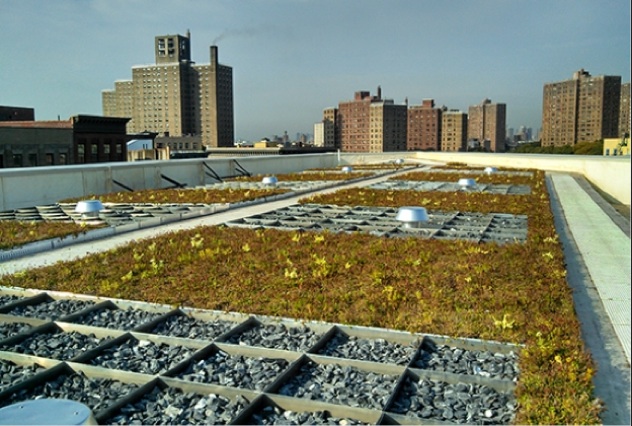
A newly installed roof on top of the Osborne Association building in the South Bronx is projected to manage more than 100,000 gallons of rainwater and will provide habitat for bees that supply honey for the association’s catering business.

The rooftop design, by Hazen and Sawyer, is being promoted as “blue and green” because a water barrier system joins vegetation on the top of the building. Trays for water detention are expected to reduce runoff from the building’s roof area by 32% during a typical storm, helping to mitigate combined sewer overflow into the East River. Other trays holding soil grow vegetation that provides habitat for bee colonies located on an adjacent roof.

The shallow tray design reduced costs and lessened the system’s weight, making it possible to install on the older commercial building. The project covers 7,200 ft2 (668 m2) of the 18,000 ft2 (1,672 m2) roof, according to the Wall Street Journal.

The roof shelters the Osborne Association—an organization that offers services to the formerly incarcerated and their families. Osborne plans to use the roof to launch a honey business in 2014, which will supply honey to its current catering business and expand employment opportunities for former prison inmates. Elizabeth Gaynes, executive director of the Osborne Association, stated in a press release that the combined social and environmental benefits of the project “have resulted in a double bottom line.”

Published December 31, 1969

(2013, September 30). "Blue Roof" Adds Stormwater Detention Alongside Green Roof in New York. Retrieved from https://www.buildinggreen.com/departments/newsbrief

Add new comment

To post a comment, you need to register for a BuildingGreen Basic membership (free) or login to your existing profile.

Data Center with Supercomputer Also Super-Efficient

News Brief

Data Center with Supercomputer Also Super-Efficient

NREL unveils high-tech data center for renewable energy research that’s expected to achieve LEED Platinum.

A new research center at the National Renewable Energy Laboratory’s (NREL) campus in Golden, Colorado, holds a supercomputer and the nation’s only utility-scale grid simulator to test renewable technologies—yet its constant use by approximately 200 scientists won’t come at the price of exorbitant energy consumption. The new $135 million, 182,500 ft2 (16,955 m2) Energy Systems Integration Facility (ESIF) is designed to earn LEED Platinum despite the energy-demanding equipment it houses, according to a press release.

An advanced warm-water cooling system uses heat produced by the petascale (1.2 quadrillion calculations per second at peak performance) supercomputer to heat the building and other areas of campus during the winter months. Energy is also reused by a power integration circuit known as a Research Electrical Distribution Buss (REDB). The system is designed for researchers simulating the grid, but it also provides interconnections between different laboratories in the building so that process and electrical energy drawn for one experiment can be reused for another.

Operable windows, exterior shading devices, and solar-powered fans manage heating loads and enable natural cooling, while skylights provide enough daylight for most lighting to be shut off between 10 a.m. and 2 p.m. All told, the building has achieved an energy use intensity (EUI) of 23 kBTU/ft2 (261 kW/m2) annually and a power usage effectiveness rate (PUE, an efficiency measure for data centers) of 1.04. The national average PUE rate for data centers ranges from 1.5 to 2.0.


Published December 31, 1969

(2013, September 30). Data Center with Supercomputer Also Super-Efficient. Retrieved from https://www.buildinggreen.com/departments/newsbrief

Add new comment

To post a comment, you need to register for a BuildingGreen Basic membership (free) or login to your existing profile.

Field Research to Provide Deeper Look at Spray-Foam Risks

News Brief

Field Research to Provide Deeper Look at Spray-Foam Risks

Exposure to MDI in spray foam is a known risk, but what about other chemicals? And is that 24-hour re-entry period based on science?

The National Institute for Occupational Safety and Health (NIOSH) is asking installers to help with onsite air sampling to facilitate ongoing research of the lesser-known chemicals in spray polyurethane foam (SPF)—a product valued in energy-efficient construction for airtightness and insulating value, but which has been under a cloud of concern about health effects.

Installers are supposed to take precautions while installing SPF because of the known health effects of methylene diphenyl diisocyanate (MDI)—a chemical that is a powerful irritant to mucous membranes, causing chemical sensitivity and asthma. However, other chemicals in the SPF mixture have not been as extensively studied and may come with exposure risks of their own.

NIOSH is attempting to fill that knowledge gap by researching the concentrations of amines, glycols, and phosphates released into the air as spray foam is installed and measuring how long they persist. In addition to lab studies, NIOSH is asking SPF installers to allow researchers access to jobsites so that they can gather air samples.

This research may provide the basis for more comprehensive worker safety procedures and will offer more data to determine safe re-entry times. NIOSH calls the 24-hour rule of thumb now common in the construction industry “anecdotal” with “no scientific underpinning.” It may also inform the development of a new “portable spray booth” that NIOSH hopes may improve ventilation at a lower cost.

Published December 31, 1969

(2013, September 30). Field Research to Provide Deeper Look at Spray-Foam Risks. Retrieved from https://www.buildinggreen.com/departments/newsbrief

Add new comment

To post a comment, you need to register for a BuildingGreen Basic membership (free) or login to your existing profile.

ASHRAE's Indoor Air Quality Guide Now Available Free

News Brief

ASHRAE's Indoor Air Quality Guide Now Available Free

Indoor air quality resource goes beyond ventilation standards, offering best practices in building construction.
In an effort to promote better indoor air quality, ASHRAE recently made its design and construction guide for indoor air quality available for free through its online bookstore.

Released in 2009, The Indoor Air Quality Guide: Best Practices for Design, Construction and Commissioning is the companion—long-awaited—to ASHRAE’s minimum ventilation requirements. According to the ASHRAE Journal, the organization had intended to develop the best practices guide as early as the development of ASHRAE 62.1 in 1997. Still considered an integral resource today, the guide has been made free in honor of ASHRAEs 2013–14 theme, “Shaping the Next.”

The resource is divided into two sources of information: a summary guide for reference during conceptual design, and a more detailed guideline section for later project phases. “The main thing to understand is each topic is covered in two locations,” Terry Brennan, a member of the ASHRAE 62.2 Ventilation and Air Quality Committee, told EBN. Where pest management stands as one of the guide’s 40 strategies, the summary section lists “block, seal, or eliminate pest entry points,” among other approaches, and links to recommendations on basaltic sand barriers and foundation vents found in the other section.

The report also offers materials to demonstrate the value of indoor air quality measures to clients and highlights how design and construction teams can coordinate at different stages of the design and construction process.


 

Published December 31, 1969

(2013, September 30). ASHRAE's Indoor Air Quality Guide Now Available Free. Retrieved from https://www.buildinggreen.com/departments/newsbrief

Add new comment

To post a comment, you need to register for a BuildingGreen Basic membership (free) or login to your existing profile.

Energy Bill Sinking Under Weight of Amendments

News Brief

Energy Bill Sinking Under Weight of Amendments

Tar sands and Obamacare debates could end it all for widely hoped-for Shaheen-Portman legislation.

Months before the Energy Savings and Industrial Competitiveness Act (S. 761) made it out of committee, acrimony over energy-related amendments was already apparent (see “Environmentalists Split Over Popular Energy Bill” and “The Hidden Beltway Lobbyists Who Shape Green Building Policy”). Now that debate on the bill has begun in the U.S. Senate, amendments that have nothing to do with energy efficiency could kill the bill for good—and one Senator is filibustering the bill until his amendment is voted on.

Proposed amendments so far would support the controversial Keystone XL oil pipeline; delay implementation of health insurance mandates; prevent unions from receiving health insurance subsidies; and require federal employees to purchase insurance through the healthcare exchanges provided for in the Affordable Care Act (a.k.a. “Obamacare”). David Vitter (R–Louisiana) introduced the latter and is stalling debate until it’s voted on.

According to The Hill, Senate Majority Leader Harry Reid (D–Nevada) told the press last week that if these issues weren’t resolved soon, “the Senate would scrap the energy bill and instead take up a technology jobs bill.”

If passed, the Shaheen-Portman bill would help make energy codes more stringent, finance retrofits, and support training programs for building tradespeople and professionals.

Published December 31, 1969

(2013, September 30). Energy Bill Sinking Under Weight of Amendments. Retrieved from https://www.buildinggreen.com/departments/newsbrief

Add new comment

To post a comment, you need to register for a BuildingGreen Basic membership (free) or login to your existing profile.