Feds Complete First National Wetlands Inventory

News Brief

Feds Complete First National Wetlands Inventory

The “wetlands mapper” is now available for more accurate site assessments that include the size and value of wetland areas.
The U.S. Fish and Wildlife Service (FWS) recently completed a 35-year effort to map the extent of the nation’s wetlands and make the data available to the public.

Researchers created the maps by using high-altitude images to identify the location of wetlands based on vegetation, visible hydrology, and geography. Data is available for the conterminous 48 States, Hawaii, Puerto Rico, the Virgin Islands, Guam, the major Northern Mariana Islands, and much of Alaska. Information about wetland types, vegetation, regional and temporal conditions, and geographic features are available in a “historic map document” available by geographic region.

The new data may facilitate more accurate site analysis by identifying the most sensitive areas to preserve and helping architects and planners evaluate the ecological services that specific wetlands provide. Despite growing awareness and more legislation protecting wetlands, the reported average annual rate of coastal wetland loss was 80,160 acres between 2004 and 2009 (see Coastal Wetlands Disappearing Faster Than Before).

“The completion of this wetland dataset marks a significant milestone in national efforts to conserve wetlands in the United States,” stated Gary Frazer, assistant director for ecological services at FWS, in a press release. “This online mapper is a key tool in the ever-more-challenging quest to maintain the health of our wetland habitats and the biodiversity they sustain.”

Published December 31, 1969

(2014, June 1). Feds Complete First National Wetlands Inventory . Retrieved from https://www.buildinggreen.com/departments/newsbrief

Add new comment

To post a comment, you need to register for a BuildingGreen Basic membership (free) or login to your existing profile.

Companies Slow to Act as Water Issues Erode Profits

News Brief

Companies Slow to Act as Water Issues Erode Profits

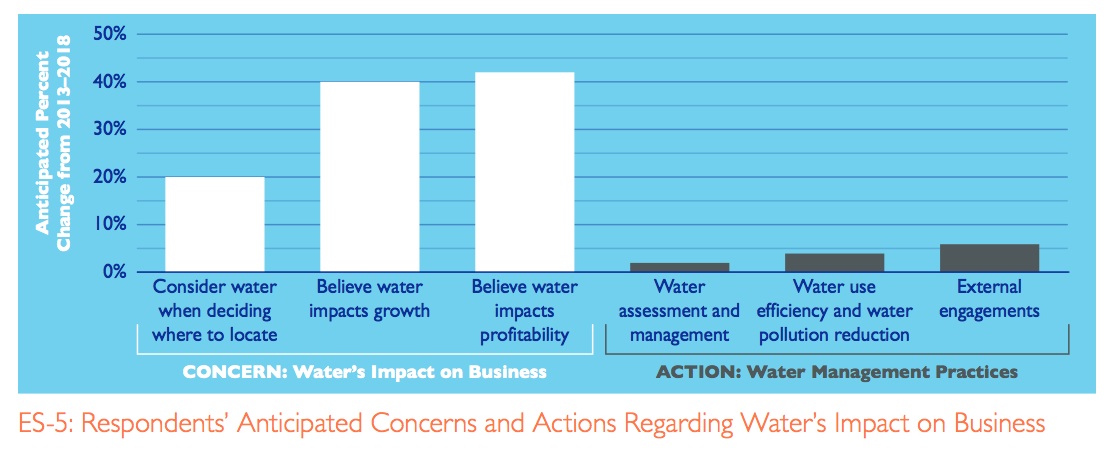
A survey found 60% of U.S. companies expect water issues such as extreme weather to hurt their business, but few plan to invest more in risk management.

A recently published survey by the Pacific Institute and VOX Global finds that, although many companies report currently facing water challenges and expect these issues to begin negatively impacting their bottom lines, few have developed plans to deal with future water risks.

Researchers distributed an online survey to businesses across the U.S. spanning different industry sectors. Of 51 that responded, including several Fortune 500 corporations, 79% reported currently facing water challenges, and 84% expect they will in the next five years. 60% expect water-related issues will negatively impact their businesses moving forward—a response that has tripled from five years ago. The majority of these companies recognize a broad range of water risks that could impact their businesses, from supply issues that could affect profitability to reputational risks that could affect their ability to market products (if the media uncovered a water pollution scandal, for example). Nearly 80% of respondents said water issues will affect where they locate facilities in the future, referencing both water scarcity and vulnerability to extreme weather as prominent considerations.

Despite the growing awareness, according to the report, there exists a large gap between concern and action. Nearly 70% of responding companies said their current level of investment in water management is sufficient. The authors suggest this is because companies need more time to raise awareness, and mitigating other risks is currently a higher priority. However, the report concludes that water is no longer a peripheral concern, and companies would do best to consider it an essential part of business strategy.

A 2011 report from the Natural Resources Defense Council examined municipalities’ water-related vulnerability, finding a similar lack of preparedness among city governments (see Warm Globally, Flood Locally: Water Crises Loom for U.S. Cities).

Published December 31, 1969

(2014, June 1). Companies Slow to Act as Water Issues Erode Profits . Retrieved from https://www.buildinggreen.com/departments/newsbrief

Add new comment

To post a comment, you need to register for a BuildingGreen Basic membership (free) or login to your existing profile.

LEDs Expected to Eclipse Fluorescents in Retrofits

News Brief

LEDs Expected to Eclipse Fluorescents in Retrofits

Industry professionals expect continued growth after LED retrofit installations climbed to 37% in 2013.

LEDs saw a significant uptick in 2013 and are expected to outpace fluorescent lighting in 2014 for retrofit installations, according to a survey conducted by lighting manufacturer Precision-Paragon.

Responses from 5,000 lighting industry professionals suggest LED installations jumped 12% in 2013 to make up 37% of the retrofit market, and the vast majority of respondents say they expect the overall energy-efficient lighting industry to experience further growth in 2014. When asked which lighting technology will be the dominant choice for retrofit projects in 2014, 49% of respondents predicted LEDs compared to 46% who expect linear fluorescent (see LEDs: The Future Is Here). 

“Our industry has seen steady growth in LED lighting performance and sales in recent years,” stated Joe Martin, Precision-Paragon vice president and general manager, in a press release. In the past three years of issuing the survey, reported LED installations grew an average of 8% per year. Meanwhile, according to the company’s own estimations, LED installation costs have been reduced by more than 60% since 2010 due to new light-engine and heat-sink technologies. Martin concludes that the survey results show “LED technology has advanced to the point that it can compete with fluorescent lighting in many applications.”

Published December 31, 1969

(2014, May 25). LEDs Expected to Eclipse Fluorescents in Retrofits. Retrieved from https://www.buildinggreen.com/departments/newsbrief

Add new comment

To post a comment, you need to register for a BuildingGreen Basic membership (free) or login to your existing profile.

Fluorescent Lamps Getting More Efficient

News Brief

Fluorescent Lamps Getting More Efficient

DOE aims to tighten energy standards for fluorescent lamps, claiming it will save $8 billion in electricity over the next 30 years.

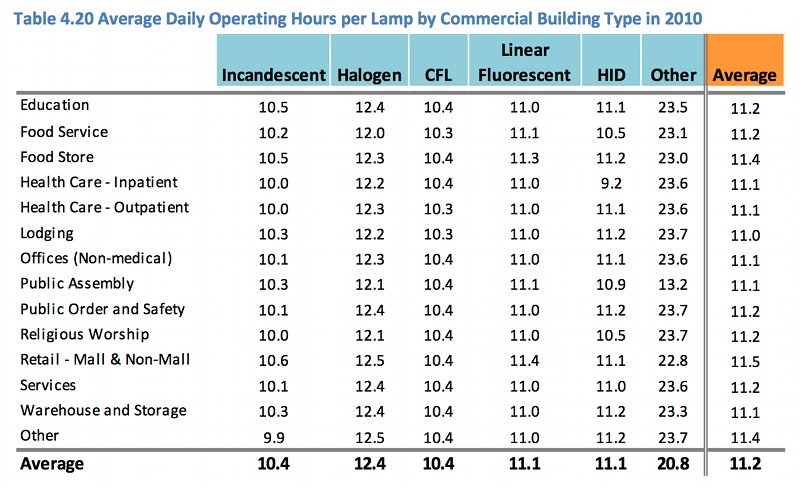
Lighting constitutes 20% of total electricity use in the U.S.—and while LEDs may be the future, the ubiquitous fluorescent tube is responsible for 42% of the nation’s lighting energy, according to a U.S. Department of Energy (DOE) study.

Although much of that share is due to the long hours during which our T8 and T4 lamps are turned on (eleven hours a day in average commercial spaces), a proposed DOE rule aims to curb energy consumption by raising efficiency standards for these lamps. The agency claims the new rule would save $8 billion over 30 years and prevent about 100 million tons of carbon emissions by 2030.

Proposed standards range from an efficiency increase of 2.1% (to 99.0 lumens per watt, or lpw) for 8' slim-line lamps to an increase of 12.9% (to 97.1 lpw) for 4' miniature bi-pin lamps. The rule also proposes modest efficiency increases for incandescent reflector lamps (flood lights and the lamps used in recessed lights) rated higher than 45W.

Published December 31, 1969

(2014, May 5). Fluorescent Lamps Getting More Efficient. Retrieved from https://www.buildinggreen.com/departments/newsbrief

Add new comment

To post a comment, you need to register for a BuildingGreen Basic membership (free) or login to your existing profile.

Life-Cycle Assessment for Dummies? New LCA Guides Available

News Brief

Life-Cycle Assessment for Dummies? New LCA Guides Available

Two new resources explain the strengths and limitations of life-cycle assessments for practitioners and the general pubic.

Two free resources are now available to help demystify life-cycle assessment (LCA) for different audiences.

The “Athena Guide to Whole-Building LCA in Green Building Programs” is intended to help designers understand LCA provisions across various rating systems and codes—LEED v4, Green Globes, general federal compliance for new construction, the 2012 International Green Construction Code (IgCC), and the 2010 CALGreen building code—as well as to give direction on how to incorporate LCA into the design process. The report provides details on the inner workings of the Athena Impact Estimator, explains how to build a reference design, and shows what inputs to include in a whole-building LCA.

A second report, which is authored by the Sustainable Materials Management Coalition, offers advice for governments and businesses that may be seeking to use LCA to buy more environmentally friendly products. “Guidance on Life-Cycle Thinking and Its Role in Environmental Decision Making,” explains life-cycle thinking and provides examples of how LCAs can be used appropriately and how poorly chosen boundaries for this type of assessment can lead to misleading results (see “Whole-Building Life-cycle Assessment: Taking the Measure of a Green Building” and “The Product Transparency Movement: Peeking Behind the Corporate Veil”).

While both reports emphasize LCA’s potential to bring to light the environmental impact that materials, products, or whole buildings may have, they also remind readers that LCA should be viewed as a limited estimating tool. The Athena report states, “LCA addresses only some of the environmental impacts of interest in a sustainability agenda” and forewarns that “it is a predictive science with uncertainities and data gaps.”

As EBN has noted previously, other impacts need to be measured with other tools, such as certifications that gauge social equity or worker and occupant health.


Published December 31, 1969

(2014, May 5). Life-Cycle Assessment for Dummies? New LCA Guides Available. Retrieved from https://www.buildinggreen.com/departments/newsbrief

Add new comment

To post a comment, you need to register for a BuildingGreen Basic membership (free) or login to your existing profile.

New "DART" Tool Helps Designers Hit the Value Bullseye

News Brief

New "DART" Tool Helps Designers Hit the Value Bullseye

An interactive platform from RTKL helps designers choose and implement sustainability strategies that will have the greatest impact on triple-bottom-line values.

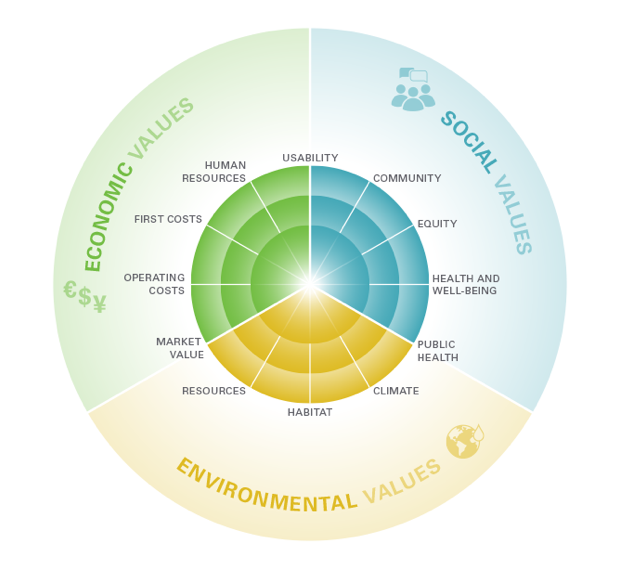
The international architecture firm RTKL recently released a free online tool called the DART to help designers maximize the value of a project in terms of sustainability goals. The interactive tool allows users to identify which social, economic, and environmental values are central to the project and to structure a design approach that delivers on those values.

This tool is unique, according to Lance Hosey, FAIA, RTKL’s chief sustainability officer, because it takes into account that sustainability goals go beyond environmentalism. “By approaching design first and foremost as a value proposition, we appeal to a larger audience,” Hosey stated in a press release.

A performance wheel helps designers identify the values of their client, and the tool provides design strategies based on those values. The strategies are accompanied by value impact ratings to show which influence the most sustainability goals. For example, energy-efficient envelopes have an impact rating of 6 out of 12, while a connection to the outdoors achieves a 9 out of 12: equity, habitat, and community are among the sustainability values that efficient envelopes do not affect.

Finally, a priority pyramid shows designers how to implement strategies at a time in the design process that will make them most effective.

The DART (which is the name of the tool and not an acronym) will continue to expand as more design strategies, case studies, and information sources are added, according to RTKL. The firm also hopes the tool will eventually be able to calculate how a strategy’s impact may differ according to factors such as project type and region. The release of the tool coincides with the RTKL’s first sustainability report.

Editor’s Note: EBN provided RTKL with links to key EBN articles, which appear within DART to help educate designers on design strategies.


Published December 31, 1969

(2014, May 5). New "DART" Tool Helps Designers Hit the Value Bullseye. Retrieved from https://www.buildinggreen.com/departments/newsbrief

Add new comment

To post a comment, you need to register for a BuildingGreen Basic membership (free) or login to your existing profile.

WELL Building Standard Moves Toward Certification-With GBCI

News Brief

WELL Building Standard Moves Toward Certification-With GBCI

The same body that reviews LEED project documentation will be the third-party certifier for the forthcoming health standard called WELL.

The International Well Building Institute (IWBI), creator of the WELL building standard, has announced a partnership with the Green Building Certification Institute (GBCI), the body that certifies LEED buildings and accredits LEED professionals. According to a joint press release, the collaboration will help streamline dual certification to both LEED and WELL, which is still in pilot phase.

“The best way to get global acceptance and adoption was to find a best-in-class partner,” Paul Scialla, founder of IWBI told EBN. U.S. Green Building Council founder and GBCI CEO Rick Fedrizzi joined the IWBI board of directors several months ago, and it was in this context that the groups “started to formalize the alliance,” he explained. Scialla characterized LEED and WELL as “complementary,” adding that LEED addresses human health primarily through indoor environmental quality; although there are some overlaps, “we’re looking to push that envelope further,” he said, adding that there would be “many synergies down the line,” including an accreditation program.

WELL addresses design attributes like lighting quality (taking into account not only daylight but also the color, hue, intensity, and angle of artificial light) as well as operation-related features such as access to quality food and drinking water. Much like LEED, the WELL system encompasses several categories—new construction, existing buildings, healthcare, homes, schools, and others. “We see synergies and complementary ways for WELL and LEED to plug and play in the existing infrastructure,” noted Scialla.

WELL began as a proprietary standard owned by real estate developer Delos, which founded IWBI as a B-Corp to further develop it. The standard will be available to the public later this year, says Scialla, after the pilot phase concludes.

For more information:

International Well Building Institute

WellBuildingInstitute.com

 

Published December 31, 1969

(2014, May 5). WELL Building Standard Moves Toward Certification-With GBCI. Retrieved from https://www.buildinggreen.com/departments/newsbrief

Add new comment

To post a comment, you need to register for a BuildingGreen Basic membership (free) or login to your existing profile.

Milwaukee Affordable Housing Project First to Achieve LEED-ND Silver

News Brief

Milwaukee Affordable Housing Project First to Achieve LEED-ND Silver

Two Wisconsin public housing projects achieved LEED on a budget, and one is the first completed project to achieve LEED Silver in Neighborhood Development.

The Housing Authority of the City of Milwaukee is celebrating LEED certification for two of its recent affordable housing projects—Westlawn Gardens, a neighborhood redevelopment project previously situated in a distressed neighborhood, and Olga Village, an apartment complex for seniors.

The Westlawn Gardens project, which is the first ever to achieve Silver in LEED for Neighborhood Development (ND) Stage 3 (completed—not just planned), accommodates 300 residents through a mixture of multifamily buildings, townhomes and single-family homes. Notably, one block contains 14 “healthy homes” with interior finishes and exterior landscaping designed to reduce exposure to allergens for people with asthma or allergies. A ground-source heat-exchange system serves the apartment buildings, and the whole neighborhood has access to a community garden.

Olga Village, which achieved LEED Silver in New Construction, targeted energy use by utilizing ground-source heat pumps that connect to a 300-foot-deep water loop. The system is anticipated to achieve a 62% decrease in the energy needed for heating and cooling compared to a conventional building. Condensing gas boilers are estimated to cut energy use for domestic hot water by 63%.

According to Ricardo Diaz, executive director of the United Community Center, which is attached to Olga Village, “These kinds of projects are at the tip of a future wave for affordable housing and an improved quality of life in Milwaukee’s neighborhoods.”


Published December 31, 1969

(2014, May 5). Milwaukee Affordable Housing Project First to Achieve LEED-ND Silver. Retrieved from https://www.buildinggreen.com/departments/newsbrief

Add new comment

To post a comment, you need to register for a BuildingGreen Basic membership (free) or login to your existing profile.

No Home Safe from Installation Mistakes with Fiberglass Batts

News Brief

No Home Safe from Installation Mistakes with Fiberglass Batts

100% of fiberglass batt installations surveyed in New Zealand included mistakes likely to compromise thermal performance.

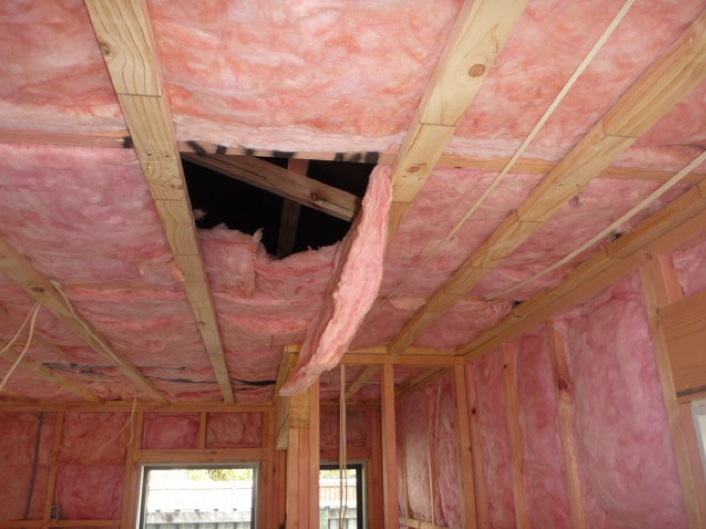
Of 58 New Zealand homes that installed fiberglass batts for insulation, none followed best practices for installation, according to an audit in New Zealand.


The audit, which was conducted for New Zealand’s Energy Efficiency and Conservation Authority, found that the most frequent mistakes were that the batts were folded, tucked, compressed, or had gaps—all of which lower overall R-values (see “Batt Insulation: Fiberglass, Mineral Wool, and Cotton”)—and in some places, batts were missing altogether. The survey, which used the New Zealand voluntary installation standard NZS 4246:2006 as a benchmark, also found that many homes lacked a 5mm gap to the underside of the roof overlay, potentially allowing moisture to be transferred to the insulation. The report was published in 2011 but came to EBN’s attention due to coverage at Treehugger.com.

The report concludes that education and training may help improve installer workmanship and guide subcontractors, like plumbers and electricians, whose work may inhibit proper installation; but responsibility also falls on the designer to ensure that an appropriate cavity is maintained, the authors argue. However, given fiberglass batts’ difficult installation and poor performance relative to that of blown-in materials, Lloyd Alter writes at Treehugger that experts should seriously be weighing other options. “There should be a designer or architect who decides what services go into insulated walls, how the wall is detailed, whether there is enough room, and what insulation is chosen.” In case there isn’t, he warns, “People get what they pay for.”

Published December 31, 1969

(2014, May 5). No Home Safe from Installation Mistakes with Fiberglass Batts. Retrieved from https://www.buildinggreen.com/departments/newsbrief

Add new comment

To post a comment, you need to register for a BuildingGreen Basic membership (free) or login to your existing profile.

Property Giant Ties Cities' Investment Prospects to Resilience

News Brief

Property Giant Ties Cities' Investment Prospects to Resilience

Canadian cities outrank U.S. in overall resilience, according to a Grosvenor report, but U.S. cities get high marks for adaptive capacity.

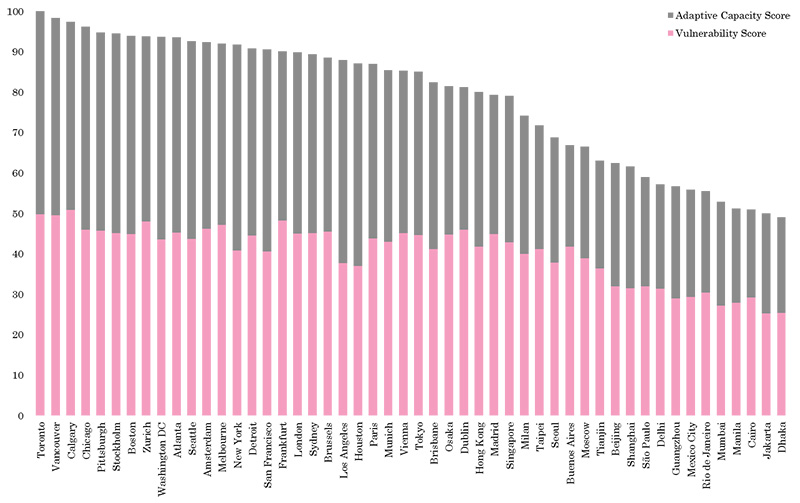
In the interest of analyzing the best cities for long-term real estate investment, the international property group Grosvenor recently ranked the resilience of 50 cities across the world. Toronto, Vancouver, and Calgary top the list, while Chicago came in fourth.

The researchers judged a city’s resilience based on its environmental and social vulnerability and its “adaptive capacity”—the sum of assets like community cohesion, infrastructure, and natural resources that might allow a city to recover after a shock. According to Grosvenor’s report, U.S. cities ranked lower than the top Canadian cities in overall resilience because “inequality in U.S. cities leads to social tension, utilities lack investment, and urban sprawl leads to over-consumption of land resources.” However, in the adaptive capacity rankings, U.S. cities took six of the seven top spots: New York is followed by Toronto, Los Angeles, Washington, Chicago, San Francisco, and Houston.

The report can be viewed as a risk-analysis tool, according to Grosvenor, because more resilient cities will be able to preserve capital values and generate sustainable rental incomes over the long term. “We are not suggesting that you shouldn’t invest in those cities that place lower down the rankings, but the research highlights the risks those cities face and enables more informed decision making,” according to Grosvenor’s group research director Richard Barkham, Ph.D.

For more information:

Grosvenor

www.grosvenor.com


Published December 31, 1969

(2014, May 5). Property Giant Ties Cities' Investment Prospects to Resilience. Retrieved from https://www.buildinggreen.com/departments/newsbrief

Add new comment

To post a comment, you need to register for a BuildingGreen Basic membership (free) or login to your existing profile.