BREEAM USA Jolts Existing Buildings Market

News Brief

BREEAM USA Jolts Existing Buildings Market

The forebear of all green building rating systems, LEED included, is arriving from the U.K. as an accessible alternative.

Before there was LEED, there was BREEAM.

While the LEED rating systems might have more buzz, the Building Research Establishment Environmental Assessment Methodology is the world’s oldest and most widely used green building rating system. Created in 1990 by the Building Research Establishment (BRE) in the U.K., the system is responsible for 544,600 certified projects worldwide, according to BRE. (By comparison, LEED currently has around 75,000 certified projects.)

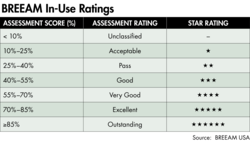
Now BREEAM is coming to the U.S. through a partnership announced by BRE and BuildingWise, a U.S.-based LEED certification consultancy. A new organization, BREEAM USA, will make the BREEAM In-Use standard available to commercial buildings of any size, age, and condition. The standard offers benchmarking and certification for existing buildings.

BREEAM In-Use available to all commercial buildings

According to BREEAM USA, BREEAM In-Use is an “independent, science-based, and inclusive assessment” that gives building managers and owners a framework for improving their operational sustainability as well as reducing energy and water costs.

Barry Giles, CEO of BuildingWise, will lead BREEAM USA as CEO. Giles told BuildingGreen, BREEAM is “a way for getting in this vast number of existing buildings that don’t have an option for a certification program.” LEED for Existing Buildings (LEED-EBOM), the best-known certification of its kind, includes a number of prerequisites. Most significantly, the current version of its energy-efficiency prerequisite requires a minimum Energy Star score of 75, which by definition excludes 75% of buildings from LEED eligibility.

Giles—a LEED Fellow who helped launch LEED-EBOM as a founding member of its Core Committee and who actively consults on LEED-EBOM projects—laments the current market response to LEED. Its uptake has been poor, he notes, and with LEED v4 raising the bar, he worries that relief is not in sight. “Even Class A buildings are beginning to reject LEED recertification because of cost, paperwork, and time,” says Giles. (Recertification is required every five years in LEED-EBOM.) “The smaller they are, the harder it is to offer a fiscally sound package to them,” he says. That’s where BREEAM In-Use comes in: for a flat fee, it helps projects benchmark themselves and gives them a road map forward.

The U.S. Green Building Council (USGBC), for its part, is investing in its LEED Dynamic Plaque as a magnet for attracting building projects. Responding to the news about BREEAM USA, Scot Horst, chief product officer at USGBC, told Bloomberg news, “We need to keep coming up with innovative ways to get people onto a path to improvement. We see the same need. We just have different approaches.”

It starts with an online questionnaire

Engaging with BREEAM USA will start with an online questionnaire that building owners will pay $1,000 to access for up to a year, says Giles. The questionnaire is in three parts:

  • Part one covers the asset: the building, construction date, materials used, glazing type and percentage, etc. “With that, we’re able to calculate quite well what the energy consumption should be,” says Giles.
  • Part two covers the operations of the building. “Nine-five percent of the questions are associated with production of operational data,” according to Giles.
  • Part three covers the tenants. According to Giles, there is “a series of questions to give themselves a rating on how they deal with the space that they lease, rent, or borrow.”

“If you’re savvy with your building, it’s probably not more than a week in total filling the questionnaire in,” says Giles. That’s not a week in front of the computer; plan on fishing around for some data. You get scored as you go, and each question leads to additional questions that, according to Giles, provide a roadmap to the next level of success. For example, if you answer “yes” to having a water meter, the next question asks whether you have a year’s worth of water bills, and a subsequent question asks about submetering. There are no prerequisites, emphasizes Giles.

That initial score is unverified. The next step, if a building owner wants certification, is to hire an independent third-party assessor licensed by BREEAM USA who will come onsite and verify the data (at a cost based on the assessor’s bid). “The assessor’s job is to assess, not to consult,” notes Giles. Their report is sent to BREEAM USA for quality control, and BREEAM may ask the assessor for follow-up information. If it all passes muster, BREEAM will issue an official certification.

Along with energy and water, BREEAM covers a total of nine environmental categories, including waste, materials, pollution, health and well-being, land use and ecology, transport, and management.

Fundamentals unchanged from U.K. origins

While Giles has his eye on what he counts as 5.6 million uncertified existing buildings in the U.S., “Our biggest focus is to have well-trained assessors out in the marketplace before having a flood of buildings.” BREEAM USA will offer assessor training starting in October 2016, but it is also starting an “early adopter” program for buildings now.

BREEAM is being Americanized, says Giles, though its fundamentals won’t change, in order to maintain its international relevance. For example, BREEAM USA will align with the data input to the widely used Energy Star Portfolio Manager, but it won’t use the output of that benchmark. European standards are being replaced with American standards (like ASHRAE’s), and some concepts are being explained differently for the American audience.

BREEAM’s rigor has not been compared with that of LEED-EBOM, according to Giles, but he noted the strong desire by BRE and BREEAM USA to bring more data to the marketplace, working with the U.S. Green Building Council and other organizations.

Read more:

More BuildingGreen articles on existing buildings

Six Ways Existing Buildings Can Save the Planet

Design Strategies for Occupant Engagement—and Why They Boost Performance

Published December 31, 1969

(2016, June 10). BREEAM USA Jolts Existing Buildings Market. Retrieved from https://www.buildinggreen.com/departments/newsbrief

Add new comment

To post a comment, you need to register for a BuildingGreen Basic membership (free) or login to your existing profile.

Brock Environmental Center Vindicates Onsite Wind Generation

News Brief

Brock Environmental Center Vindicates Onsite Wind Generation

The Brock project team achieved Living Building Challenge certification and survived to tell this story.

The Living Building Challenge (LBC) has a strict ban on greenfield development, with one exception. It allows for buildings in previously undeveloped—even ecologically sensitive—locations when they are there to help people learn about the place. As a facility that’s all about caring for and teaching people about nature, the Chesapeake Bay Foundation’s Brock Environmental Center fit that bill perfectly and achieved LBC certification in May 2016.

Going the extra meter

What does it take to achieve such a goal? “Dedication” is the word that comes up most often, but it hardly seems adequate to the actual experience.

Design and construction were no picnic, with frequent energy modeling to fine-tune every aspect of the electrical, mechanical, and enclosure systems. And like other LBC project teams, the designers and contractor struggled to vet every single product against the LBC Red List and transportation distance constraints. (See Take Control of Your Materials: Four Empowering Lessons from Teams That Beat the Red List.)

But what makes this and other LBC projects stand out in terms of commitment is how closely they are watched during that critical 12-month performance period. Project architect Greg Mella, FAIA, of SmithGroupJJR describes getting a nightly email from the building management system detailing the building’s energy use for the past 24 hours and checking it every day for anomalies. That vigilance paid off: the photovoltaics and wind turbines generated more energy than was predicted and a whopping 83% more energy than the building used during its first year.

The energy used in the building came in at just over 14 kBtu/ft2·year, about 80% less than the average building of its type. Overall, this energy use is slightly less than the energy models predicted, but the details show greater variation: lighting came in at 39% less than predicted because the lights are mostly off rather than dimmed to 10% output as modeled. Fans and pumps are using more energy than predicted, however. One reason for this is that the fans in the mini-split (VRF) heat pumps run continuously, which wasn’t anticipated.

“My favorite part of operating Brock is that each day is a new learning experience, and being able to use those lessons to educate our guests,” says Chris Gorri, Brock Environmental Center manager for the Chesapeake Bay Foundation. You don’t have to be onsite to monitor the building’s performance, however: its Lucid Energy Dashboard is available online.

Swimming to utopia

It’s not easy to supply one’s own potable water and treat wastewater at the scale of individual buildings, which is exactly what officials at Virginia Beach Public Utilities tried to tell the Brock project team when they asked about permits to run their own waterworks for the 10,500 ft2 building (for more on building-scale water treatment, see Waste Water, Want Water.)

Many LBC projects are using municipally supplied water under a temporary exemption from the International Living Future Institute, which oversees LBC certification, but Brock is now the first LBC project to provide its own drinking water from rainwater with official sanction. Gorri was amazed at the amount of time and knowledge it takes to capture rainwater and treat it onsite to potable water standards. “If you would have told me a year ago that I would know so much about treating rainwater, I would have laughed at you,” he told BuildingGreen.

Blowing (more than) smoke

BuildingGreen has been skeptical of onsite wind energy as a power source for buildings (see The Folly of Building-Integrated Wind), but Mella suggests a rule of thumb for identifying sites with wind power potential. “If the wind frequently blows hard enough that it’s uncomfortable, you might have a good site for it,” he says. The two Bergey 10 kW turbines on this project generate about 40% of the onsite renewables at a cost of $0.38 per kWh (assuming a 25-year service life). The cost is that high mostly because anchoring the turbines in the coastal sands required multiple 110-foot-deep pilings.

The Bergey turbines spin on the horizontal axis, which is inherently more efficient than vertical-axis designs, and they are certified for performance by the Small Wind Certification Council. (BuildingGreen recommends avoiding turbines that lack this certification.) After they came online, they required adjustment to increase their maximum operating wind speed; winds onsite were so strong that the turbines were cutting out unnecessarily often.

Grand Central on the Bay

The location also made flooding an obvious concern, leading the team to incorporate a number of resilience measures, most notably raising the facility on piers to 14 feet above sea level.

For an organization dedicated to raising awareness of the need to “Save the Bay,” the best metric of success has been the tremendous visitor flow at the new facility—30,000 visitors in year one, according to the foundation. Some of these visitors came across the facility by chance—attracted, in some cases, by the wind turbines. Regardless of how they arrive, “there’s always a moment during a tour of the building when you see the light bulb go off in the group’s minds,” says Gorri. “They get it, they understand it, and they leave here inspired to do or change one thing.”

Published December 31, 1969

(2016, June 6). Brock Environmental Center Vindicates Onsite Wind Generation. Retrieved from https://www.buildinggreen.com/departments/newsbrief

Add new comment

To post a comment, you need to register for a BuildingGreen Basic membership (free) or login to your existing profile.

Cutting Emissions as Cities Grow: 8 Actions from WRI

News Brief

Cutting Emissions as Cities Grow: 8 Actions from WRI

Energy efficiency is a prime investment in an era of rapid urbanization, saving $2 for every $1 invested, according to a new report.

In the next 15 years, we have a choice: to lock our world into another century of building inefficiency, or to blaze another path. By 2030, an area equal to roughly 60% of the world’s current total building stock will be built or rebuilt in urban areas, according to the World Resources Institute (WRI), and those buildings will define our cities’ energy consumption for the next 30 to 100 years.  

A new policy roadmap report from WRI, Accelerating Building Efficiency: Eight Actions for Urban Leaders, attempts to outline that other path for city-level leaders worldwide.

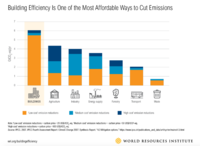
Globally, buildings and construction are responsible for 60% of electricity use, 12% of water use, 40% of waste, and 40% of material resource use. Precisely because conventional buildings are so resource-intensive, increasing building efficiency is a cost-effective way to reduce climate-change-causing emissions from cities. For every $1 invested in building energy efficiency, $2 is saved in new electricity generation and distribution costs, according to the report. Improving building efficiency could also reduce global CO2 emissions from buildings 83% below business-as-usual by 2050, say the researchers.

WRI’s eight actions for unlocking building efficiency:

  1. Adopt local building efficiency codes and standards: Best practices include requiring or incentivizing retro-commissioning for low-performing buildings, issuing lighting standards, and phasing in performance requirements for major renovations.
  2. Set efficiency improvement targets: Local governments must set clear energy reduction targets to align interests and spur action across a city.
  3. Provide performance information and certifications: The collection of information about the energy use in buildings at the jurisdictional or building scale enables better policy and program design (see Energy Reporting: Its the Law).
  4. Incentivize: Revolving loan funds, trust funds, and tax-lien financing are suggested to help developers overcome upfront cost barriers. Non-financial incentives, such as priority processing of permits or greater allowed floor area, are also recommended and require no investment by local governments.
  5. Lead by example: Local governments should “walk the walk” by making their own building portfolios more efficient and adjusting their procurement procedures to meet certain efficiency standards.
  6. Engage building owners, managers, and occupants: Private-sector building owners should be engaged through partnerships, competitions and awards, and awareness campaigns. Cities should also endorse green lease contract clauses to help address split incentives between building owners and occupants.
  7. Engage technical and financial service providers: Local governments can support private-sector building service providers by providing loan guarantees and assisting with workforce training programs.
  8. Work with utilities: Policies can be developed at a local level to make energy-use data available to residents, building owners, and public agencies.

Accelerating Building Efficiency includes case studies from many efforts in cities across the world, including Johannesburg, South Africa; Ho Chi Minh City, Vietnam; Puebla, Mexico; Abu Dhabi, United Arab Emirates; and Lviv, Ukraine.

More on cities and climate change

Climate Change: Building Industry, You’ve Got This!

How Boston Reduced Its Carbon Footprint

NYC Buildings Gain Three Energy Star Points in Year Two


Published December 31, 1969

(2016, June 1). Cutting Emissions as Cities Grow: 8 Actions from WRI. Retrieved from https://www.buildinggreen.com/departments/newsbrief

Add new comment

To post a comment, you need to register for a BuildingGreen Basic membership (free) or login to your existing profile.

Study Vets Materials for Entire Wall Assemblies

News Brief

Study Vets Materials for Entire Wall Assemblies

When you look at the whole assembly, it can change how you see the materials. Here XPS and fiberglass come out ahead, and SPF behind.

Rarely is anything in the built environment made of a single product. “So why do we approach materials research and selection at the product level?” a new study conducted by Re:Vision Architecture asks.

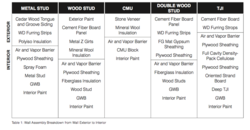
Report authors Christopher Lee, project manager, and Nicole Campion, sustainability researcher for Re:Vision, present an alternative, applying a multi-attribute assessment to five sample wall assemblies (described in the table to the right). The assemblies are evaluated for:

  • cost
  • embodied carbon footprint (using the Athena Impact Calculator)
  • material toxicity and transparency (using the Living Building Challenge Red List and transparency documents like environmental product declarations)
  • moisture and thermal performance
  • recyclability and reusability at end of life

TJI and double wood stud score highest

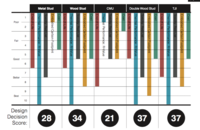
Based on a decision matrix where each of these metrics was equally weighted, a truss I-joist (TJI) assembly and a double-stud wood assembly with fiberglass insulation scored highest. Both scored high in thermal performance and had low embodied carbon.

A single-stud wood assembly closely followed, only a few points behind in the toxicity category. A concrete masonry unit (CMU) and a metal stud assembly were the lowest performers, scoring “poor” in thermal performance and embodied carbon footprint, respectively.

Notably, the study found that the metal stud assembly with spray foam had an embodied carbon footprint more than six times that of the double-stud wood assembly with fiberglass insulation.

Split insulation wins across assembly types

In a follow-up analysis, the researchers focused on just one variable—insulation choice—for three assembly types. The findings:

  1. Cellulose and fiberglass have a low embodied carbon footprint and low toxicity, but cellulose can be expensive, and both must be disposed in a landfill.
  2. Spray foam has a high insulating value per inch but performed poorly across all other metrics in the study.
  3. Extruded polystyrene (XPS) performed poorly when it came to embodied carbon footprint and toxicity, but it did well from a cost and end-of-life perspective because of its ability to be salvaged.
  4. Mineral wool was average in terms of carbon footprint, toxicity, and cost, and best under end of life.

As a result, the researchers found that having XPS and mineral wool on the exterior, with fiberglass or cellulose in the cavity, scored the highest across all wall assemblies.

More on priorities for assessing assemblies

What Makes the Building Envelope Green? BuildingGreen’s Guide to Thermal & Moisture Protection Products

Can We Replace Foam Insulation?

The Hidden Science of High-Performance Building Assemblies

Published December 31, 1969

(2016, June 1). Study Vets Materials for Entire Wall Assemblies. Retrieved from https://www.buildinggreen.com/departments/newsbrief

Add new comment

To post a comment, you need to register for a BuildingGreen Basic membership (free) or login to your existing profile.

AIA Top Ten Projects Really Do Lead the Industry

News Brief

AIA Top Ten Projects Really Do Lead the Industry

Top Ten Projects reduce energy use by half compared to baselines and are well above the industry average for reporting to the 2030 Commitment.

The American Institute of Architects (AIA) Committee on the Environment (COTE) has been issuing Top Ten Awards for nearly 20 years now, and its winners now number 189. The award is meant to shine a light on each project individually as a model and case study for sustainable design. COTE has discovered, however, that grouped and analyzed together, the projects also help reveal a high-level view of the trends and evolutions of sustainable design.

In a new report, “Lessons from the Leading Edge,” COTE takes a look at what this historical group of winners has in common and uses the data to give a rough picture of performance.

How high do the high achievers go?

Across every measure, Top Ten projects certainly exceed industry standards.

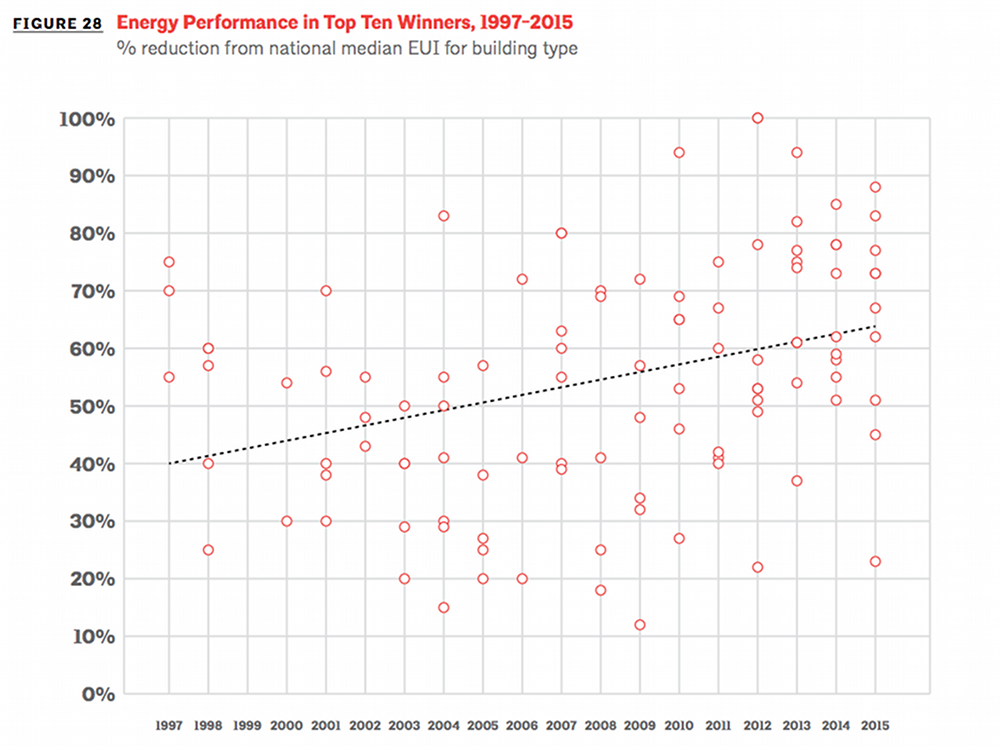
For example, the report found that Top Ten projects predicted 54% reduced energy on average from a baseline. Furthermore, the winners appear to be getting more successful, as average modeled energy reductions, which hovered around 35%–40% in the first decade, jumped to 65% in the latter decade.

That trajectory of progress should probably be taken with a grain of salt, however, for several reasons. First, only about half of the winners actually submitted a percentage for energy reduction; and second, the benchmarks themselves have changed. Projects pre-2010 used ASHRAE 90.1 as a baseline and based energy reductions on cost savings. The benchmark switched in 2010 to be consistent with Energy Star Portfolio Manager and the 2030 Challenge, both of which use the 2003 national average determined by the Commercial Buildings Energy Consumption Survey, or CBECS. On a recent Top Ten submission, the difference between the two baselines was ten percentage points.

And although the projects landed well above average, as a group, Top Ten winners barely top AIA 2030 thresholds. That average 54% energy reduction is just four points above the maximum energy points rewarded in LEED (see Progress on 2030 Goals, Ten Years Later). Judging by the 2030 energy targets, Top Ten projects did better than their reporting peers but could be described as on track, considering the program’s goals.  In 2014, the average modeled reduction was 67% for Top Ten winners, when the 2030 target was 60%. However, that’s still well above the industry average, and it is also well above the 36.9% average for all projects reporting to 2030.

Looking at materials, Top Ten projects did go above and beyond LEED thresholds. Locally sourced materials accounted for 36% on average (LEED’s threshold is 20%), and 82% of construction waste was diverted from landfills, compared to LEED’s 50%–75%.

Potable water reductions come in at about 52% below a baseline standard and have trended upward by 10% since 1997.

The traits of the winners

Is there a recipe for success? Not exactly, but a project’s type and location might help your odds. Of the 189 Top Ten winners, 41 are located in California—nearly triple the number in any other state. No projects have yet won in Mississippi, Alabama, South Carolina, or the whole region of the Upper Great Plains (Idaho, Montana, Wyoming, Nebraska, and the Dakotas). Only five winners are located outside North America.

Early on, office buildings were the most popular building type, according to the report, representing 30%–40% of all winners, but diversity in type has expanded, with more winners in residential and public projects in particular. Additionally, 75% of all Top Ten winners are new buildings, though projects utilizing adaptive reuse have increased in recent years (see 2014 AIA Top Ten Green Winners Highlight Adaptive Reuse). “This trend could signal wider adoption of green building across various markets,” says the report.

It is worthy of note that Top Ten winners generally remain relatively small: 70% are under 100,000 ft2, and roughly half are under 50,000 ft2. That’s not to say that small firms have a leg up: two-thirds of Top Ten winners are from large firms. That’s not representative of the AIA membership, where 97% of members are sole practitioners or have fewer than 50 employees. “Larger firms may have more success with Top Ten Awards because they have more work and therefore more opportunity for success,” according to the report.

Room for progress

In terms of performance, the report also points out areas for improvement. In 2009, a COTE-sponsored study of 28 Top Ten winners found that, in about a third of the projects, actual energy use differed substantially from what had been predicted. Going forward, actual energy performance information will be requested in the submission forms for all Top Ten entries, starting with the applicants for the 2016 awards.
Top Ten projects also didn’t appear to be as far out on the leading edge as one might expect in two important areas: material health and post-occupancy evaluations (POEs). Roughly half mention using finishes and materials with low VOCs, but only 16% referenced any other material health strategy. Three projects cited the Living Building Challenge Red List, and none have listed Health Product Declarations (though that framework launched relatively recently, in 2012). In addition, only half of the winners conducted POEs, though the numbers have trended upward since 2003.

The news about cost isn’t entirely rosy either. For the 13 net-zero-energy Top Ten winners, cost per square foot was 22% higher than the average for all Top Ten projects. That comparison doesn’t take into account differences in project type or local markets, but it may suggest that the most energy-efficient projects come at a higher price point. Still, more than 70 projects have been built for less than $250 per square foot, notes the report, and most of those achieved more than a 50% energy reduction compared to a baseline.

Staying on mission

The report also attempts to evaluate the program’s success in its mission of bringing together “design excellence” and sustainable performance. Thirteen projects have achieved both a Top Ten award and an AIA Institute of Honor Award, most of them in the past six years. This could indicate that the two standards are progressively aligning. And in fact, based on the research team’s own scoring, projects have gotten better and better at achieving both since the Top Ten’s inception in 1997.

More on the Top Ten Awards

AIA Top Ten Projects Demonstrate High Ideals on a Real-World Budget

New “Top Ten Plus” Award Crowns AIA’s 2013 Green Projects

AIA Honor Awards to Be Judged on Sustainability

 

Published December 31, 1969

(2016, April 4). AIA Top Ten Projects Really Do Lead the Industry. Retrieved from https://www.buildinggreen.com/departments/newsbrief

Add new comment

To post a comment, you need to register for a BuildingGreen Basic membership (free) or login to your existing profile.

Trade Group Releases EPD for Light-Gauge Steel Framing

News Brief

Trade Group Releases EPD for Light-Gauge Steel Framing

The industry-wide environmental product declaration covers cold-formed structural steel, paving the way for potential LEED v4 credits.

The Steel Recycling Institute has released the first industry-wide environmental product declaration (EPD) for U.S and Canadian structural steel building products. The EPD is for Cold-Formed Steel Studs and Track, also known as light steel framing or light-gauge steel framing. This EPD will allow individual companies to compare their EPDs against industry averages, helping them improve environmental practices while also allowing these steel components to potentially qualify for LEED v4 credits.
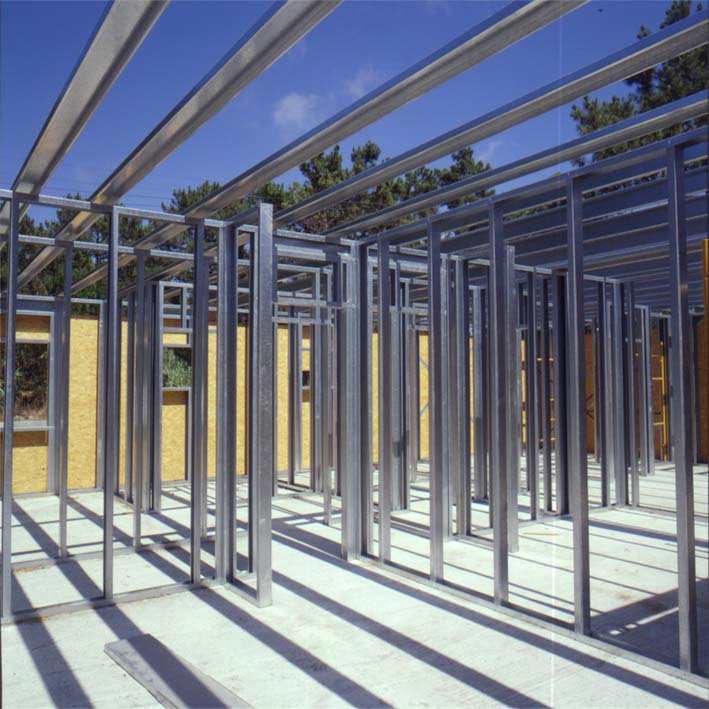
Used primarily for wall studs and tracks, cold-formed steel studs are made from sheet steel that has been rolled or pressed, galvanized to protect against corrosion, and then formed. This EPD does not cover heavy, hot-rolled structural steel.

The declaration is based on a “cradle-to-gate” life-cycle assessment (meaning it accounts for impacts of extraction and manufacturing but not use and disposal) using the North American Product Category Rule (PCR) for Designated Steel Construction Products. This EPD is unusual in that it accounts for future benefits of recycling even though the scope is mostly cradle to gate.

The PCR used for the Cold-Formed Steel Studs and Track EPD was adapted from a European PCR, according to the steel industry, to better reflect the complexities of U.S. and Canadian steel production. The industry says North American producers have different manufacturing facilities and regulations, and create different co-products during their process. The PCR was finally published in May 2015 after years of data collection and feedback.

Though this is the first industry-wide EPD for these products, in July 2015 ClarkDietrich was the first to release individual EPDs for its ProStud and ProStud with DiamondPlus steel framing systems. These are based on the same steel industry PCR.

For more information:

Steel Recycling Organization

www.recycle-steel.org/

Published December 31, 1969

(2016, April 4). Trade Group Releases EPD for Light-Gauge Steel Framing. Retrieved from https://www.buildinggreen.com/departments/newsbrief

Add new comment

To post a comment, you need to register for a BuildingGreen Basic membership (free) or login to your existing profile.

GRESB to Track Health Measures for Real Estate Investors

News Brief

GRESB to Track Health Measures for Real Estate Investors

Health features may attract tenants or help companies retain talent; now investors will be able to pick real estate portfolios with those advantages.  

Behind every tightfisted developer is a frugal investor—and this show-me-the-money crowd wants hard evidence that measures like improving indoor air quality and adding biophilic design elements add value to real estate investments. Luckily, there’s now a new tool to capture information about steps that property companies have taken to promote health and well-being, and it easily tracks against financial performance.

GRESB, the annual survey that has already begun to prove to investors that real estate portfolios with better sustainability rankings yield higher returns, has now added a health and well-being module. This optional section of the survey introduces ten new questions that help make health-promoting actions taken by property companies, fund managers, and developers more visible to investors.

For example, the survey asks, “Does the entity use specific strategies to promote health and well-being through its real estate assets and services?” Respondents check off all strategies that apply, upload supporting evidence, and indicate the percentage of assets that implement these strategies. The survey also asks whether the organization is conducting any monitoring, but the organization is not required to submit those results.

A company that is investing in health-promoting features for its employees might be able to better attract and retain talent. Or a real estate developer that provides leased space or services that promote well-being might attract more desirable clients. The GRESB health and well-being module won’t help discern whether these actions result in better health outcomes, but it may show that companies that invest in these measures perform better and reduce risk, and thus are better choices for investors.

The health and well-being module will be open for use in April 2016 and is available as an add-on to the GRESB Real Estate or Developer Assessments.

More on GRESB and buildings that promote health

GBCI Acquires Sustainable Real Estate Benchmark GRESB

Employee Performance Doubled in Well-Ventilated Buildings

Make Your Buildings WELL: A New Design Standard for Health

Published December 31, 1969

(2016, April 4). GRESB to Track Health Measures for Real Estate Investors. Retrieved from https://www.buildinggreen.com/departments/newsbrief

Add new comment

To post a comment, you need to register for a BuildingGreen Basic membership (free) or login to your existing profile.

Resilient Design Pilot Credits Added to LEED

News Brief

Resilient Design Pilot Credits Added to LEED

Three new pilot credits encourage resilience in the new reality of climate change.

A suite of three new pilot credits on resilient design was just approved by the U.S. Green Building Council’s LEED Steering Committee, opening them for use by LEED project teams for innovation credits.

Alex Wilson, founder of BuildingGreen, has been working to develop the credits since 2013 through the Resilient Design Institute (RDI), a not-for-profit sister organization of BuildingGreen that he founded in 2012. With the help of Mary Ann Lazarus, FAIA, a member of the RDI advisory board, and a committee of practitioners providing input, the credits have now been finalized and approved.

The three credits are intended to ensure that a design team is aware of the type of natural and human-made disasters that are most likely to occur in the project’s region (taking into account longer-term trends like climate change), and that the team addresses the riskiest vulnerabilities through the project’s design. The credits include:

  • Credit IPpc98: Assessment and Planning for Resilience
  • Credit IPpc99: Design for Enhanced Resilience
  • Credit IPpc100: Passive Survivability and Functionality During Emergencies

Project teams are challenged to consider innovative technologies such as microgrids or solar storage to provide electricity in the case of an outage. Option 1 of the Passive Survivability credit sets a particularly high bar, requiring thermal modeling to demonstrate that the building will remain within a range of “livable temperatures” for one week. This range is defined as a standard effective temperature (SET) between 54°F and 86°F, with some deviation allowed for peak summer and winter conditions. (The SET measurement factors in relative humidity and mean radiant temperature, which can drastically skew comfort levels.)

Readers can refer to Wilson’s blog post explaining more about each credit.

More on resilient design

Resilient Design: Smarter Building for a Turbulent Future

Resilient Design: 7 Lessons from Early Adopters

To Become Resilient, NYC Looks to Its Buildings

Published December 31, 1969

(2015, November 16). Resilient Design Pilot Credits Added to LEED. Retrieved from https://www.buildinggreen.com/departments/newsbrief

Add new comment

To post a comment, you need to register for a BuildingGreen Basic membership (free) or login to your existing profile.

CalStar Suspends Fly Ash Brick Production

News Brief

CalStar Suspends Fly Ash Brick Production

CalStar Products, Inc. stopped production of its fly ash brick products on October 1 due to financial difficulties.

CalStar Products, manufacturer of a wide assortment of bricks and pavers made from fly ash, has ceased production after failing to secure financing to keep operations running, according to former CEO Craig Ratchford.


In 2010, CalStar started manufacturing bricks made from type C fly ash, local aggregates, and proprietary ingredients (see CalStar to Begin Production of Fly Ash Bricks). The company’s products made use of a coal industry waste product and did not require energy-intensive firing or portland cement for curing, so they had a smaller carbon footprint than either fired clay or concrete brick.

On the other hand, the product contains 40% fly ash, which can contain the heavy metals mercury, lead, and arsenic. The company claimed testing showed that heavy metals are safely encapsulated by their process. (See our position on fly ash for more information.)

Whether or not CalStar will resume production is unclear, but Ratchford claims an acquisition of the company is imminent, so fly ash bricks and pavers may be available again in the near future.

Published December 31, 1969

(2015, October 27). CalStar Suspends Fly Ash Brick Production. Retrieved from https://www.buildinggreen.com/departments/newsbrief

Add new comment

To post a comment, you need to register for a BuildingGreen Basic membership (free) or login to your existing profile.

Energy Disclosure Laws Prompt New Standard for Rating Systems

News Brief

Energy Disclosure Laws Prompt New Standard for Rating Systems

Basic requirements for labeling and disclosure underlie a proposed ASHRAE standard for building energy labels. 

As cities and states begin to require building owners to disclose energy use, government agencies are evaluating the labels and rating systems that facilitate such transparency and wondering which is best.

In response, ASHRAE is proposing a standard that outlines the characteristics of a valid rating system. Once complete, the standard could be adopted as an underlying requirement in legislation or policy.

Standard 214P—based on input from the U.S. Department of Energy, the U.S. Green Building Council, and developers of ASHRAE’s own labeling program, Building Energy Quotient (bEQ)—focuses on ensuring a rating system’s methodology is transparent so that “users know what they are getting,” Wayne Stoppelmoor, CEM, chair of the committee, told BuildingGreen.

Most of the requirements are things current labels and rating systems already do, such as describing the parameters and methodology used to predict or measure energy use, clearly defining the inputs that affect the score of a building, and providing a methodology for comparing a rated building to similar buildings in the same climate zone.

However, having a standard will encourage consistency going forward and serve as a guideline for developing future rating systems.

Some of the questions that are up for discussion during public comment include:

  1. How should indoor environmental quality be addressed in a building energy rating system?
  2. Should “consensus-based” development be a minimum requirement? If so, with a public review process or balanced committee?
  3. Should this standard address energy produced by the building?

The proposed standard remained open for public comment through September 28, 2015.

More on measuring energy performance

Energy Reporting: It’s the Law

New Energy Data Is Changing How We Judge Efficiency—And LEED

NYC Buildings Gain Three Energy Star Points in Year Two

Published December 31, 1969

(2015, October 3). Energy Disclosure Laws Prompt New Standard for Rating Systems. Retrieved from https://www.buildinggreen.com/departments/newsbrief

Add new comment

To post a comment, you need to register for a BuildingGreen Basic membership (free) or login to your existing profile.