Case Studies Track Building Code Breakthroughs

News Brief

Case Studies Track Building Code Breakthroughs

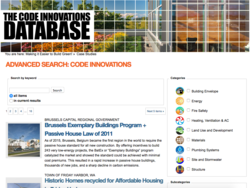
Need examples of water or energy features that successfully challenged local policy? The Code Innovations Database can help.

When engineers for the six-story Bullitt Center went to Seattle code officials looking to install composting toilets, success was not assured. Composting toilets don’t follow the letter of the Universal Plumbing Code, and bathrooms with composting toilets aren’t ventilated in the usual way. Yet because of a local ordinance designed to encourage Living Building Challenge certification, the team had almost no trouble getting a permit for this and a number of other novel systems.

As projects push the limits of green building technology, they often push the limits of building codes as well—but it all happens quietly in the offices of local code officials. The Code Innovations Database is trying to change that by sharing small, local successes on an internationally accessible platform.

The database records successful code variances in the form of searchable case studies. Building professionals and code officials can then find precedent-setting projects and potentially use the same methods to gain approval for similar technologies. A project of the Northwest EcoBuilding Guild, the database currently focuses on jurisdictions in the Pacific Northwest, but the owners are seeking to expand it to a national scope.

The case studies cover two types of innovation: projects that have successfully stretched or changed building codes, and policy and code updates that encourage green building. Users can filter by green building attributes (energy, materials, land use, etc.) or can search by keyword to find relevant case studies.

Users can submit their own success stories by writing to education@ecobuilding.org.

For more information:

The Code Innovations Database
ecobuilding.org/code-innovations

Published December 31, 1969

(2017, August 14). Case Studies Track Building Code Breakthroughs. Retrieved from https://www.buildinggreen.com/departments/newsbrief

Add new comment

To post a comment, you need to register for a BuildingGreen Basic membership (free) or login to your existing profile.

California Code Scores LEED Points

News Brief

California Code Scores LEED Points

Many LEED v4 prerequisites and credits are now automatic for projects meeting the CALGreen code.

UPDATE: This article was updated on April 19, 2018, to reflect major changes announced by the U.S. Green Building Council.

Commercial building projects and homes in California can now get a huge jumpstart on achieving LEED certification.

New construction, commercial interiors projects, and both single-family and mid-rise multifamily homes meeting certain requirements will enjoy streamlined documentation to achieve LEED v4 prerequisites and credits. The move acknowledges significant overlaps between the voluntary LEED rating systems and the progressive energy and building codes in the state.

For Building Design and Construction (BD+C) projects, all prerequisites can be earned, along with six optional credits, for a total of six automatic points. The BD+C credits to be awarded are:

For a full list of prerequisites and credits that can be earned for LEED for Commercial Interiors (ID+C) and LEED for Homes projects, see the U.S. Green Building Council (USGBC) website.

The decision updates prior guidance by USGBC that allowed far fewer automatic prerequisites and a different set of credits for California projects. Prior guidance also applied only to BD+C projects.

“This alignment in LEED represents an evolution by the USGBC to better support and encourage green building code adoptions across the country,” said Wes Sullens, USGBC’s director of codes technical development, in an email announcement. “We hope that California’s leadership can showcase how a strong green building code helps fulfill the local and state goals as well as our mission to achieve green buildings for all.”

In addition to this streamlining, USGBC has developed a tool designed to reconcile differences between the type of energy modeling required for the CALGreen code and that required for LEED. Using the resulting tables soon to be published by the organization, project teams can document the Optimize Energy Performance credit without having to create two different energy models. This can potentially help them earn more than the automatic one point offered under the credit.

Projects registered to take advantage of the CALGreen streamlining comprise more than three million square feet, according to USGBC.

For more information:

U.S. Green Building Council
usgbc.org

Published December 31, 1969

(2017, August 14). California Code Scores LEED Points. Retrieved from https://www.buildinggreen.com/departments/newsbrief

Add new comment

To post a comment, you need to register for a BuildingGreen Basic membership (free) or login to your existing profile.

Petal Certifications Help the Living Building Challenge Jump in Scale

News Brief

Petal Certifications Help the Living Building Challenge Jump in Scale

With recent and upcoming certifications, the Living Building Challenge breaks out of its boutique building typology.

The stereotype of a Living Building has been an environmental education classroom or visitor center that’s not much bigger than the average American house. That stereotype wasn’t too far off during the program’s first five years—until the 10,700 ft2 Phipps Center for Sustainable Landscapes and the 50,800 ft2 Bullitt Center were certified in March 2015, the average certified project was 3,700 ft2 (see chart).

The Bullitt Center remains an outlier among Living Buildings—in the early days of the Living Building Challenge the perceived risk of pursuing such an aggressive goal was just too much for most owners and developers of larger projects. No certified project since the Bullitt Center has exceeded 20,000 ft2, and it might not have a peer until the 42,000 ft2 Living Building at Georgia Tech is certified around March 2020.

In the meantime, however, petal certifications are expanding, and extending to much larger corporate facilities. Petal certification under the Living Building Challenge involves achieving all of the imperatives under the Place and Beauty petals, along with one of these three petals: Energy, Water, or Materials. Just this year two enormous commercial interiors projects achieved Petal certification via the Materials Petal: Etsy’s Brooklyn headquarters and Google’s Chicago office. Both of these are around 200,000 ft2: almost twenty times larger than the average size of all previously certified projects.
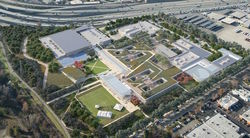
As if to prove that these are not flukes, ILFI announced in May 2017 that Microsoft intends to pursue Petal certification with a focus on the Water Petal for its 640,000 ft2 Silicon Valley campus in Mountain View, California. This combination of existing buildings and new construction will include office space, labs, and conference facilities, with integrated food services and other amenities.

The project is anticipating a 55% reduction in water use, even though the gross floor area is growing by 40%, the landscaped area by 300%, and the population by more than 50%, according to Katie Ross, sustainability program manager for Microsoft Real Estate & Facilities. The water savings amount to 3.9 million gallons per year, nearly enough to fill six Olympic-sized swimming pools.

The focus on water and ecosystems is especially motivating to Pauline Souza, AIA, principal at WRNS Studio, design architects for the project. The project team includes ecologists to guide restoration of wildlife habitat in an adjacent creek, and hydrologists to design stormwater infiltration to mitigate the intrusion of saline water from the San Francisco Bay into the area’s groundwater. “What a great opportunity to showcase both innovative and tried-and-true technologies that save water without sacrificing beauty, productivity, growth, and user experience,” exclaims Souza.

It will be a few years before the Microsoft campus can submit for certification, but the idea that a Living Building should not be much bigger than a house is already outdated. These large project examples will help put the Living Building option on the table for many teams that might not have otherwise considered it, and raise the bar for the entire industry.

More on Living Building certification

How to Succeed with the Living Building Challenge: 12 Teams Share Tips

For more information:

International Living Future Institute
www.living-future.org

Published December 31, 1969

(2017, August 2). Petal Certifications Help the Living Building Challenge Jump in Scale. Retrieved from https://www.buildinggreen.com/departments/newsbrief

Add new comment

To post a comment, you need to register for a BuildingGreen Basic membership (free) or login to your existing profile.

New York State Launches Initiative to Scale Net-Zero Retrofits

News Brief

New York State Launches Initiative to Scale Net-Zero Retrofits

The state has budgeted $30 million to develop a self-sufficient, private sector-based market for deep energy retrofits of multifamily buildings.

The goal of RetrofitNY is to transform the state’s building industry over the next decade by driving the development of scalable solutions for deep energy retrofits of large residential buildings. It’s an initiative of New York State Energy Research and Development Authority’s (NYSERDA) Multifamily Performance Program. RetrofitNY is part of Governor Andrew Cuomo’s energy plan, “Reforming the Energy Vision,” which includes an effort to perform deep energy retrofits on 100,000 affordable housing units by 2025.

The core of the initiative is an ongoing design-build competition—starting in August 2017—for affordable, replicable retrofit solutions that are able to reduce energy use by 70% or more. The state will subsidize the implementation of selected solutions on pilot buildings within New York’s affordable housing portfolio.

The results of these initial pilot projects will inform the next iteration of the competition. NYSERDA will organize successive competitive rounds until performance goals are met and the retrofit solutions become cost-effective. When that milestone is met, the goal is for the private sector to retrofit these buildings without additional public subsidies.

RetrofitNY is based on the Dutch program Energiesprong (“energy leap”), which developed a method for rapidly renovating the existing public housing stock in the Netherlands to achieve net-zero energy performance. The RetrofitNY program is working with Energiesprong International to adapt this approach for New York, and to address regulatory and financial challenges particular to the state.

For more information:

NYSERDA
nyserda.ny.gov

Published December 31, 1969

(2017, July 25). New York State Launches Initiative to Scale Net-Zero Retrofits. Retrieved from https://www.buildinggreen.com/departments/newsbrief

Add new comment

To post a comment, you need to register for a BuildingGreen Basic membership (free) or login to your existing profile.

Healthy Building Network Launches Online Forum

News Brief

Healthy Building Network Launches Online Forum

The forum invites affordable housing designers to join HBN experts and others to ask questions and share information on material health.

The Healthy Building Network’s HomeFree database recently launched an online forum on healthy building materials—an idea exchange that brings together practitioners in affordable housing with HBN’s researchers.

“It is a great place to ask individual questions and be able to get more specific information from the Healthy Building Network team,” said Jess Blanch, an Enterprise Rose Architectural Fellow with Capitol Hill Housing in Seattle.

The forum builds on the HomeFree database, which compares the toxicity of products using ‘stoplight’ colors to identify healthy and less healthy choices. For example, under cabinets and millwork, the site rates solid wood as green—the healthiest—and standard formaldehyde resins as red, at the bottom of the healthy scale. The health assessments come from HBN’s extensive chemical material library, the Pharos database.

Anyone can use the site and participate in the forum, as long as they register.

HomeFree is “interpreting data in a way that people who aren’t technical experts can absorb and understand,” said Gina Ciganik, HBN’s CEO.

HBN’s goal is to get healthier products into affordable housing. “And then, ultimately, people are healthier because they are not exposed to toxic chemicals, especially children,” said Ciganik.

HBN has used HomeFree to help six affordable housing demonstration projects choose healthier building materials.

The Liberty Bank Building, a 115-unit building for low-income households in Seattle, is one of the demonstration projects. When the design team from Mithun used HomeFree to compare flooring for Liberty Bank, they learned the vinyl that had been chosen did not have phthalate plasticizers, a class of chemicals associated with endocrine disruption and other health concerns. “To know that we are spec’ing a product that is as green as it can be, within our price point, that’s really helpful for us,” said Jess Blanch of Capitol Hill Housing.
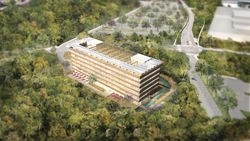
Leigh Avenue Senior Apartments in San Jose, California, designed for low-income and formerly homeless seniors, is another demonstration project. Hilary Noll, now with Mithun, was the design director on Leigh Avenue for First Community Housing. Noll says HomeFree helped the project assess the feasibility of incorporating solid surface countertops instead of plastic laminate plastic. Compared to going to the web or to the manufacturer, “you are getting something that has been through some level of evaluation from your peers [in affordable housing],” said Noll. “So, it is a more trusted way.”

HBN hopes HomeFree’s new online forum will be an additional place to leverage the knowledge of HBN experts and others who build and renovate affordable housing.

Published December 31, 1969

(2017, August 2). Healthy Building Network Launches Online Forum. Retrieved from https://www.buildinggreen.com/departments/newsbrief

Add new comment

To post a comment, you need to register for a BuildingGreen Basic membership (free) or login to your existing profile.

First Standards for Carbon Neutral Buildings Launched in Canada

News Brief

First Standards for Carbon Neutral Buildings Launched in Canada

The new zero carbon standard is designed to assess carbon emissions from commercial, institutional, and multi-family buildings across Canada.

The World Green Building Council launched its Advanced Net Zero project in 2016, with the goal of eliminating carbon emissions from all new buildings by 2030, and from every building by 2050.  Now, the Canada Green Building Council has introduced the first national standard to emerge from that campaign, a certification program focused solely on carbon neutrality.

Eliminating all emissions from buildings “is a very ambitious target,” said Mark Hutchinson, vice president of Green Building Programs at Canada Green Building Council, “but it’s simply a recognition of what is going to be needed.”

Certification requires project teams to:

  • Evaluate the type of energy their project will use and the carbon associated with generating that energy;
  • Reduce thermal energy demand by meeting envelope and ventilation efficiency targets;
  • Offset carbon emissions from the building’s operations by the generation of renewable energy either on or off site; and, ultimately,
  • Achieve zero net carbon emissions. 

The standard also requires designers to report on the anticipated peak energy demand of the building. There is no specific target, but by considering peak demand, a designer will better understand the carbon-intensive energy sources that may be used during peak demand periods.

Similarly, the standard also requires the assessment of the embodied carbon of structural and envelope materials—but does not require that low-carbon materials be chosen.  “Just by undertaking that exercise there is a significant advantage in moving the industry forward,” said Hutchinson.

New buildings can earn a design certification, which requires them to generate 5% of their energy from onsite renewables and to meet targets designed to reduce heat loss from a building’s envelope and ventilation.

Existing buildings can earn a performance certification. It’s based on twelve months of operations, with the performance verified every year.

New buildings that have earned the design certification can, after a year of operation, apply for dual certification in both design and performance.

Besides Canada, nine other green building councils have also committed to developing a carbon neutral buildings standard. Australia is expected to release its next. That standard is being developed jointly by the government and the Green Building Council of Australia.

Editor's note: The Canada Green Building Council does not include emissions from transportation in its zero carbon standard.

For more information:

Canada Green Building Council Zero Carbon Standard

www.cagbc.org/zerocarbon

Australian Government’s Carbon Neutral Buildings

http://www.environment.gov.au/climate-change/carbon-neutral/buildings-precincts

World Green Building Council

http://worldgbc.org/advancing-net-zero

Published December 31, 1969

(2017, July 10). First Standards for Carbon Neutral Buildings Launched in Canada. Retrieved from https://www.buildinggreen.com/departments/newsbrief

Add new comment

To post a comment, you need to register for a BuildingGreen Basic membership (free) or login to your existing profile.

Sustainable Development through Open-Source, Participatory Design

News Brief

Sustainable Development through Open-Source, Participatory Design

Alejandro Aravena wins Gothenburg Award for offering revolutionary strategies for social housing.

The Gothenburg Award for Sustainable Development—based in Gothenburg, Sweden—recognizes organizations and individuals that contribute toward a sustainable future through work that conserves resources, develops greater global justice, or leads to systematic change.

Chilean architect Alejandro Aravena—who has suggested that “sustainability is nothing but the rigorous use of common sense”—is the first architect to receive the Gothenburg award. He is recognized for his simple, synthesized solutions for affordable social housing—identified by the jury as both an urgent contemporary issue and something that is crucial for sustainable cities.

Aravena’s firm, Elemental, has become known for executing on the idea that building occupants should be actively involved in the design process rather than be perceived as a problem to be solved. In an attempt to address the economic challenges of providing quality housing for all, the firm has developed a concept of incremental, participatory design. Families move into a fully constructed “half” of a house that provides all the basic necessities of a dwelling—along with the foundation and framework for the building’s other “half.”  With information and guidance from the architect, the homeowners build the remainder of their home themselves—as needed and as fits their financial situation.

This inclusive process empowers people and can help foster trust between citizens, business, and government—just one way in which Aravena and his colleagues are experimenting with architecture as a tool for solving social and political issues.

The firm has also made the plans for four of their social housing projects available for download as an “open-source” tool for others to study. By sharing the drawings for these projects, the firm is trying to foster collaboration, and shift the ways markets and governments address the rapid urbanization happening at a massive scale around the world.

For more information:

The Gothenburg Award
gothenburgaward.com

Published December 31, 1969

(2017, May 30). Sustainable Development through Open-Source, Participatory Design. Retrieved from https://www.buildinggreen.com/departments/newsbrief

Add new comment

To post a comment, you need to register for a BuildingGreen Basic membership (free) or login to your existing profile.

LBC Projects Get Head Start on WELL Certification

News Brief

LBC Projects Get Head Start on WELL Certification

Describing how their rating systems complement each other, ILFI and IWBI encourage use of both certifications.

There is no shortage of different tools, initiatives, and certification programs available to guide building professionals in the design and construction of healthy, sustainable buildings. Rather than creating competition, however, organizations like International Living Future Institute (ILFI) are creating partnerships and collaborating with other initiatives to transform the built environment. Recent examples of this include the relaunch of ILFI’s Reveal label to align with Architecture 2030’s new Zero Tool, and the organization’s just-announced partnership with New Buildings Institute (NBI) to streamline the tracking and certification of zero-energy (ZE) buildings.

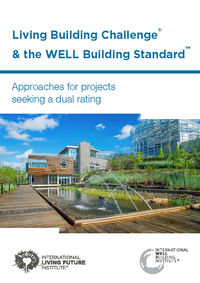
In the same spirit, ILFI has partnered with International WELL Building Institute (IWBI) to create a new crosswalk document explaining how WELL “features” and Living Building Challenge “imperatives” align.

The goal, as with similar crosswalk documents describing equivalencies between rating systems (see New Report Helps Leverage the Overlap between WELL and LEED), is to simplify the certification process by reducing the amount of documentation project teams must do to demonstrate compliance.

Project teams pursuing both WELL and LBC certification can achieve up to ten WELL features by meeting the requirements of certain LBC imperatives. Conversely, teams can use certain WELL features to contribute toward compliance with the requirements of 13 LBC imperatives.   

Though WELL and LBC intersect in several places, the guide also illustrates that there are many areas in which they do not––emphasizing why the two rating systems should be used in combination rather than interchangeably. Though LBC incorporates a number of requirements related to human health, it leaves out many things a project could do to achieve more in this area. There are more than 100 features focused on human health and wellbeing in the WELL Standard—a certified Living Building would earn only ten of these. As a system focused solely on the health of the occupant, WELL complements the more holistic sustainability concerns of systems like LBC and LEED.

For more information:

International Living Future Institute (ILFI)
living-future.org

Published December 31, 1969

(2017, May 30). LBC Projects Get Head Start on WELL Certification. Retrieved from https://www.buildinggreen.com/departments/newsbrief

Add new comment

To post a comment, you need to register for a BuildingGreen Basic membership (free) or login to your existing profile.

Study Reinforces Carbon Benefit of Renovation

News Brief

Study Reinforces Carbon Benefit of Renovation

A new study of the U.N. headquarters demonstrates how retrofitting existing buildings is a critical strategy for addressing the urgency of climate change.

When the United Nations planned the multi-year, campus-wide renovation of its New York City headquarters, it made sustainability a priority. The resulting project, completed in 2015, was designed and built to meet the equivalent of a LEED Gold rating and the iconic Secretariat Building to meet the equivalent of a LEED Platinum rating. But according to a new analysis, the greatest impact on sustainability stems from the decision to retrofit the existing buildings rather than demolish and replace them.
The U.N. study quantifies the benefits of this decision by assessing the carbon cost––both embodied and operational—of renovation compared with demolition and new construction.

The study (led by Michael Adlerstein, assistant secretary-general and executive director for the U.N. Capital Master Plan, and prepared by Vidaris, Inc. and Syska Hennessy Group) confirms that the retention of the structural components, opaque envelope, and core walls of the U.N. complex’s existing buildings has resulted in significant carbon savings—both in terms of embodied energy and carbon emissions. The savings are substantial enough to not be easily offset by the more energy-efficient building operations of new construction.

The study was based on life-cycle analysis calculations and energy modeling. It found that, had the existing buildings been demolished and replaced with new construction, it would have taken 35–70 years to offset the associated carbon cost with the improved operating efficiency of new buildings.

The findings of this study gain further significance considering the critical timeframe that climate change confronts us with. As noted in the report, climate scientists believe there is a small window for stabilizing and reducing greenhouse gas emissions. This means that the extra energy and carbon required to replace existing buildings with new construction is counter-productive, especially when we consider the rate at which carbon is purged or reabsorbed from the earth’s atmosphere. (Scientists estimate carbon’s atmospheric life to be between 100 and 300 years—which means that the carbon burden of the original U.N. construction is still in the atmosphere.)

For more on the topic of the value of existing buildings and carbon, read:

Building Materials and the Time Value of Carbon

Historic Preservation and Green Building: A Lasting Relationship

Raze or Retrofit? Six Extraordinary Answers to an Everyday Question

For more information:

Vidaris, Inc.
vidaris.com

Published December 31, 1969

(2017, May 25). Study Reinforces Carbon Benefit of Renovation. Retrieved from https://www.buildinggreen.com/departments/newsbrief

Add new comment

To post a comment, you need to register for a BuildingGreen Basic membership (free) or login to your existing profile.

Workbook Provides Hands-On Exercises to Cultivate Integrative Design

News Brief

Workbook Provides Hands-On Exercises to Cultivate Integrative Design

A new book offers practical guidance on how to foster a culture of meaningful collaboration.

Architectural practice must react and adapt as technological and cultural change continuously disrupt established ways of working. As the tools, processes, and priorities of the building industry evolve, the profession has responded by adopting increasingly collaborative models of organization and operation.


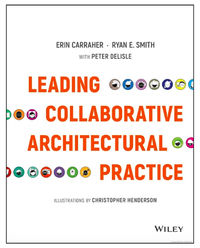
In Leading Collaborative Architectural Practice, authors Erin Carraher, Ryan Smith, and Peter Delisle offer building professionals strategies for an integrative approach to architectural production and show how a culture of collaboration supports innovative design solutions.

The book follows a two-year AIA research project that focused on defining the particular values, attitudes, and abilities associated with effective project team leadership. A unique, practical resource, it is organized as a workbook containing hands-on exercises to help readers implement leadership and communication techniques.

An example of the exercises included in the book is an activity intended to improve self-awareness. After introducing Luft and Ingham’s “Johari Window” model describing categories of perception and how these affect communication, readers are guided through a real-world scenario and a series of reflection prompts. Another exercise focuses on building understanding of various types of feedback and how these motivate different types of behavior.

By developing team members’ interpersonal skills, and promoting awareness and commitment in working relationships, these exercises can help foster a highly collaborative culture.

The book also includes case studies illustrating the successful strategies that real-world firms have implemented on a variety of projects. Descriptions of the particular leadership and communication dynamics of different project teams show readers how to develop and reinforce collaborative modes of practice.

In addition to discussing practical matters of successfully managing integrated project teams, the book also raises the question of what it means to facilitate integration at all levels of an architectural practice and how this can transform the organization’s work—and even, potentially, its mission.

For more information:

John Wiley & Sons, Inc.
wiley.com

Published December 31, 1969

(2017, May 25). Workbook Provides Hands-On Exercises to Cultivate Integrative Design. Retrieved from https://www.buildinggreen.com/departments/newsbrief

Add new comment

To post a comment, you need to register for a BuildingGreen Basic membership (free) or login to your existing profile.