Architects Organize to Oppose Border Wall

News Brief

Architects Organize to Oppose Border Wall

The nation’s design professionals are speaking out in great numbers in response to the Trump administration’s agenda, including the plan to build a wall on the U.S.-Mexico border.

The design disciplines have been very active in communicating both concerns and priorities to the new administration.  Architects Advocate, a recently formed, nonpartisan network of designers, published an open letter to President Trump and Congress urging meaningful action on climate change. AIA Committee on the Environment (COTE) sent an open letter to new EPA Director Scott Pruitt urging him to preserve EPA programs that are critical for architectural practice, including various Energy Star tools and the Toxic Substances Control Act (TSCA) Chemical Substance Inventory. Each letter garnered signatures from over 700 design firms.

More recently, Architects / Designers / Planners for Social Responsibility (ADPSR), a public-benefit organization focused on the promotion of ecologically and socially responsible development, issued another open letter in response to the Department of Homeland Security’s request for proposals for prototypes of a border wall.

The message of the ADPSR letter is simple: the organization, representing more than 750 members across design professions, rejects any plan to build a border wall. The letter serves to reiterate the professional commitments of the design disciplines to protect public health, safety, and welfare, and describes how involvement with the construction of the border wall would violate the basic ethics of design. Describing the wall as a “project of hatred, racism, violence, and waste,” the letter outlines the organization’s objections to the wall, which include issues of human safety, international relations, and ecological impact.

Beyond stating these objections, the letter argues there are much better uses of both the money (an estimated $21.6 billion) and the design talent that would be involved in the border wall project, calling for these resources to be used instead to support homeland security by upgrading and restoring the country’s aging infrastructure, addressing urgent concerns of climate change in vulnerable regions, and devoting more attention to the nation’s housing crisis.

The ADPSR also encouraged its members to respond to the government’s solicitation by submitting alternative, “protest” bids that focus on supporting human rights and that highlight the design discipline’s investment in creating safe, healthy, humane solutions for the public good.

For more information:

Architects / Designers / Planners for Social Responsibility
www.adpsr.org

Published December 31, 1969

(2017, May 2). Architects Organize to Oppose Border Wall. Retrieved from https://www.buildinggreen.com/departments/newsbrief

Add new comment

To post a comment, you need to register for a BuildingGreen Basic membership (free) or login to your existing profile.

Could Passivhaus High-Rise Become the Norm?

News Brief

Could Passivhaus High-Rise Become the Norm?

Report indicates that designing tall urban residential buildings to the Passivhaus standard is achievable and worth the added cost.

A study funded by New York State Energy Research and Development Authority (NYSERDA) indicates that the Passivhaus standard—notable for reducing heating- and cooling-related energy use by 70%–90%—could successfully be applied on tall residential buildings in dense urban environments like New York City at a viable cost. The detailed methodology and conclusions of the study are outlined in a report published last month.

Researchers compared a large, mixed-use multifamily housing project designed to achieve LEED Silver certification (under LEED 2009)––currently under construction––to a theoretical Passivhaus version of the same building. They found that the Passivhaus version would use 47% less energy overall and require a 2.4% increase in capital costs.

Upgrading to Passivhaus could be accomplished using common construction methods and requiring minimal changes to aesthetic design, according to the report. It was determined that the 36% window-to-wall ratio of the original design could be maintained by upgrading the windows to include high-performance triple glazing and thermally broken frames.  

The payback period for the upgrades was estimated to be 24 years, though the authors argue that certifying to the Passivhaus standard will likely become increasingly more cost-effective as the building industry gains familiarity.

Though the study demonstrates that the added cost may not be an insurmountable barrier, the report describes a number of other challenges that must still be addressed before the Passivhaus standard is adopted as a mainstream approach in urban high-rise construction. One significant challenge relates to the level of workmanship and coordination required during construction in order to successfully install the air barrier. Variable construction practices, product availability, and cultural use patterns also limit the current applicability of Passivhaus in certain locations and on particular building types.

Despite these challenges, it is clear that a paradigm shift is within view. Municipalities in Europe have mandated the Passivhaus standard in various ways and New York has introduced it as an energy code compliance path for new city buildings. With the publication of this optimistic feasibility study, it is possible that more U.S. municipalities will soon follow suit.

For more information:

New York State Energy Research and Development Authority (NYSERDA)

nyserda.ny.gov

Published December 31, 1969

(2017, May 2). Could Passivhaus High-Rise Become the Norm?. Retrieved from https://www.buildinggreen.com/departments/newsbrief

Add new comment

To post a comment, you need to register for a BuildingGreen Basic membership (free) or login to your existing profile.

Rental And Occupancy Levels Remain Higher For Green Office Buildings

News Brief

Rental And Occupancy Levels Remain Higher For Green Office Buildings

A new report verifies the greater value of environmental certification in the commercial real estate market

A recently published working paper by Nils Kok, Maastricht University, and Rogier Holtermans, University of Southern California, demonstrates that the demand in the commercial real estate market for “green” space continues to grow, enabling owners to command higher leasing rates.

The researchers recorded the quarterly rental statistics for 25,690 environmentally certified and non-certified commercial office buildings from 2004 to 2013, and found that properties with environmental certifications (Energy Star or LEED) were found to have higher rental, occupancy, and pricing levels than non-certified properties. Specifically, office buildings with Energy Star ratings leased for 1.5% more than non-rated buildings and buildings certified under LEED leased for 2.3% more.

This demand has translated into a striking conversion of the market. In a survey of the 30 largest U.S. commercial real estate markets, the researchers documented that the average share of environmentally certified space grew from 4.6% in 2005 to 38.6% by the end of 2014.

Interestingly, the value of environmental certification varied based on a few different factors. For example, the researchers found that:

  • the value of LEED certification was higher for newly constructed buildings than for existing buildings;
  • certain LEED credit categories, such as Water Efficiency, Materials and Resources, and Sustainable Sites, have a larger impact on rental value than other credit categories;
  • environmental certifications were more valuable in locations with more extreme climates, even accounting for local energy prices.

Nevertheless, Kok and Holtermans make the case that environmental certifications generally bring value to commercial real estate—if only by partially correcting for information asymmetry in the market, or the current inability for consumers to access building performance information.

For more information:

European Centre for Corporate Engagement
corporate-engagement.com

Published December 31, 1969

(2017, April 4). Rental And Occupancy Levels Remain Higher For Green Office Buildings. Retrieved from https://www.buildinggreen.com/departments/newsbrief

Add new comment

To post a comment, you need to register for a BuildingGreen Basic membership (free) or login to your existing profile.

Overcooled Offices Impair Thinking

News Brief

Overcooled Offices Impair Thinking

New research shows a warmer setpoint combined with personal fans saves energy while maintaining occupant comfort and performance levels in tropical climates.

By the year 2050, much of the world’s population will live in tropical climates, according to Stefano Schiavon, Assistant Professor at UC–Berkeley—and the temperature setpoint on their air conditioning units will have a big impact on energy usage. Luckily, a study conducted by Schiavon and several other researchers suggests that thermostat setpoints could be raised in warm, humid climates and actually improve occupant comfort, health, and productivity.

The research was informed by previous findings that occupants in office buildings in Singapore prefer warmer indoor temperatures and cite overcooling as the main cause for discomfort. A previous study has shown, in turn, that the overcooling commonly experienced in large commercial buildings often results from the need to provide adequate dehumidification in oversized HVAC systems.

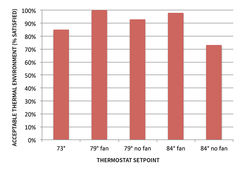
The new study found that thermal comfort, perceived air quality, and symptoms of sick building syndrome were reported to be equal or improved at setpoints three and six degrees warmer than the common setpoint of 73.4°F (23°C). The increased temperature also helped occupants think better, increasing their productivity.

The researchers used four tests to measure how the indoor climate affected cognitive performance. The tests were administered through the cognitive testing platform Quantified Mind and included exercises to evaluate processing speed and motor function, as well as executive functions like inhibition (the ability to suppress a learned response) and context switching (the ability to switch attention between different tasks).

The researchers recorded the best cognitive performance at 78°F (26°C). At 84°F (29°C), the negative impact the warmer temperature has on cognitive performance was partially mitigated by supplying individual occupants with controllable fans. The lowest cognitive performance was recorded at 23°C (73.4°F), which happens to be the typical indoor temperature setpoint in Singapore.

These findings are significant considering that roughly 50% of the total electricity used in Singapore is used to cool commercial and residential buildings for occupant comfort. As global temperatures rise along with global population density and wealth, the demand for air conditioning in tropical regions of the world is expected to intensify.

For more information:

Center for the Built Environment
www.cbe.berkeley.edu

Published December 31, 1969

(2017, March 20). Overcooled Offices Impair Thinking. Retrieved from https://www.buildinggreen.com/departments/newsbrief

Add new comment

To post a comment, you need to register for a BuildingGreen Basic membership (free) or login to your existing profile.

Smog Outdoors Saps Worker Productivity Indoors

News Brief

Smog Outdoors Saps Worker Productivity Indoors

75% of small particulates in outdoor air pollution come indoors and cause workers to be less productive, putting a $2 billion dent in China’s service sector.

A recent study conducted in two call centers in China found that air pollution significantly hampered worker productivity. Pollution zaps mental processing abilities, the researchers found, causing employees to take longer breaks on bad air quality days.

Dog days in the call center

The study analyzed data from almost 5,000 employees that worked in call centers for Ctrip, China’s largest travel agency. Because each worker is compensated in part based on the volume of calls and orders, each worker tracks the number of calls handled per shift and the amount of time that he or she spent on breaks. Researchers compared this productivity data to daily air pollution levels and found that workers were 5%–6% more productive when air pollution levels are rated as good (defined as an air pollution index, or API, of 0–50) versus when they are rated as unhealthy (API of 150–200).

What’s more, some measures of productivity took a hit when air quality levels exceeded just 100 API, contradicting current guidance that suggests impacts to the general population (as opposed to sensitive populations, such as asthmatics) don’t occur until the API is over 150.

As the researchers deconstructed the data, they found that the productivity hits were mainly caused by workers taking longer breaks, not because they spent longer on each phone call. 

Your brain on air pollution

The culprit, the researchers suggest, is likely very small particulate matter (PM10). Although the API in China takes into account three criteria pollutants, the pollutant with the highest index on a given day determines the score. In Shanghai and Nantong where the study was conducted, PM10 is the pollutant with the highest index 95% of the time, according to the researchers.

This outdoor air pollutant is formed when airborne solid and liquid particles emitted from power plants, industries, and automobiles react together, but it can easily penetrate indoors. One report from JLL and PureLiving estimates that 75% of PM10 finds its way into our buildings from the outside. And then, it is so small that it can pass beyond the lung barrier, enter the bloodstream, and become embedded deep in the brain stem. Greater exposure to these particles is associated with lower intelligence and diminished performance over a range of cognitive domains, so it makes sense that short-term exposures might cause the mind to grow weary faster, say the researchers. That explains why productivity so closely correlated with air quality—the workers weren’t being lazy; they physically needed more breaks for their brains.

Claiming causality

The authors argue that their study setup allows them to “credibly isolate the causal effect” that air pollution has on worker productivity—something that previous study authors have been reluctant to claim. That’s because this study takes into account potential confounders like:

  • Discretion over labor supply—the workers have little control over which days they come to work, so the possibility that the most productive chose not to work on high pollution days can be ruled out.
  • Variation in demand—the firm serves clients throughout China, so it is not likely that pollution levels local to the call center influence client demand for services.
  • Stress of traffic—traffic is potentially a strong confounder because it can directly reduce productivity by creating emotional stress and making employees late for work—and it also may coincide with bad air quality days. The researchers discounted this possibility by consulting a previous experiment at Ctrip that measured productivity when employees worked from home. The correlation between avoiding traffic and productivity was negative and statistically significant at conventional levels, indicating traffic was not likely confounding the productivity effects the researchers had observed.  

Adding up the cost

This lost productivity comes at a cost, according to the researchers. If the same effect is applied to all service-sector workers in China, for example, a 10-unit reduction in national pollution levels would bring in US$2.2 billion per year. Or, applied to Los Angeles, bringing air quality into compliance (API of 0–50) would grow service sector productivity by $374 million.

Published December 31, 1969

(2016, December 5). Smog Outdoors Saps Worker Productivity Indoors. Retrieved from https://www.buildinggreen.com/departments/newsbrief

Add new comment

To post a comment, you need to register for a BuildingGreen Basic membership (free) or login to your existing profile.

Canada: Green Building Can Help Meet Emissions Commitments

News Brief

Canada: Green Building Can Help Meet Emissions Commitments

A report describes how Canada can realize its 2030 carbon emissions targets, while growing the country’s green building industry.

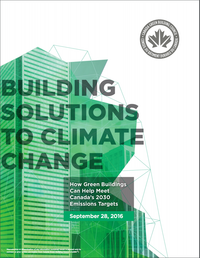
The Vancouver Declaration on Clean Growth and Climate Change requires Canada to meet or exceed its international greenhouse gas (GHG) emission reduction target of 30% below 2005 levels by 2030—but how is still being worked out. A new Canada Green Building Council (CaGBC) report, Building Solutions to Climate Change: How Green Buildings Can Help Meet Canada’s 2030 Emissions Targets, describes one potential path that focuses on building efficiency.

“Building on a culture of innovation in Canada’s green building sector, this report demonstrates how we can achieve real results in the battle against climate change by investing in the building sector,” said Thomas Mueller, president and CEO of the CaGBC. “Buildings represent the most cost-effective way to reduce GHG emissions, generate positive returns on investment, and stimulate the economy.”

The report finds that re-commissioning, performing deep energy-saving retrofits, installing onsite renewable energy systems, and switching to renewable energy sources in all existing institutional, commercial, and high-rise residential projects of over 25,000 ft2 would enable Canada to surpass its reduction targets, ultimately reducing GHG emissions by an estimated 44% from 2005 levels. This would lower GHG emissions by 19.4 million tons, while having a $35.2 billion direct and indirect impact on gross domestic product (GDP).

The report makes further recommendations to pave the way for such extensive building retrofits:

  • Advancing green building benchmarking, reporting, and disclosure could help promote building performance. Greater investment in systems such as the Energy Star Portfolio Manager would help support a wide range of building types and enhance reporting capabilities.
  • Investment is needed to establish a National Net Zero Building initiative to help guide the industry. According to the report, constructing all new buildings over 25,000 ft2 to have net-zero carbon emissions would result in a 17% reduction in GHG emissions by 2030.
  • The government should lead by example by using advanced green building initiatives for the renovation and new construction of its own federal buildings. Utilizing carbon-reduction measures for federal projects over 25,000 ft2 would account for financial savings of $117 million annually and a 480,000-ton reduction in GHG emissions.


Published December 31, 1969

(2016, December 5). Canada: Green Building Can Help Meet Emissions Commitments. Retrieved from https://www.buildinggreen.com/departments/newsbrief

Add new comment

To post a comment, you need to register for a BuildingGreen Basic membership (free) or login to your existing profile.

Architects Go Political For Climate Change

News Brief

Architects Go Political For Climate Change

Architecture firms are taking it upon themselves to call for climate change legislation with the new Architects Advocate campaign.

A grassroots campaign started by a small number of Chicago-based architecture firms has quickly caught fire. The group, Architects Advocate for Action on Climate Change, now has 114 architecture firms as signatories and has just gone nationwide.

The goal of the initiative is to make the voice of the architecture community heard by legislators and the general public. Supporters of the initiative are asked to display the campaign’s logo or advocate statement on their firm’s website, engage with the media or contact legislators, and encourage other firms to join.

With more momentum, the group plans to expand the campaign to other industry groups. The work will only be done when “meaningful legislation to mitigate climate change” is adopted, according to a press release.

To sign up, visit http://www.architects-advocate.com/

Published December 31, 1969

(2016, October 4). Architects Go Political For Climate Change. Retrieved from https://www.buildinggreen.com/departments/newsbrief

Add new comment

To post a comment, you need to register for a BuildingGreen Basic membership (free) or login to your existing profile.

HPD User Guide Helps with LEED, WELL Product Selection

News Brief

HPD User Guide Helps with LEED, WELL Product Selection

Just in time for LEED v4, a guide for using Health Product Declarations is being released.

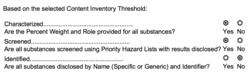
Do you know what it means if the checkboxes for “characterized” and “screened” are checked off on a Health Product Declaration (HPD), but the box for “identified” is left blank? (See the answer at the end.)

This and other nuanced questions about how to use HPDs are answered in a new handbook—Project Team User Guide: Using Health Product Declaration (HPD) Open Standard, version 2—which the HPD Collaborative has announced will be available publicly (and for free) in early October. The guide has already been released to members of the Health Product Declaration Collaborative.

The guide walks through how to evaluate whether HPDs meet requirements in LEED v4 and WELL (also see What’s an HPD? Health Product Declaration FAQs) and presents other ways to use the data, including:

  • Setting material selection goals
  • Screening for high-priority chemicals
  • Gauging the chemical hazard profile of a project by comparing HPD data from real product selections against generic products (through the Quartz database, for example)

The guide acknowledges that specialized consultants and third parties will likely need to be engaged for these latter uses of HPDs. However, case studies demonstrate how HPDs are already being put to use to screen for Living Building Challenge Red List chemicals, inspiring company procurement policies to include a preference for product transparency data, and prompting engagement between product teams and their suppliers.

So, what does it means if the checkboxes for “characterized” and “screened” are checked off on a Health Product Declaration (HPD), but the box for “identified” is left blank? Answer: The manufacturer is not disclosing all of the product ingredients by name but is still reporting information about the potential hazards associated with its contents. Bonus point: This kind of HPD can still be used to comply with the LEED v4 Materials credit. See our HPD Quick-Start Guide for visuals.

Published December 31, 1969

(2016, September 19). HPD User Guide Helps with LEED, WELL Product Selection. Retrieved from https://www.buildinggreen.com/departments/newsbrief

Add new comment

To post a comment, you need to register for a BuildingGreen Basic membership (free) or login to your existing profile.

Legal Wood in LEED Barks Up Wrong Tree, Say NGOs

News Analysis

Legal Wood in LEED Barks Up Wrong Tree, Say NGOs

A pilot credit to address illegal logging has been criticized by advocacy groups like the Sierra Club. They’ve offered USGBC their own ideas.

Illegal logging is one of our most pressing environmental and social issues. Yet just a few months after the U.S. Green Building Council (USGBC) began addressing it with a new LEED pilot program, several major environmental groups say the effort should be scrapped and reworked.

The Sierra Club, Greenpeace, and other environmental advocates claim that the new pilot provides little technical guidance on legality; instead, they say, its main effect is to legitimize what they consider to be weak forestry certifications.

Published December 31, 1969

(2016, September 7). Legal Wood in LEED Barks Up Wrong Tree, Say NGOs. Retrieved from https://www.buildinggreen.com/departments/newsbrief

Bark Cladding Is First Cradle to Cradle Platinum Product

News Brief

Bark Cladding Is First Cradle to Cradle Platinum Product

C2C Platinum certification sets a very high bar for sustainability. A decade in, Bark House shingles are the first product to make the grade.

Cradle to Cradle (C2C) was the first certification to attempt to define in 2005 what true sustainability might look like in a building product.  Since then, several hundred products have been certified at C2C’s lower levels: Basic, Bronze, Silver, and Gold. But until now, Platinum certification, the highest level, has appeared more aspirational.

The first product to achieve C2C’s highest bar? Bark. Specifically, Highland Craftsmen Inc. Bark House shingle and wall panels. The product is made from tulip-poplar tree bark that has been reclaimed from logs, flattened, dried, and trimmed into a durable finished product.

Harder than we thought

In the 2002 book Cradle to Cradle, William McDonough, FAIA, and Michael Braungart, Ph.D., envisioned our products and everything that goes into them as safe “nutrients” in ongoing technical and biological cycles. (For a status report on these concepts and how they’re entering our buildings, see Circular Economy at Scale: Six International Case Studies.) The C2C certification fleshed out this vision with five certification categories:

  • material health
  • material reutilization
  • renewable energy and carbon management
  • water stewardship
  • social fairness

A product’s overall rating is based on its lowest score in these five categories, so if you had Platinum for social fairness but Silver for water, you can only get an overall rating of Silver.

When BuildingGreen took an in-depth look at the certification in 2007 (see Cradle to Cradle Certification: A Peek Inside MBDC’s Black Box), the consensus was that a certified Platinum product:

  • was at least three or four years away
  • would probably be something “simple” like a coating
  • would be the result of a conscious design process, not a conventional product modified to meet the standard

It’s clear that C2C Platinum was harder than we thought.

Stepping up from Gold to Platinum

Highland Craftsman has been working with C2C (which several years ago moved from a private consultancy to the Cradle to Cradle Products Innovation Institute, or C2CPII) since 2008, and Bark House shingles were previously certified Gold. According to Highland and C2CPII, the company undertook the following measures to meet Platinum requirements in C2C’s five categories:

  • Material Health: Bark House shingles are 100% bark with no additives or coatings.
  • Material Reutilization: The bark is harvested from trees that are already on their way to the sawmill. At the end of their useful life, the shingles can be composted, mulched, or otherwise returned to nature. It should be a long life: the company has been around for 25 years and says it monitors installations of similar bark shingles that pre-date it by another 60.
  • Water Stewardship: No water is used in manufacturing, and the company participates in regional river and stream stewardship.
  • Clean Energy and Carbon Management: All of the electricity used to make the shingles is generated with onsite solar power. The company keeps its footprint small by harvesting 90% of raw materials within 50 miles of its facility. According to the company, it dries its bark with gas-fired kilns and makes up for those carbon emissions by generating excess onsite solar power. The company also manages its carbon footprint with its product, which keeps carbon out of the atmosphere for much longer than it would otherwise. The bark would normally degrade naturally or be burned, releasing its carbon much sooner.
  • Social Fairness: Highland Craftsmen is B Corp-Certified. The B Corporation framework is used by companies that have a mission to support the environment and their communities, and to provide optimal working conditions. This area of the C2C standard is also where material-specific certifications are covered. The company told BuildingGreen that it has worked to maintain a Forest Stewardship Council (FSC) certified supply but has been unable to do so because of lack of demand and FSC’s lack of scalability for small Appalachian landowners. The company meets C2C’s requirements for social fairness in part by supporting logger education programs that address sustainability and worker safety.

“Holistic approach to business”

“At Bark House, we have always taken a holistic approach to business, from the low impact of our product lines to the high impact of our social outreach,” said Chris McCurry, cofounder for The Bark House at Highland Craftsmen Inc., in a press release. “This mentality is key to creating balance, and without balance, systems will ultimately fail.” According to McCurry, the company didn’t make substantial changes in its product or manufacturing process in going from Gold to Platinum; it simply “reorganized processes in alignment to Cradle to Cradle’s five points.”

“Achieving an overall Platinum certification demonstrates the depth and commitment of the company’s efforts to provide safe products that can be perpetually cycled and are manufactured in ways that respect humans and the environment,” commented Stacy Glass, vice president for the built environment at C2CPII.

Bark House shingles come in a standard grade as well as a thicker, premium grade that has deep furrows and more-pronounced shadow lines. The company’s interior-grade shingles and large wall panels are certified Gold under C2C. These are a more complex product: they can be laminated to order (low-emitting substrates are available) for use in cabinetry or wall mounts, or as an interior wall covering. 

Published December 31, 1969

(2016, August 4). Bark Cladding Is First Cradle to Cradle Platinum Product. Retrieved from https://www.buildinggreen.com/departments/newsbrief

Add new comment

To post a comment, you need to register for a BuildingGreen Basic membership (free) or login to your existing profile.